Why Is the TPMS Light on but Tires Are Fine?
If every tire matches the door-jamb pressure and the TPMS light stays on, the problem is usually a sensor, a relearn issue, or a system error, not low tire pressure. Ignore it, and you can miss a real pressure drop later or chase the wrong repair. Check threshold pressure first, then sensor faults, then relearn problems.
Why the light stays
Check pressure before assuming the system is bad
Use a manual tire pressure gauge on all four tires, then compare each reading to the door-jamb tire placard. Do not use the tire sidewall as your target; that number is a maximum, not the vehicle’s recommended cold inflation pressure.
A tire can look normal and still be low enough to trigger TPMS. Some systems turn the light on once a tire drops about 25% below recommended pressure, so a tire that still looks rounded may still be below the threshold.
Check the spare tire too if your vehicle monitors it. Some vehicles have a spare tire with a TPMS sensor, and an underinflated spare can keep the warning on.
Typical pressure checks in order
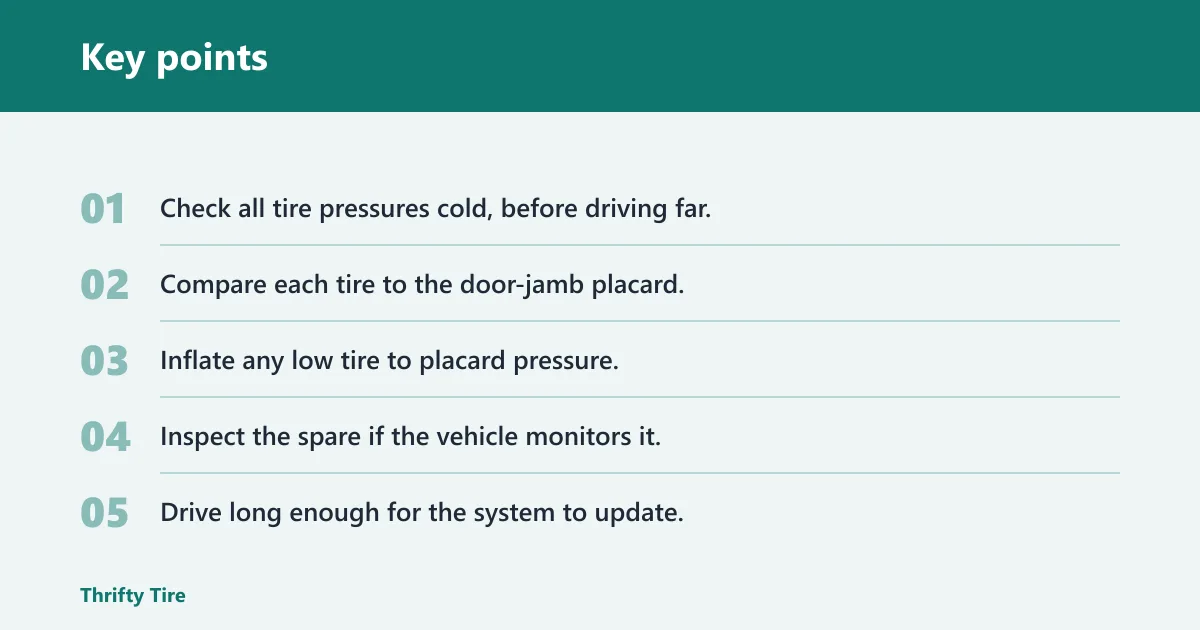
- Check all tire pressures cold, before driving far.
- Compare each tire to the door-jamb placard.
- Inflate any low tire to placard pressure.
- Inspect the spare if the vehicle monitors it.
- Drive long enough for the system to update, or perform the vehicle-specific reset if required.
TPMS warning matrix
The table below separates a pressure problem from a system fault. Read the symptom pattern first, then follow the next check in order. If the pattern points to a loss of pressure, stop driving long enough to verify the tire before you push on.
| Symptom pattern | Most likely cause | What to check next | When to stop driving |
|---|---|---|---|
| Steady light after airing up | Pressure is still low, or the system has not relearned the new pressure yet | Recheck all tires with a gauge, confirm the placard pressure, then follow the reset or relearn procedure for the vehicle | Stop if any tire is still below placard pressure or losing air |
| Flashing-then-solid light | TPMS malfunction, often a sensor or receiver problem | Check for a TPMS scan code, inspect sensor age or damage, and schedule diagnosis | Stop if the vehicle is also warning about a flat tire or if one tire is visibly losing pressure |
| Light returns after a few days | Slow leak, weak sensor battery, or a sensor that is intermittently failing | Recheck cold pressures, inspect valve stems and tread for leaks, and see whether the spare is monitored | Stop if one tire keeps dropping more than the others |
| Light appears only in cold mornings | Cold weather pressure drop near the warning threshold | Check pressure cold; temperature can drop pressure roughly 1 PSI for every 10°F change | Stop if the tire is below placard pressure, not just near it |
What the warning pattern means
A steady TPMS light usually means one or more tires are under-inflated. A flashing light that turns solid usually points to a system malfunction instead of a simple low-air condition. A morning-only warning often means the pressure is close to the threshold and cold weather pushed it under.
Steady light
A steady light usually means one or more tires are under-inflated. That is the most common TPMS message, and it should be treated as a pressure check prompt, not proof that the tires are fine.
If the gauge reading is correct and the light still stays on, the issue shifts away from simple inflation and toward a reset, relearn, or fault in the monitoring system.
Flashing-then-solid light
A TPMS light flashing for about 60 seconds can indicate a system malfunction. After that, it may stay on as a warning that the system cannot read pressure data correctly.
That behavior is more consistent with a failed sensor, a receiver fault, or a communication problem than with a tire that is merely low on air.
Morning-only warning
Cold weather can make a tire fall below the trigger point even if it looked fine the day before. Pressure falls roughly 1 PSI for every 10°F temperature drop, so a tire that is close to the placard value can tip into a warning on a cold morning.
Picture a sedan set to about 35 PSI on a warm afternoon. After an overnight temperature drop, the next morning the front tires may be around 33 PSI. The vehicle may warn even though the tires are not visibly flat.
Direct versus indirect TPMS faults
TPMS does not work the same way on every vehicle. Direct TPMS uses a sensor in each wheel, while indirect TPMS uses ABS wheel speed sensors instead of wheel-mounted pressure sensors. That difference matters because the failure points are different.
Direct TPMS
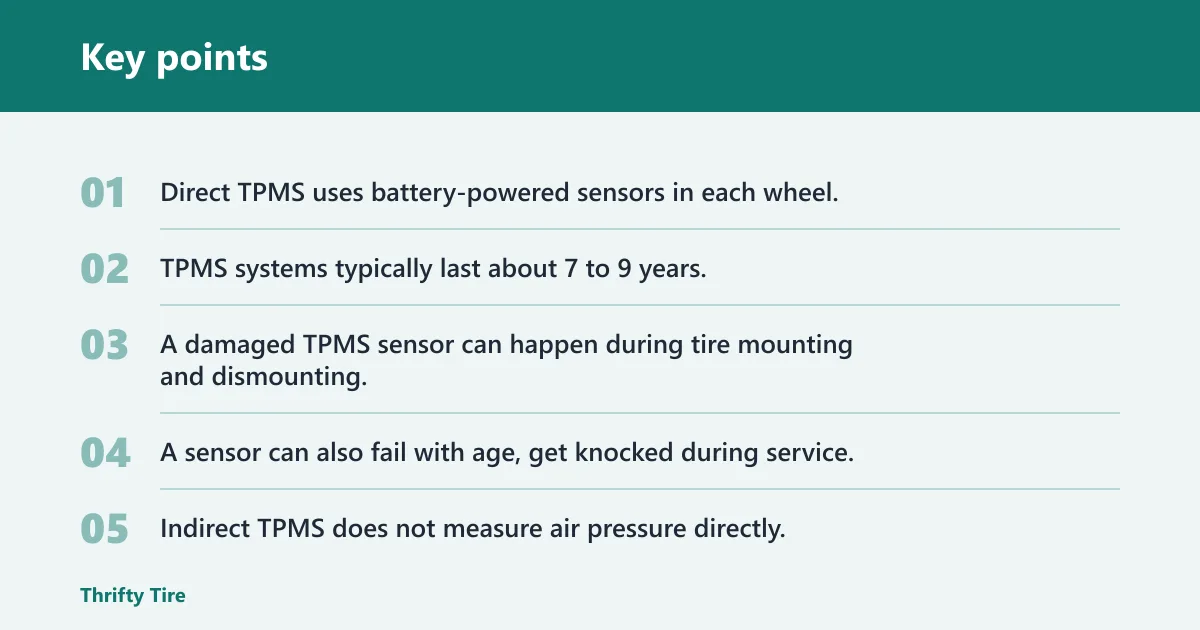
Direct TPMS uses battery-powered sensors in each wheel, which makes it more failure-prone than indirect systems. TPMS systems typically last about 7 to 9 years, and a TPMS sensor battery may fail every five to ten years.
A damaged TPMS sensor can happen during tire mounting and dismounting. A sensor can also fail with age, get knocked during service, or need reprogramming or replacement after work on the wheels.
Indirect TPMS
Indirect TPMS does not measure air pressure directly. It watches ABS wheel-speed data instead, so it can react to traction loss, wheel-size differences, or changes in tire circumference that make one wheel appear to spin differently.
That means an indirect system can trigger a warning even when pressures look normal on a gauge. Tire rotation, uneven wear, or a non-matching spare can confuse the system until it is relearned.
Receiver and communication faults
When pressure data disappears completely, the problem may be on the vehicle side. A TPMS receiver can fail, which causes loss of pressure data even if the wheel sensors are still working.
If the light flashes, then stays on, and no tire is actually low, the vehicle may be reporting a system fault rather than a tire problem. That is the point where scan-tool diagnosis becomes more useful than more air.
Do you need a reset or relearn?
If the tire pressure is correct but the light stays on, a vehicle-specific reset or relearn may be needed after inflation, tire rotation, wheel replacement, or sensor work. That is common after inflation, tire rotation, wheel replacement, or sensor work. The exact steps vary by vehicle, so the same button sequence does not apply everywhere.
When inflation alone is enough
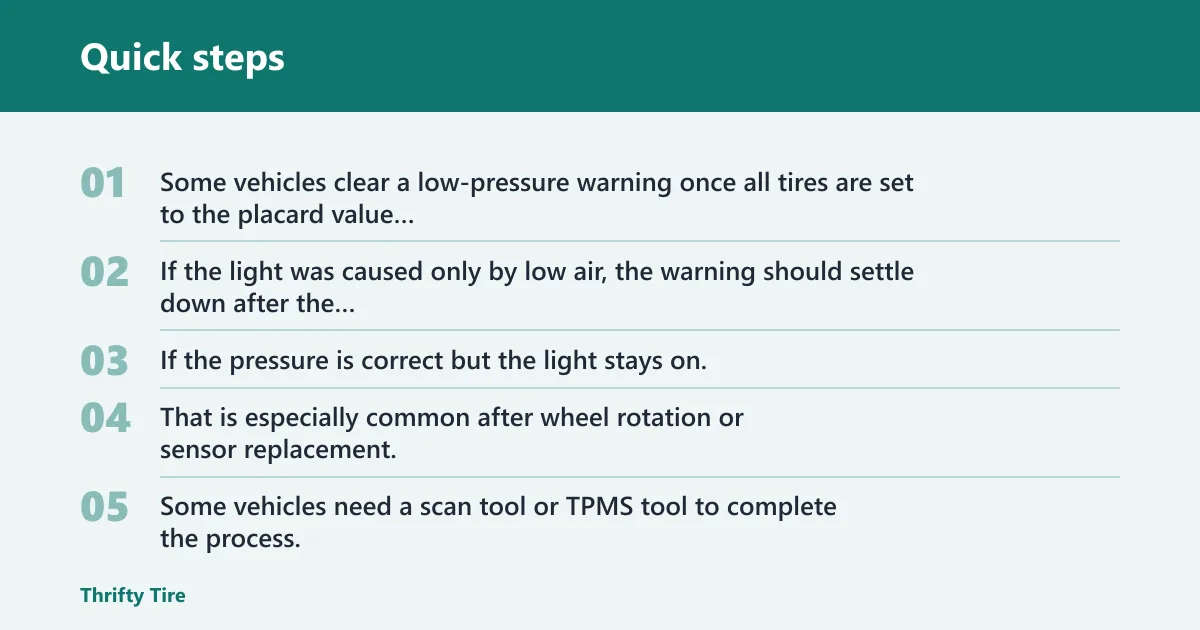
Some vehicles clear a low-pressure warning once all tires are set to the placard value and the car is driven long enough for the system to update. If the light was caused only by low air, the warning should settle down after the pressure correction.
When a relearn is required
If the pressure is correct but the light stays on, the system may need a relearn procedure. That is especially common after wheel rotation or sensor replacement. Some vehicles need a scan tool or TPMS tool to complete the process.
A common first-timer mistake is to add air, drive a mile, and expect every system to clear itself. Some do. Others need a reset sequence or a relearn before they recognize the current sensor IDs or wheel positions.
Why service tools matter
Not every relearn is a dashboard button press. Some vehicles need a scan tool to trigger the procedure, and some require a specific drive cycle. If the sensor was replaced, the wrong tool or an incomplete relearn can leave the warning on even though the tire pressure is correct.
What to do before service
Before paying for diagnosis, confirm that every tire is cold and at the placard pressure. Then look for a slow leak, a damaged valve stem, or a monitored spare tire that is out of range. Those checks solve the simple cases and help the shop focus on the real fault if the light remains.
Use this order
- Check all tire pressures with a gauge.
- Set each tire to the door-jamb placard.
- Check the spare if the vehicle monitors it.
- Look for a puncture, cracked valve, or bead leak.
- Perform the vehicle-specific reset or relearn.
- Schedule TPMS diagnosis if the light flashes, returns, or will not clear.
If the warning returns after a few days, do not assume the last tire check was wrong. That pattern often points to a slow leak or a weak sensor battery. A simple TPMS sensor repair can cost between $75 and $250 for part and labor, so it is worth separating an inflation issue from a hardware problem before authorizing parts.
Suppose an SUV reads 35 PSI at all four corners after airing up, but the warning returns three days later on the rear left. That is more consistent with a slow leak or a failing sensor than with a one-time low-pressure event. The next step is a leak check and a scan, not more air.
Frequently asked questions
Why is my TPMS light on but tires are fine?
If the gauge shows correct pressure but the light stays on, the issue is usually a TPMS fault, a relearn problem, or a sensor battery issue. Direct systems use wheel sensors, and indirect systems use ABS wheel-speed data, so the fix depends on how your vehicle measures pressure.
What does it mean if the TPMS light stays on after airing up?
A light that stays on after airing up usually means the system has not recognized the correction yet, or the vehicle still sees a fault. Recheck the cold pressure against the placard, then use the vehicle-specific reset or relearn procedure if the tires are correct.
Is it a bad TPMS sensor if the light keeps coming on?
Not always. A recurring warning can come from a weak sensor battery, but it can also come from a slow leak, a damaged sensor, or a receiver fault. If the light flashes first or returns after a few days, the system needs diagnosis, not just more inflation.
Can cold weather make the TPMS light come on even when tires are okay?
Yes. Cold weather can drop tire pressure enough to trigger the warning near the threshold, even when the tire looked fine the day before. Since pressure falls roughly 1 PSI for every 10°F temperature drop, morning checks matter most during cold snaps.
Why does the TPMS light flash and then stay on?
A flash followed by a steady light often points to a TPMS malfunction rather than a simple low-pressure event. That pattern can mean a failed sensor, a communication problem, or a receiver issue. If the tires are correctly inflated, a scan tool diagnosis is usually the next step.
Can a spare tire trigger the TPMS light?
Yes. Some vehicles have a monitored spare tire, and an underinflated spare can keep the warning light on. If the other tires check out, inspect the spare and confirm whether your vehicle monitors it before assuming the sensors in the road tires failed.