How Much Does Brake Pad Replacement Cost for All 4?
A fair all-four brake quote usually runs about $300 to $700 for pads only on many mainstream cars in the U.S., and often about $650 to $1,400 when pads and rotors are replaced together. The total changes with labor rate, vehicle design, rotor thickness, rear electronic parking brake service, and whether the shop is quoting just one axle or both.
What does an all-4 brake quote include?
An all-four brake quote can mean pads only, or it can mean pads plus rotors, hardware, labor, shop supplies, taxes, and sometimes electronic parking brake service. The first step is to split the estimate into parts and labor, then verify whether the shop measured pad thickness and rotor thickness before recommending work on both axles.
Pads-only versus pads and rotors
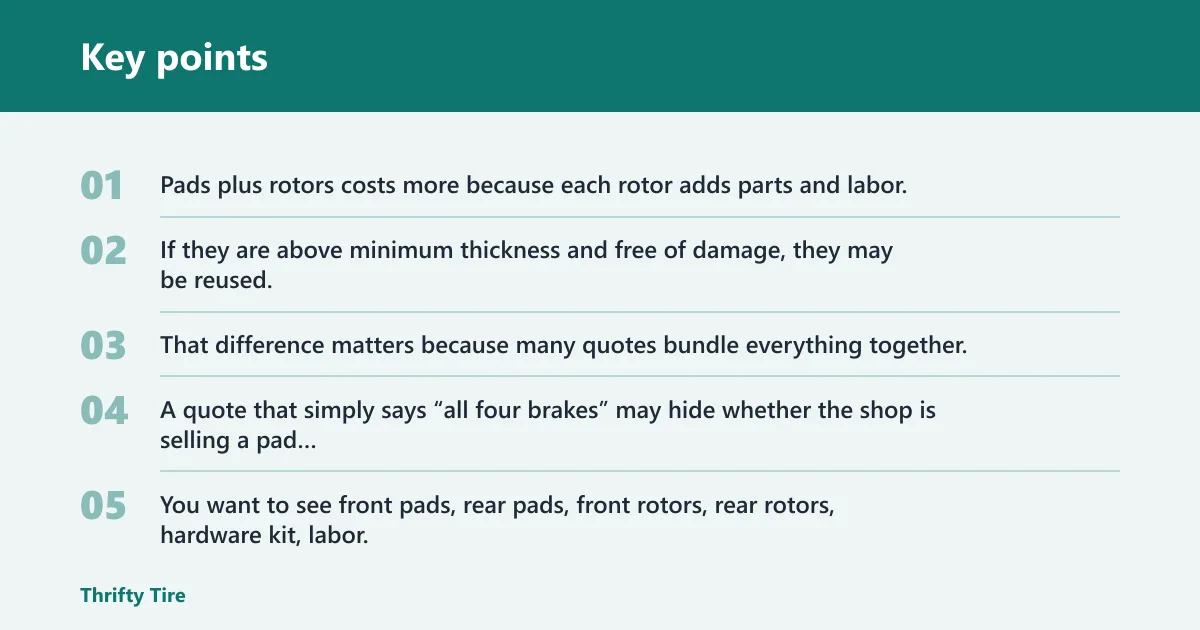
Pads-only work is the leaner quote. Pads plus rotors costs more because each rotor adds parts and labor, and that increase can be large when a shop replaces all four corners at once. Rotors do not always need replacement. If they are above minimum thickness and free of damage, they may be reused.
That difference matters because many quotes bundle everything together. A quote that simply says “all four brakes” may hide whether the shop is selling a pad job or a full brake service.
Which line items should be itemized?
Ask for each line item to be broken out. You want to see front pads, rear pads, front rotors, rear rotors, hardware kit, labor, shop supplies, taxes, and any electronic parking brake service. If the shop cannot separate those pieces, it is harder to tell whether the estimate is fair.
Brake inspection comes first. A proper inspection should measure pad thickness and rotor thickness, then compare both with service limits. That is the only way to know whether all four wheels need work or whether one axle can wait.
What are fair price ranges for all four brakes?
Manufacturer service information, repair-estimator data, and consumer auto organizations all point to the same pattern: the price depends on whether the job is pads only or pads plus rotors, and whether the front axle, rear axle, or both are involved. National repair-estimator sites and large consumer auto organizations generally show lower costs for pads only and a higher total once rotors are added.
Typical pads-only range
For many mainstream cars, a fair pads-only all-four estimate often lands around $300 to $700 in the U.S. That range usually reflects four pads sets, basic labor, and common shop charges. A compact car with easy access may come in lower; a larger vehicle, premium pad material, or a higher labor rate can move it higher.
Typical pads-plus-rotors range
When all four rotors are replaced with the pads, a fair estimate often falls around $650 to $1,400 in the U.S. Rotor price, labor time, and rear brake design make this range wider than pads only. Manufacturer service guidance also matters because some vehicles call for rotor replacement only when thickness or surface condition fails specification.
Sample all-4 estimate with line items
| Line item | Price | Audit result |
|---|---|---|
| Front brake pads | $118 | Yes |
| Rear brake pads | $104 | Yes |
| Front rotors | $178 | Yes |
| Rear rotors | $164 | No |
| Hardware kit | $36 | Yes |
| Labor | $248 | Yes |
| Shop supplies | $22 | Yes |
| Taxes | $58 | Yes |
| Electronic parking brake service | $45 | No |
This sample totals $973 with rear rotors and EPB service included, but the strict audit column shows those two items should be declined unless the rear rotor measurements fail minimum thickness or the vehicle needs rear service mode for actual rear brake work.
When do you need pads only versus pads and rotors?
You may need pads only, pads and rotors, or pads with rotor resurfacing or reuse depending on thickness and condition. Rotors should be replaced when they are below minimum thickness, warped, heavily scored, cracked, or otherwise damaged. If they still pass inspection, replacing them is not always necessary.
When pads can be reused with rotors
It is more common for pads to be replaced than reused, because thin pads trigger the service. Rotors can sometimes stay in place if the surface is acceptable and the thickness remains above the limit. A quote that assumes new rotors without measurements deserves a second look.
Say the front pads are down to the wear indicator but the rotors are smooth and still within spec. The estimate should not automatically include new front rotors unless the inspection shows damage or thickness loss.
Rotor thickness and damage checks
Ask the shop what the measured rotor thickness was and what the minimum allowable thickness is for the vehicle. Also ask whether the rotors show scoring, hot spots, rust pitting, or runout concerns. Those details matter more than a generic “rotors are recommended” note.
For more detail on when a rotor swap is justified, see rotor-replacement guidance. If the answer is vague, the rotor charge may be more opinion than measurement.
Signs the quote is adding unnecessary rotors
Watch for estimates that include all four rotors when only one axle shows pad wear. Another warning sign is a quote that lists rotor replacement without a thickness measurement. If the shop cannot explain why the rotors fail inspection, ask for that step before approving work.
Brakes can be noisy for several reasons, but noise alone does not prove a rotor change is needed. The job should follow measurements, not just a complaint.
When are all four brakes actually needed?
All four brakes are needed when both axles are worn, damaged, or below service limits. That is more common on vehicles with high mileage, uneven wear, poor maintenance, or rotor damage on both ends. A fair four-wheel quote should be based on measured wear, not on a package sale.
Why the front axle usually costs more
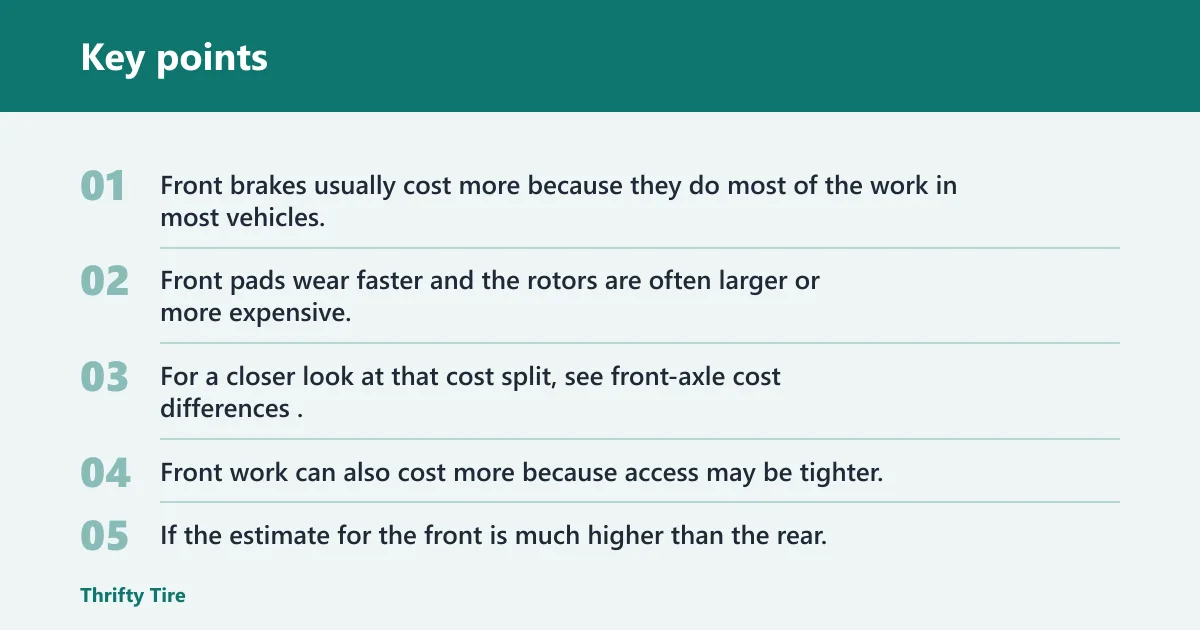
Front brakes usually cost more because they do most of the work in most vehicles. Front pads wear faster and the rotors are often larger or more expensive. For a closer look at that cost split, see front-axle cost differences.
Front work can also cost more because access may be tighter, and the parts themselves are sometimes pricier. If the estimate for the front is much higher than the rear, that is not automatically a problem. It may simply reflect the extra brake work up front.
Why rear brake work can be cheaper
Rear pads and rotors often run a little less because the rear axle usually wears more slowly. On some cars, the rear setup is simpler and sees less wear. On others, the rear brake service still needs an electronic parking brake service mode, which can add labor and time.
That is why rear pricing is not always the “cheap” part of the job. If the estimate includes rear service mode, the lower parts cost may be partly offset by labor.
How axle wear affects timing
Brake pads can last up to 80,000 miles with gentle driving, but wear is not even across a vehicle. Because the front brakes do most of the work in most vehicles, the front pads are often replaced before the rear pads. A four-wheel quote should still be based on measured wear, not on a guess.
Brake pads are typically replaced in pairs, not all four at once. That is why a quote for all four should be treated as a claim that both axles need service, not as a default package.
What should a fair brake quote list?
A fair quote should show what parts are being replaced, what labor is being charged, and what add-ons are included. It should also state whether the rear axle needs electronic parking brake service and whether shop supplies or taxes are part of the final total. Hidden bundles make comparison shopping harder.
Brake pads
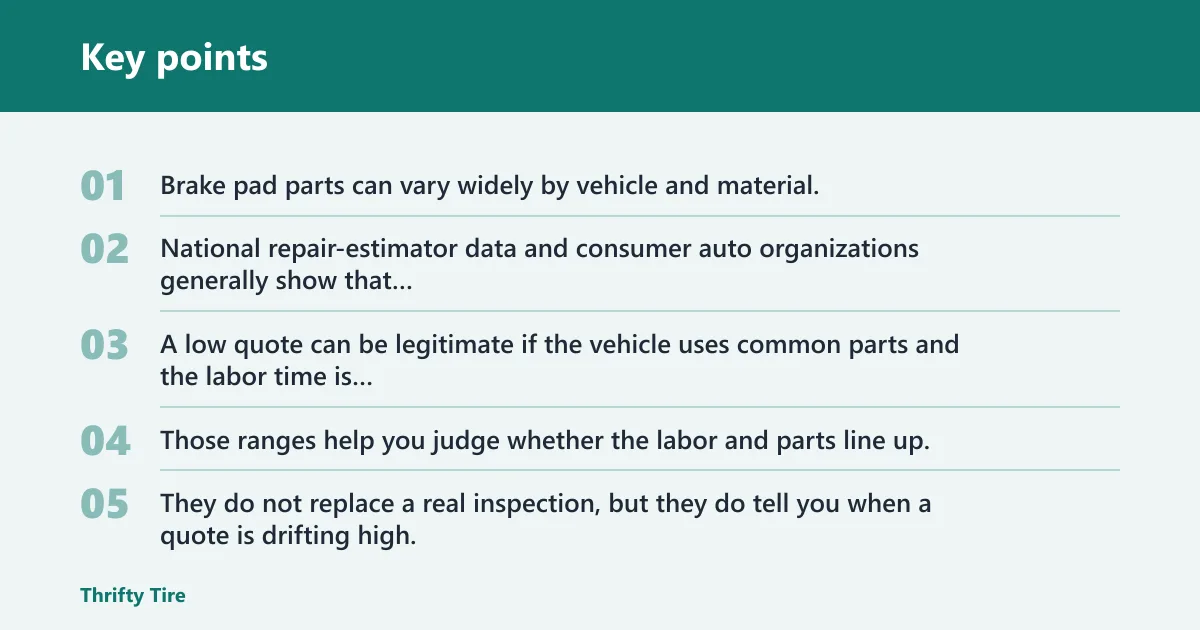
Brake pad parts can vary widely by vehicle and material. National repair-estimator data and consumer auto organizations generally show that pads-only quotes stay far below pads-plus-rotors quotes when rotor replacement is not needed. A low quote can be legitimate if the vehicle uses common parts and the labor time is short.
Those ranges help you judge whether the labor and parts line up. They do not replace a real inspection, but they do tell you when a quote is drifting high.
Brake rotors or discs
Rotors add meaningful cost. Consumer auto organizations and manufacturer service guidance both support rotor replacement when thickness, surface condition, or runout do not meet specification. If the quote is near the top of the range, ask whether it includes four new rotors or just one axle.
Hardware kit
A hardware kit can include anti-rattle clips, shims, and slide pins. Cheap quotes sometimes leave it out. That can matter for fitment and noise control, especially if the old hardware is worn, corroded, or distorted.
Labor rate
Labor rate varies by shop type and region. Dealerships usually cost more than independent shops. Since brake jobs are labor-sensitive, a higher shop rate can move the total a lot even when the parts are ordinary.
Shop supplies and taxes
Shop supplies and taxes should be visible at the end of the estimate. Supplies can cover small consumables used during the job. They should not be used as a vague catch-all for unexplained charges.
Electronic parking brake service
Modern cars often use an electric parking brake on the rear axle. Rear brake work on those vehicles may require service mode or a scan-tool procedure. If the estimate includes that charge, it should say so plainly.
Brake quote audit checklist
Use this checklist to sort a real estimate into needed work and optional work. A yes answer means the line item has a clear reason to be there based on measured wear, damage, or vehicle setup. A no answer means the shop should explain why it is included.
| Line item | Should it be present? | What justifies it |
|---|---|---|
| Front pads | Yes if front pads are thin or noisy | Measured wear, squealing, grinding, or wear indicator light |
| Rear pads | Yes if rear pads are thin or damaged | Measured wear on the rear axle, not a blanket all-4 sale |
| Front rotors | Yes if below thickness or damaged | Scoring, warping, cracks, or minimum thickness failure |
| Rear rotors | Yes if below thickness or damaged | Same rotor checks as the front axle |
| Hardware kit | Maybe | Worn clips, shims, or slide pins; noise prevention; fitment issues |
| Labor | Yes | Every brake job has labor, but the hours should match the scope |
| Shop supplies | Maybe | Small consumables, listed clearly and kept reasonable |
| Taxes | Yes if required | Local tax rules apply to parts and sometimes labor |
| Electronic parking brake service | Maybe | Rear axle work on vehicles with an electric parking brake |
- Ask for pad thickness and rotor thickness on each axle.
- Confirm whether the front, rear, or both axles are actually worn out.
- Request the quote broken into parts, labor, supplies, and taxes.
- Check whether rotor replacement is tied to a measurement or only to a package price.
- Ask if the rear brake job needs electronic parking brake service mode.
- Compare the total against a pads-only and pads-plus-rotors version.
Frequently asked questions
How much does brake pad replacement cost for all 4?
For many mainstream cars, a fair all-four brake pad replacement quote often lands around $300 to $700. The total rises with labor rate, vehicle design, and whether the quote includes rotors. Once all four rotors are added, the estimate can move into a much higher range.
Do I need to replace all 4 brake pads at once?
No. Brake pads are typically replaced in pairs, not all four at once. Front and rear wear differently, and the front brakes do most of the work in most vehicles. Replace the axle that is actually worn out, based on inspection, not a package price.
How much should a brake pad replacement quote include?
A good quote should show the axle being serviced, pad parts, labor, and any added items such as rotors, hardware, shop supplies, taxes, or electronic parking brake service. Ask for measured pad thickness and rotor thickness so you can tell whether the recommended parts match the inspection.
What is the difference between pads-only and pads plus rotors pricing?
Pads-only pricing covers the friction material and labor to install it. Pads plus rotors adds new discs and the extra labor that comes with them, so the price rises more sharply. Rotors should be replaced only when they are below minimum thickness or damaged.
How do I know if my rotors also need replacing?
Ask the shop for rotor thickness measurements and an inspection of the rotor surface. Rotors usually need replacement when they are below minimum thickness, cracked, scored, or badly warped. If the quote includes new rotors without those checks, request the measurements first.
What signs mean my brake pads are worn out?
Common signs include squealing or squeaking, grinding when braking, pulling, a dash warning light, or very thin pads during inspection. Those symptoms do not all mean the same thing, but they do mean the brakes need attention soon. A brake inspection should confirm which axle needs work.