What Temperature Is Considered Cold Tire Pressure?
There is no single temperature that makes tire pressure “cold.” It means the tires have sat long enough to match outside air, ideally for at least 3 hours and before driving. Checking them hot can leave you underinflated or overinflated, which hurts wear, grip, and fuel economy. Here’s the simple rule for reading cold PSI and using your vehicle placard correctly.
How to find your correct tire pressure
Cold tire pressure is the PSI reading taken before you drive, after the tires have had enough time to match the surrounding air temperature. The target number is not the tire sidewall rating. It is the vehicle tire pressure placard number, usually found on the door jamb or doorframe. (Wikipedia)
Use the placard, not the sidewall
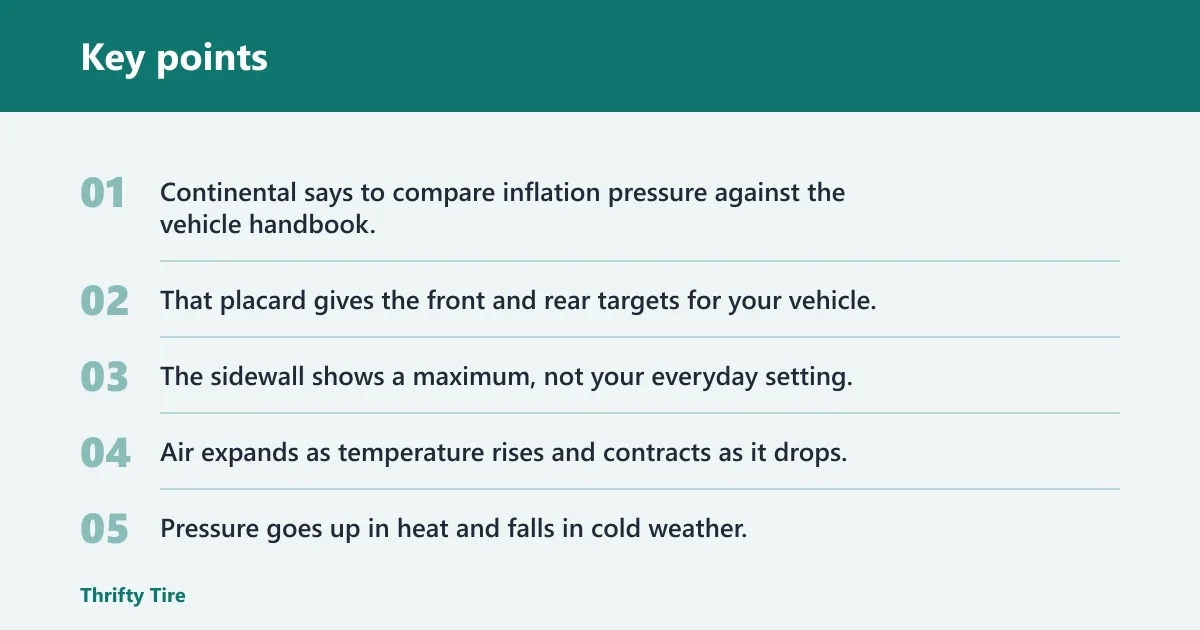
Continental says to compare inflation pressure against the vehicle handbook, and Firestone says the recommended PSI is listed on the door jamb or in the manual. That placard gives the front and rear targets for your vehicle. The sidewall shows a maximum, not your everyday setting.
Why ambient air matters
Air expands as temperature rises and contracts as it drops. Pressure goes up in heat and falls in cold weather. Cold tire pressure gives you a stable comparison point. If the tire has not matched the air around it, the reading can be off.
What temperature is considered cold tire pressure?
There is no fixed tire temperature threshold for “cold.” The practical rule is time and rest, not a specific tire-surface number. A tire is cold when it has sat long enough to match ambient air, before driving, so the reading reflects the tires at rest rather than heat from road use or braking.
Cold is a condition, not a number
That is the part many guides skip. Cold tire pressure is not the same as “cold outside temperature.” A tire can be cold on a mild morning, or still warm after a short stop on a freezing day. The key is whether the pressure has settled to match the air around it.
Why 7°C matters for winter tires
Canada recommends winter tires below 7°C, and Hankook says winter tires keep elasticity at much lower temperatures. That does not change the pressure rule. Winter tires still need the placard PSI, checked cold. Cold weather can also make a tire that looked fine in a warm garage come up low outside below zero.
When is a tire still cold?
A tire is usually still cold if the vehicle has been parked overnight, or long enough for the tire to match outdoor air again. Two hours in shade may still count as cold in many cases. A warm garage, a short drive, or direct sun can change the reading enough that it no longer reflects true cold PSI.
Decision table: is this reading still cold?
| Scenario | Is it still cold? | Recommended action |
|---|---|---|
| Overnight parked | Yes | Check PSI before driving and compare it to the placard. |
| 2 hours in shade | Usually yes | Check it if the tires have not been driven on; use the gauge reading as a cold check if the tires feel close to ambient. |
| Warm garage to freezing outside | Not always | Let the tires sit outside long enough to match the air, then recheck before adjusting. |
| 10-minute drive | No | Assume the reading is warm. Add air if the tire is already below a safe level, then verify cold pressure later. |
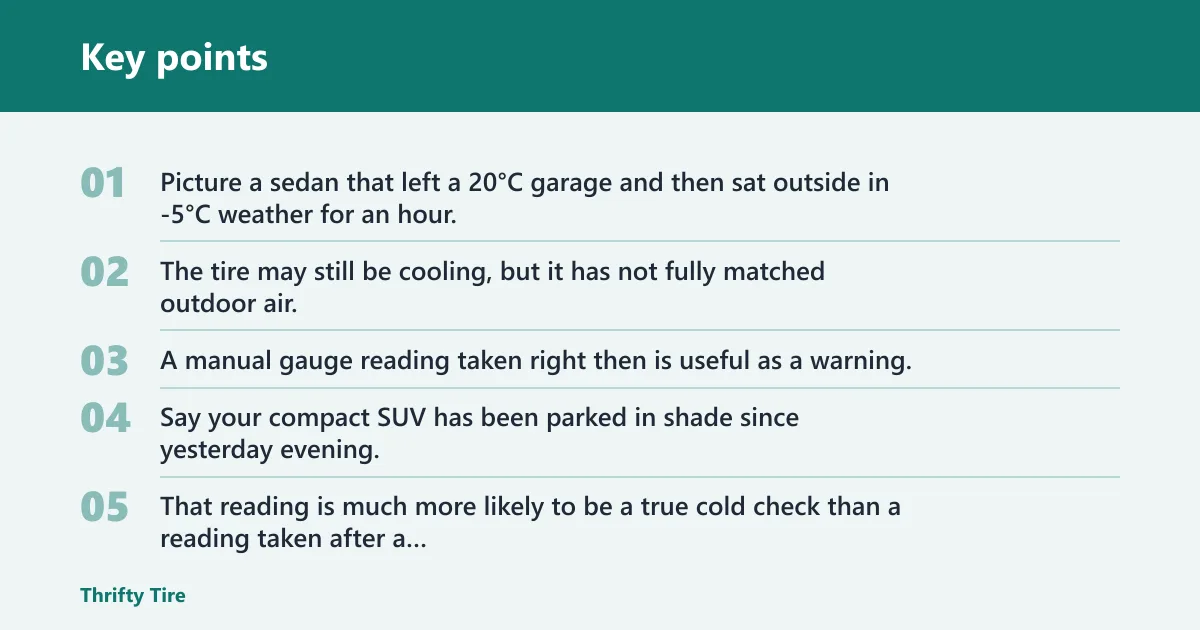
Picture a sedan that left a 20°C garage and then sat outside in -5°C weather for an hour. The tire may still be cooling, but it has not fully matched outdoor air. A manual gauge reading taken right then is useful as a warning, yet it should be checked again once the tire has truly settled to outdoor air.
Say your compact SUV has been parked in shade since yesterday evening. That reading is much more likely to be a true cold check than a reading taken after a school drop-off and a stop at the gas station. The time parked matters more than whether the day feels cold.
How temperature changes PSI
Temperature changes can move tire pressure enough to matter. Firestone says tire pressure changes about 1 to 2 PSI for every 10 degrees Fahrenheit. That is why pressure drops in fall and winter, and why a sunny tire can read higher than one in shade. (Firestonecompleteautocare)
Use a simple rule of thumb
If the air gets colder, PSI usually falls. If the air gets warmer, PSI usually rises. A 10°F swing can change the reading by about 1 to 2 PSI. That is enough to trip TPMS on some vehicles or leave a tire below the placard target if you only checked it on a warm day.
Sun, shade, and elevation can shift readings
One example showed a shaded tire at 57° F and a sun-exposed tire at 107.5° F, with the sun-exposed tire pressure increasing by 5 PSI. That gap shows why direct sun can mislead a quick check. Elevation changes can matter too, because atmospheric pressure changes with altitude.
Infrared thermometers have a limited role
An infrared thermometer can show surface temperature differences between sun and shade, which helps explain why two tires on the same vehicle may not read the same. It is not the primary tool for setting PSI. Use a reliable tire pressure gauge for the actual inflation number.
How do you check and set cold pressure?
Use a reliable tire pressure gauge and compare the reading with the placard on the door jamb or doorframe. A gauge may read in PSI or bar. TPMS can warn that pressure is low, but it does not replace a manual check or give the exact placard target.
Steps to set the right pressure
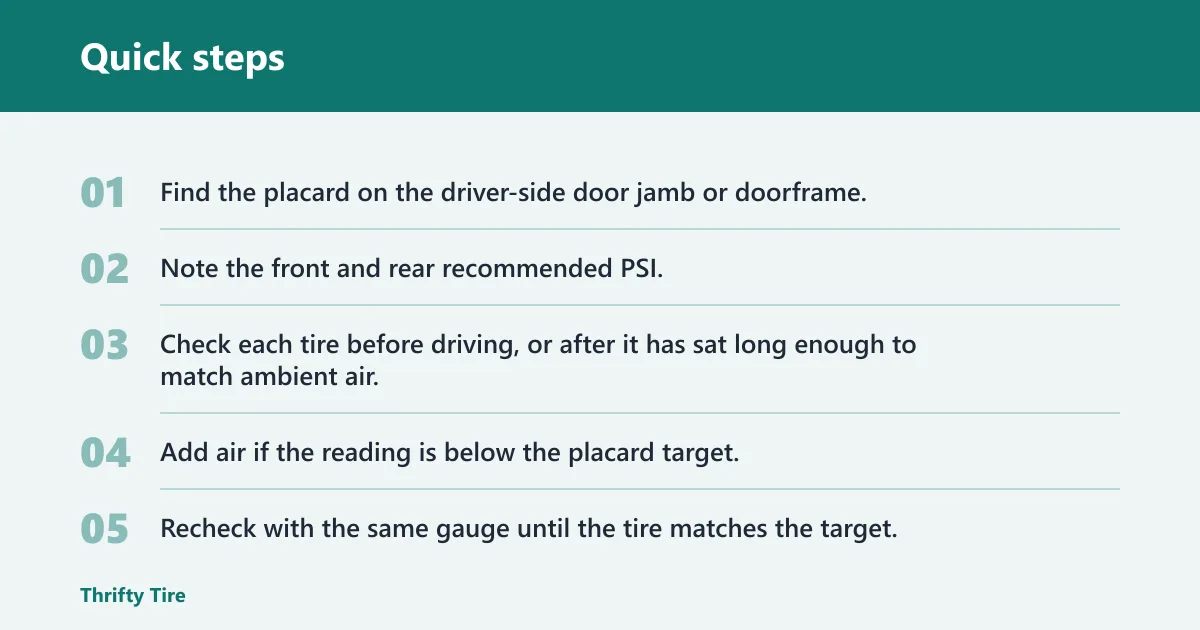
- Find the placard on the driver-side door jamb or doorframe.
- Note the front and rear recommended PSI.
- Check each tire before driving, or after it has sat long enough to match ambient air.
- Add air if the reading is below the placard target.
- Recheck with the same gauge until the tire matches the target.
What if the tire is already low and warm?
Do not wait to add air if the tire is already below a safe pressure and the only reading available is warm. Inflate it promptly to the placard target or close to it, then verify again when the tire is cold. A warm reading is not ideal, but a low tire should not be left low just to preserve a perfect cold reading later.
How to read a warm gas-station check
A short drive to the gas station can raise pressure enough that the reading is no longer cold. That does not mean the tire should be ignored. If the gauge still shows low pressure, add air now. Then recheck cold as soon as practical and fine-tune to the placard number.
What do TPMS and winter tires change?
TPMS warns when pressure is low enough to need inflation, but it may not match the exact recommended PSI on the placard. Cold weather can trigger the light because pressure falls as air cools. Winter tires also need the same correct air pressure, even though they stay more flexible at lower temperatures.
Why TPMS and a gauge can disagree
TPMS is a warning system, not a precision fill tool. It can alert after a temperature drop even if the tires are only a little low. A manual gauge tells you the actual PSI or bar, which is what you need to match the placard.
Winter tires still need the placard PSI
Hankook says winter tires keep elasticity at much lower temperatures, which helps traction in cold conditions. That advantage does not replace correct inflation. If the tires are underinflated, you can still lose wear life, fuel economy, and handling precision.
Frequently asked questions
What temp is considered cold tire pressure?
There is no exact temp that defines it. The better test is whether the tire has been parked long enough to settle to ambient air. If the vehicle has not been driven and the tires have had time to rest, the reading can be treated as cold.
What temperature is cold tire pressure measured at?
It is measured at the ambient temperature around the tire after rest, not at a fixed tire temperature. That is why a cold reading on a winter morning can differ from one taken after the vehicle sat in a warm garage. Time parked matters as much as outside air.
What temperature is cold tire pressure in Fahrenheit?
There is no set Fahrenheit number for cold tire pressure. The common rule is to check before driving, after the tires have had time to match the air around them. A 10°F change can move pressure by about 1 to 2 PSI, so the exact reading depends on conditions.
Is cold tire pressure higher or lower?
Cold tire pressure is usually lower than a warm reading because air contracts as temperature drops. That is why tires can look fine in a warm garage and read low outside in freezing weather. Use the cold reading to match the placard, then expect a small rise when the tires heat up.
How long should tires sit before checking cold pressure?
As a practical rule, let the vehicle sit long enough for the tires to match ambient air, ideally 3 hours or more. Overnight parking is the easiest way to get a true cold reading. If the tires were driven recently, assume the reading is warm until they rest again.