How to Measure Center Bore on a Wheel at Home
Measure the wheel’s center bore by reading the inside diameter of the center hole with calipers. Do not include the outer lip or chamfer. For hub-centric fitment, the wheel bore should match the hub diameter or be slightly larger with the correct hub-centric ring. This follows standard wheel-fitment practice: the bore centers the wheel, and the hub or ring provides the centering interface. A bad reading can lead to vibration, poor centering, or wheels that do not fit. This guide shows how to measure at home, spot false readings, compare wheel and hub diameters, and know when to verify the fitment professionally.
What center bore means
Center bore is the diameter of the wheel’s center opening, the hole that sits over the hub. It is measured in millimeters or, on some specs and tools, in inches. You may also see it called center drill, center hole, CB, or rim hole. The key point is simple: the bore is the wheel opening itself, not the outer edge.
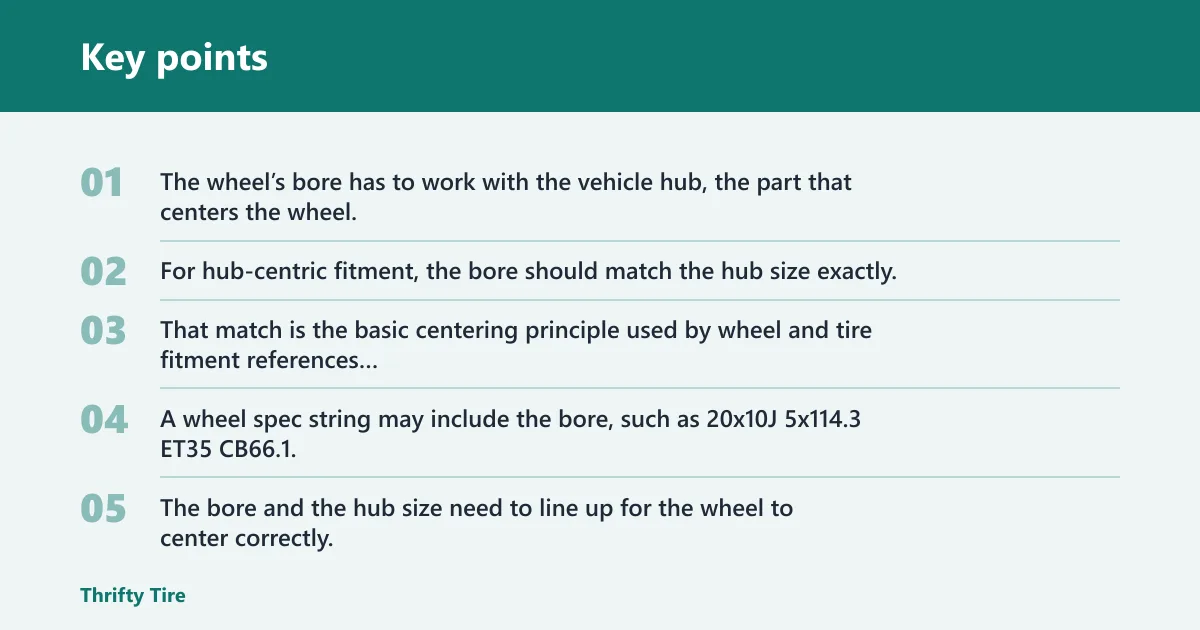
The wheel’s bore has to work with the vehicle hub, the part that centers the wheel. For hub-centric fitment, the bore should match the hub size exactly, or the wheel should use hub-centric rings if the bore is larger. That match is the basic centering principle used by wheel and tire fitment references and by wheel manufacturers’ spec sheets. A wheel spec string may include the bore, such as 20x10J 5×114.3 ET35 CB66.1, where CB66.1 means a 66.1mm center bore.
Center bore vs hub size
The bore and the hub size need to line up for the wheel to center correctly. If the wheel bore is too small, the wheel will not seat on the hub. If it is larger, rings may adapt it, but only if the rest of the fitment works too. Center bore is one part of wheel fitment, alongside bolt pattern and offset. Industry fitment guidance treats the hub as the centering surface and the bore as the matching opening, so nominal spec and measured reality both matter.
Do not judge wheel fitment from bore alone. A 5×114.3 PCD means 5 bolt holes with a 114.3mm circle diameter, and that bolt pattern still has to match the vehicle. Offset matters too. A wheel can have the right bore and still be wrong for the car.
Why center bore matters
Center bore matters because the hub is what centers the wheel. When the bore matches the hub, the wheel locates on the hub instead of relying only on the lug hardware. That reduces fitment error and helps prevent vibration. Loose or oversized center bores can contribute to high-speed vibration, which is why the measurement matters before installation.
If the bore is wrong, the wheel may still bolt on but not run true. That is a fitment problem, not a cosmetic one. A wheel with the correct bore, bolt pattern, and offset is far easier to trust than one that only matches one of those specs.
Where center bore fits in overall wheel fitment
Think of fitment as a set of checks, not a single number. You need the correct bolt pattern, the correct offset, and a center bore that works with the hub or ring setup. If one of those is off, the wheel may mount badly or create vibration even if the others look right. Hub-centric fitment is especially dependent on the bore/hub relationship because that is what centers the wheel before the lugs are fully loaded.
A wheel marked CB66.1 may be a 66.1mm bore on paper, but the real-world opening can differ slightly if the wheel is painted, worn, or corroded. A reading like 66.3mm is larger than the nominal spec and should be checked for ring availability and actual fit before you assume it is usable. Wheel manufacturers publish nominal values; the measured opening can be affected by coating buildup, corrosion, burrs, or previous damage.
What tools do you need to measure bore diameter accurately?
A digital caliper is commonly used as a practical home tool for measuring bore diameter accurately. Use it to measure the inside diameter directly. A ruler or tape measure is too crude for this job because the opening is small and the difference between a correct fit and a bad one can be minimal. Clean the wheel first so debris does not skew the reading. Calipers are the standard choice because they can bridge the inside walls of the opening and read the diameter directly.
You may also want a soft brush, a clean cloth, and a marker or notepad for recording readings. If the wheel is dirty, painted, or corroded, the bore can read smaller than it really is. That can make a usable wheel look undersize. Corrosion and thick paint are especially important because they can change the contact point enough to create a false fail.
Digital caliper setup
Set the caliper to millimeters and verify that it closes smoothly to zero. Open the jaws, place them inside the bore, and keep the jaws square to the cylinder wall. The goal is to measure the true cylindrical opening, not the opening’s top edge or any bevel around it. A caliper reading is only useful when both jaws contact parallel surfaces on the bore wall.
Cleaning the bore before you measure
Remove loose dirt, brake dust, and rust flakes from the center hole. If the bore has paint buildup, corrosion, or chips, note that before measuring. Cleaning does not change the wheel’s designed bore, but it can change whether the reading is trustworthy. If the bore surface is rough enough to affect jaw contact, you should expect a wider spread between readings.
How do I measure wheel bore size at home?
Measure the wheel bore by removing the wheel if needed, cleaning the center opening, and placing a digital caliper across the true inside wall of the bore. Do not measure the lip, the chamfer, or the outer face. Take three readings in the same area and compare them. If the numbers vary too much, the wheel needs a closer check. The practical goal is a repeatable diameter, not just one number that looks close.
Step-by-step measurement
- Remove the wheel if access or visibility is poor. The wheel should usually be off the vehicle for the most reliable reading.
- Clean the center hole so rust, paint, and debris do not change the contact point.
- Open the caliper wider than the bore, then place the jaws inside the hole.
- Align the jaws with the straight cylindrical wall, not the bevel at the opening.
- Close the jaws gently until both sides touch the true bore wall.
- Read the measurement and write it down.
- Rotate the caliper slightly and repeat twice more.
- Average the three readings and compare that average to the hub size or ring size.
Suppose a wheel is marked CB66.1, but the caliper reads 66.3mm on one spot, 66.2mm on another, and 66.3mm again. That is larger than the nominal size, so you should confirm whether the ring and hub fit before using the wheel. The average matters more than a single reading. If the spread stays small and repeatable, the wheel is much easier to verify.
A common first-timer mistake is pressing the caliper against the chamfer at the opening. That can make the bore seem larger than it is. Another mistake is letting the jaws ride on corrosion or paint buildup, which can make the bore seem smaller.
Center bore worksheet
Use this worksheet after the measurement. It separates the actual bore reading from the condition of the wheel, which is the part that often changes the decision. If the bore is dirty, painted, corroded, or worn, treat the result as provisional until it is repeated cleanly. A nominal specification is only useful when the measured reading is repeatable enough to trust.
| Check item | Entry to record | Why it matters |
|---|---|---|
| Tool used | Digital caliper | Direct diameter reading is the preferred home method |
| Where the caliper touched | True cylindrical bore wall | Confirms the reading did not come from the lip or chamfer |
| Bore condition | Clean / painted / corroded / damaged | Condition can distort the reading |
| Reading 1 | _____ mm | First repeat measurement |
| Reading 2 | _____ mm | Second repeat measurement |
| Reading 3 | _____ mm | Third repeat measurement |
| Average reading | _____ mm | Used for the final fitment check |
| Tolerance note | Repeat if the spread is more than 0.2 mm | A wide spread means the reading is not repeatable enough to trust |
| Fitment result | Pass / fail for hub-centric or ring-based installation | Turns the reading into an actual decision |
Mistake log:
- Wrong surface measured: lip, chamfer, or bore wall
- Wrong tool used: tape, ruler, or other imprecise tool
- Dirty bore: rust, paint, or debris affecting the contact point
- Large reading spread: values that do not repeat cleanly
- Oversized reading: reading larger than the nominal CB spec without confirming ring fit
- Decision: verify, use with ring, or reject until checked professionally
How do you know the reading is wrong?
A reading is too uncertain to trust when the numbers do not repeat, the caliper keeps landing on the lip, or the bore surface is visibly distorted. If the wheel is worn, bent, chipped, painted heavily, or corroded, the measured diameter may not reflect the original bore. Stop and verify if the result keeps changing.
Spotting lip and chamfer errors
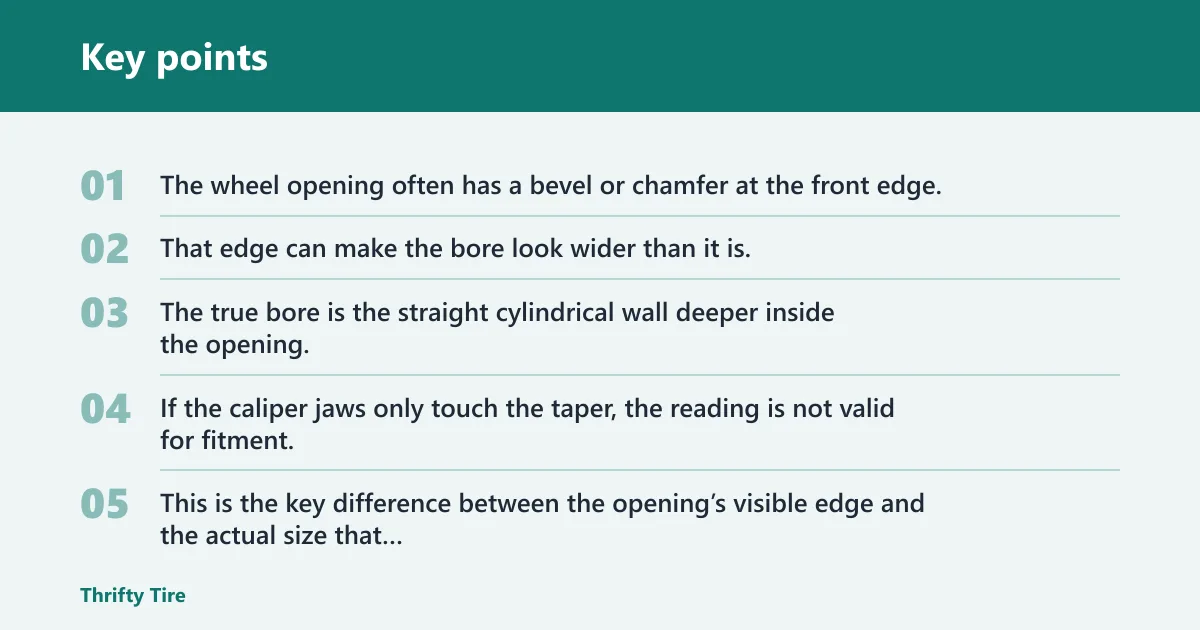
The wheel opening often has a bevel or chamfer at the front edge. That edge can make the bore look wider than it is. The true bore is the straight cylindrical wall deeper inside the opening. If the caliper jaws only touch the taper, the reading is not valid for fitment. This is the key difference between the opening’s visible edge and the actual size that matters.
Measure only the straight section. If the wheel opening narrows or flares right away, that is the wrong contact zone. A bad contact point is the most common reason a home measurement goes off.
Reading a worn or damaged wheel
If the wheel is worn, the center opening can measure differently from one spot to another. That amount can be large enough to change the fit decision, so a worn wheel should not be trusted from one quick reading. Repeated variance is the warning sign: if the caliper reads different values around the opening, the bore may be damaged, out of round, or contaminated by buildup.
Picture an older wheel with corrosion inside the bore and chipped paint on the edge. A first reading may look smaller because the caliper is landing on buildup, while a second reading looks larger after the jaws shift to bare metal. That spread means the result is unreliable.
Compare the wheel to an unworn sibling wheel if one is available. A matching wheel in better condition can reveal whether the suspect bore is distorted or just dirty. If there is no clean repeatable reading, stop and verify the wheel with a machinist or fitment shop.
How do I measure the vehicle hub diameter at home?
Measure the vehicle hub with the caliper’s outside jaws across the hub register. The hub diameter is the matching surface that centers the wheel. If the hub is rusty or painted, clean it first so the reading reflects the actual metal, not surface buildup.
Do not confuse the hub register with the wheel’s center hole. The hub is the vehicle-side diameter; the bore is the wheel-side diameter. For hub-centric fitment, those values should match closely, or the wheel should have the correct ring if the bore is larger.
| What you measure | Where the caliper goes | What not to measure | What the result tells you |
|---|---|---|---|
| Wheel hole / center bore | Inside the wheel’s center opening | The outer lip, chamfer, or decorative edge | Whether the wheel can center on the hub or accept a ring |
| Wheel lip / chamfer | At the beveled entrance of the opening | The straight cylindrical wall | Not a valid fitment size; can make the opening seem larger |
| Vehicle hub diameter | On the hub’s centering register | Bolt holes, studs, or brake components | Whether the wheel bore matches the hub or needs a ring |
Can hub-centric rings fix a larger bore?
Yes, if the wheel bore is larger than the hub and the rest of the fitment is correct, hub-centric rings can adapt the opening to the hub. Centering rings are used to make the center bore in the rim smaller so it fits the hub. They are an adapter, not a fix for every fitment problem. The ring must match both the wheel bore and the hub diameter exactly enough to support centering.
When rings are appropriate
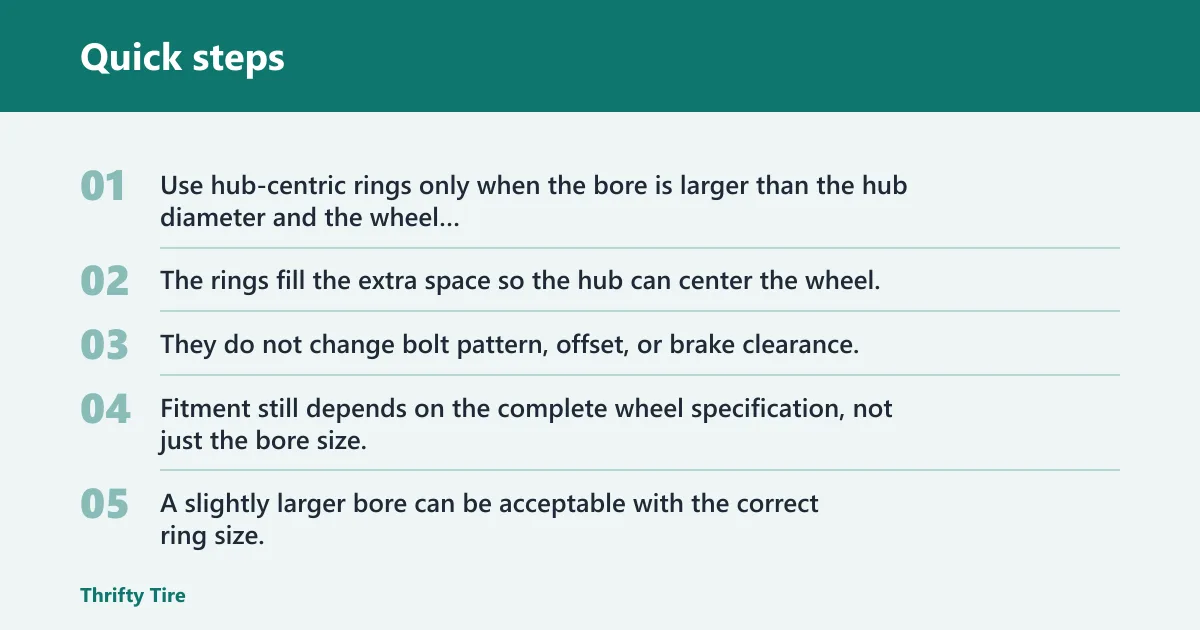
Use hub-centric rings only when the bore is larger than the hub diameter and the wheel otherwise matches the vehicle. The rings fill the extra space so the hub can center the wheel. They do not change bolt pattern, offset, or brake clearance. Fitment still depends on the complete wheel specification, not just the bore size.
A slightly larger bore can be acceptable with the correct ring size. A smaller bore cannot be corrected with a ring because the wheel still will not seat on the hub. That is a fail for hub-centric installation. If the measured wheel bore is smaller than the hub, stop and verify before trying to force the fit.
Plastic vs metal rings
Hub-centric rings are available in hard plastic or metal. Either can work when sized correctly. The important part is not the material alone, but the exact fit between the ring, the wheel bore, and the hub. A loose ring defeats the purpose. In practice, a ring only helps when the measured dimensions are repeatable and the ring fills the gap cleanly.
When rings are not enough
If the wheel is bent, the bore is irregular, or the reading changes across multiple repeats, rings will not solve the problem. They are not a cure for a damaged wheel or a bad measurement. If the bore is too small, too distorted, or too uncertain to trust, verify before you buy rings or mount the wheel.
Center bore decision table
Use this quick check after you compare the measured wheel bore to the hub diameter. The goal is to decide whether the wheel can mount as-is, can work with a ring, or should be rejected until verified. Nominal spec, measured reality, and repeatability all need to agree.
| Situation | Decision | Why |
|---|---|---|
| Exact match | Pass | Wheel can center directly on the hub if the reading is repeatable and the rest of the fitment matches |
| Larger bore with ring | Pass with ring | Ring can reduce the effective opening so the hub can center the wheel |
| Smaller bore | Fail | The wheel will not seat over the hub and should not be forced |
| Inconsistent readings | Hold / verify | Repeated variance means the measurement is not trustworthy enough to approve fitment |
Frequently asked questions
How do I measure centre bore on a wheel?
Measure the same way as center bore: read the inside diameter of the center opening with calipers, not the outer edge. The term “centre bore” means the same thing in this context. If the wheel is dirty, painted, or corroded, clean it first and repeat the reading.
What is the center bore on rims?
It is the hole in the middle of the wheel that mounts on the hub. It may also be called center drill, center hole, CB, or rim hole. For hub-centric fitment, it must match the hub size exactly or be adapted with rings.
How do I measure hub bore?
In common fitment language, “hub bore” usually refers to the vehicle hub register that the wheel centers on. Measure the vehicle hub with the caliper’s outside jaws, then compare it to the wheel bore. The wheel should fit the hub exactly for hub-centric mounting, or be used with the correct ring.
How accurate does the measurement need to be?
Accurate enough to repeat the same result three times is the standard for a home check. A small spread can be acceptable or not depending on the wheel, hub, and ring fit, so use the repeat readings as a guide rather than a fixed rule. Clean the bore, retake the measurement, or verify it professionally before making a fitment decision.