What Is Positive, Zero, and Negative Wheel Offset?
Wheel offset is the millimeter distance between a wheel’s hub-mounting face and its centerline. Positive offset tucks the wheel inward, zero offset sits on the centerline, and negative offset pushes the wheel outward. Get it wrong and you can trigger rubbing, caliper interference, altered steering feel, or extra bearing and suspension load.
What wheel offset means
Wheel offset is measured from the wheel centerline to the flat hub-mounting surface. The sign tells you where the mounting face sits relative to center: toward the street side of the wheel for positive offset, exactly on center for ET0, or behind center for negative offset.
How to read ET values
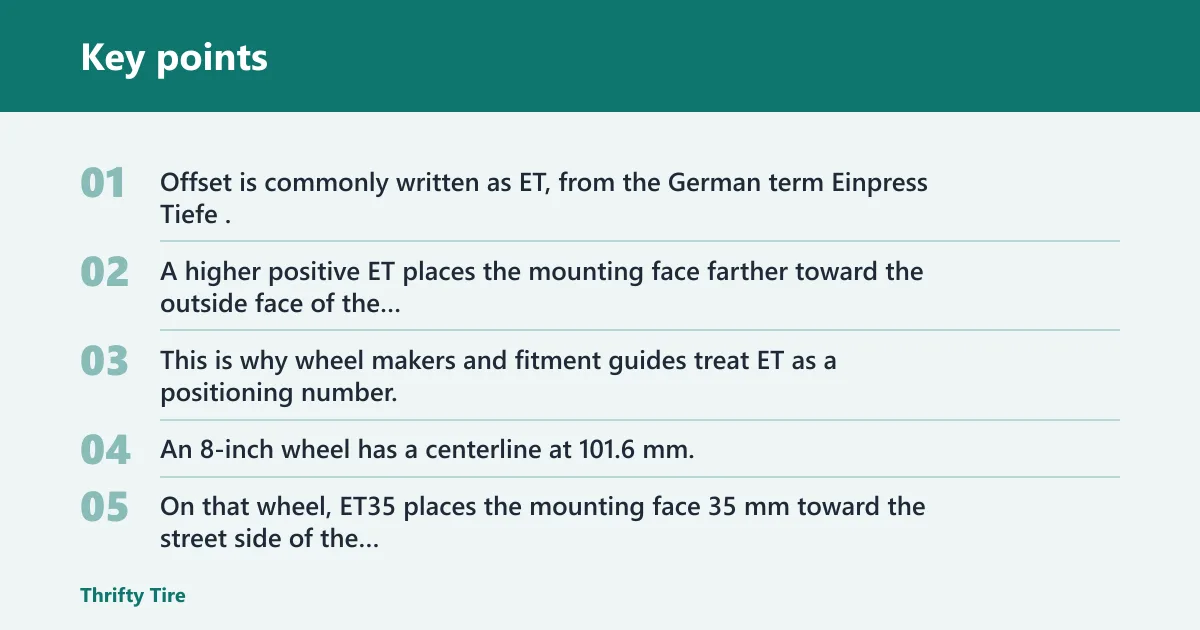
Offset is commonly written as ET, from the German term Einpress Tiefe. A higher positive ET places the mounting face farther toward the outside face of the wheel; a lower or negative ET moves it inward and changes how the wheel sits in the fender opening. This is why wheel makers and fitment guides treat ET as a positioning number, not just a label.
An 8-inch wheel has a centerline at 101.6 mm. On that wheel, ET35 places the mounting face 35 mm toward the street side of the centerline. That helps visualize the geometry: the offset is a physical location, not a vague style choice.
Positive offset, zero offset, negative offset
Positive offset puts the mounting surface toward the street-facing side of the wheel, so the wheel tucks inward toward the suspension. Zero offset, also written ET0, means the mounting surface is exactly on the centerline. Negative offset places the mounting surface behind centerline and pushes the wheel and tire outward. Manufacturer fitment charts and wheel brands commonly use positive offsets in the +30mm to +50mm range on many modern passenger cars, but the safe range is vehicle-specific and should be verified against brake, suspension, and wheel-width clearance.
Positive offset
Positive offset is common on many factory wheels for modern front-wheel-drive cars, sedans, crossovers, and compact hatchbacks. Many factory wheels on those vehicles use positive offset, and a typical range on many modern passenger cars is +30mm to +50mm, according to common OEM fitment patterns and retailer guidance such as Tire Rack and Les Schwab. The inward position can help with fender clearance and keep the tire tucked under the body.
Zero offset
Zero offset means the wheel mounting surface is aligned with the wheel centerline. It is the neutral reference point. On ET0 wheels, half of the wheel width sits inward and half sits outward from the hub face, although the actual fit still depends on width, tire size, and the vehicle’s brake and suspension shape. Tire section width and overall diameter can add sidewall bulge that changes whether a “good” offset still clears a liner or fender.
Negative offset
Negative offset pushes the wheel and tire assembly outward away from the vehicle. Negative offsets might range from -10mm to -44mm or beyond on certain deep-dish, off-road, or widened applications, but the usable range depends on the vehicle and wheel width. More negative offset increases outer poke and can raise steering and bearing loads, so the fit needs to be checked carefully rather than guessed.
Offset fitment table
The table below translates common ET values into millimeter movement from a single baseline on the same wheel width. Because width stays fixed here, each offset change moves both the inner lip and the outer lip by the same amount relative to the hub. Use it as a starting point, not a final verdict; wheel width and tire size still change the real fit.
| ET value | Mounting face position | Effect on wheel position | Practical reading |
|---|---|---|---|
| ET50 | 50 mm in front of centerline | 15 mm farther inward than ET35; 30 mm farther inward than ET20; 50 mm inward from ET0; 70 mm inward from ET-20 | More inner tuck; more chance of strut, spring, or caliper contact if width is not matched |
| ET35 | 35 mm in front of centerline | 15 mm farther inward than ET20; 35 mm inward from ET0; 55 mm inward from ET-20 | Common on many passenger-car setups; usually a moderate inward position |
| ET20 | 20 mm in front of centerline | Baseline reference in this table | Neutral comparison point for the examples below |
| ET0 | At the centerline | 20 mm farther outward than ET20 | Neutral position relative to the centerline |
| ET-20 | 20 mm behind centerline | 40 mm farther outward than ET20; 20 mm outward from ET0; 55 mm outward from ET35; 70 mm outward from ET50 | Deep outward position; more poke, more fender-risk, and more load shift away from the hub |
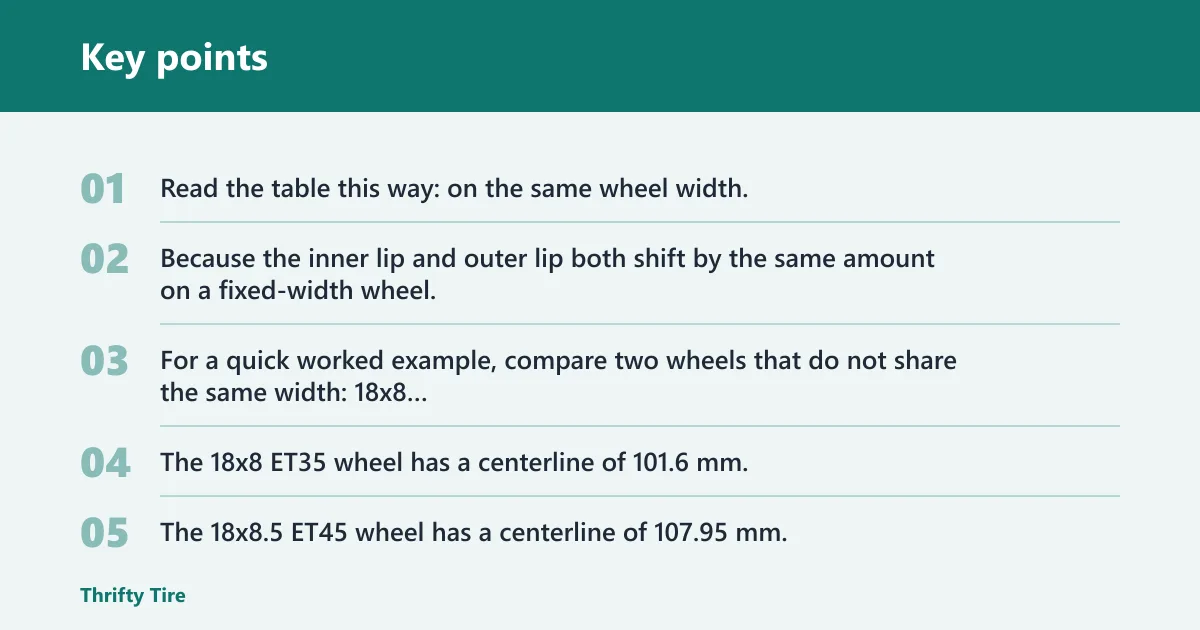
Read the table this way: on the same wheel width, a 15 mm jump from ET35 to ET50 moves the entire wheel 15 mm inward, and a 20 mm drop from ET20 to ET0 moves it 20 mm outward. Because the inner lip and outer lip both shift by the same amount on a fixed-width wheel, the offset change is easy to calculate once the width is held constant.
For a quick worked example, compare two wheels that do not share the same width: 18×8 ET35 versus 18×8.5 ET45. The 18×8 ET35 wheel has a centerline of 101.6 mm, so its inner lip sits 136.6 mm from the hub face and its outer lip sits 66.6 mm from the hub face. The 18×8.5 ET45 wheel has a centerline of 107.95 mm, so its inner lip sits 152.95 mm from the hub face and its outer lip sits 62.95 mm from the hub face. Even though ET45 is only 10 mm more positive, the wider wheel pulls the inner lip 16.35 mm farther inward and changes backspacing more than offset alone suggests.
How offset changes fitment
Offset changes where the wheel sits in the wheel well. That changes inner clearance, outer poke, and brake space. It also changes the tire’s relationship to the fender lip, liner, strut, knuckle, and caliper. The wheel width has to be part of the calculation, or the offset number by itself can mislead you.
Inner clearance and suspension contact
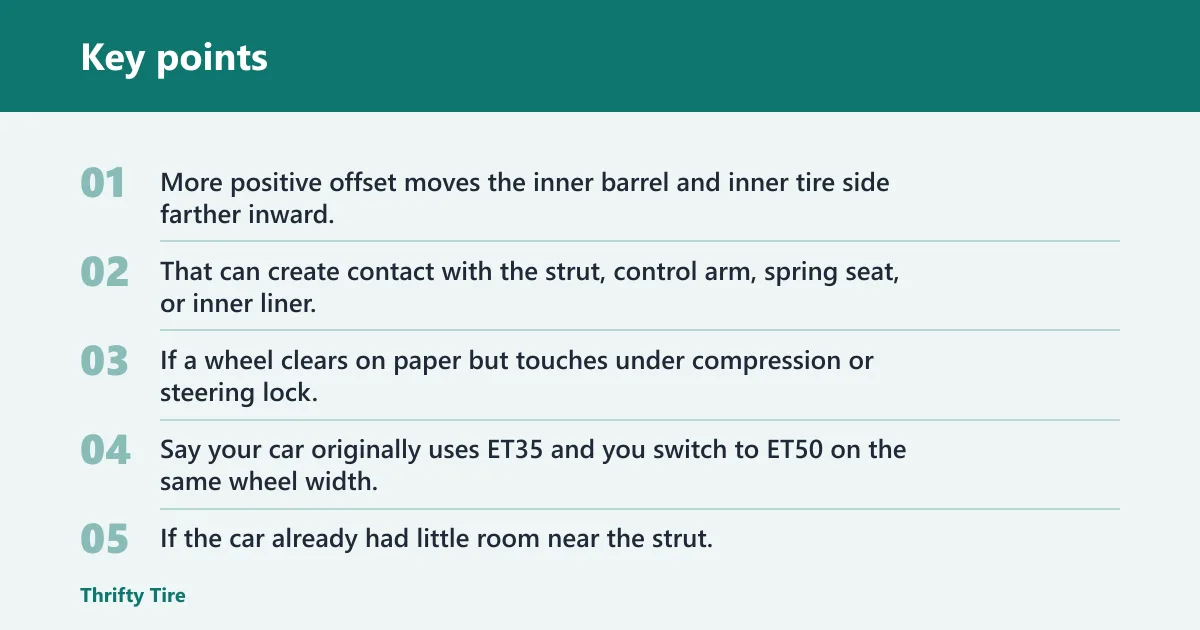
More positive offset moves the inner barrel and inner tire side farther inward. That can create contact with the strut, control arm, spring seat, or inner liner. If a wheel clears on paper but touches under compression or steering lock, the issue usually shows up at the inner side first.
Say your car originally uses ET35 and you switch to ET50 on the same wheel width. That 15 mm shift moves the wheel inward. If the car already had little room near the strut, the new wheel can contact the suspension even though the tire size did not change. Fitment guides from wheel and tire manufacturers generally treat offset changes in small steps because brake and suspension packaging leaves limited margin.
Outer poke and fender clearance
More negative offset pushes the wheel outward. That can create extra outer poke, which may look aggressive but can bring the tire close to the fender lip or liner. On lowered cars, the outer edge may contact the body during turns or over bumps. On trucks and off-road rigs, more poke may be tolerated if the body and suspension have room for it.
A common first-timer mistake is to judge fit by the outer edge only. A wheel that looks “close enough” at the fender can still rub the inner liner at full lock. The outside appearance does not tell you whether the inner side clears the suspension.
Brake clearance and caliper interference
Offset also affects how the barrel and spokes line up with the brake caliper. A wheel can have enough outer space but still strike the caliper face or spoke area. Wrong offset can reduce vehicle stability or interfere with braking, and Les Schwab cautions that new wheel offset generally should not be more than 5 millimeters different from the old offset without checking the vehicle-specific setup.
That guidance is a reminder that fitment changes should stay small unless you have verified brake package, wheel width, and suspension clearance. Larger brakes, spacers, and wider tires reduce the margin even more.
Offset vs backspacing
Offset and backspacing are related, but they are not the same measurement. Backspacing is the distance from the inner edge of the wheel to the mounting surface, usually measured in inches. Offset is measured from the wheel centerline to the hub-mounting surface in millimeters.
Why wheel width changes the answer
Wheel width changes backspacing because the inner edge moves when the wheel gets wider or narrower. A wheel with the same offset can have different backspacing if the width changes. That is why offset alone does not fully describe where the wheel sits.
Use offset when comparing wheel position relative to the centerline. Use backspacing when you need a quick inner-clearance check, especially on trucks or older vehicle platforms where backspacing is often part of the wheel spec sheet. For modern fitment work, you usually need both numbers plus the actual wheel width.
Why offset changes handling
Changing offset changes scrub radius, which affects steering behavior and the force acting on suspension parts. As the wheel moves outward or inward, the tire’s contact patch shifts relative to the steering axis. That can change steering weight, kickback, and the way the front end reacts to bumps. Wheel and suspension manufacturers generally warn that large offset swings can alter steering geometry enough to be felt immediately.
Scrub radius and steering feel
More negative offset usually moves the tire farther from the steering axis, which can increase scrub radius. That often means more steering effort, more kickback over rough pavement, and a stronger load on suspension joints. More positive offset can reduce that outward force, but too much can create inner-clearance problems instead.
Bearings and suspension load
More negative offset can increase load on wheel bearings and suspension components because the tire’s contact patch sits farther outboard. That extra force can raise stress on hub parts over time. Manufacturer and retailer fitment guidance commonly treats this as a caution point: the farther the wheel moves away from the hub face, the more leverage it places on the bearing and hub assembly.
Why some vehicles accept different ranges
Front-wheel-drive cars often rely on positive offset to keep the wheel tucked and the steering geometry manageable. Trucks and off-road builds may use lower or negative offset to clear larger tires, wider track components, or aftermarket suspension parts. Even then, fitment still has to be checked against the specific brake package and wheel width.
Wheel offset checklist
Use this safe-to-check fitment checklist before buying or mounting wheels. It keeps the decision tied to real clearances instead of appearance alone. A small change can be fine; a larger change should be checked against the vehicle’s actual space around the brake, strut, liner, and fender.
- Check inner clearance to the strut, spring, control arm, and inner liner. Pass or fail?
- Check outer poke against the fender lip and liner at full steering lock and compression. Pass or fail?
- Check brake and caliper contact, including spoke shape and barrel depth. Pass or fail?
- Compare the new ET to the old ET and keep the change small when possible; a common fitment caution is to stay within about 5 mm of the original offset unless the vehicle has been verified. Pass or fail?
- Confirm wheel width, because width changes the backspacing relationship and the final wheel position. Pass or fail?
- After installation, look for fresh rub marks, steering kickback, or tire wear at the inner or outer shoulder. Pass or fail?
Picture a wheel that clears the caliper at the shop but starts rubbing the inner liner after a hard turn into a driveway. That is a fitment problem, not a tire problem alone. The offset, width, and vehicle clearances have to work together.
Frequently asked questions
What is a negative wheel offset?
Negative wheel offset means the hub-mounting surface sits behind the wheel centerline. That pushes the wheel and tire outward from the vehicle. It can work on some deep-dish, off-road, or widened setups, but it raises the chance of outer poke, fender contact, and extra bearing load.
What is a positive offset wheel?
A positive offset wheel has the mounting surface toward the street-facing side of the wheel. That usually tucks the wheel inward toward the suspension. Most factory wheels on modern passenger cars and front-wheel-drive vehicles use positive offset, often in the +30mm to +50mm range.
What does zero offset mean on a wheel?
Zero offset, or ET0, means the mounting face sits exactly on the wheel centerline. It is the neutral midpoint between positive and negative offset. The wheel is split evenly inward and outward from the hub face, although the final fit still depends on width and vehicle clearance.
How do positive, zero, and negative offset change wheel fitment?
Positive offset moves the wheel inward and can improve fender clearance, but it may reduce room near the strut or brake. Zero offset is neutral. Negative offset moves the wheel outward, which can help with inner space but can create outer poke, rubbing, steering kickback, and more load on suspension parts.
How is offset different from backspacing?
Offset measures from the wheel centerline to the mounting surface in millimeters. Backspacing measures from the inner edge of the wheel to the mounting surface, usually in inches. Backspacing changes when wheel width changes, so it is useful for quick inner-clearance checks, but it does not replace offset.
Can negative offset wheels cause rubbing or handling issues?
Yes. Negative offset can push the wheel outward enough to contact the fender, liner, or body on turns or over bumps. It can also increase scrub radius, steering kickback, and load on wheel bearings and suspension components. The risk rises as the offset change grows and the wheel gets wider.