How to Find the Speed Rating on Your Tires
Find the speed rating in the tire service description on the sidewall: it is the final letter after the load index, such as 91H or 94V. Reading only that letter can make you miss load capacity or fitment details, and the wrong tire size or rating can affect safety and vehicle compliance. This guide shows you how to read the full marking, then verify it against the placard and owner’s manual.
What the tire speed rating means
A tire speed rating is the maximum speed capability shown by a single letter in the service description. It is a tested limit under standardized conditions, not a recommended cruising speed or a match for the vehicle’s top speed. The AA treats tyre speed rating as a chart-based safety topic for a reason.
The full service description matters more than the last letter alone. A marking like 225/50R16 89H includes tire size, load index, and speed symbol together. The final letter tells you the speed category; the number before it tells you how much load the tire is designed to carry.
Common passenger-car speed letters
For everyday passenger vehicles, the most common letters are S, T, H, V, W, and Y. Common list references also include Q and R. The letter matters, but only in the full code.
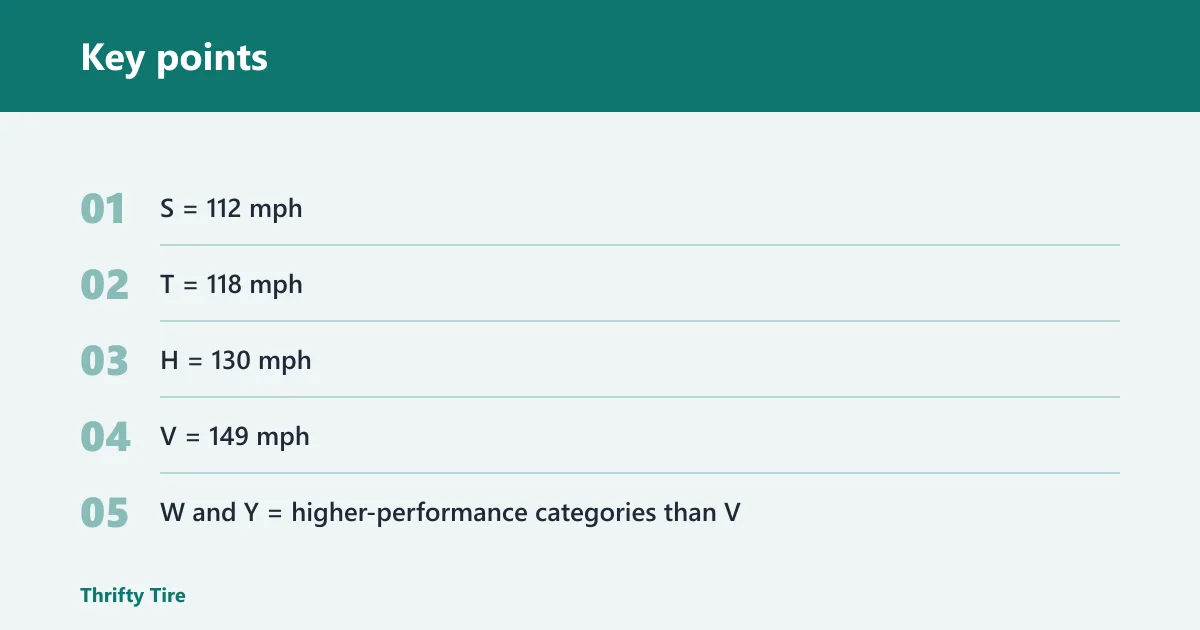
- S = 112 mph
- T = 118 mph
- H = 130 mph
- V = 149 mph
- W and Y = higher-performance categories than V
What you’ll need
- The tire sidewall, cleaned enough to read the markings
- A phone flashlight or good lighting
- The owner’s manual
- The driver’s side door-jamb placard
- Optional cross-check spots: glove box door and gas tank hatch
Find the sidewall service description
Look for the longest alphanumeric string on the sidewall. It usually sits near the tire size and includes slash marks, a rim diameter, a load index, and a final speed letter. Example formats include 205/60R15 91V and 225/65R17 102H.
The speed symbol is the last letter in that service description. The number before it is the load index. Keep those two separate.
Read mixed formats in order
- Find the size first, such as 225/45R17 or 245/40ZR18.
- Read the number after the size, such as 91 or 97; that is the load index.
- Read the final letter, such as W or Y; that is the speed symbol.
- Compare the full service description to the placard, not only the last letter.
Suppose a tire reads 225/45R17 91W. The speed symbol is W, but the load index is 91. If the placard calls for a different size or load index, the tire does not pass the fitment check even though the speed letter looks right.
Read the speed letter
Match the last letter to its mph value. H is listed as 130 mph, V as 149 mph, T as 118 mph, and S as 112 mph. These are capability figures, not a speed target for normal driving.
ZR markings need extra care. On older or high-speed tires, ZR can appear in the size, but the exact modern speed rating still comes from the full service description. Do not stop at ZR alone.
Why the load index matters too
The load index is the number before the speed letter. It describes load carrying capacity and must be read separately from speed rating. A tire can carry the right speed symbol and still miss the load requirement.
That matters when you replace only one tire or a pair. The new tire must match the axle or full-set specification the vehicle calls for.
Check the door placard and manual
The owner’s manual and the driver’s side doorjamb placard are the best cross-checks for recommended tire size, load, and inflation information. Other reference spots can include the glove box door and gas tank hatch, but the placard and manual should be your first stops.
Use the placard for vehicle-specific tire size and pressure. Use the manual to confirm the required service description when the tire sidewall is hard to read, worn, or different from what the vehicle should carry.
- Open the driver’s door and read the placard on the jamb.
- Write down the tire size, load, and pressure listed there.
- Check the owner’s manual for the same specification.
- Compare the service description on the tire sidewall with both sources.
- If the tire is damaged or worn smooth, inspect the spare or the remaining axle tire instead of guessing.
A common first-timer mistake is checking only the tire on the car after one replacement. If one tire says 94V and its mate on the axle says something different, the axle pair may no longer match the vehicle’s required spec.
Tire sidewall decoding checklist
This checklist shows where the speed symbol sits in real service descriptions, what each character means, and whether the marking can pass a placard check when the placard asks for the same size and rating family.
| Sidewall marking | Speed symbol location | What each character means | Placard match? |
|---|---|---|---|
| 205/60R15 91V | Final letter: V | 205 = width; 60 = aspect ratio; R = radial; 15 = rim diameter; 91 = load index; V = speed symbol | Pass if the placard calls for 205/60R15 91V |
| 225/65R17 102H | Final letter: H | 225 = width; 65 = aspect ratio; R = radial; 17 = rim diameter; 102 = load index; H = speed symbol | Pass if the placard calls for 225/65R17 102H |
| 225/50R16 89H | Final letter: H | 225 = width; 50 = aspect ratio; R = radial; 16 = rim diameter; 89 = load index; H = speed symbol | Pass if the placard calls for 225/50R16 89H |
| 215/55R17 94V | Final letter: V | 215 = width; 55 = aspect ratio; R = radial; 17 = rim diameter; 94 = load index; V = speed symbol | Pass if the placard calls for 215/55R17 94V |
| 245/40ZR18 97Y | Final letter: Y | 245 = width; 40 = aspect ratio; ZR = high-speed marking in the size; 18 = rim diameter; 97 = load index; Y = speed symbol | Pass if the placard calls for the same full service description |
Can you use a lower speed rating?
Sometimes, yes. Winter tires may carry a lower speed rating than original equipment, and that can be acceptable when you understand the limit and drive within it. The key is not the letter by itself; it is whether the full tire spec still fits the vehicle’s needs.
When replacing one tire or a pair, match the axle or the full set to the vehicle’s required specification. If a winter set is lower rated, keep the limit in mind and confirm the size, load index, and fitment on the placard and in the manual.
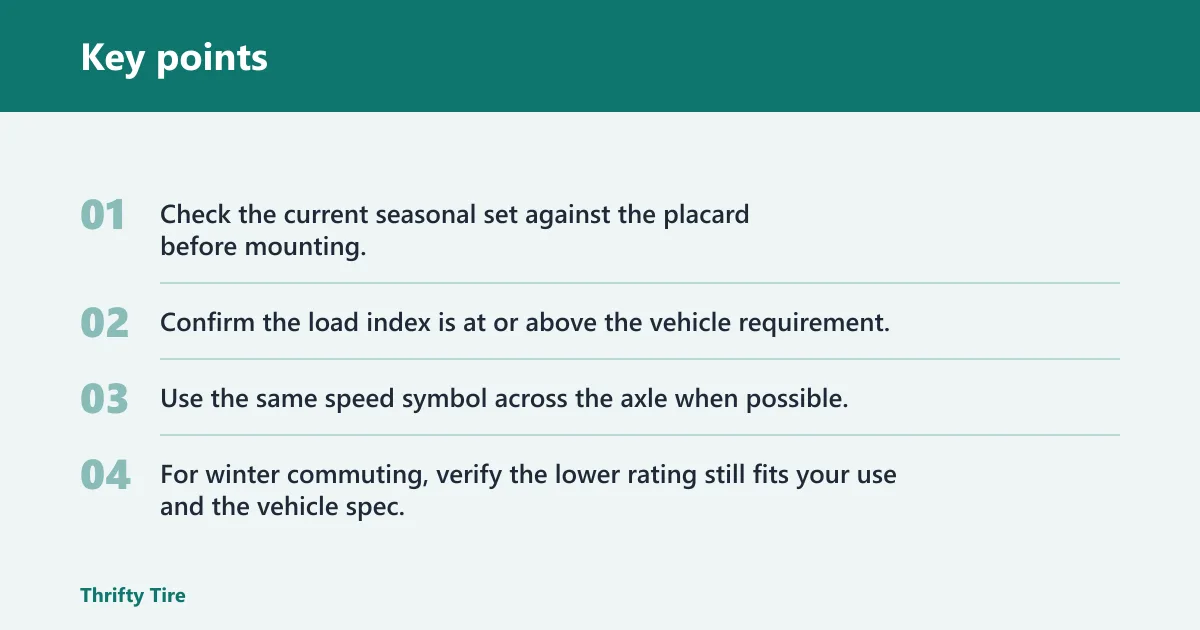
- Check the current seasonal set against the placard before mounting.
- Confirm the load index is at or above the vehicle requirement.
- Use the same speed symbol across the axle when possible.
- For winter commuting, verify the lower rating still fits your use and the vehicle spec.
Picture a commuter who swaps to winter tires marked H instead of the original V. That can be acceptable if the vehicle and tire maker allow it, but the driver still has to follow the lower limit and keep the rest of the service description aligned.
Common mistakes
People often read only the final letter and stop there. That misses the load index and can hide a size mismatch. Others trust a worn or damaged sidewall without checking the placard, which is risky when a previous owner changed the tires.
Another mistake is assuming a higher speed rating fixes fitment problems. It does not. A higher-rated tire can affect ride comfort, treadwear, and cornering ability, but it still has to fit the vehicle’s required size and load specs.
- Reading only the last letter: check the entire service description.
- Mixing up load index and speed symbol: the number comes first, the letter comes last.
- Trusting one tire only: compare both axle tires when replacing a pair.
- Ignoring the placard: the sidewall must agree with the vehicle’s spec.
Frequently asked questions
How do I find the speed rating on my tire?
Look for the last letter in the tire service description on the sidewall. For example, in 225/50R16 89H, the H is the speed symbol and the 89 is the load index. Then compare that full marking with the driver’s-side doorjamb placard.
How do I know the speed rating of my tires?
Check each tire sidewall and write down the full service description. The letter at the end is the speed rating, while the number before it is the load index. If the sidewall is hard to read, use the placard, glove box door, or gas tank hatch as a cross-check.
Where is the speed rating on the tire sidewall?
It appears at the end of the service description, right after the load index. On a marking such as 215/55R17 94V, the V is the speed symbol. The number 94 is the load index, so both need to be checked together.
What does the last letter on a tire size mean?
The last letter is the tire’s speed symbol. It gives the maximum speed capability under standardized conditions, not a permission slip to drive that fast. Use it with the size and load index, then verify the result against the placard and manual.
Where else can I find my tire speed rating besides the sidewall?
Check the owner’s manual and the driver’s side doorjamb placard first. Other reference spots can include the glove box door and gas tank hatch. Those sources help if the sidewall is dirty, worn, or on a replacement tire that does not match the vehicle.
Can I use a tire with a lower speed rating than stock?
Sometimes, especially with winter tires, but only if the full spec still works for the vehicle and the limit is understood. Confirm the load index, size, and vehicle recommendation before mounting. If you replace only one tire or one axle pair, keep the set consistent.