Coolant vs Water: What Should You Put in a Radiator?
Use the coolant specified in your owner’s manual. Plain water is only for a short emergency top-up, and you should correct the mix as soon as you can. The wrong fill can lead to overheating, corrosion, scale, and water-pump or heater damage. This guide shows when water is acceptable, when coolant is required, and how to restore the system correctly afterward.
| Decision factor | Coolant | water | Winner |
|---|---|---|---|
| Heat and freeze protection | Designed to raise boiling point and prevent freezing when mixed correctly. | Moves heat, but freezes at 0°C (32°F) and boils sooner than a proper mix. | Coolant |
| Corrosion protection | Contains corrosion inhibitors that protect aluminum, steel, seals, and soldered parts. | Lacks corrosion inhibitors, so it offers no long-term protection against rust and scale. | Coolant |
| Emergency use | Best for the system when the right mix is available. | Acceptable only as a temporary emergency stopgap. | Coolant |
| Short-term convenience | Usually ready to use if it matches the vehicle’s required type and mix. | Can be poured in quickly when you are stranded and need to move the car. | water |
| Long-term system health | Helps protect the water pump, thermostat, radiator, heater core, and hoses. | Can promote corrosion, deposit buildup, and cold-weather damage if left in place. | Coolant |
Coolant vs water
Coolant is the correct long-term fluid for most radiators. It is usually a 50/50 mix of glycol and water, and it includes corrosion inhibitors that help protect the cooling system. Water can move heat, but it cannot replace coolant for normal service, so treat it as a temporary emergency fill only. OEM owner’s manuals and coolant manufacturers’ tech sheets consistently point to the specified coolant chemistry and mix, not plain water, for normal operation.
What coolant is and why it is mixed with water
Antifreeze is the concentrate in the bottle; coolant is the diluted fluid that goes in the engine. The common coolant mix gives a practical balance of freeze protection, boil protection, and heat transfer. In very cold conditions, some guidance allows a stronger mix. That said, the owner’s manual remains the first source for the exact ratio and chemistry.
How plain water differs from coolant in a cooling system
Water can absorb heat, but it lacks the corrosion inhibitors found in coolant. That matters because the cooling system includes the radiator, water pump, thermostat, and internal metal passages that need protection from rust and deposits. Water also freezes at 0°C (32°F), which can damage parts if temperatures drop low enough. Service references commonly warn that mineral-bearing tap water can also leave scale deposits over time, which is why distilled water is preferred for mixing.
What antifreeze means on the bottle
Antifreeze is the concentrate that gets mixed with water to make coolant. On its own, it is not the final in-engine fluid for most vehicles. The bottle label matters because coolant types include IAT, OAT, HOAT, P-HOAT, Si-OAT, and NOAT, and color alone is not a reliable indicator of chemistry. Manufacturer technical documents and service guides note that color can vary by brand and formula, so chemistry and OEM approval matter more than appearance.
Picture a compact car that begins creeping toward the hot mark in traffic. If the reservoir is low and the owner’s manual calls for a specific coolant type, the right response is to use that coolant, not to guess from color or pour in a random bottle.
How do I know if I need coolant or just water?
If the engine is overheating, water can be a brief emergency measure. If the car is not overheating and you are simply topping off, use the coolant your owner’s manual specifies. In winter, or when the fluid type is unknown, coolant is usually the safer choice. Repeated low levels or visible leaks mean the system should be inspected.
Quick checklist
- Overheating emergency: use water only long enough to reach safety.
- Normal top-off: use the correct coolant, not plain water.
- Winter weather: use coolant with the proper freeze protection.
- Unknown fluid: identify the required coolant chemistry before adding anything.
- Leak symptoms: repeated top-offs, smell, steam, or puddles point to inspection.
What to add to a radiator right now
Start with the owner’s manual. It gives the exact coolant specification, capacity, and mix guidance for your vehicle. If you are topping up in a hurry and the manual is unavailable, a 50/50 mix is a common starting point, but the coolant type still has to match the car. When the radiator is empty or the reservoir is very low, the right choice depends on whether this is a normal refill, an emergency, or an unknown-fluid situation.
| Situation | Safe top-up choice | How long it is acceptable | Next step |
|---|---|---|---|
| Overheating emergency | water | Just long enough to get the vehicle to a safe place or repair shop | Let the engine cool, then refill with the correct coolant mix |
| Radiator empty | Coolant | Only after the engine is cool and the correct chemistry is known | Refill with the specified coolant and verify there is no leak |
| Reservoir low but not overheating | Coolant | Long term, if it matches the owner’s manual | Check the reservoir level and keep it between MIN and MAX/FULL |
| Unknown coolant type | Coolant | Only after identifying the correct type in the manual | Do not guess from color; confirm the chemistry first |
| Freezing forecast | Coolant | Long term | Use the specified mix before freezing temperatures arrive |
| Repeated top-offs | Coolant | Temporary top-up only until the leak is found | Inspect for leaks and do not treat repeated top-offs as normal |
| Post-emergency flush/refill timing | Coolant | As soon as practical after the emergency drive | Drain the temporary water and restore the correct mix |
Use the owner’s manual first
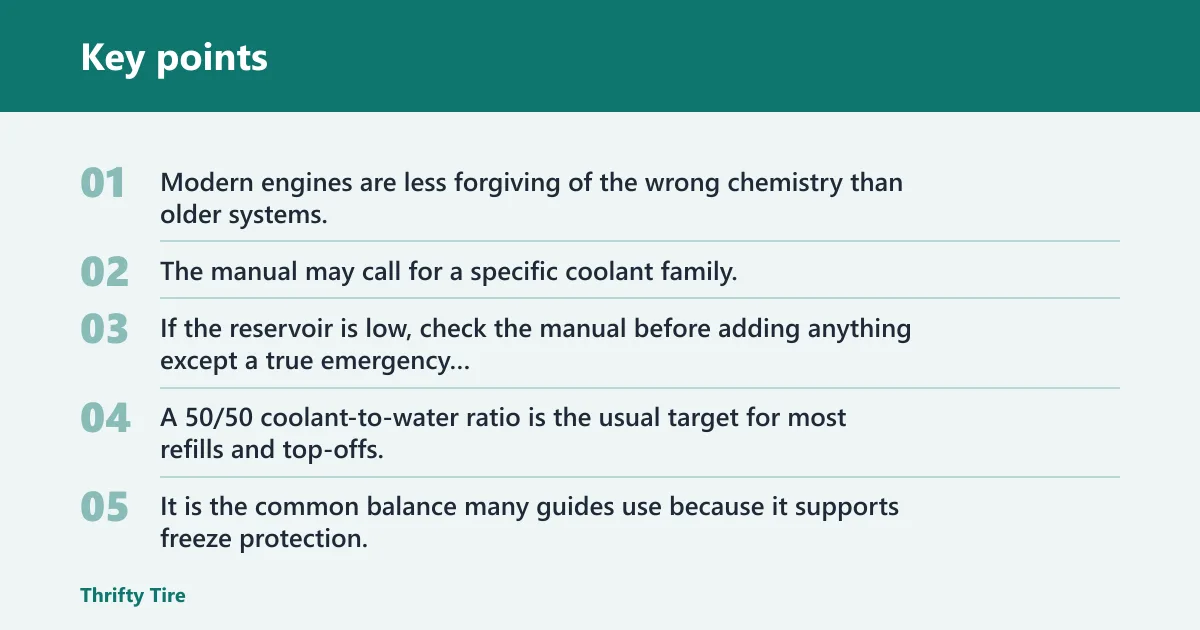
Modern engines are less forgiving of the wrong chemistry than older systems. The manual may call for a specific coolant family, and that choice can matter more than the color of the fluid already in the system. If the reservoir is low, check the manual before adding anything except a true emergency fill.
When a 50/50 mix is the usual target
A 50/50 coolant-to-water ratio is the usual target for most refills and top-offs. It is the common balance many guides use because it supports freeze protection, boiling resistance, and corrosion control at the same time. Straight coolant is not the default fill, because the engine needs water in the final mix for proper heat transfer. Manufacturer guidance commonly treats 50/50 as the practical baseline unless the vehicle or climate requires something different.
When distilled water is acceptable for mixing or rinsing
Distilled water is sometimes used with coolant for mixing, rinsing, or filling guidance because it avoids the minerals found in tap water. Service references prefer distilled water over tap water because minerals can contribute to deposits and scale inside the cooling system. That said, it is still only water. It can help as a mixing ingredient or a temporary emergency top-up, but it should not stay in the system as the long-term fill.
Radiator decision table
This table gives a practical choice for the situation in front of you. It separates emergency use from normal service so you can avoid the two common mistakes: overusing water and using the wrong coolant type.
| Situation | Safe top-up choice | How long it is acceptable | Next step |
|---|---|---|---|
| Overheating emergency | water | Just long enough to get the vehicle to a safe place or repair shop | Let the engine cool, then refill with the correct coolant mix |
| Normal top-off | Coolant | Long term, if it matches the owner’s manual | Check the reservoir level and keep it between MIN and MAX/FULL |
| Winter weather | Coolant | Long term | Use the specified mix before freezing temperatures arrive |
| Unknown existing fluid | Coolant | Only after identifying the correct type in the manual | Do not guess from color; confirm the chemistry first |
| Repeated coolant loss | Coolant | Temporary top-up only until the leak is found | Inspect for leaks and do not treat repeated top-offs as normal |
Overheating emergency
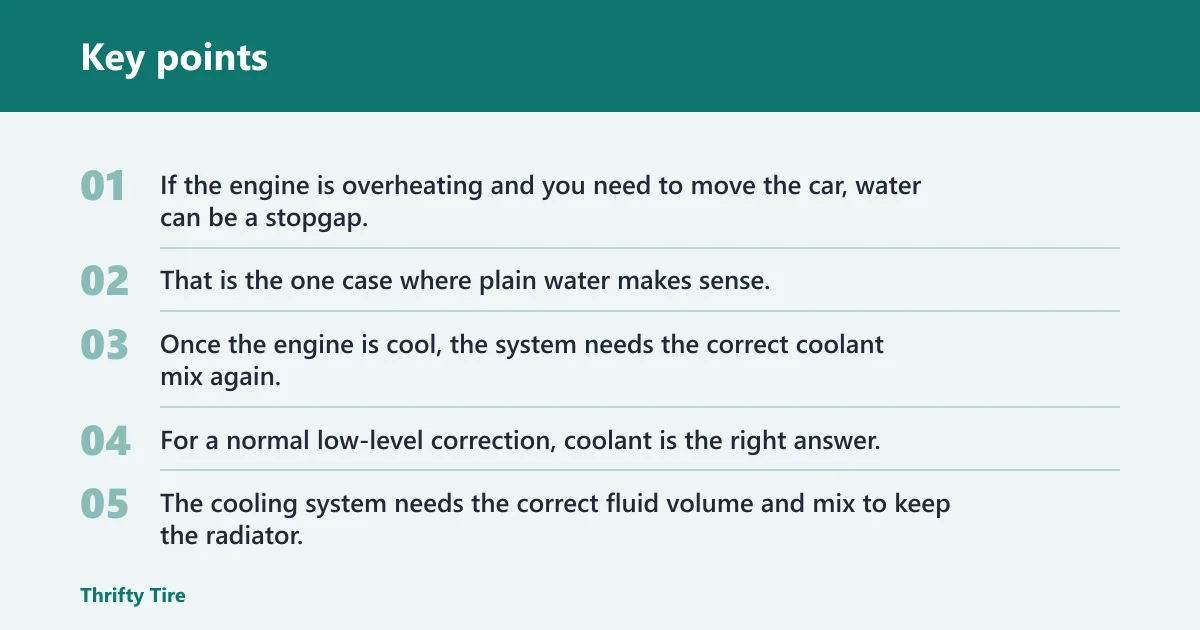
If the engine is overheating and you need to move the car, water can be a stopgap. That is the one case where plain water makes sense, because moving the vehicle safely comes first. Once the engine is cool, the system needs the correct coolant mix again.
Normal top-off
For a normal low-level correction, coolant is the right answer. The cooling system needs the correct fluid volume and mix to keep the radiator, water pump, thermostat, and heater circuit working as designed. If you are only adding a little, a proper coolant top-up is still the better choice.
Winter weather
In cold weather, coolant is mandatory for routine service. Plain water freezes at 0°C (32°F), so an all-water fill can create a cracked radiator, damaged hoses, or a stressed water pump if temperatures drop far enough. The colder the forecast, the less room there is for improvisation.
Unknown existing fluid
If you do not know what is already in the system, do not rely on color. Color is not a reliable indicator of coolant chemistry, and mixing the wrong formulas can create compatibility problems. Check the owner’s manual, identify the required coolant family, and use that as your guide.
Repeated coolant loss
Frequent top-ups are not normal. They usually point to a leak, a bad cap, a damaged hose, a seep at the radiator, or another fault in the cooling system. Top-offs can buy time, but they do not fix the underlying issue.
Can you add water in an emergency?
Yes, but only as a temporary emergency stopgap. If the reservoir is low and the engine is hot, use the reservoir only if you can do so without opening the radiator cap; wait until the engine cools before adding anything directly to the radiator. Water can help prevent immediate damage or get you to a repair location, but the radiator cap should stay closed until the system is cool enough to service safely.
How long plain water is acceptable?
Plain water is acceptable only for the shortest practical window: long enough to get the vehicle off the road, home, or to a shop. It should not stay in the system through winter, and it should not become the normal fill after a repair. The sooner you correct it, the better.
What to do before the next drive
If you only need to bring the level up in the overflow reservoir, add fluid there with the engine cool. If the radiator itself needs to be filled, let the radiator cool fully before opening the cap. Never crack a hot cap open, because pressure and steam can cause a burn. Check the reservoir afterward and keep the level between MIN and MAX/FULL, not above it, because overfilling can make coolant vent out and spill.
Why emergency water is temporary only
Water lacks corrosion inhibitors and does not protect the system the way coolant does. Left in place, it can lead to rust, scale, heater problems, and water-pump wear. It also gives up freeze protection, which makes cold-weather damage more likely.
How much coolant should you use?
A 50/50 mix is the usual starting ratio because it gives a practical balance of cooling, freeze protection, and boiling resistance. That ratio is a rule of thumb, not a substitute for the owner’s manual. Some vehicles or climates call for a different mix, but straight coolant is still not the default fill.
Why 50/50 is the usual starting ratio
At 50/50, coolant usually provides the protection most drivers need without reducing heat transfer too far. It is common in top-offs and refills because it is simple, widely recommended, and compatible with many systems when it matches the vehicle specification. For most drivers, it is the best starting point.
When a different mix may be specified
Some manuals allow a different ratio for severe cold. That kind of adjustment is about climate and specification, not guesswork. If the manual gives a precise mix, follow that instead of a generic target.
Why straight coolant is not the default fill
Straight coolant is too concentrated for normal use in most systems. The engine needs water in the final mixture for proper heat transfer, and coolant depends on dilution to do its job correctly. Antifreeze on its own is the concentrate; the diluted fluid is what belongs in the engine.
Suppose a pickup loses a small amount of fluid after a hose clamp loosens on a cold morning. The right fix is not to fill the reservoir to the top or guess at a random bottle. It is to add the correct coolant mix, keep the level between the marks, and verify the leak did not return.
What happens after water goes in?
After an emergency water fill, the system needs follow-up. Check the reservoir when the engine is cold, confirm the level sits between MIN and MAX/FULL, and plan to restore the correct coolant concentration as soon as possible. If the engine overheated, inspect for leaks or damage before regular driving resumes.
How to check the reservoir level when the engine is cold
Wait until the engine is fully cool, then inspect the coolant reservoir. When the engine is cold, the coolant reservoir level should typically sit between the MIN and MAX/FULL marks. Do not overfill the tank, because extra fluid can vent out and spill as the system heats up.
What to do after adding water
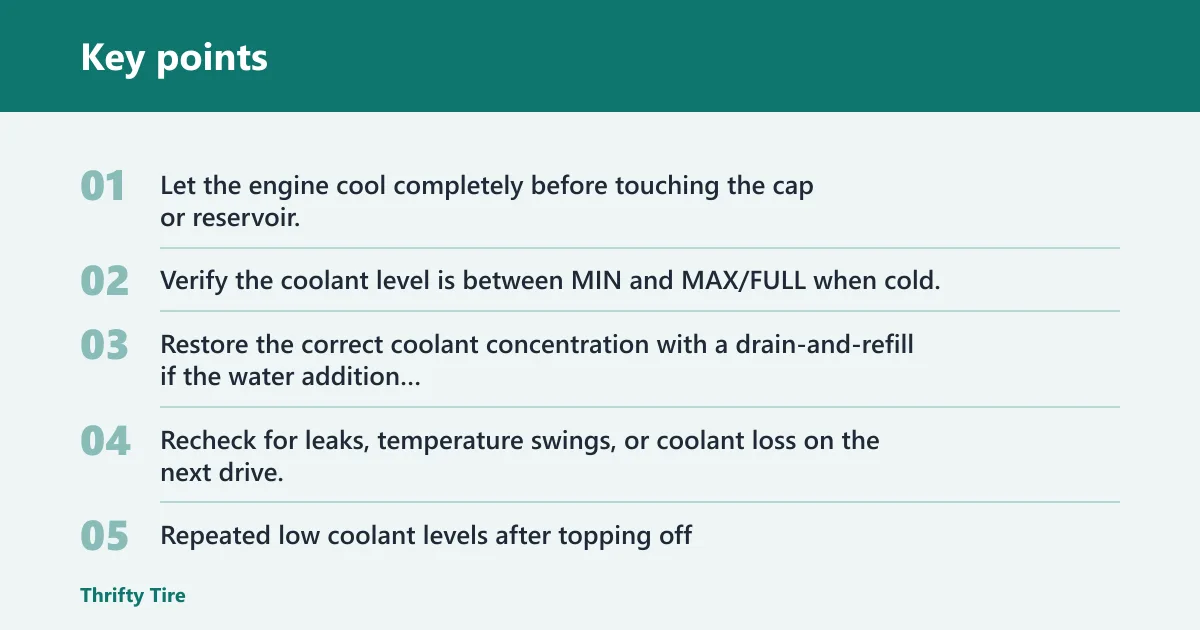
- Let the engine cool completely before touching the cap or reservoir.
- Verify the coolant level is between MIN and MAX/FULL when cold.
- Restore the correct coolant concentration with a drain-and-refill if the water addition was substantial or the fluid is otherwise due for service.
- Recheck for leaks, temperature swings, or coolant loss on the next drive.
When to drain and refill with proper coolant
If you added plain water for an emergency, correct the mixture as soon as practical. A simple concentration correction is appropriate when the system only took a small temporary water top-up; a full flush and refill is the better next step if the coolant is old, contaminated, or the wrong type, or if the manual calls for it. That is especially important before freezing weather or after a major top-up. The owner’s manual should guide the exact mix.
Signs you need inspection
- Repeated low coolant levels after topping off
- Sweet coolant smell near the engine or inside the cabin
- Puddles, drips, or dried residue under the car
- Temperature gauge creeping up or fluctuating
- Steam from the hood or visible coolant spray
- Heater output that becomes weak or inconsistent
Signs the cooling system needs inspection
Watch for repeated low levels, coolant smell, visible leaks, temperature gauge movement, or heater performance that changes unexpectedly. Those symptoms suggest the cooling system is not holding fluid or is not circulating it properly. The problem may involve the radiator, water pump, thermostat, fan, overflow hose, or another component.
Choose coolant if…
Choose coolant for normal service, winter weather, unknown fluid, or any refill you expect to keep in the car. It is the correct long-term choice because it protects against overheating, freezing, corrosion, and rust. If the owner’s manual specifies a certain type, match it exactly.
Choose water if…
Choose water only when you need a temporary emergency top-up to keep the car from overheating long enough to get to safety. Use it as a stopgap, not a permanent fill. Then replace it with the proper coolant mix and check for the reason the system was low.
Frequently asked questions
Can I put water in my radiator instead of coolant?
Only for a short emergency. Water can move heat, but it lacks corrosion inhibitors and freezes at 0°C (32°F), so it is not an adequate long-term substitute for coolant. If you use it to get off the road, replace it with the correct coolant mix as soon as the engine is cool.
Is distilled water okay to use instead of coolant?
Distilled water is better than mineralized tap water for mixing or rinsing because it avoids extra minerals, but it is still not coolant. It can be used temporarily in an emergency, or as part of a proper mix, yet it should not remain the final fluid in the system.
How long can I drive with water in the radiator?
Only long enough to reach a safe location or repair shop. That means a short, necessary drive rather than routine use. Once the engine cools, the system should be corrected with the proper coolant mixture, especially before cold weather or extended driving.
What happens if I use plain water in my cooling system?
Plain water can leave the system unprotected against rust, scale, and freezing. It may also contribute to overheating sooner than a correct coolant mix and can shorten the life of parts such as the radiator, water pump, thermostat, heater core, and hoses.
Should I use 50/50 coolant or straight coolant?
For most vehicles, a 50/50 coolant-to-water mix is the usual starting point. Straight coolant is not the default fill because the engine needs water in the final mixture for proper heat transfer. Follow the owner’s manual if it specifies a different ratio or coolant type.
What should I do after I add water to the radiator?
Let the engine cool, recheck the reservoir level, and plan to replace the water with the correct coolant mix as soon as possible. If the level drops again, inspect for leaks instead of topping off repeatedly. Frequent loss usually means the cooling system needs attention.
Sources
- Bosch Auto Parts — Coolants 101
- Prestone — What is the correct coolant/water ratio?
- PEAK Auto — What is Antifreeze/Coolant?
- Valvoline Global — Engine cooling systems guidance
- Vehicle Service Pros — Coolant color is not a reliable indicator of chemistry
- AAA — How to check your coolant