Load Index Chart: How Much Weight Each Number Means
Use the load index chart to match the number on your tire sidewall to its maximum load at the listed pressure, and choose a tire with a load index at least as high as your vehicle’s heaviest axle load requires. A tire with too little load capacity can run hotter, wear faster, and fail when loaded with passengers, cargo, or towing weight. This guide explains the chart, how to convert the number to pounds, and how to check vehicle weight, cargo, towing, and pressure before you buy.
Quick answer
A load index is a sidewall number that indicates the maximum load capacity of a tire at a specified inflation pressure and speed condition. You read it per tire, not per axle. The number matters because the same tire size can be sold with different load capacities.
That is why the code alone is not enough for fitment. You also need the vehicle’s weight limits, the tire’s speed rating, and the inflation pressure the tire is meant to run. Load capacity can change when those conditions change.
Where to find the load index on a tire sidewall
The load index sits in the tire size and service description on the sidewall. It usually appears after the tire size and construction code, then beside the speed code. Continental’s example marking 225/45 R 18 95 H shows the pattern clearly: tire size first, then load index, then speed rating.
Read the full marking, not only the number. The size, construction, load index, and speed code belong together. If a tire size changes, the load index may change too. That is one reason a size upgrade can be safe in one case and wrong in another.
Use this as a quick conversion table for common passenger-car load index numbers. It is a lookup aid, not a substitute for the exact tire data sheet.
| Load index | Maximum load | Decision note |
|---|---|---|
| 65 | 290 kg / 639 lb | Marginal for compact cars |
| 80 | 450 kg / 992 lb | Common for small and compact passenger cars |
| 90 | 600 kg / 1,323 lb | Common for midsize sedans |
| 100 | 800 kg / 1,764 lb | Often used on heavier passenger vehicles |
| 108 | 1000 kg / 2,205 lb | Often used on SUVs and vans |
Use the band notes as a starting point only. A tire with a higher index is not automatically the right choice, and a tire with the right index still has to fit the wheel, the vehicle, and the inflation recommendation.
How much weight can tire load index 80 carry?
Load index 80 can support 450 kg, which is 992 lb. That figure is the number you use when you convert the code on the sidewall into a capacity check. It is one tire’s rating under the stated conditions, not the vehicle’s total capacity.
Check more than the number alone. Compare that tire’s rating with the vehicle placard, the heaviest axle load, and the expected pressure. A tire that meets the chart but is run at the wrong pressure may not carry its intended load safely.
Say your front axle is carrying more weight because of an engine, passengers, and a full cargo area. A tire marked 80 may still be acceptable if the axle load divided across the two front tires stays within the tire’s working limit and the pressure matches the placard. If not, the tire is too light for the job.
How to know what load index your car needs
Start with the tire placard and the owner’s manual. The placard gives you the recommended tire size and cold inflation pressure, and it points you toward the load capacity the vehicle expects. Then compare the load index of all four tires combined with the vehicle’s GVWR and the axle limits.
GVWR is the maximum allowed weight of the vehicle itself, passengers, cargo, and fuel. If the combined tire capacity is too low, the tires can become the weak link even if the vehicle is not overloaded on paper. Add passengers, luggage, roof cargo, and towing load before deciding. (Wikipedia)
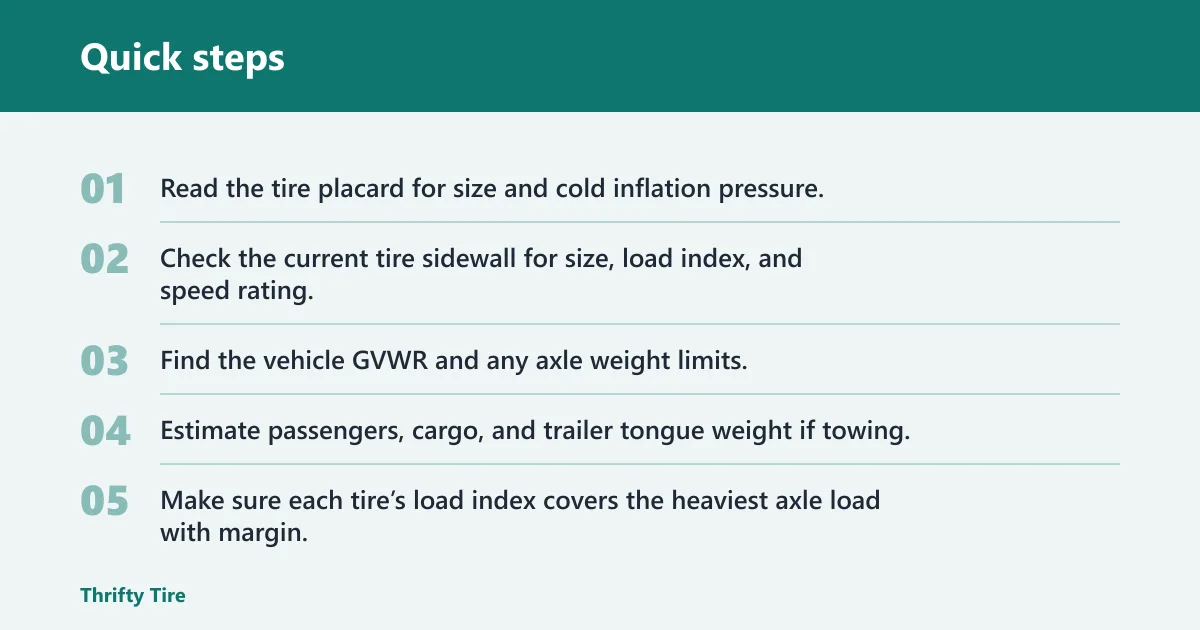
- Read the tire placard for size and cold inflation pressure.
- Check the current tire sidewall for size, load index, and speed rating.
- Find the vehicle GVWR and any axle weight limits.
- Estimate passengers, cargo, and trailer tongue weight if towing.
- Make sure each tire’s load index covers the heaviest axle load with margin.
Suppose a midsize sedan is carrying five people and a full trunk for a trip. The rear axle load may rise enough that a tire that looked fine for daily commuting no longer leaves much reserve. That is the moment to compare the placard, not guess from size alone.
Load index and speed rating
The speed rating is the letter code paired with the load index. It tells you the maximum speed the tire is designed to handle under specified conditions. Kwik Fit says load ratings should be compared with speed ratings when buying new tires.
This pairing matters because load capacity can change with speed conditions. A tire that looks acceptable at one speed rating may not keep the same load-carrying margin if the speed code changes. Keep both ratings aligned with the vehicle’s needs.
Do not treat the speed code as a footnote. A tire marked for a certain load index still has to be used within the conditions attached to its speed rating, especially when the vehicle is carrying passengers, cargo, or towing weight for long distances.
Inflation pressure and safe load carrying
Inflation pressure changes how much weight a tire can safely carry. Too little pressure increases heat and flexing. Too much pressure can reduce the contact patch and raise impact risk. The pressure on the door placard is part of the load calculation, not a separate detail.
That is why a load index chart cannot stand on its own. The same load index can behave differently if the tire is underinflated, overinflated, or used at a speed condition outside the rating. Always check cold pressure before loading the vehicle.
A common first-timer mistake is assuming a higher pressure always means more safety. It does not. If the pressure is above the placard by a wide margin, ride quality drops and the tire is more exposed to pothole damage, even if the sidewall number looks strong.
Can you use a higher load index than stock?
Yes, a higher load index is often acceptable if the tire size, wheel fitment, pressure range, and speed rating still match the vehicle. It can give you more capacity margin, which is useful when you regularly carry heavy cargo or tow. It is not a fix for the wrong size or wrong pressure.
Higher load index does not automatically mean better fitment. Some tires with a higher index also have stiffer construction, different ride feel, or a different pressure requirement. If the tire size changes at the same time, check the full marking and the placard together.
One common mismatch is moving to a larger tire size and ending up with a lower load index than the original tire. Another is choosing a strong-sounding load number while ignoring the speed code or the recommended pressure. Both can create a false sense of margin.
OTR service descriptions
Off-the-road tires use combined load and speed service descriptions such as 185B and 201A2. That format is handled differently from passenger-car load index charts. The rating depends on the service description and the speed condition tied to it.
Do not translate an OTR marking with a passenger-car chart. The math and use case are different. If you are working with OTR equipment, use the exact tire data sheet for that service description instead of assuming a passenger code applies.
What happens if you pick a tire with too low a load index?
If the load index is too low, the tire may run hotter, flex more, wear faster, and fail under load. The risk rises when the vehicle is full of passengers, carrying cargo, or towing. A tire that is already near its limit has less reserve for bumps, cornering, and braking.
That failure can show up as accelerated shoulder wear, abnormal heat, sidewall stress, or a blowout in severe cases. The problem is not limited to long highway runs. Short trips with a heavy vehicle and low pressure can also push a tire beyond its safe range.
Frequently asked questions
What does a tire load index number mean?
The load index number is a code for maximum load capacity per tire under specified conditions. It is not a vehicle weight rating by itself. You still need the placard, the axle load, the speed rating, and the inflation pressure to know whether the tire is correct for the vehicle.
Where do I find the load index on a tire sidewall?
Find it in the full sidewall marking beside the tire size and speed code. A marking like 225/45 R 18 95 H shows the load index between the size and the speed rating. The exact layout may vary slightly, but the code is always on the sidewall.
How do I know what load index my car needs?
Use the tire placard first, then compare the tire’s load index with the vehicle’s GVWR and axle loads. Add passengers, cargo, and towing weight to the calculation. Choose a tire whose load index covers the heaviest axle with enough margin at the correct pressure.
Can I use a tire with a higher load index than stock?
Often yes, as long as the size, wheel, pressure range, and speed rating still fit the vehicle. A higher index can add reserve capacity, but it does not fix a wrong tire size or poor inflation. Check the full sidewall marking and the placard together before buying.
What is the difference between load index and speed rating?
The load index tells you how much weight a tire can carry under specified conditions. The speed rating tells you the maximum speed the tire is designed for under its tested conditions. The two codes work together, and the load rating can change with speed conditions.
Does load index mean per tire or per axle?
It means per tire. For fitment, you then consider the four tires combined against the vehicle’s GVWR and the axle loads. That is why a tire that looks fine on a chart can still be wrong if one axle carries more weight than expected.