DOT 3 vs DOT 4 Brake Fluid: Can You Mix Them?
Yes. DOT 3 and DOT 4 are both glycol-ether based brake fluids, so they are generally compatible by chemistry in a non-silicone system. Even so, the correct long-term fill should match the reservoir cap or owner’s manual, because mixing can lower the system’s heat margin and push brake performance toward the lower-spec side.
Emergency roadside checklist: what to do if the reservoir is low
If the brake-fluid level is low, the safe order is simple: verify the cap/manual, top up only enough to keep the reservoir above minimum, avoid mixing in silicone DOT 5, and plan a proper service soon. If the fluid is dark, the pedal feels spongy, or the fluid type is unknown, treat it as a service-now issue rather than a simple top-up.
If the cap says DOT 3 or DOT 4
Use the fluid specified on the cap when possible. If you are stranded and only have a compatible glycol-ether fluid, a short-term top-up is better than letting the master cylinder run low. Then schedule a flush that restores the system to the manufacturer’s specified fill.
If you do not know what is already in the reservoir
Do not guess. Unknown fluid history is the biggest compatibility risk because DOT 5 silicone fluid should not be mixed with glycol-ether fluids. If the level is not critically low, wait for the correct fluid and a proper service rather than introducing a mixture you cannot verify.
If the pedal feels soft or the fluid looks dark
That is a warning sign, not just a low-level problem. Soft pedal feel can point to moisture, air, or degraded fluid, and dark fluid often means the fluid has aged or absorbed contaminants. In that case, a flush is the right next step, not repeated topping-off.
DOT 3 vs DOT 4 at a glance
DOT 3 and DOT 4 both belong to the glycol-ether family used in hydraulic brake and clutch systems, and both are covered by FMVSS 116 classifications. DOT 4 has the higher minimum boiling-point class, so it provides more heat margin in repeated braking, but the vehicle’s cap or manual still decides the correct long-term fill.
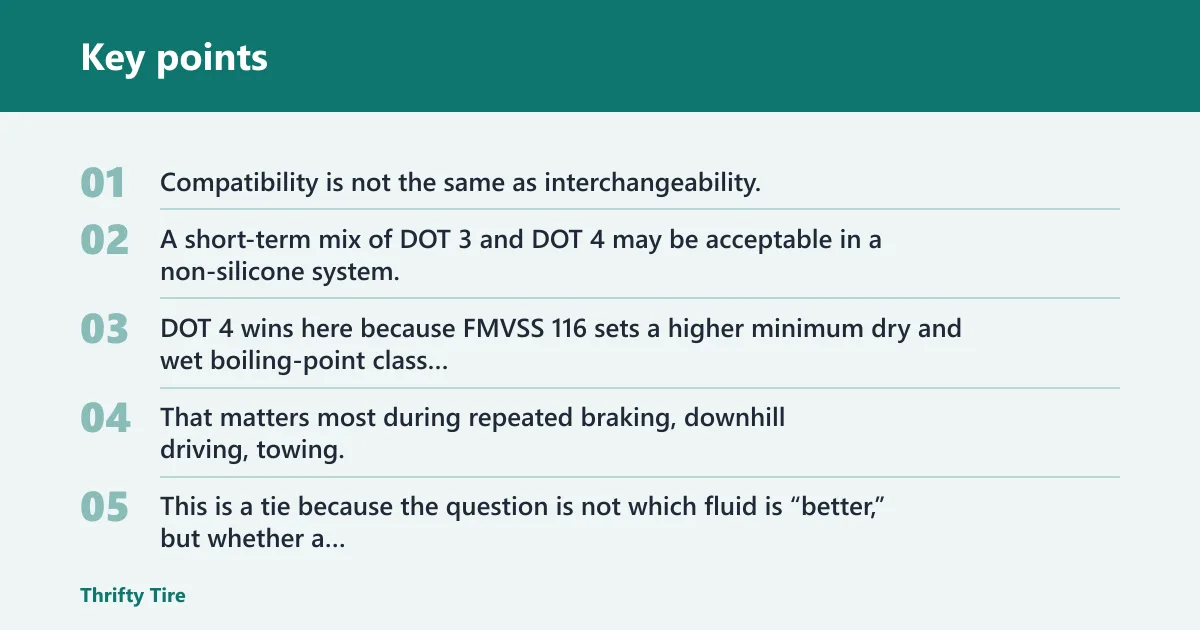
Compatibility is not the same as interchangeability. A short-term mix of DOT 3 and DOT 4 may be acceptable in a non-silicone system, but a mixed reservoir should be treated as a temporary compromise and serviced back to the specified fluid type.
| Factor | DOT 3 | DOT 4 | Winner |
|---|---|---|---|
| Heat margin | Lower minimum boiling-point class under FMVSS 116 | Higher minimum boiling-point class under FMVSS 116 | DOT 4 |
| Emergency top-up compatibility | Can coexist short term with some DOT 4 products in non-silicone systems | Can coexist short term with some DOT 3 products in non-silicone systems | Tie |
| Long-term service fit | Best when the vehicle spec calls for DOT 3 | Best when the vehicle spec calls for DOT 4 | Tie |
| Boiling-point reserve after mixing | May leave less reserve if the system was designed around DOT 4 | Usually the safer direction if the system already uses DOT 4 | DOT 4 |
| Specification labeling | Often marked FMVSS 116 and SAE J1703 on product specs | Often marked FMVSS 116 DOT 4 and may also reference SAE J1704 on product specs | DOT 4 |
Heat margin
DOT 4 wins here because FMVSS 116 sets a higher minimum dry and wet boiling-point class for DOT 4 than for DOT 3. That matters most during repeated braking, downhill driving, towing, or stop-and-go heat soak, when fluid temperature can rise enough to reduce braking consistency.
Emergency top-up compatibility
This is a tie because the question is not which fluid is “better,” but whether a short-term mix is acceptable in a non-silicone system. In that narrow case, both directions can work if the fluid is glycol-ether based and you are only adding enough to keep the reservoir from running dry.
Long-term service fit
Neither side wins outright because the correct long-term fill is the one named on the cap or in the owner’s manual. DOT 3 is correct for some systems, DOT 4 for others, and the manufacturer’s service spec should settle the final choice even when a roadside top-up was possible.
Boiling-point reserve after mixing
DOT 4 has the edge if the system is already built around it, because adding DOT 3 can reduce the heat reserve the system was designed to have. A mixed fill effectively defaults to the lower-performance side in the areas that matter most under heat, so the mix should be treated as temporary.
Specification labeling
Product labeling matters more than marketing copy. Look for FMVSS 116, and check whether the product lists DOT 3, DOT 4, or the related SAE references such as SAE J1703 and SAE J1704, because those markings are the clearest clue to the fluid’s intended class.
Can you mix DOT 3 and DOT 4?
Yes, usually in a non-silicone hydraulic system. DOT 3 and DOT 4 are glycol-ether based and generally compatible by chemistry, but they are not identical-performance fluids. The safe reading is temporary compatibility, not permanent interchangeability, and the system should later be serviced with the fluid type specified by the manufacturer.
That matters because a mixed reservoir can still function, but it may not keep the same boiling-point reserve the vehicle had before the top-up. If the fluid level is low enough that you need a large refill, or the fluid history is unknown, a flush is safer than assuming the mix will be fine long term.
Emergency top-up versus long-term fill
If the reservoir is low and you need to drive, topping up with the closest compatible glycol-ether fluid is usually better than letting the master cylinder run low or dry. Once the immediate problem is handled, schedule a proper service that restores the system to the exact fluid spec on the cap or in the manual.
Say the reservoir sits just below the minimum line after brake-pad wear. A small DOT 3 top-up into a DOT 4 system can keep the car mobile for the trip home, but it should still be followed by a full fluid service if the manual calls for DOT 4.
What happens after the mix
The main change is performance margin, not instant failure. A mixed fill may still stop the vehicle normally, but the system can reach boil sooner under repeated braking because the blend may not match the higher-spec reserve you expected from the original fill.
That is why the practical question is not “Will it work at all?” but “How much heat margin do you still have?” If you drive in mountains, tow, or spend time on long descents, the long-term choice should be a flush back to the specified fluid.
When to plan a flush
Plan a flush when the fluid is old, dark, contaminated, or the system already has unknown history. Also plan one if the pedal feels spongy, if the vehicle sees heavy heat load, or if the current fluid type is uncertain and the cap or manual does not settle it.
Brake fluid compatibility table
Use this table as a decision tool, not a substitute for the cap or manual. The goal is to decide whether you can top up now, should service later, or need attention right away. For primary-spec context, FMVSS 116 defines the minimum boiling-point classes, while SAE J1703 and SAE J1704 are commonly referenced product standards for glycol-based brake fluids.
| Current fluid type | Topping up option | Acceptable short-term action | Recommended long-term action | Red-flag conditions |
|---|---|---|---|---|
| Known DOT 3, non-silicone | DOT 3 preferred; DOT 4 acceptable only as a short-term top-up if the manual allows glycol compatibility | Top up enough to keep the reservoir above minimum | Refill with the specified fluid at the next service | Unknown fluid history, dark fluid, spongy pedal, overheating use |
| Known DOT 4, non-silicone | DOT 4 preferred; DOT 3 acceptable only as a short-term top-up in an emergency | Top up enough to prevent the reservoir from running dry | Flush to the correct DOT 4 fill if that is the vehicle spec | Unknown fluid history, dark fluid, spongy pedal, overheating use |
| Known DOT 5.1, non-silicone | Only compatible glycol-based fluid that the product label allows | Top up only if the label specifically permits it | Service to the stated spec soon | Any silicone fluid, mixed unknown products, dark fluid, spongy pedal |
| Unknown fluid | Do not guess | Service now if possible; avoid adding unless needed to prevent damage | Flush and refill to the correct spec | Silicone fluid history, spongy pedal, contamination, overheating use |
How to read the table
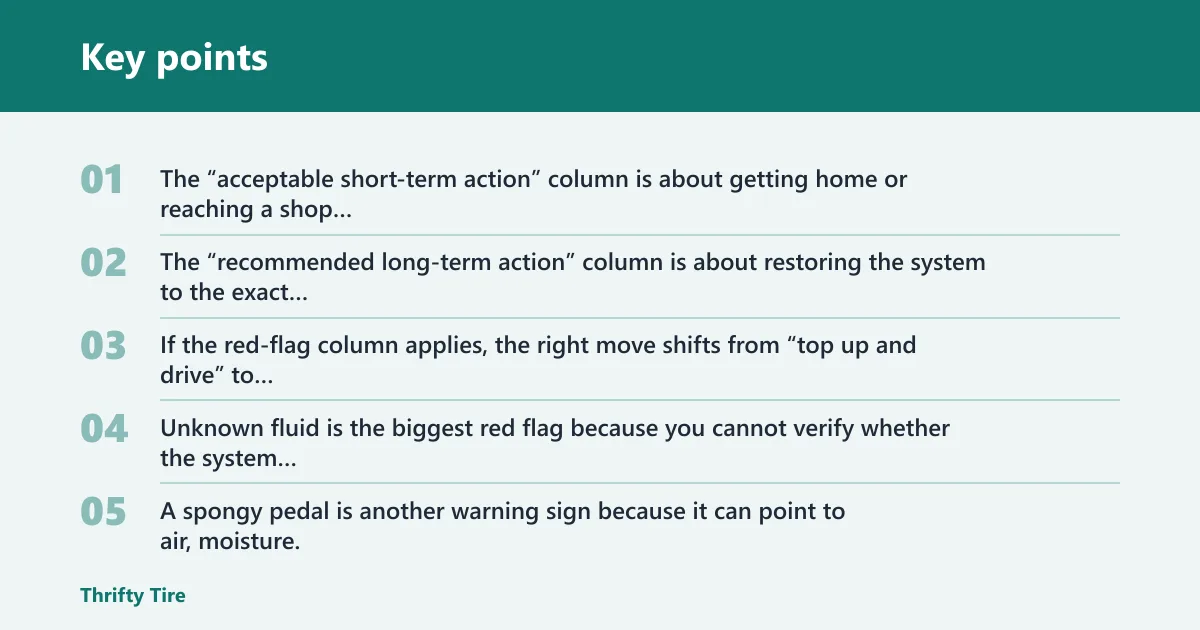
The “acceptable short-term action” column is about getting home or reaching a shop without letting the reservoir run dry. The “recommended long-term action” column is about restoring the system to the exact fluid the vehicle expects, which is why the cap and manual still outrank any shelf label.
If the red-flag column applies, the right move shifts from “top up and drive” to “service now.” Dark fluid, a soft pedal, or unknown fluid history are all signs that condition matters more than compatibility.
Red-flag conditions that mean service now
Unknown fluid is the biggest red flag because you cannot verify whether the system already contains silicone fluid or a mixed history. A spongy pedal is another warning sign because it can point to air, moisture, or degraded fluid rather than a simple low-level problem.
Dark or contaminated fluid usually means the fluid has absorbed moisture or picked up debris, and overheating use raises the odds that the fluid is being asked to do more than its current condition can handle. In those cases, a flush is safer than a top-up-only fix.
What boiling point changes mean
Boiling point is where brake fluid starts turning to vapor under heat. Dry boiling point describes fresh fluid; wet boiling point describes fluid after it has absorbed moisture, which is the more realistic condition for an in-service system. FMVSS 116 sets minimum dry and wet boiling points for DOT 3, DOT 4, DOT 5, and DOT 5.1, so the comparison below uses those minimums rather than brand example numbers.
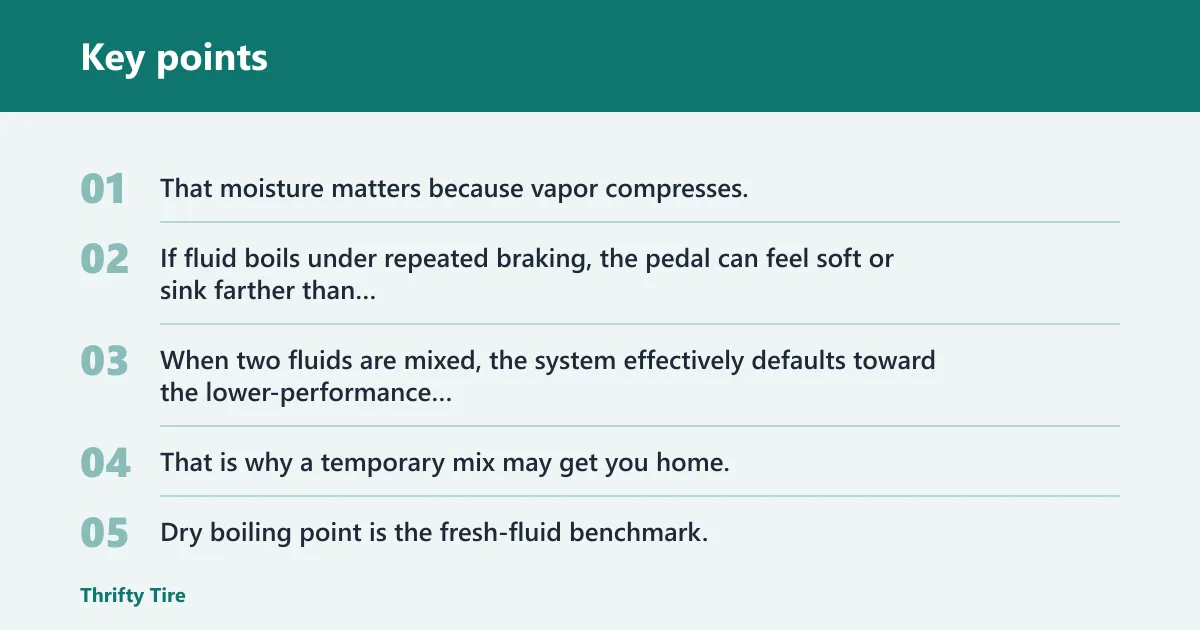
That moisture matters because vapor compresses. If fluid boils under repeated braking, the pedal can feel soft or sink farther than expected, and brake fade becomes more likely.
| FMVSS 116 class | Base chemistry | Minimum dry boiling point | Minimum wet boiling point | Mixing note |
|---|---|---|---|---|
| DOT 3 | Glycol-ether based | 205 °C | 140 °C | Generally compatible with DOT 4 and DOT 5.1 in non-silicone systems |
| DOT 4 | Glycol-ether based | 230 °C | 155 °C | Generally compatible with DOT 3 and DOT 5.1 in non-silicone systems |
| DOT 5 | Silicone based | 260 °C | 180 °C | Not mixable with glycol-ether DOT 3, DOT 4, or DOT 5.1 |
| DOT 5.1 | Glycol-ether based | 260 °C | 180 °C | Generally compatible with DOT 3 and DOT 4 by chemistry, but follow the cap/manual |
When two fluids are mixed, the system effectively defaults toward the lower-performance side of the blend, especially for heat margin and wet-condition behavior. That is why a temporary mix may get you home, but it should not be treated as the final fluid choice.
Dry boiling point
Dry boiling point is the fresh-fluid benchmark. It matters when fluid is new, sealed, and uncontaminated, but real-world systems usually drift away from this ideal as moisture enters through the reservoir venting path and normal service exposure.
Wet boiling point
Wet boiling point is the more realistic benchmark for an in-service system. Because absorbed moisture lowers the heat ceiling, the wet figure is the better number to use when comparing risk under repeated braking or when the service history is unknown.
Why fade risk rises with heat and age
A fluid that started out with strong numbers can still underperform after moisture absorption. That is why the long-term answer is a flush, not repeated top-offs with the same old fluid or assumptions based only on the fresh-fluid rating.
Choose DOT 3 if… / Choose DOT 4 if…
Choose based on the vehicle spec first, then use the emergency rule only when you need to keep the reservoir from running dry. The right short-term choice is the one that protects the system now without locking you into the wrong long-term fill.
Choose DOT 3 if…
- The reservoir cap or owner’s manual specifies DOT 3.
- You need a short-term top-up and the system is a non-silicone glycol-based setup.
- You are matching an existing DOT 3 fill and only need enough fluid to restore the level.
- The vehicle spec does not call for the higher-boiling-point reserve of DOT 4.
Choose DOT 4 if…
- The reservoir cap or owner’s manual specifies DOT 4.
- You want the higher-boiling-point class for repeated braking or hotter use.
- The system already contains DOT 4 and you are planning a proper service refill.
- The product label clearly states FMVSS 116 DOT 4 and the vehicle calls for it.
What the cap or manual says should override the label on the shelf. If the vehicle asks for DOT 4, a DOT 3 top-up is only a temporary emergency move; if the vehicle asks for DOT 3, a DOT 4 fill may be acceptable only if the manual and product labeling support that compatibility.
Common first-timer mistake: topping up any low reservoir with whatever bottle is open. That can get the car mobile, but it can also leave you with the wrong fluid type, mixed history, and no plan for the flush that the system will eventually need.
Can motorcycles and clutch systems use it?
Yes, many glycol-based brake fluids are used in hydraulic brake systems and in hydraulic clutch systems, including some motorcycles and ATVs. The rule is still the same: verify the reservoir cap, the owner’s manual, and the product label before topping up. If the system calls for a glycol-ether fluid, it should follow the same compatibility rules as a car brake system.
Some products are labeled for hydraulic brake and clutch systems, which makes them relevant to more than passenger cars. But motorcycle systems can be more sensitive to what is already in the reservoir, so unknown fluid history or a vague “universal” label should trigger caution.
What to verify before topping up
Check the reservoir cap, then confirm whether the system specifies DOT 3 or DOT 4. If the label mentions FMVSS 116, SAE J1703, or SAE J1704, that is stronger guidance than a generic “brake fluid” bottle description. Internal references such as brake fluid flush intervals and why a brake fluid reservoir goes low can help you decide whether this is a simple top-up or a service issue.
If the fluid in the reservoir looks dark or the clutch or brake feel has changed, do not treat a top-up as the final fix. In a motorcycle or hydraulic clutch, the better long-term answer is often a flush so the system is back to a known condition.
When DOT 5.1 enters the conversation
DOT 5.1 is also glycol-ether based and non-silicone, but it is still a separate class with its own compatibility caveats. Some DOT 3 and DOT 4 products state that they can mix with DOT 5.1 on a non-silicone basis, but that does not make DOT 5.1 a casual substitute for every system.
Do not confuse DOT 5.1 with silicone DOT 5. Silicone-based fluid should not be mixed with standard glycol-ether DOT 3, DOT 4, or DOT 5.1 products. For a clearer side-by-side, see DOT 5 vs DOT 5.1.
Frequently asked questions
What does the brake-fluid cap or manual specify: DOT 3 or DOT 4?
The cap or owner’s manual is the first place to check because it tells you what the vehicle was designed around. If the cap says DOT 4, use DOT 4 for the long-term fill; if it says DOT 3, stay with DOT 3 unless the manual clearly allows another compatible glycol-ether fluid.
Can I top up DOT 4 brake fluid with DOT 3 in an emergency?
Yes, if the system is non-silicone and you only need a short-term top-up to keep the reservoir above minimum. Treat it as a temporary fix, then schedule a flush or service back to the vehicle’s specified fluid type as soon as practical.
What happens if you mix DOT 3 and DOT 4 brake fluid?
The system can usually keep working, but the mixed fluid may no longer give you the boiling margin you expected from the higher-rated fluid alone. That raises fade risk under repeated braking and makes the next service more important than the emergency top-up itself.
Is DOT 3&4 brake fluid the same as DOT 4?
No. A “DOT 3&4” label usually means the product is marketed for compatibility with both specifications in a glycol-ether, non-silicone system, but it is still not proof that every brand, vehicle, or service plan is identical. Read the actual label and match it to the manual.
What brake fluid is compatible with DOT 5.1?
DOT 5.1 is glycol-ether based, and some DOT 3 and DOT 4 products state that they can mix with it on a non-silicone basis. Even so, you should verify the product label and the vehicle specification before topping up, because compatibility claims do not override system requirements.
Does DOT 3 vs DOT 4 affect boiling point and braking performance?
Yes. FMVSS 116 sets a higher minimum boiling-point class for DOT 4 than for DOT 3, so DOT 4 generally offers more margin before vapor forms under heat. That matters most during repeated braking, where fluid temperature can rise enough to make a lower-margin fill more likely to fade.
Dot 3 vs dot 5 brake fluid
Do not mix DOT 3 with silicone-based DOT 5. DOT 3 is a glycol-ether fluid, while DOT 5 is silicone based and not compatible with standard glycol-ether systems, so this is not a short-term top-up decision; it is a hard compatibility break.
Dot 4 vs dot 5 brake fluid
Do not mix DOT 4 with silicone-based DOT 5. DOT 4 belongs to the glycol-ether family used in hydraulic brake and clutch systems, and silicone fluid should stay out of that system unless the vehicle was specifically designed for it.
Is DOT 3&4 brake fluid safe for motorcycles and hydraulically operated clutches?
It can be, if the cap and manual call for a compatible glycol-ether fluid and the system is not silicone-based. That said, motorcycles and hydraulic clutches should be checked carefully, because the wrong fluid or an unknown history can matter more in a small reservoir.
Top up only enough to protect the system now, then service it to the correct specification later. That keeps the reservoir from running dry without turning a roadside fix into a long-term guess.
Sources
- FMVSS 116, Federal Motor Vehicle Safety Standard No. 116: Motor Vehicle Brake Fluids
- SAE J1703, Motor Vehicle Brake Fluid
- SAE J1704, Motor Vehicle Brake Fluid — High Temperature Performance