What Does Transmission Fluid Do in an Automatic Transmission?
Automatic transmission fluid powers the hydraulic system that applies clutches and bands, cools internal parts, and lubricates moving surfaces. If the level is low or the fluid is worn, shifting can slip, flare, or fail. Ignore it long enough, and a basic service can become clutch damage or a costly rebuild. This article explains what ATF does, the warning signs of trouble, how to check it, and when service is due.
What ATF does
ATF is the automatic transmission’s working fluid, not only its lubricant. It moves pressure through passages and valves, helps the transmission select the right gear at the right time, and keeps heat in check while clutch packs, bands, bearings, and seals do their jobs.
Lubrication, pressure, and heat control
Inside an automatic transmission, ATF lubricates gears, bearings, and other moving parts. It also helps maintain fluid pressure, which lets hydraulic circuits apply clutches and bands cleanly. Without that pressure, the transmission can hesitate, slip, or shift at the wrong moment.
ATF also carries heat away from the gearbox and helps prevent oxidation and rust. Heat and contamination age the fluid, and aged fluid loses the friction behavior and pressure stability the transmission depends on.
Valve operation, friction, and torque converter function
ATF supports valve operation, brake band friction, and torque conversion. That means it helps valves move and seal correctly, helps the bands grip when commanded, and lets the torque converter transfer engine power smoothly at low speed and during takeoff.
Normal torque-converter operation is different from clutch-pack lubrication and pressure control. A converter can do its job while the fluid is failing elsewhere in the transmission, so a smooth idle does not rule out a fluid problem.
| Function | What the fluid is doing | What drivers notice when it fails | Likely cause |
|---|---|---|---|
| Lubrication | Coats gears, bearings, and moving parts to reduce wear | Noise, rough operation, or wear-related symptoms that get worse under load | Old fluid, low fluid, or mechanical fault |
| Hydraulic pressure | Maintains pressure so clutches and bands apply at the right time | Delayed engagement, slipping, or flare between shifts | Low fluid first, then possible mechanical fault |
| Cooling | Moves heat away from internal components | Overheating, hot smell, warning light, harsh shifting | Low fluid or old, dirty fluid |
| Oxidation and rust prevention | Helps the fluid stay stable and protects metal surfaces | Dark fluid, varnish, sticky operation, degraded shift quality | Old fluid |
| Valve operation | Supports valves that route pressure through the transmission | Erratic shifting, wrong-gear behavior, or delayed response | Dirty fluid, old fluid, or mechanical fault |
| Brake band friction | Helps bands grip when the transmission commands a change | Slip, flare, or a shift that feels late and soft | Low fluid, worn fluid, or worn internal parts |
| Torque conversion | Helps the torque converter transfer power smoothly | Shudder, poor takeoff feel, or loss of smoothness at low speed | Old fluid, wrong fluid, or mechanical fault |
Say your car hesitates for two seconds before moving after you shift from Park into Drive. That delay points to pressure control, not a tire problem or a random bad shift. Low ATF is one common cause, but worn seals, a clogged filter, or another internal fault can produce the same symptom.
📊 Checking fluid on an automatic vehicle can be done in less than 20 minutes. Source: Thedrive.
What are the symptoms of low transmission fluid?
Low transmission fluid often shows up as delayed engagement, slipping, flare between gears, shudder, rough shifts, or overheating. It can also trigger warning lights if the fluid gets hot enough or the transmission control system detects a pressure problem. A burnt smell is another common clue.
Delayed engagement and slipping
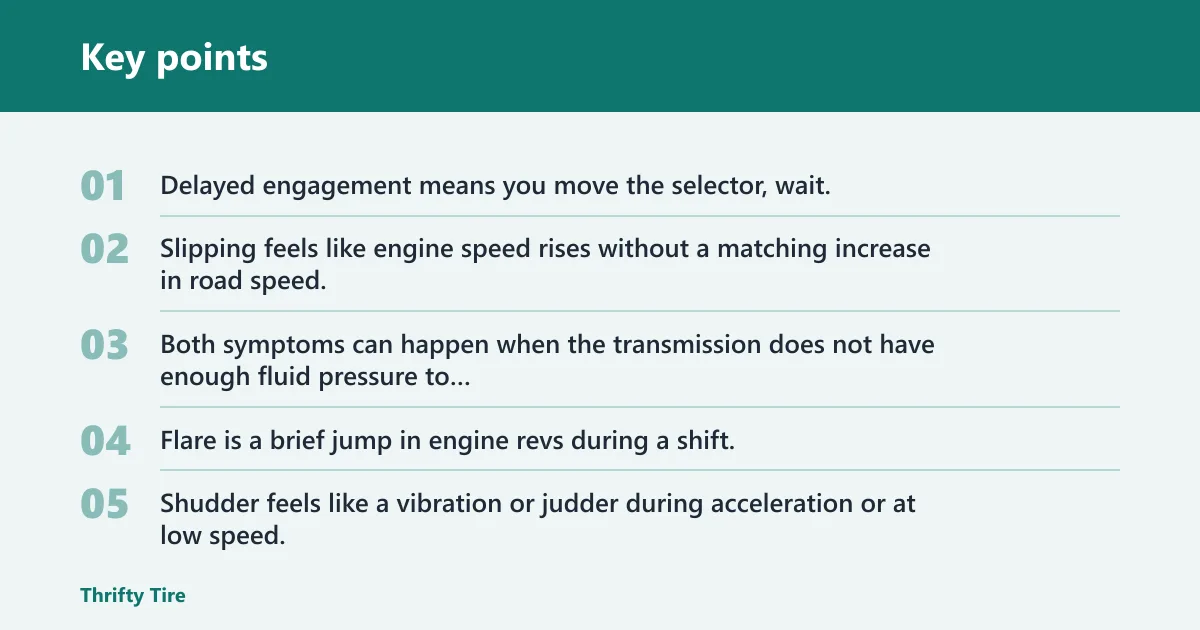
Delayed engagement means you move the selector, wait, and then the gear finally takes hold. Slipping feels like engine speed rises without a matching increase in road speed. Both symptoms can happen when the transmission does not have enough fluid pressure to apply its clutches firmly.
Flare, shudder, and rough shifts
Flare is a brief jump in engine revs during a shift. Shudder feels like a vibration or judder during acceleration or at low speed. Rough shifts can feel harsh, late, or inconsistent. These symptoms can come from low fluid, but they can also come from dirty fluid or worn internal parts.
Overheating and warning lights
Transmission overheating can be caused by low fluid, and it can also be caused by burned, old, or dirty fluid. Heat then makes the fluid thinner and less effective, which can worsen shift quality and trigger warning lights. If the fluid smells burnt, the problem is no longer just a level check.
A common first-time mistake is to top up fluid after seeing a shudder, then assume the issue is fixed. If the fluid was low because of a leak, the level may fall again. If the fluid was already burned or dirty, adding more fluid will not restore the lost friction and pressure behavior.
How do you check transmission fluid?
On many automatics, you check transmission fluid with a dipstick: warm the vehicle as directed, park on a level surface, wipe the stick, reinsert it, and read it again. Some sealed-for-life automatics do not have a dipstick, so the owner’s manual must confirm the correct check method.
Dipstick checks on many automatics
A transmission dipstick is used on many automatics to check level and sometimes fluid condition. The key steps are to wipe it clean, reinsert it fully, and then read it again. A quick pull-and-glance check can give a false reading.
Some checks also require the engine running for an accurate fluid reading. The exact procedure varies by model, so the owner’s manual matters more than a general rule.
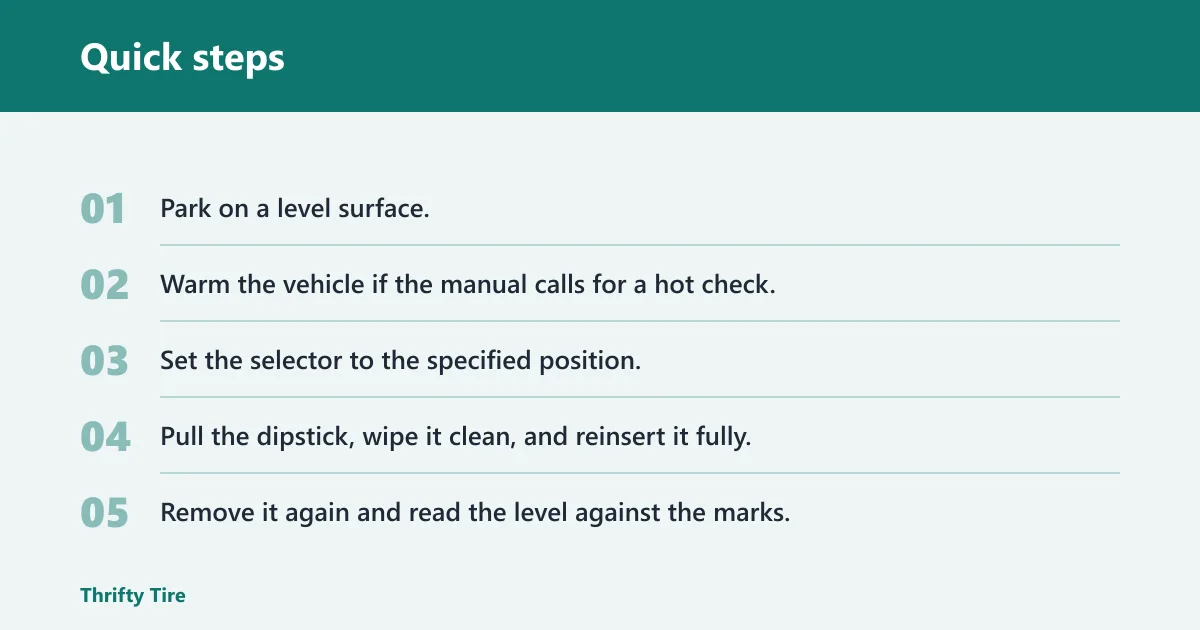
- Park on a level surface.
- Warm the vehicle if the manual calls for a hot check.
- Set the selector to the specified position.
- Pull the dipstick, wipe it clean, and reinsert it fully.
- Remove it again and read the level against the marks.
- Check the fluid color and smell if the manual allows that inspection.
Sealed-for-life transmissions
Some newer cars have a sealed-for-life automatic transmission with no dipstick. That does not mean the fluid never needs attention. It means the check and service procedure is different, often requiring a specific plug, temperature range, or service tool. The owner’s manual should confirm the exact process.
Checking fluid on an automatic vehicle can be done in less than 20 minutes when the design is dipstick-friendly and access is clear. Sealed systems usually take longer because the level check is more specific.
Where do you add transmission fluid in an automatic transmission?
Where you add ATF depends on the transmission design. Many vehicles fill through the dipstick tube, while others use a dedicated fill plug or service port. You should not guess at the location, because the wrong opening or the wrong fill level can damage the transmission.
Fill points vary by model
On a dipstick-equipped transmission, fluid is often added through the same tube used for checking. On sealed systems, the fill point may be on the case, and the level may need to be verified at a specific fluid temperature. The owner’s manual is the safest starting point before you add anything.
Why overfilling causes problems
Too much ATF can foam or aerate inside the transmission case. That can disturb hydraulic pressure, lead to poor shifting, and create its own overheating issue. A level that is too high is not a harmless cushion.
Suppose a sedan that normally uses a dipstick has a fluid level checked cold, right after a short driveway move. That reading may not match the recommended check condition. Adding fluid to “fix” a cold, inaccurate reading can leave the transmission overfilled once it reaches operating temperature.
Fluid service basics
Transmission fluid service is manufacturer-dependent. Some schedules call for service every 30,000 miles or every 2 years, while some manufacturers suggest 100,000 miles for flushing. The manual should decide the interval, because service needs vary with transmission design, driving load, and heat exposure.
Change interval and service content
A fluid service may include draining the old ATF and refilling with fresh fluid. A transmission flush goes further by removing old ATF, sludge, and grime before replacing it with fresh fluid. Neither option should be treated as universal; the correct choice depends on the vehicle and its condition.
Many services also involve the transmission filter. The filter helps prevent damage by trapping debris, and it may be changed during service to support efficient operation. Some jobs also call for a gasket or pan seal replacement, which adds parts cost beyond the fluid itself.
Flush versus fluid change
A flush removes more old fluid than a simple drain-and-fill, and it can be useful when the transmission is due for a complete fluid exchange. A fluid change is often simpler and may be the better fit for some vehicles. The right choice is model-specific, not a one-size answer.
Cost depends on what is included. A basic service may be just fluid and labor, while a fuller job can add a filter, gasket, or pan service. If symptoms are unclear, a transmission diagnostic may be needed first; FixMyCar lists an average transmission diagnostic cost of £117.47.
What happens if you put CVT fluid in an ATF transmission?
CVT fluid and ATF are not interchangeable unless the manufacturer says they are. CVT fluid is formulated for a different type of transmission behavior, and using it in a conventional ATF transmission can upset friction, pressure, and shift timing. That can create symptoms fast, or worsen existing ones.
Why the wrong fluid causes trouble
An automatic transmission depends on specific friction characteristics and pressure behavior. Wrong fluid can change how clutches engage, how valves respond, and how the torque converter works. The result may be slip, flare, shudder, delayed engagement, or overheating.
What to do next
If the wrong fluid was added, do not keep driving and hope it sorts itself out. Have the transmission checked against the vehicle’s fluid specification. The correct response is model-specific because some transmissions use low-viscosity ATF, others use a dedicated ATF type, and CVT units need their own approved fluid.
Frequently asked questions
What is ATF transmission?
An ATF transmission is an automatic transmission that uses automatic transmission fluid as its hydraulic working fluid. That fluid lubricates parts, carries pressure through the system, supports valve and clutch operation, and helps with cooling. In short, the fluid is part of how the transmission shifts, not just how it stays lubricated.
What does transmission fluid do in an automatic transmission?
Transmission fluid lubricates moving parts, maintains fluid pressure, cools internal components, helps prevent oxidation and rust, supports valve operation, supports brake band friction, and assists torque conversion. Those jobs let the transmission apply gear changes at the right time and keep heat and wear under control.
How do you check transmission fluid in an automatic transmission?
On many automatics, you check fluid with a dipstick on a level surface, often with the engine running and the transmission warmed as the manual directs. Wipe the dipstick, reinsert it, then read the level again. Some sealed-for-life transmissions do not have a dipstick, so the manual decides the method.
When should transmission fluid be changed?
Service intervals vary by manufacturer. The owner’s manual is the best source, because the right interval depends on the transmission design and the service type.