What Engine Oil Does My Car Need?
Your car needs the engine oil grade, manufacturer approval or spec, and oil capacity listed for that exact engine; if the manual is missing, use the under-hood cap, emissions label, or VIN or reg lookup to confirm before buying. Do not guess from bottle colour, brand, or old paperwork alone. Using the wrong viscosity or spec can increase wear, affect cold-start protection, or raise oil consumption. Owner’s manuals and service data are the primary sources for this information.
How to find the right oil fast
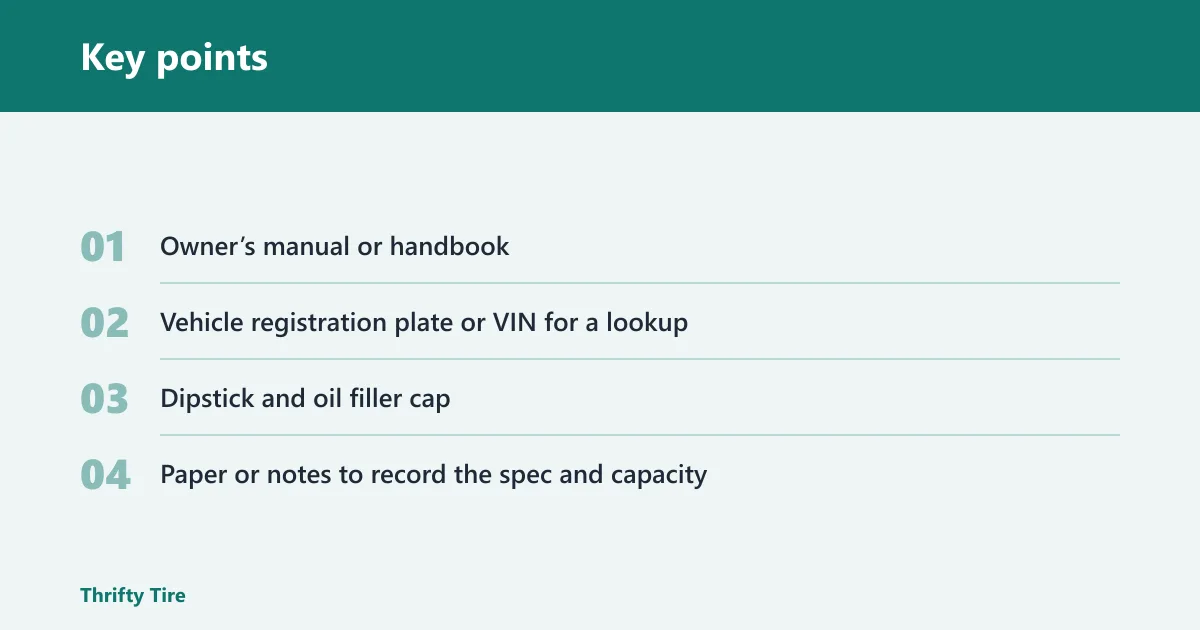
What you’ll need
- Owner’s manual or handbook
- Vehicle registration plate or VIN for a lookup
- Dipstick and oil filler cap
- Paper or notes to record the spec and capacity
Find the right oil in 60 seconds
| Branch | What to check | Record before buying | Buy for |
|---|---|---|---|
| Manual available | Look up the oil page and service notes | Viscosity grade, manufacturer approval or spec, engine type, capacity, and whether you need a top-up or full change | The exact engine listed in the manual, or the latest service bulletin if the car has been updated |
| Reg lookup available | Run the reg or VIN through a selector tool | Viscosity grade, approval or spec shown by the tool, engine size, capacity, and whether it is a top-up or full change | The make, model, year, and engine the lookup identifies |
| Only dipstick or cap available | Read the oil filler cap, dipstick, and under-hood labels | Any viscosity or spec printed on the cap or label, engine type if visible, current oil level, and whether you only need a top-up | Enough matching oil to return the level to the safe range |
| None available | Do not guess from bottle colour, brand, or old paperwork alone | Wait to record viscosity grade, approval or spec, engine type, capacity, and service type from a manual, selector, or dealer lookup | Nothing until you can confirm the exact requirement |
What engine oil do I need for my car by reg?
A reg lookup can be a practical starting point when the manual is missing. It can identify make, model, engine size, and often the recommended viscosity grade and approval, but you still need to check for engine swaps, facelift changes, or service updates before you buy. The lookup should be treated as a cross-check, not a final authority.
How to use a reg lookup or selector
- Enter the registration plate or VIN in the selector tool.
- Confirm the make, model, year, and engine size.
- Write down the viscosity grade and the exact approval or spec shown.
- Compare the result with the bottle label before checkout.
- If the result names more than one oil, choose the one that matches the manufacturer approval first, then the viscosity grade.
Why the reg lookup is not the final check
Selector tools help, but they can miss later updates or engine changes. Suppose a used car now has a replacement engine from a different trim level. The reg may still point to the original engine, so the approval on the manual, the VIN lookup, or the under-hood label should be checked against the car’s current engine before you buy oil.
How do you find the oil spec?
The oil spec matters as much as viscosity. The right oil can still be wrong if it lacks the manufacturer approval your engine needs. The owner’s manual is the primary source for both the oil type and the capacity guidance, and API and ACEA classifications define the performance categories that bottles must state clearly. Manufacturer approval still comes first when the manual names one.
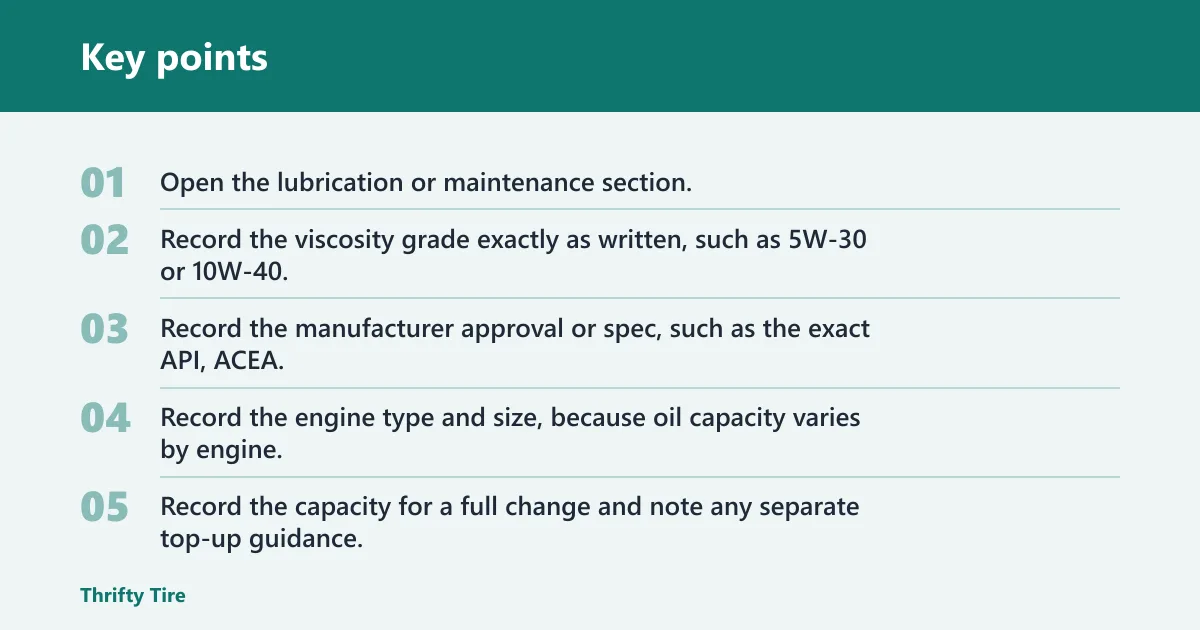
How to find the right engine oil from your owner’s manual
- Open the lubrication or maintenance section.
- Record the viscosity grade exactly as written, such as 5W-30 or 10W-40.
- Record the manufacturer approval or spec, such as the exact API, ACEA, or maker code listed for your engine.
- Record the engine type and size, because oil capacity varies by engine.
- Record the capacity for a full change and note any separate top-up guidance.
What to look for on the bottle
Check the bottle label for the same approval or spec named in the manual, not just a matching viscosity. A synthetic, semi-synthetic, or conventional oil can all be acceptable if the vehicle recommendation allows it, but the approval still has to match. A bottle that says 5W-30 is not enough on its own; look for the exact API, ACEA, or OEM approval listed for the engine.
Worked example: manual, lookup, and bottle label
Picture a petrol hatchback whose manual lists 5W-30 with a specific manufacturer approval and a capacity for the engine size shown in the book. A reg lookup returns the same engine size and the same viscosity. The bottle label also shows the same approval code. That is a match. If the bottle only says 5W-30 and omits the approval, leave it on the shelf.
What type of engine oil does my car take?
Oil family matters, but it is the third check after spec and viscosity. Synthetic, semi-synthetic, and conventional oil are family variants. Any one of them can be correct only if it still meets the vehicle’s recommendation. Diesel, petrol, turbocharged, and high-mileage engines can each have different needs, so do not assume one family fits all.
Brand-agnostic checklist by engine type
- Petrol: Confirm the exact viscosity grade and approval, especially if the car has stop-start or turbocharging.
- Diesel: Check the approval carefully, because aftertreatment systems can narrow the allowed oil choices.
- Turbocharged: Follow the specified approval, then verify that the bottle is approved for turbo use in that engine family.
- High-mileage: Use only an oil that still meets the listed approval; do not choose by mileage wording alone.
How much oil does the car need?
Oil capacity is separate from oil type. Different makes and engine sizes need different oil amounts, so the amount needed for a full change can vary a lot even when two cars use the same viscosity grade. The manual is the recommended source for capacity information, and the dipstick tells you when the level is within the safe range. Underfill risks oil starvation; overfill can aerate the oil and increase pressure.
Full change versus top-up
A full change means draining the old oil and refilling to the stated capacity. A top-up means adding oil only to bring the dipstick back into the safe range. Do not buy the same amount for both jobs, because topping up too far can push the level above the maximum mark.
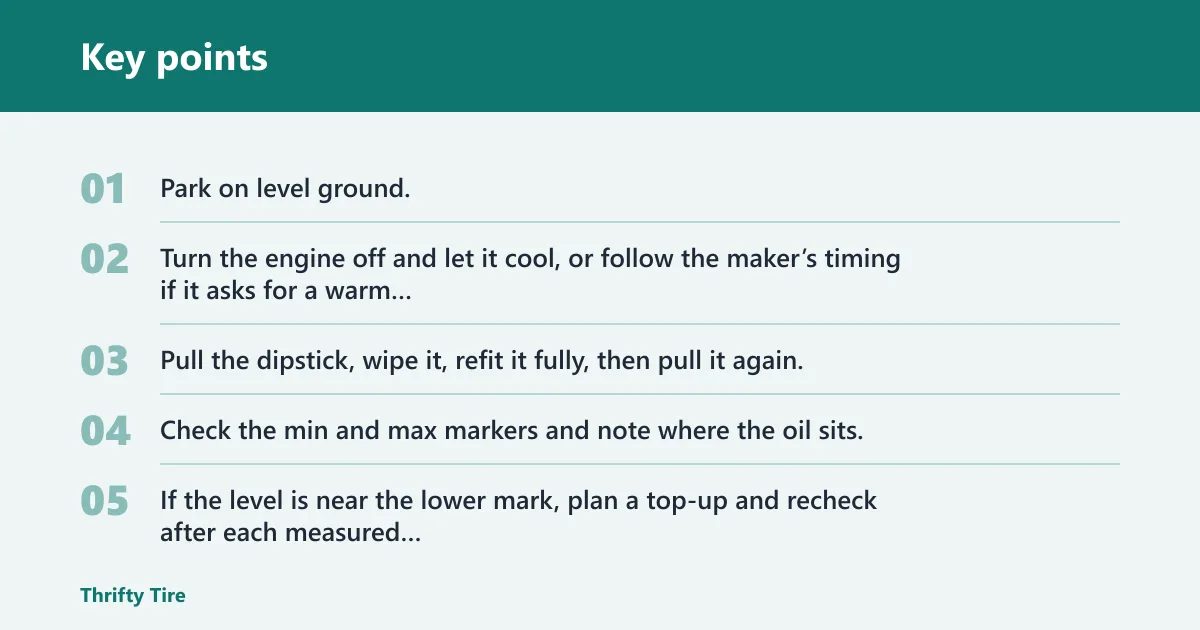
How to check the dipstick
- Park on level ground.
- Turn the engine off and let it cool, or follow the maker’s timing if it asks for a warm engine and a short wait.
- Pull the dipstick, wipe it, refit it fully, then pull it again.
- Check the min and max markers and note where the oil sits.
- If the level is near the lower mark, plan a top-up and recheck after each measured addition.
How much is safe to add?
Do not pour in oil until the stick is full without checking again. Add a measured amount, then recheck the dipstick. Mobil advises the level should be nearer the higher dipstick mark, but it should still stay below the maximum mark. Too much engine oil can increase pressure and friction on the crankshaft, and too little engine oil can cause increased friction and overheating.
Oil amount versus oil detail: quick comparison
| What you need | What it means | Where to find it | Why it matters |
|---|---|---|---|
| Oil grade | The viscosity, such as 5W-30 or 10W-40 | Owner’s manual, under-hood label, or selector tool | Affects cold-start flow and operating thickness |
| Oil spec | The required API, ACEA, or manufacturer approval code | Owner’s manual and bottle label | Confirms the oil meets the engine maker’s performance requirement |
| Oil capacity | The amount needed for a full drain-and-fill | Owner’s manual or service data | Prevents underfilling or overfilling after a service |
| Top-up amount | The small measured amount added to restore the dipstick to the safe range | Dipstick reading after the engine is parked level | Helps avoid adding too much oil during maintenance |
How do you find the right oil if the manual is missing?
If the manual is missing, use the vehicle registration plate or VIN lookup first, then verify the result against what you can see on the car. The oil filler cap, emissions label, and dipstick can help confirm the engine family and the current level, but they should not be used as the only source if the car has had a swap or update.
What to do when sources disagree
- Check the manual if you have one.
- If the manual and reg lookup disagree, inspect the engine label, service records, or VIN-based parts lookup.
- Use the approval or spec that matches the current engine and the latest service information.
- Do not buy oil until the viscosity grade, approval, and capacity all line up.
Common first-timer mistakes
Buying by viscosity alone is the biggest error. A bottle can match 5W-30 and still miss the required approval. Mixing up capacity and top-up amount is next; a full change can need far more oil than a top-up. Overfilling past the max mark is harmful. Skipping the dipstick check before adding oil can hide a low level or turn a small top-up into an overfill.
Can I mix different engine oils?
Mixing oils is sometimes acceptable if both oils are suitable and recommended by the manufacturer, but that is a fallback, not the buying plan. The priority is matching the required approval or spec. If you must top up in an emergency, use the closest approved oil you can confirm, then replace the oil with the correct spec at the next service.
Say your car uses 5W-30 with a specific approval, but the only nearby bottle is the same viscosity with a different approval. That bottle is not the right long-term choice. Add only enough to protect the level, then book a proper oil change with the correct spec.
When should you change it?
Regular oil changes help keep engine parts lubricated and reduce contamination buildup. Check the service schedule in the owner’s manual, because time and mileage intervals vary by make and engine. A monthly level check is a useful habit, and checking before long trips is sensible. The schedule in the handbook should override guesswork or generic interval advice.
Prevention
Keep a note of the exact viscosity grade, approval or spec, and capacity in the glove box or phone. That saves time the next time the warning light comes on or the oil level needs a top-up.
Frequently asked questions
What engine oil does my car need?
Your car needs the manufacturer-listed viscosity grade, approval or spec, and capacity for its exact engine. Start with the owner’s manual, then confirm the same details on a VIN or reg lookup and on the bottle label. Do not buy on viscosity alone.
What engine oil does my car need by reg?
A reg lookup should return the make, model, engine size, and a matching oil recommendation. Use it as the first pass, then verify the approval code and capacity against the manual or under-hood labels before you buy. Engine swaps can change the answer.
How do I find the right engine oil from my owner’s manual?
Open the lubrication section and write down the viscosity grade, the exact approval or spec, the engine size, and the oil capacity. If the manual is old, check for service updates or a VIN lookup that may supersede it. Match all of them before buying.