What Is Plus Sizing on Wheels and Tires?
Plus sizing means moving to a larger wheel diameter while choosing a lower-profile tire that keeps overall tire diameter close to stock, usually within about 3%. Get it wrong and you can create speedometer error, rubbing, ABS issues, and stressed suspension parts. This guide explains the math, the fitment measurements that matter, and the tradeoffs between wheel width, offset, and tire size.
How plus sizing changes fitment
Plus sizing is fitting a larger wheel diameter with a lower-profile tire so the overall tire diameter stays close to the original equipment size. The goal is fitment, not a dramatic size jump. Keep the rolling diameter near stock, then check width, offset, load index, and speed rating.
That last part matters because the wheel and tire package has to work as one system. A larger rim changes sidewall height, but it does not remove the need to match brake space, suspension travel, steering lock, and wheel well room. The OEM size is the reference point for every comparison.
What changes and what stays close to stock
Plus sizing changes wheel diameter first. To keep the total package near stock, the tire sidewall gets shorter as the rim gets larger. The section width may also change, but not every plus step needs a wider tire. The best fit keeps overall diameter close while still matching the wheel and the vehicle.
The main tradeoff is plain. Larger wheels can sharpen steering response and change appearance, but they often reduce ride comfort because the sidewall has less air and flex to absorb bumps. They can also raise cost, since wider or lower-profile tires are not always the least expensive choice.
Plus zero, plus one, plus two, and plus three
Plus Zero keeps wheel diameter the same and only increases tire width. Plus One means increasing rim diameter by 1 inch. Plus Two means increasing rim diameter by 2 inches. Plus Three means increasing rim diameter by 3 inches. Each step generally lowers sidewall height and changes the tire’s aspect ratio.
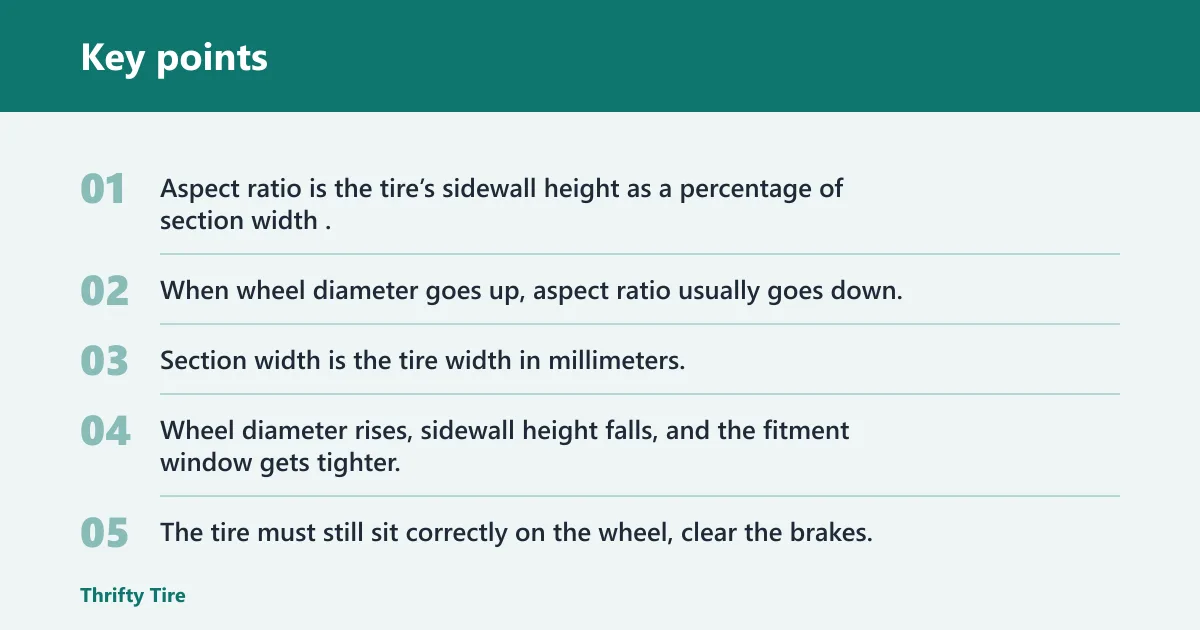
Aspect ratio is the tire’s sidewall height as a percentage of section width. When wheel diameter goes up, aspect ratio usually goes down. Section width is the tire width in millimeters, and it often increases by about 10 mm per plus step, though the tire still needs to fit the approved wheel width range.
How the package changes step by step
A plus step does not change only one number. Wheel diameter rises, sidewall height falls, and the fitment window gets tighter. The tire must still sit correctly on the wheel, clear the brakes, and avoid rubbing at full steering lock and full suspension compression. Those checks matter as much as the diameter math.
| Plus step | Wheel change | Typical tire change | What stays similar |
|---|---|---|---|
| Plus Zero | No wheel diameter change | Wider tire, same rim diameter | Overall diameter can stay close to OE |
| Plus One | Rim diameter increases by 1 inch | Shorter sidewall | Overall diameter should stay near stock |
| Plus Two | Rim diameter increases by 2 inches | Lower aspect ratio tire | Overall diameter should stay near stock |
| Plus Three | Rim diameter increases by 3 inches | Even shorter sidewall | Overall diameter should stay near stock, if fitment allows |
How does plus sizing affect fitment?
Fitment depends on more than wheel diameter. Tire section width, approved wheel width range, and wheel offset all affect where the tire sits. A package can keep the right overall diameter and still rub if the wheel is too wide or the offset pushes the tire outward or inward too far.
Wheel width range tells you what rim widths the tire can safely mount on. If the wheel is outside that range, the tire shape can be distorted, the contact patch can change, and bead seating can be compromised. Width compatibility matters as much as diameter matching.
Wheel width, offset, and rubbing risk
Wheel offset controls how far the wheel sits inboard or outboard relative to the hub. A similar diameter wheel with a different offset can still rub the strut, control arm, brake parts, or fender liner. Wider tires add more risk because they occupy more space inboard and outboard.
Suppose you keep the same overall diameter but move to a wheel with a lower offset and a wider tire. The outer edge moves closer to the fender, while the inner edge moves toward suspension parts. That is why offset has to be verified alongside width, not after the purchase.
Overall diameter and speedometer checks

Overall tire diameter is the rolling diameter that affects how far the vehicle travels in one wheel revolution. A common industry guideline is to keep overall diameter within about 3% of OE size. Going outside that range raises the risk of speedometer error, gearing changes, and fitment problems.
The 225/65R17 example calculates an overall diameter of 28.52 inches. Tire Scouter lists 225/60R18 as a +0.4% change from 225/65R17, 235/65R17 as a +1.8% change, and 245/65R17 as outside the guideline at +3.6%. The OE size is the baseline for every comparison.
Speedometer and odometer effects
If the new tire diameter is larger than stock, actual speed is higher than the speedometer shows. If the diameter is smaller, the speedometer over-reports speed. The odometer changes too, because it counts revolutions rather than true road distance. Even small diameter changes can create noticeable error over time.
That is why the 3% rule is a useful screening tool, not a free pass. It tells you whether a size is close enough to consider, but it does not replace checks for load index, speed rating, wheel width, offset, and clearance. A size can be close on paper and still be a bad fit.
Comparison example
Say your OEM size is 225/65R17 and you are comparing 225/60R18. The diameter change is small enough to stay near the factory baseline, and the wheel diameter increases by 1 inch. That can work well if the wheel width range, offset, and brake clearance also line up.
A common first-timer mistake is to look only at the rim size. A 17-inch wheel and an 18-inch wheel are not interchangeable unless the tire choice keeps the total diameter close and the rest of the fitment checks pass. The wheel size alone does not tell the whole story.
Plus sizing decision matrix
This matrix turns the fitment question into a shopping check. Use it to match your goal with the measurements that matter before you buy. If a package misses more than one line, it usually needs a closer review.
| Scenario | Overall diameter target | Wheel width range check | Offset caution | Speedometer impact | Rubbing risk |
|---|---|---|---|---|---|
| Stock look | Match OE size as closely as possible | Stay within the tire maker’s approved range | Keep OE offset or very close | Minimal if diameter stays near OE | Low, if all OE dimensions are respected |
| Mild upgrade | Within about 3% of OE | Confirm the new tire fits the new wheel width | Verify outer clearance and inner clearance | Small error, usually manageable | Moderate if width increases or offset changes |
| Aggressive look | May approach the 3% limit | Must be checked carefully against the wheel spec | High caution; offset often drives the fit issue | Possible measurable error | Higher, especially at full lock and full compression |
| Winter compromise | Stay close to OE for predictable speed and traction control behavior | Choose a width that still suits the winter wheel | Prefer conservative offset choices | Should remain close to stock | Low to moderate, depending on snow-chain or slush clearance needs |
Will plus sizing cause rubbing or clearance problems?
It can. Diameter changes affect vertical clearance, but rubbing often comes from width and offset changes instead. Check fenders, suspension parts, brake calipers, and steering lock. Then confirm room at full suspension compression, because a wheel that clears in the driveway can still touch under load or over a bump.
Clearance should be checked in the real positions that stress the package: full left and right steering lock, and full up-travel when the suspension compresses. If the tire contacts a liner, spring perch, strut body, control arm, or fender edge, the fit is not ready.
Brake and suspension room
Bigger wheels sometimes help brake clearance, but that is not automatic. Spoke shape, barrel shape, and offset still decide whether the wheel clears the caliper. A tire with the right diameter can still fail if the wheel barrel or spoke design hits the brake hardware.
Width makes this more sensitive. A wider tire with a slightly different offset can look fine from the outside and still contact suspension parts on the inside. A fitment check should include both dimensions and the path the wheel takes as the steering turns.
What else should you verify before buying?
Do not stop at diameter. Load index and speed rating must meet or exceed the original tire’s requirements. Those are non-dimension safety checks. Then confirm wheel width, offset, and tire-to-wheel compatibility so the package is safe to mount and legal for the vehicle’s expected load and speed use.
Most manufacturers list the approved wheel width range for each tire size. Compare that range to the wheel you plan to buy. Then compare the new size to the OE size, not to a random online result, so you know how far the package moves from the original baseline.
- Start with the OE tire size and note the original overall diameter.
- Choose a candidate size and check the diameter change against the about 3% guideline.
- Confirm the tire fits the wheel width range for the rim you plan to use.
- Check wheel offset so the tire does not move too far inward or outward.
- Verify load index and speed rating meet or exceed OE requirements.
- Review brake clearance, fender clearance, steering lock, and full compression space.
Frequently asked questions
What is plus sizing on wheels and tires?
Plus sizing is fitting a larger wheel diameter with a lower-profile tire while keeping overall tire diameter close to stock. The point is to preserve speedometer and gearing behavior as much as possible while changing the wheel and tire package. It still requires width, offset, and clearance checks.
How does plus sizing keep overall diameter the same?
It uses a larger rim and a shorter sidewall so the combined wheel-and-tire height stays near OE size. The tire’s aspect ratio drops as wheel diameter increases. That balance is what keeps rolling diameter close to stock rather than letting the package grow too tall.
What do plus one, plus two, and plus three mean?
Plus One means increasing rim diameter by 1 inch, Plus Two means increasing rim diameter by 2 inches, and Plus Three means increasing rim diameter by 3 inches. Each step usually means a lower-profile tire to keep the overall diameter close to the original size.
How much can you change tire size before it causes problems?
A common industry guideline is to stay within about 3% of the OE overall diameter. That is a practical boundary, not a universal legal rule. Beyond that, speedometer error, gearing changes, and fitment issues become more likely, especially if width or offset also changes.
Will plus sizing affect the speedometer?
Yes. A larger diameter tire makes the vehicle travel farther per revolution, so actual speed is higher than indicated. A smaller diameter does the opposite, causing the speedometer to over-report. The odometer is affected too because it tracks wheel revolutions, not road distance directly.
Do I need a wider wheel when I plus size?
Often, yes, but not always. The tire must fit the wheel width range listed by the manufacturer, and that range may change with the new size. A tire can mount poorly or wear badly if the wheel is too narrow or too wide for that specific size.