What Is Wheel Offset on a Car Wheel?
Wheel offset is the distance from a wheel’s centerline to its hub-mounting face, measured in millimeters; positive offset places the mounting face toward the street side, negative offset toward the suspension. Get it wrong, and the tire can touch the fender, sit too far out, or put extra load on the steering and bearings. This guide explains offset with a simple side-view model and a fitment checklist for predicting what moves inward, outward, or rubs first.
Wheel offset explained
Picture the wheel from the side. Draw a line through the exact middle of its width; that is the wheel centerline. Then find the mounting surface, also called the mounting pad, where the wheel bolts to the hub. Offset is the distance between those two points.
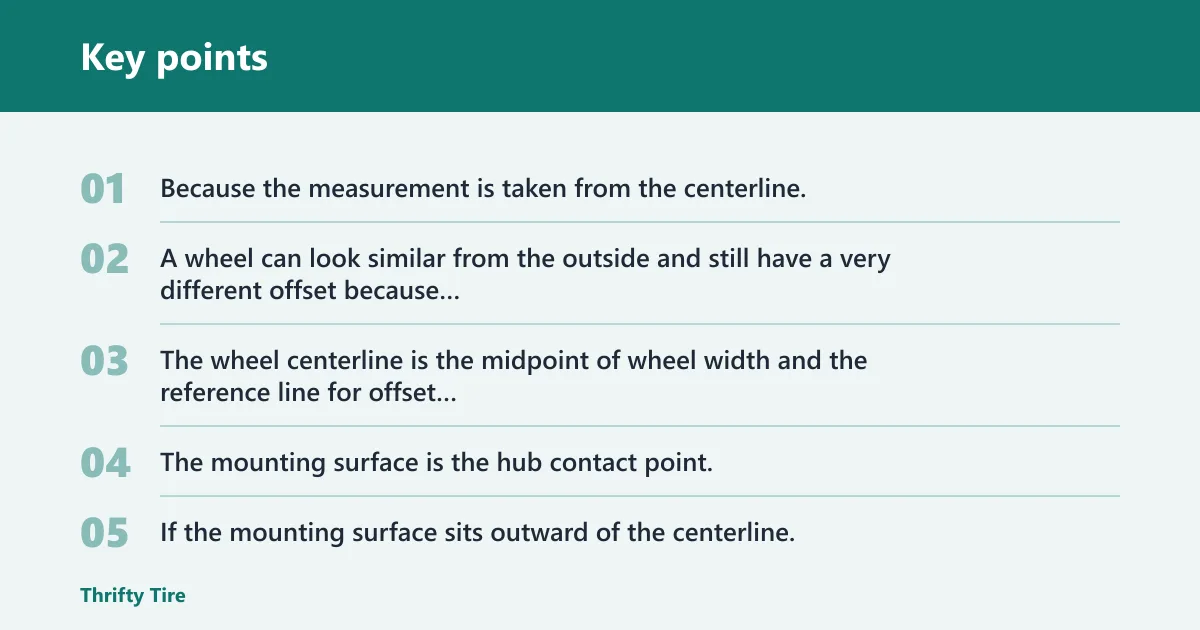
Because the measurement is taken from the centerline, offset is not the same as how far the rim lip sticks out. A wheel can look similar from the outside and still have a very different offset because the mounting pad sits in a different place.
Centerline and mounting surface
The wheel centerline is the midpoint of wheel width and the reference line for offset calculation. The mounting surface is the hub contact point, and its location decides whether offset is positive, zero, or negative.
If the mounting surface sits outward of the centerline, the wheel sits more inward under the car. If it sits inward of the centerline, the wheel moves outward.
Measured in millimeters
Wheel offset is measured in millimeters. A wheel marked ET30 means a positive offset of 30 mm. ET is a common German offset notation, and it is often stamped on the wheel. (Wikihow)
That number is a starting point, not the whole fitment story. Wheel width, tire size, brake shape, and suspension clearance all change what the car can accept.
Positive, zero, and negative offset
Positive offset means the mounting surface is toward the outside or face of the wheel, so the wheel sits closer to the chassis. Zero offset means the mounting plate is in the exact center. Negative offset moves the mounting surface toward the inside or back, so the wheel sits farther out.
A +35 offset means the mounting surface is 35 mm toward the outside from centerline. A +40 offset positions the wheel farther inward. A +45 offset tucks wheels even more inward. Those are the same direction of change, just with different depth.
What does offset mean on a wheel?
Offset means where the wheel’s mounting surface sits relative to its middle. More positive offset pulls the wheel inward toward the chassis. More negative offset pushes the wheel outward toward the fender. The same offset number can still look different because wheel width and tire size change the final shape.
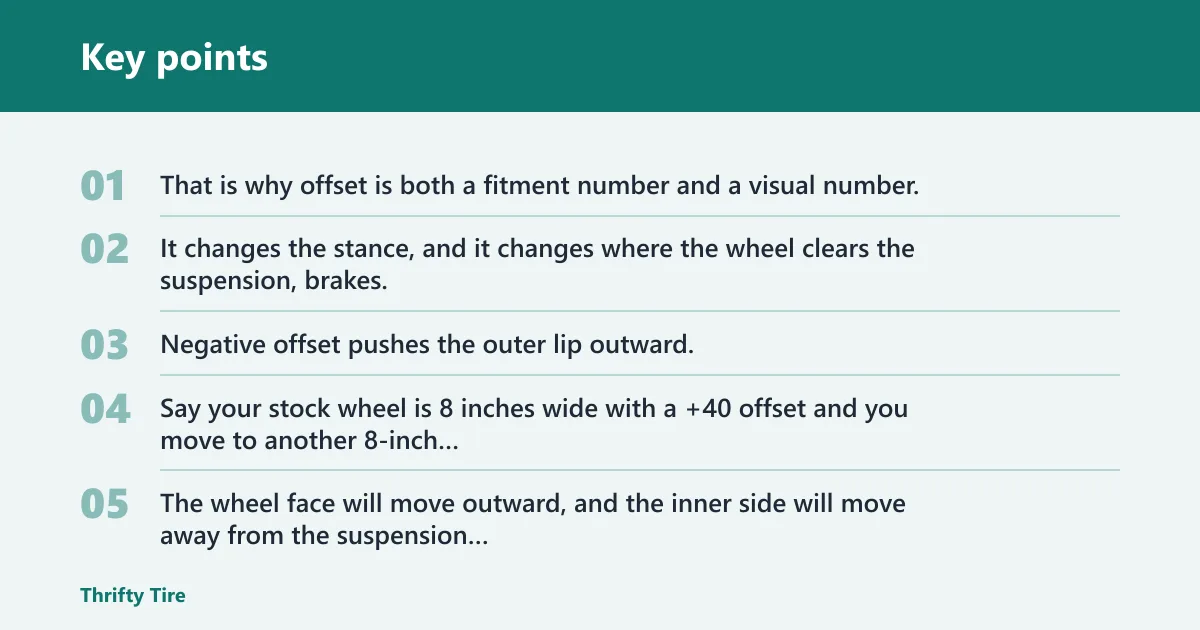
That is why offset is both a fitment number and a visual number. It changes the stance, and it changes where the wheel clears the suspension, brakes, and bodywork.
How the wheel sits inward or outward
Think of offset as a side-view shift. Positive offset tucks the wheel inward. Negative offset pushes the outer lip outward. Zero offset splits the difference.
Say your stock wheel is 8 inches wide with a +40 offset and you move to another 8-inch wheel with a +30 offset. The wheel face will move outward, and the inner side will move away from the suspension by a smaller amount. That can help brake or strut clearance, but it may bring the outer edge closer to the fender.
Why the same number can look different on wider wheels
Wheel width matters when you read offset because the same offset number can look different on a wider or narrower wheel. A wider wheel places both lips farther apart, so the outer edge may poke more even if the offset number stays the same.
Wheel width is measured in inches or millimeters. Bead-seat width is the number usually quoted for sizing, and overall width is a little larger because it includes the wheel lips. That means two wheels with the same ET marking can sit differently once width changes.
How do you tell if offset is positive or negative?
Read the ET marking if the wheel has one. ET30 is positive 30 mm. Then look at the mounting pad as the reference point: if that pad sits toward the street side of the wheel, the offset is positive; if it sits toward the back side, the offset is negative.
When the mounting surface is centered, the wheel is zero offset. If you are comparing two wheels by eye, the position of that pad relative to the centerline is the clue that matters.
Read the ET marking
Most wheels stamp the offset near the size markings. ET30, ET35, or ET45 tells you the offset in millimeters. The number after ET is the amount, and the sign is implied by the layout or stated in the fitment data.
Use the mounting pad as the reference
The mounting pad is the hub contact point. If it is moved toward the outside face of the wheel, the offset is positive. If it is moved toward the inside barrel, the offset is negative.
Match the sign to wheel position
Positive offset makes the wheel sit closer to the chassis. Negative offset pushes tires farther away from the chassis. Zero offset places the mounting plate in the exact center.
Offset and wheel width
Offset does not work alone. Wheel width changes the visible result of the same offset number, and that is where many first-time buyers get tripped up. A small offset change can matter a lot on a tight wheel well, especially when the tire is wide or the car is lowered.
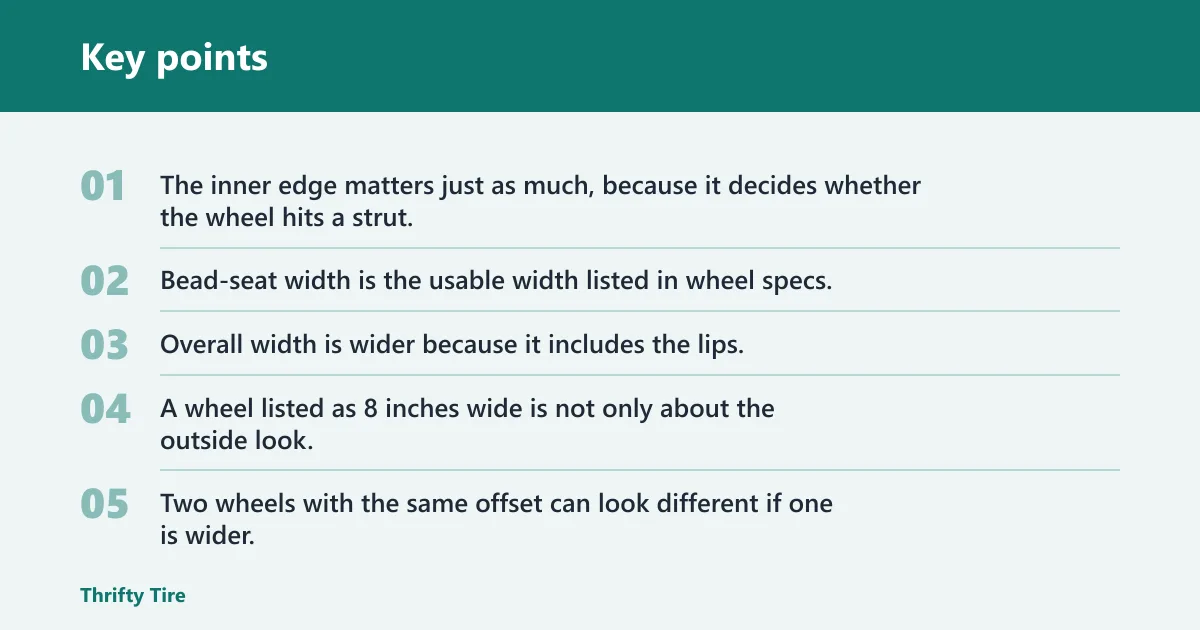
Most buyers think only about the outer edge. The inner edge matters just as much, because it decides whether the wheel hits a strut, spring perch, or brake hardware.
Bead-seat width versus overall width
Bead-seat width is the usable width listed in wheel specs. Overall width is wider because it includes the lips. A wheel listed as 8 inches wide is not only about the outside look; it also changes where the tire beads sit and where the inner and outer edges land relative to the car.
Why width changes the visual result
Two wheels with the same offset can look different if one is wider. The wider wheel spreads both edges outward from the centerline, so the outer lip can poke more and the inner lip can move closer to suspension parts.
Suppose a driver swaps from a 7-inch wheel with a 42 mm offset to an 8-inch wheel with a 32 mm offset. One common calculator example returns a clearance change of negative 2.7 mm and a position change of negative 22.7 mm. That shows why width and offset should be read together, not separately.
Why a small offset change can matter
A change of about 5 to 10 mm can matter on tight-fit vehicles. That is enough to change whether the tire kisses a liner, clears a caliper, or contacts the fender under compression. The smaller the gap now, the faster a small offset change becomes a clearance issue later.
Wheel offset decision table
Use this table as a quick side-view check. It is not a universal answer, because tire size, wheel width, brake shape, and suspension setup still control the final result.
| Wheel offset direction | Likely visual effect | Primary clearance risk | Best-use scenario |
|---|---|---|---|
| More positive | Wheel tucks inward | Strut, spring perch, brake caliper | Stock cars with limited outer room |
| Zero | Balanced stance around the centerline | Either side, depending on tire width | Simple baseline for comparisons |
| More negative | Wheel pokes outward | Fender, liner, outer arch on compression | Trucks or off-road setups that need extra outward room |
| Small change, 5-10 mm | Subtle move in or out | Early contact on tight-fit cars | Fine-tuning stock cars or lowered cars |
Stock car fitment
On a stock car, the first problem is often inner clearance on a more positive wheel and outer clearance on a more negative wheel. If the original setup was already close, a small offset shift can change whether the tire clears the liner or reaches the fender lip at full lock or full compression.
Lowered car fitment
Lowered cars usually have less compression room. That means a wheel that seems fine at ride height can contact the fender or liner as the suspension moves. Lowering often makes outer clearance the first thing to check, then inner clearance if the new wheel is wider.
Truck fitment
Trucks often use less positive or even negative offset so the wheel and tire sit farther out. That can help with suspension room and certain tire sizes, but it raises the chance of fender, flare, or liner contact. Wider stance also means more splash and debris thrown outward.
How offset affects fitment clearance
Offset changes where the wheel lands relative to the body and chassis. The first contact point depends on the direction of the change. More positive offset usually threatens the inner side first. More negative offset usually threatens the outer side first.
Fitment clearance is not one problem. It can involve the fender, suspension, brakes, and liner at the same time, and the first part to hit depends on the wheel, tire, and vehicle layout.
Fender clearance
Outer poke increases with more negative offset. That can place the tire closer to the fender edge. On compression, the tire may touch the arch, flare, or lip before anything else.
Suspension and brake clearance
More positive offset moves the inner barrel closer to the suspension and brake hardware. The usual checks are the strut tube, spring perch, and caliper face. Brake clearance matters most when the wheel design changes or the barrel shape is tight.
Liner and rubbing risk
The plastic liner can be the first thing to rub when the tire shifts outward. That often happens at steering lock or during suspension travel. A wheel that clears at rest can still contact the liner once the suspension compresses or the steering turns fully.
A common first-timer mistake is buying a wider wheel with the same ET number and assuming the fit will stay the same. Picture a driver moving from an 8-inch wheel to a 9-inch wheel while keeping the offset unchanged. The outer edge moves outward, the inner edge moves inward, and the car may now touch the liner and the strut at different times.
Frequently asked questions
What is the offset on a wheel?
Wheel offset is the distance from the wheel centerline to the mounting surface in millimeters. A positive value places the wheel closer to the chassis, while a negative value moves it outward. The number helps predict fitment, stance, and whether the wheel will clear suspension or bodywork.
What is a wheel offset explained?
The simplest way to explain wheel offset is side view placement. The centerline is the reference, and the mounting pad decides where the wheel sits relative to that line. More positive offset tucks the wheel in. More negative offset pushes it out. Zero offset splits the difference.
How does wheel offset affect fitment?
Offset changes which part of the vehicle is most likely to rub first. More positive offset can cause inner contact with a strut, spring perch, or caliper. More negative offset can cause outer contact with the fender or liner. Wheel width and tire size can shift those limits further.
How do you tell if a wheel offset is positive or negative?
Check the ET marking first, such as ET30. Then look at the mounting surface location: if it sits toward the wheel face, the offset is positive; if it sits toward the back, it is negative. If the pad is centered, the wheel is zero offset.
What is the difference between wheel offset and backspacing?
Offset and backspacing are related, but they are not the same measurement. Offset uses the wheel centerline as the reference. Backspacing measures from the back edge of the wheel to the mounting surface. Both matter for fitment, but they describe the wheel from different sides.