Bolt Pattern on Rims: What It Means and Why It Matters
A bolt pattern on rims is the number of lug holes and their spacing, such as 5×114.3, and it must match the hub exactly or the wheel will not seat correctly. If you ignore it, you can get vibration, damaged studs, poor clamping, or brake contact that costs time and money. This guide explains how to read bolt patterns and check centering, clamping, and brake clearance before you buy or swap rims.
How to read a wheel bolt pattern
A bolt pattern is the wheel’s lug count plus the diameter of the imaginary circle that passes through those lug holes. It is also called PCD, short for Pitch Circle Diameter. The usual format is number of bolts × circle diameter in mm, such as 5×112.
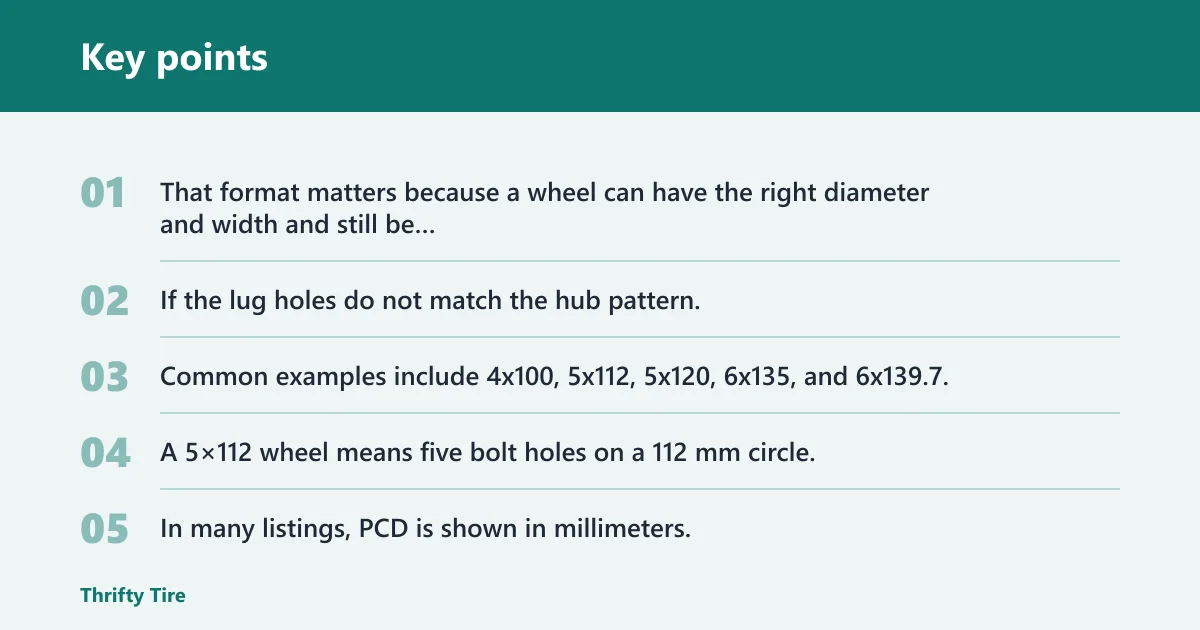
That format matters because a wheel can have the right diameter and width and still be wrong at the mounting face. If the lug holes do not match the hub pattern, the wheel will not center and clamp as intended.
Common examples include 4×100, 5×112, 5×120, 6×135, and 6×139.7. A 5×112 wheel means five bolt holes on a 112 mm circle. In many listings, PCD is shown in millimeters, but some older references and wheel charts still use inches for certain fitment references.
For a quick read, 5×112 means five lug holes spaced on a 112 mm pitch circle diameter. That is the same idea as saying the holes sit on an imaginary 112 mm circle. OEM wheel guides and wheel-industry technical references use this measurement to identify the mounting pattern, not the wheel’s diameter or width.
How the format reads
The first number tells you how many lug holes the wheel has. The second number tells you the diameter of the circle those holes sit on. Measurements are usually listed in millimeters.
That makes the number easy to compare with vehicle specs. If the pattern is different, the wheel will not match the hub pattern, even if it looks close.
How do you measure a bolt pattern?
Measuring depends on lug count. For 4- or 6-bolt wheels, measure from the center of one hole to the directly opposite hole. For 5-bolt wheels, measure to the far outer edge of the hole two positions away. A dedicated bolt pattern gauge makes measuring straightforward.
That measurement gives you the PCD. It does not tell you whether the wheel clears the brakes, centers on the hub, or sits in the right place in the wheel well.
How do you measure 4-lug wheels?
With 4-lug wheels, the opposing holes sit directly across from each other. Measure from the center of one hole to the center of the hole straight across. A common example is 4×100.
How do you measure 5-lug wheels?
Five-lug wheels do not have a directly opposite hole. Measure from the center of one hole to the far outer edge of the hole two positions away.
How do you measure 6-lug wheels?
Six-lug wheels use the same center-to-opposite-hole method as 4-lug wheels. The spacing still has to match the vehicle exactly.
Bolt pattern fitment checklist
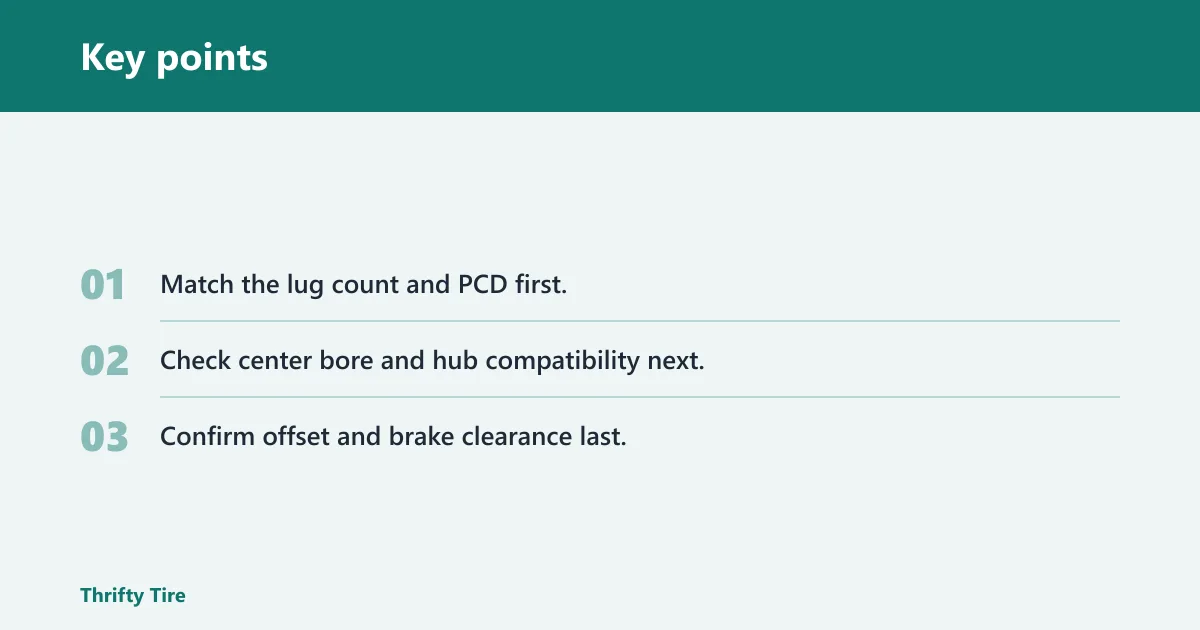
Use this order. Do not start with offset or wheel style. The first fitment check is usually lug count and PCD, followed by center bore and hub compatibility, then offset and brake clearance.
| Check | What to verify | If it is wrong | Do this first? |
|---|---|---|---|
| 1) Lug count and PCD | The wheel’s bolt count and circle diameter match the vehicle hub | The wheel will not mount correctly, and the holes will not line up as they should | Yes |
| 2) Center bore and hub fit | The wheel centers on the hub or uses proper hub-centric support | The wheel may sit off-center, which can affect load distribution and create vibration | Second |
| 3) Offset and brake clearance | ET places the wheel correctly and the barrel clears calipers and hardware | The tire may rub, the wheel may sit too far in or out, or the brake parts may contact the wheel | Third |
- Match the lug count and PCD first.
- Check center bore and hub compatibility next.
- Confirm offset and brake clearance last.
| Failure case | Does the wheel mount at all? | Common symptoms | Likely risk |
|---|---|---|---|
| PCD is off | No | Holes will not line up cleanly; studs may not pass through correctly | Unsafe clamping, damaged hardware, immediate fitment failure |
| Center bore is too small | No | Wheel will not slide fully over the hub | Physical interference; forcing it can damage the wheel or hub |
| Center bore is too large | Sometimes | Wheel may bolt on but sit off-center without proper hub-centric support | Vibration, uneven loading, possible loosening if centered poorly |
| Offset is wrong | Usually yes | Wheel sits too far in or out, may rub suspension or fender | Handling changes, rubbing, bearing or tire wear concerns |
| Brake clearance fails | Sometimes | Caliper or rotor contact inside the barrel or against spokes | Wheel damage, brake interference, unsafe operation |
Why bolt pattern matters for fitment and safety
Bolt pattern matters because it is the first fitment gate. If the lug holes do not match the hub, the wheel cannot seat on the mounting face the way it should. Even small errors at that point can lead to poor clamping, wheel movement, or damage to studs and nuts.
Wheel hub, studs, and lug nuts all have to work together. The wheel must align with the vehicle hub, and the lug nuts must clamp evenly. Missing or mismatched hardware creates safety risk because the wheel may not be held square against the hub.
A wheel can appear close and still be wrong for road use. If your car uses 5×112 and you buy a wheel drilled for 5×120, the bolt pattern will not match. The wheel may look similar on the spec sheet, but the holes will not match the hub pattern, so proper seating and clamping are off from the start.
A common first-timer mistake is assuming that “it bolts on” means “it fits.” That is not enough. A wheel can thread onto the studs and still be unsuitable if it does not center correctly, clamps unevenly, or leaves too little brake clearance.
Wobble bolts, wobble nuts, and adapters are vehicle- and hardware-specific solutions, not universal safe defaults. They should only be used when the wheel, hub, thread engagement, seat type, and clearance details are compatible with the exact application.
What else can stop a wheel from fitting?
Center bore, offset, and brake clearance can stop a wheel even when the bolt pattern matches. Those checks come after PCD because they affect how the wheel sits, centers, and moves around the brakes. Matching bolt pattern alone does not guarantee a safe or usable fit.
What is center bore and hub-centric fitment?
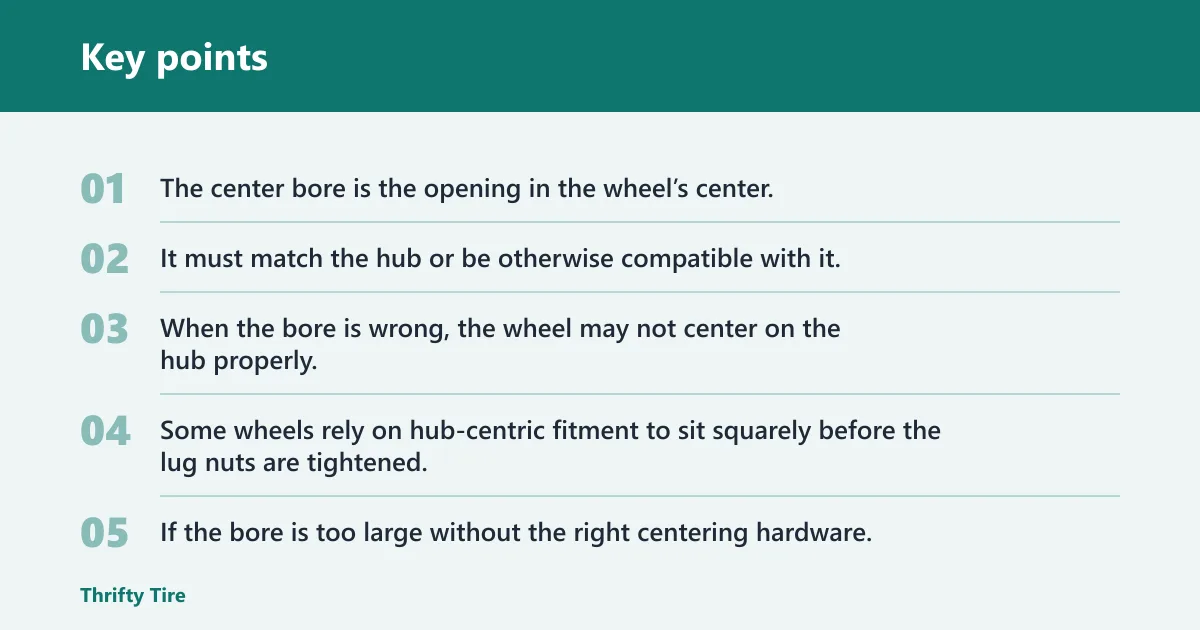
The center bore is the opening in the wheel’s center. It must match the hub or be otherwise compatible with it. When the bore is wrong, the wheel may not center on the hub properly, which can affect load distribution and create vibration.
Some wheels rely on hub-centric fitment to sit squarely before the lug nuts are tightened. If the bore is too large without the right centering hardware, the wheel can still mount but not locate itself the way it should.
What does offset or ET change on a wheel?
Offset, often shown as ET, is separate from bolt pattern. It affects how the wheel sits in the wheel well. Too much positive or negative offset can cause rubbing, contact with suspension parts, or a wheel position that does not suit the vehicle.
That is why a wheel with the right PCD can still be wrong for the car. The mounting holes match, but the wheel may sit too far inboard or outboard once installed.
How do you check brake clearance?
Larger brakes may need extra clearance inside the wheel barrel and around the spokes. Brake clearance can stop a wheel from fitting even when the bolt pattern matches. Caliper size, rotor shape, and spoke design all matter here.
Picture a wheel with the correct 5×112 pattern and the right center bore, but the front caliper still touches the inside barrel. The wheel might mount on the studs, yet it will not be suitable for daily driving if the brake hardware contacts it.
How to check wheel fitment before you buy
Start with the wheel spec sheet and compare it to the vehicle’s wheel specs. Read the bolt pattern first, then the center bore, then offset and brake clearance. If any one of those checks fails, do not assume the wheel will work just because the bolt pattern matches.
Use the same order every time. That keeps you from chasing the wrong problem and saves time before an order is placed.
How should you read the wheel spec sheet?
Then check the center bore and offset. If the listing does not show those values, do not guess.
How do you compare vehicle specs to wheel specs?
Match the vehicle’s lug count and PCD exactly. Then confirm whether the hub and wheel center bore work together. After that, compare ET and brake clearance against the caliper and wheel shape.
What should you verify before ordering?
A wheel should pass in this order: lug count/PCD, center bore/hub compatibility, offset and brake clearance. That is the simplest decision tree for shoppers who are checking fitment before removing a wheel.
Frequently asked questions
What does bolt pattern mean on rims?
Bolt pattern means the number of lug holes and the diameter of the circle they form. It is written as number of bolts × circle diameter in mm, such as 5×112. The pattern must match the vehicle hub for the wheel to mount correctly.
How do I determine bolt pattern on rims?
Count the lug holes, then measure the circle diameter using the correct method for the lug count. For 4- or 6-bolt wheels, measure center to directly opposite hole. For 5-bolt wheels, measure to the far outer edge of the hole two positions away.
How do I find bolt pattern on wheels?
Check the wheel’s spec sheet first. If you are measuring the wheel itself, use the correct method for the lug count and confirm the result in mm. A bolt pattern gauge can make the job easier and more consistent.
How do I measure a rim bolt pattern?
Measure from hole center to hole center on 4- and 6-lug wheels. On 5-lug wheels, measure from the center of one hole to the far outer edge of the hole two positions away. That gives you the PCD used in the size listing.
What is the rim’s bolt pattern?
The rim’s bolt pattern is the same thing as its PCD: the lug count and the diameter of the circle formed by those lug holes. The number must match the vehicle exactly.
Sources
- Vehicle OEM wheel fitment and service information
- Wheel manufacturer technical fitment guides
- Industry references for PCD, offset, hub-centric fitment, and brake clearance