How to Check Transmission Fluid with a Dipstick
Check the owner’s manual first. Then read the transmission only if it has a dipstick. For many automatic transmissions, check the fluid with the engine idling, the shifter in Park or Neutral, and the fluid at operating temperature. A wrong check can mimic low fluid, trigger a false refill, and leave the transmission overfilled. This guide shows how to confirm the correct dipstick procedure, read the stick accurately, and avoid overfilling.
Which transmission check method does my car use?
The owner’s manual is the first stop because it tells you whether the vehicle uses a traditional automatic dipstick, a sealed automatic, or a different procedure for a manual transmission or CVT. Factory service information and dealer service pages are the best authority for the exact method, because the check point, engine state, and temperature target can vary by model year and transmission family. See also our ATF type/spec guide for fluid compatibility basics.
| Which transmission fluid check method does my car use? | Engine state | Vehicle position | Access method | Stop and consult the manual or shop when |
|---|---|---|---|---|
| Traditional automatic dipstick | Usually running, at warm operating temperature | Level ground, parking brake fully engaged, shifter in Park or Neutral as specified | Owner-access dipstick, often near the back of the engine bay | You cannot find the stick, the manual calls for a different state, or the reading conflicts with symptoms |
| Sealed automatic | Manufacturer-specific; may be running or off depending on the procedure | Usually level, sometimes on a lift | No owner dipstick; may require diagnostic tools, a service plug, or lift access | The manual does not give a simple dipstick check, or the procedure calls for special tools |
| Manual or CVT | Confirm exact state in the manual before opening anything | Confirm exact position and access point before checking | May use a different fill or inspection point, not a standard automatic dipstick | The manual is unclear, the fluid spec is unknown, or the check requires a shop procedure |
| False reading cause | Why it misleads the check | What to do next |
|---|---|---|
| Cold fluid | Fluid contracts and can read lower than the operating level | Warm the transmission only if the manual says to, then recheck |
| Engine off | Some automatics need the pump running to show the correct level | Use the engine state specified in the manual |
| Vehicle not level | Sloped parking changes where fluid sits in the pan | Move to level ground or follow the service procedure exactly |
| Skipped gear cycling | Fluid may not be distributed through the valve body and passages | Cycle gears only if the manual instructs it, then return to the stated position |
| Wrong gear position | Park, Neutral, or another position may change the reading | Set the shifter to the position named in the manual |
| Overfill symptoms | Foaming, harsh shifting, or leaks can look like low-fluid problems | Stop adding fluid and verify the level and symptoms before continuing |
For sealed transmissions, do not treat a plug like a simple dipstick substitute. Manufacturer service information and dealer procedures often require a specific fluid temperature, a level lift, and an exact fill or overflow process. Some units have no owner-access dipstick at all. If you need a model-specific procedure, a dealership service page or factory service manual is the right reference point.
Use this simple rule: if the manual does not clearly describe a dipstick check, stop there and verify the exact method before adding fluid. A false low reading can lead to overfilling a transmission.
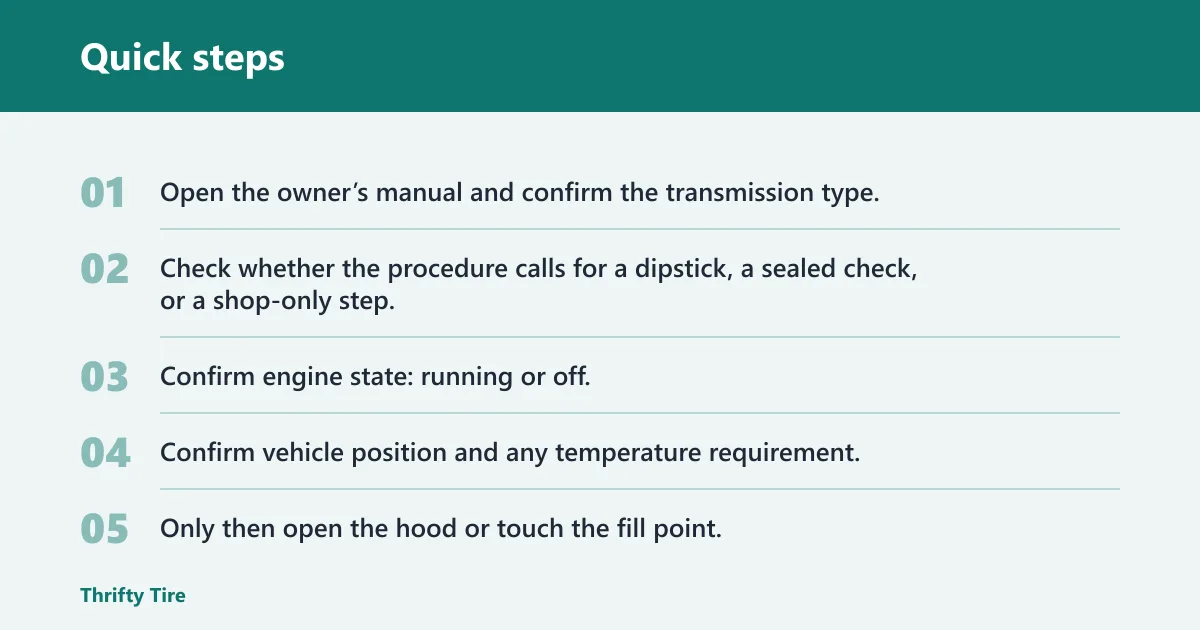
- Open the owner’s manual and confirm the transmission type.
- Check whether the procedure calls for a dipstick, a sealed check, or a shop-only step.
- Confirm engine state: running or off.
- Confirm vehicle position and any temperature requirement.
- Only then open the hood or touch the fill point.
How do you check transmission fluid with a dipstick?
For a traditional automatic transmission, warm the vehicle if the manual calls for it, fully engage the parking brake, and keep the engine running if required. Shift through the gears if the manual asks for that step, then return to Park or the specified position before reading the dipstick. Work on level ground. For quick symptom checks, see our transmission slipping symptoms guide.
Find the dipstick and read it the right way
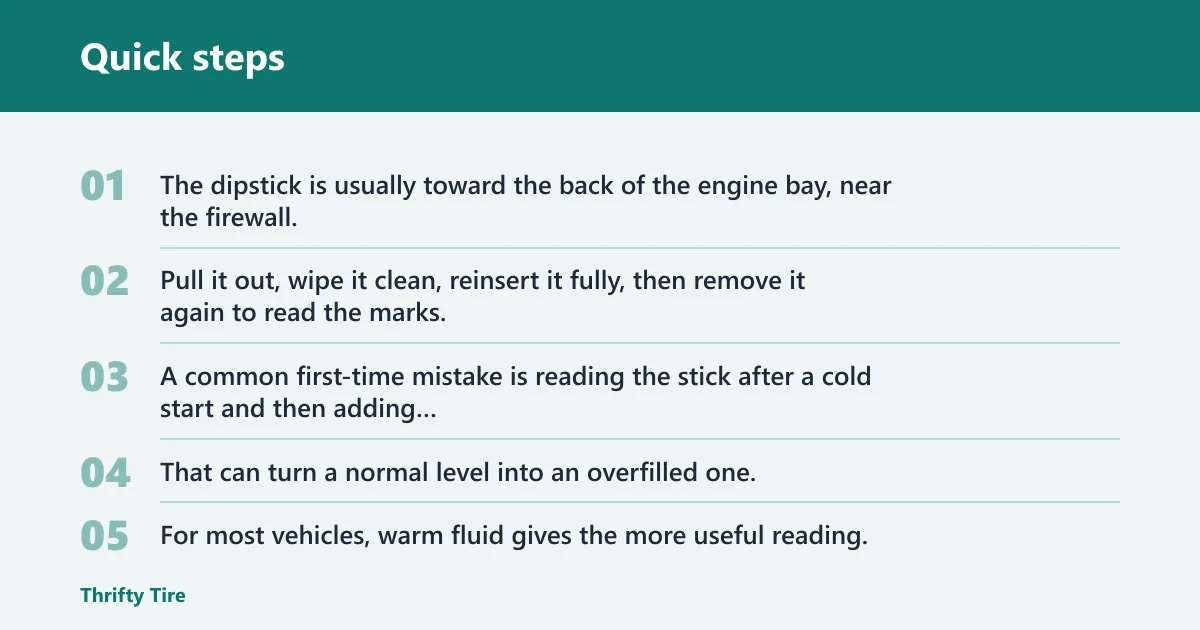
The dipstick is usually toward the back of the engine bay, near the firewall. Pull it out, wipe it clean, reinsert it fully, then remove it again to read the marks. Many dipsticks have MIN and MAX marks. The fluid should usually sit between them.
A common first-time mistake is reading the stick after a cold start and then adding fluid right away. That can turn a normal level into an overfilled one. For most vehicles, warm fluid gives the more useful reading.
Some procedures say the shifter should move through Park, Reverse, Neutral, Drive, and lower gears before the final reading. That circulates fluid through the valve body and passages. The parking brake should stay fully engaged during the whole check.
What if the dipstick is hard to find?
If you cannot find the dipstick, do not keep guessing around the engine bay. Some vehicles hide the stick low and rearward, while others do not have an owner-access dipstick at all. A missing handle is a strong clue that the transmission is sealed.
What does the fluid on the dipstick tell you?
Healthy transmission fluid is typically bright red to dark red and nearly transparent. Color alone is not the whole story, but it gives a quick condition check. A burnt smell is a warning sign of transmission damage, and grit or metal particles point to internal wear or contamination. If the level is high and the transmission shows symptoms, see our overfilled transmission signs guide.
| What you see or smell | What it usually means | What to do next |
|---|---|---|
| Bright red to dark red, nearly transparent | Fluid is generally in healthy condition | Confirm the level is between MIN and MAX |
| Burnt smell | Possible overheating or damage | Stop and arrange a professional inspection |
| Grit or metal particles | Possible internal wear or failure | Do not top off and hope for the best; get the transmission checked |
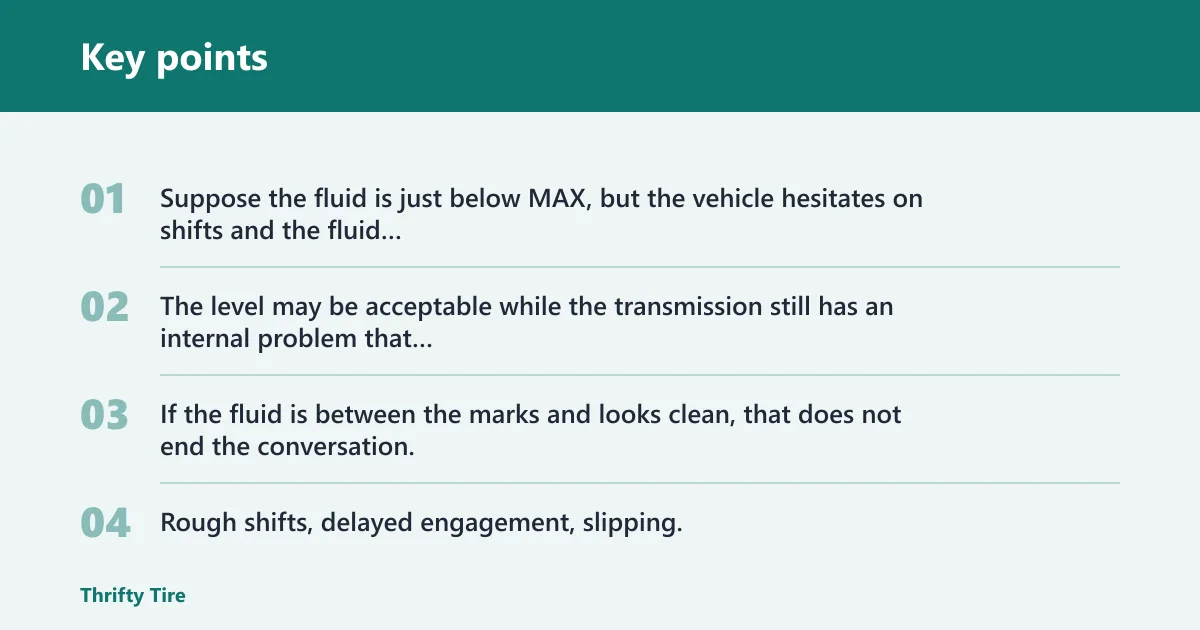
Suppose the fluid is just below MAX, but the vehicle hesitates on shifts and the fluid smells burnt. That is not a simple top-off situation. The level may be acceptable while the transmission still has an internal problem that needs diagnosis.
If the fluid is between the marks and looks clean, that does not end the conversation. Symptoms matter. Rough shifts, delayed engagement, slipping, or warning lights mean you should stop and verify the correct procedure or have the system inspected.
What if your car has no dipstick?
If your car has no dipstick, it may have a sealed transmission. Some vehicles do not have a transmission dipstick at all. In that case, there is no universal owner check, and the correct procedure depends on the exact model year and transmission design. For service setup and access details, review our sealed transmission service page.
Sealed transmissions may require diagnostic tools and a lift for checking. That is not the same as opening a plug and guessing at the level. A generic check can give a bad result and a bad refill.
Do not assume a sealed unit uses the same method as a conventional automatic. If the manual points to a service-fill or overflow procedure, follow that exact process or send the job to a dealership or qualified shop.
When in doubt, stop before adding fluid. A wrong check on a sealed unit can create more trouble than a low level ever would. If the vehicle has symptoms and no owner dipstick, professional diagnosis is the safer route.
Frequently asked questions
Is there a dipstick for transmission fluid?
Sometimes, but not always. Many older and some current automatics use a dipstick, while many sealed transmissions do not. The owner’s manual confirms whether your vehicle has an owner-access stick or a different service procedure. If the manual does not mention a dipstick, do not assume one exists.
Where is the transmission fluid dipstick?
It is often toward the back of the engine bay, near the firewall, but placement varies by make and model. Some dipsticks are easy to see, while others are tucked low or hidden. If you cannot find it quickly, check the owner’s manual before assuming the vehicle is low on fluid.
Do I add transmission fluid through dipstick?
Only if the manual allows it. Some automatics use the dipstick tube for adding fluid, but you should never top off based on a false low reading from the wrong temperature or engine state. Add small amounts, recheck, and stop if the level conflict does not make sense.
How do I know if my car has a transmission dipstick?
Check the owner’s manual first. If it lists a dipstick procedure and shows a check point near the engine bay, the vehicle likely has one. If it gives a sealed-transmission procedure, or says to use a shop or special tools, there may be no owner-access dipstick at all.