Coolant vs Antifreeze: What’s the Difference?
Coolant is the fluid that circulates through the cooling system and carries heat to the radiator. Antifreeze is usually the concentrated base, or a product label for that same fluid, and you need the right bottle type, prediluted or concentrate, to match how you plan to fill the system. Buying the wrong format can leave you with an overmixed or undermixed fill that hurts freeze protection, boil protection, and corrosion control. This guide explains bottle labels, mix ratios, and how to top off without choosing the wrong product.
| Decision factor | Coolant | antifreeze | Winner |
|---|---|---|---|
| What it usually means on a bottle | Ready-to-use fluid or the in-service fluid already in the system | Often the concentrate or chemical base used to make coolant | Coolant |
| Best fit for a simple top-off | Better when the bottle says 50/50 or ready-to-use | Needs attention, because many antifreeze bottles are concentrate | Coolant |
| Best fit for a full refill | Works if it matches the vehicle spec and is the right premix | Works if you are mixing to the correct ratio with water | tie |
| Label clarity for most drivers | Usually clearer when the bottle says 50/50, prediluted, or ready-to-use | More likely to require reading the back label for mix instructions | Coolant |
What coolant and antifreeze mean
Coolant is the fluid that moves through the cooling system to absorb heat, carry it to the radiator, and help protect the engine from boiling, freezing, and corrosion. Antifreeze is the chemical base or label language many bottles use, and it is commonly ethylene glycol or propylene glycol mixed with water for use in the vehicle. (Wikipedia)
The naming confusion happens because people use both words for the same service fluid, and many retail labels use the terms interchangeably. A bottle may still be concentrate or ready-to-use, so read the label instead of relying on the name alone.
How the terms get mixed up
In normal use, the fluid in the car is coolant. On a store shelf, antifreeze may mean the base chemical, the label family, or the concentrate version of a coolant product. That is why the same shopping trip can produce two very different fills if you do not read the label.
Coolant also does more than move heat. It helps limit rust and corrosion, and the correct mix helps the system handle hot and cold conditions.
Do you need coolant or antifreeze?
For most drivers, the real question is not which word to use. It is whether you need a top-off, a drain-and-fill, or a full flush, because that determines whether you should buy a premixed coolant or a concentrate that must be diluted.
Top-off versus full refill
If the reservoir is only slightly low and the vehicle calls for a premix, a 50/50 coolant bottle is usually the straightforward choice. If the system is being refilled after a service, you need the exact specification the vehicle calls for and the right format to reach the proper mix.
Say your expansion tank is one quart low after a long highway trip, and the owner’s manual specifies a premixed coolant. A 50/50 bottle fits that job better than concentrate, because you do not need to measure water separately.
Why the owner’s manual matters
Different vehicles call for different coolant families. IAT coolant is common in older cars, while OAT coolant lasts longer. HOAT combines elements of both IAT and OAT, so the manual matters more than the bottle’s marketing language.
Universal antifreeze and coolant products are sold for broad compatibility, but the exact fit still depends on the vehicle spec and the bottle label. Check the coolant spec listed by the vehicle maker, then match the product to that spec before you pour.
What to check before you buy
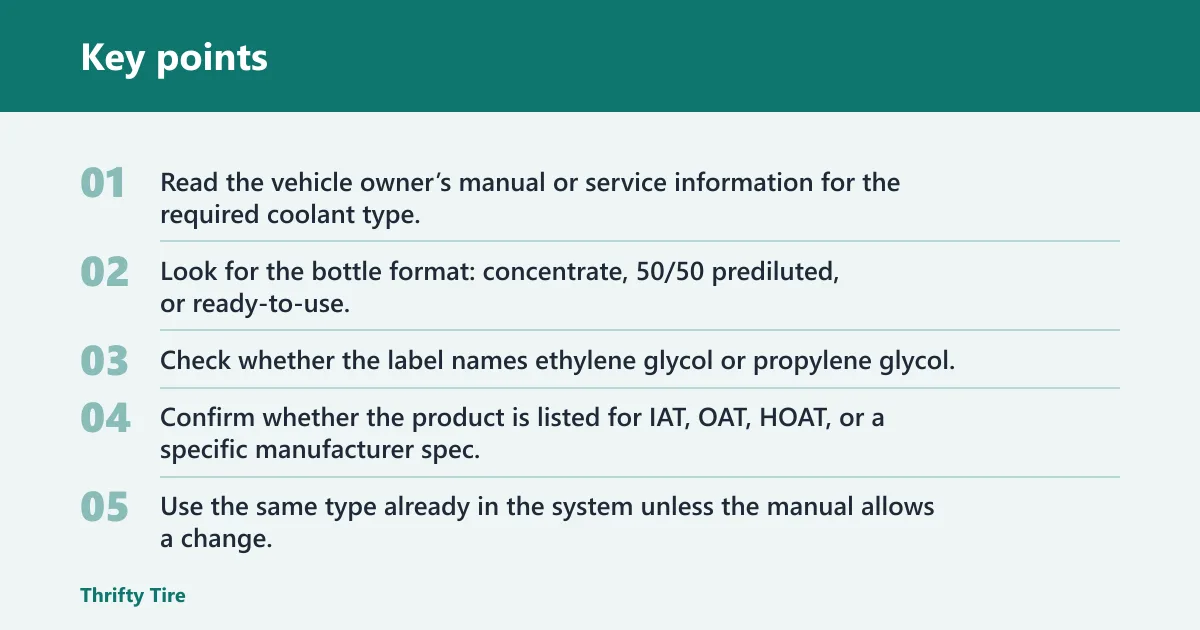
- Read the vehicle owner’s manual or service information for the required coolant type.
- Look for the bottle format: concentrate, 50/50 prediluted, or ready-to-use.
- Check whether the label names ethylene glycol or propylene glycol.
- Confirm whether the product is listed for IAT, OAT, HOAT, or a specific manufacturer spec.
- Use the same type already in the system unless the manual allows a change.
Coolant vs antifreeze label decoder
| Bottle wording | Likely product format | Needs dilution? | Typical use case | What to check before topping off |
|---|---|---|---|---|
| Coolant | Often ready-to-use 50/50, sometimes a product family name | No, if it says prediluted or ready-to-use | Top-off or refill when the vehicle calls for premix | Look for 50/50, vehicle spec, and coolant family |
| Antifreeze | Often concentrate or chemical base | Yes, in many cases | Mixing a refill to the proper ratio | Check the back label for dilution instructions and water type |
| 50/50 coolant | Prediluted ready-to-use product | No | Simple top-off or full fill in vehicles that call for premix | Verify the coolant family and the vehicle’s required spec |
| Universal antifreeze and coolant | Either premix or concentrate | Maybe | Broad-compatibility shopping when the manual allows it | Confirm whether it is prediluted or concentrate, and confirm fitment |
| Concentrate | Antifreeze base | Yes | Full refill when you need to mix to spec | Use the correct water mix and do not guess the ratio |
How to read the label
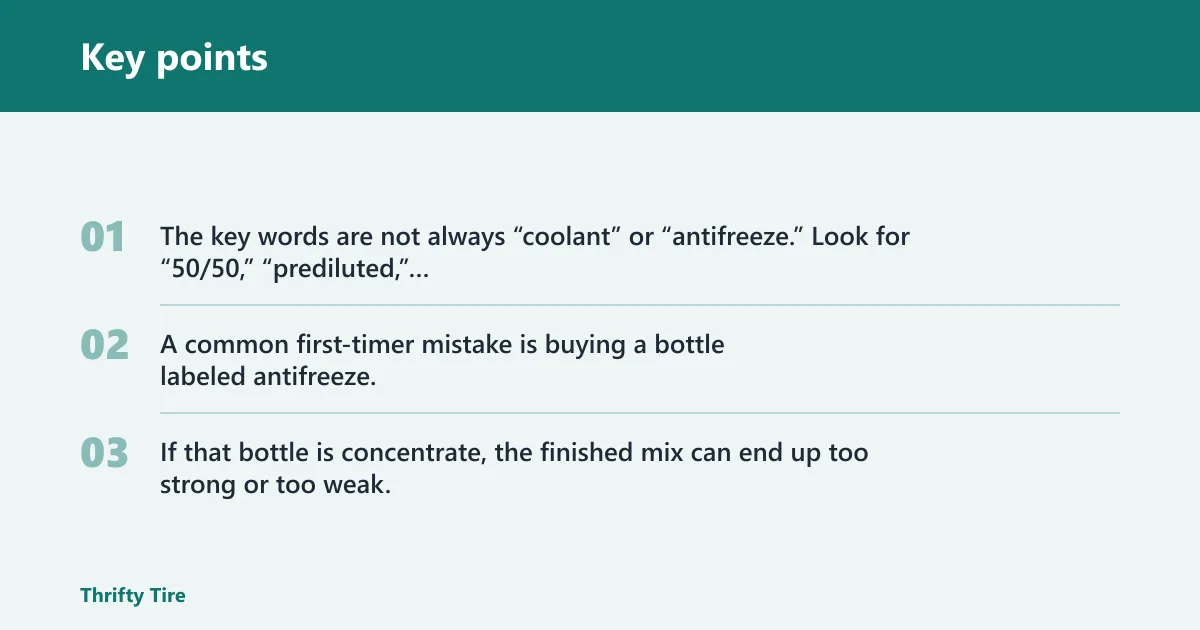
The key words are not always “coolant” or “antifreeze.” Look for “50/50,” “prediluted,” “ready-to-use,” or “concentrate.” Those words tell you whether water is already in the bottle or whether you must add it yourself.
A common first-timer mistake is buying a bottle labeled antifreeze, then pouring it in straight. If that bottle is concentrate, the finished mix can end up too strong or too weak, depending on what was already in the system.
Why many bottles say 50/50
A 50/50 coolant mix is common because it balances protection and ease of use. A 50/50 coolant-to-water mix raises the boiling point to about 265°F in a properly pressurized cooling system and lowers the freezing point to about -34°F, which is enough for many passenger vehicles and light-duty applications.
Ready-to-use versus concentrate
Prediluted coolant is mixed at the factory, so you can pour it in as-is. Concentrate gives you more control over the mix, but it also adds the risk of using the wrong ratio if you do not measure carefully.
Why the water matters is simple: coolant chemistry alone does not do the whole job. Water helps carry heat, and the antifreeze chemical helps with freeze protection, boil protection, and corrosion control.
Where 50/50 fits best
Use 50/50 coolant when the vehicle calls for a premix or when you want a simple top-off that matches the system’s current fill type. Use concentrate when the service procedure calls for a specific mix and you are prepared to add the correct amount of water.
What types of coolant are there?
The main coolant families are IAT, OAT, and HOAT, and they are not interchangeable by default. IAT coolant is common in older cars, OAT lasts longer, and HOAT combines elements of both.
IAT coolant
IAT is the older-style coolant family. It is often found in older vehicles and has a shorter service life, so it is a poor guess-and-pour choice if the vehicle spec does not call for it.
OAT coolant
OAT is a long-life coolant family. Many modern vehicles use it because the service interval is longer, but the exact application still depends on the manufacturer’s requirements.
HOAT coolant
HOAT blends elements of IAT and OAT. It exists because some cooling systems need a middle ground between older inhibitor packages and longer-life formulas.
Universal antifreeze and coolant
Universal antifreeze and coolant products are sold for broad compatibility. Some are prediluted, some are concentrate, and some claim extended life, such as a product marketed for 300,000 miles or 10 years of maximum protection; even then, the vehicle manual still comes first.
Prestone Universal Antifreeze + Coolant is sold as 50/50 prediluted, and the same product also lists a concentrate version. That split shows why the bottle wording matters more than the generic “universal” claim.
Can you use universal coolant?
Universal coolant can be a workable choice when the product label matches the vehicle spec and the format matches your job. It is not a blanket pass for every car, because the cooling system may call for a specific chemistry or a specific service life.
What universal labels usually mean
Universal usually means the product is marketed for a wide set of vehicles. That can make shopping easier, but it does not erase the need to verify the exact spec on the bottle and in the manual.
When to avoid guessing
A wrong coolant type can reduce corrosion protection or create compatibility issues that force a full flush to correct. If the system already has a specific coolant family in it, match that family unless the manufacturer says you can switch.
Suppose a sedan calls for a specific OAT coolant and the shelf tag only says universal. That is not enough information by itself. You still need the back label, the vehicle spec, and the current coolant type already in the system.
Does coolant color matter?
Color alone is not a reliable universal guide for identifying whether coolant is IAT, OAT, HOAT, concentrate, or a 50/50 mix. Two bottles with the same color can use different chemistry, and two different colors can still point to compatible products depending on the manufacturer, so label wording matters more than appearance.
Why color can mislead
Color is often used for marketing and product grouping, not as a universal standard. That means green, orange, yellow, blue, or pink coolant color alone does not tell you whether the product is IAT, OAT, HOAT, concentrate, or 50/50.
What matters more than color
Look for the type listed on the label, the mix format, and the vehicle approval or recommendation. Also check whether the product is ethylene glycol or propylene glycol based, since some formulas use the less toxic propylene glycol instead of ethylene glycol.
How to confirm the right product
Start with the owner’s manual, then match the bottle wording. If the vehicle calls for a specific coolant type, do not rely on the color on the shelf or on a vague “for all vehicles” claim alone.
Choose coolant if…
Choose Coolant if you want the straightforward in-service fluid, especially for a top-off or a ready-to-use fill. It is the better choice when the bottle says 50/50, prediluted, or ready-to-use and the vehicle calls for that format.
Choose antifreeze if…
Choose antifreeze if you are buying the concentrate version and you plan to mix it to spec before filling. That is the right call when the label clearly says concentrate and the service procedure expects you to add water yourself.
For the practical decision, the label beats the word. If the bottle is prediluted, use it as coolant; if it is concentrate, treat it as antifreeze base and mix it correctly before adding it to the system.
Frequently asked questions
What is the difference between coolant and antifreeze?
Coolant is the fluid in the cooling system, while antifreeze is usually the chemical base or label language on a bottle. In practice, the difference is often format: coolant may mean a ready-to-use mix, while antifreeze often points to concentrate that must be diluted.
Is antifreeze the same as coolant?
They are often used interchangeably in stores, but they are not always the same bottle format. Antifreeze commonly refers to the base chemical, such as ethylene glycol or propylene glycol, while coolant is the finished fluid that circulates in the engine.
Do I need coolant or antifreeze for my car?
Check the owner’s manual and match the product to the fill job. If you need a simple top-off, a 50/50 coolant bottle may be the best fit; if you are refilling from concentrate, you need antifreeze plus the correct amount of water.
Why is antifreeze sold as 50/50 coolant?
Because many vehicles use a premixed product that is ready to pour in. A 50/50 mix raises boiling protection to about 265°F and lowers freezing risk to about -34°F, which is why it is common for everyday driving conditions.
What does the coolant color mean?
Color alone is not a dependable fitment guide. It can hint at a product line, but it does not reliably tell you whether the fluid is IAT, OAT, HOAT, concentrate, or premixed, so the label and the manual matter more.
What happens if I use the wrong coolant type?
You can lose corrosion protection, create compatibility problems, or end up needing a full flush to correct the system. The wrong type may also defeat the service life the vehicle expects, which is why matching the spec matters more than matching the color.