What Does Cold Tire Pressure Mean on the Door Sticker?
“Cold tire pressure” on the door sticker is the PSI your tires should be set to when they are cold, meaning the car has sat for several hours or driven less than a mile. Ignore it and you can mistake a normal temperature drop for a leak, or run the tires underinflated. This guide explains how to read the sticker, when to check pressure, and how to tell weather-related shrinkage from a tire problem.
What the door sticker means
What is the tire and loading information label?
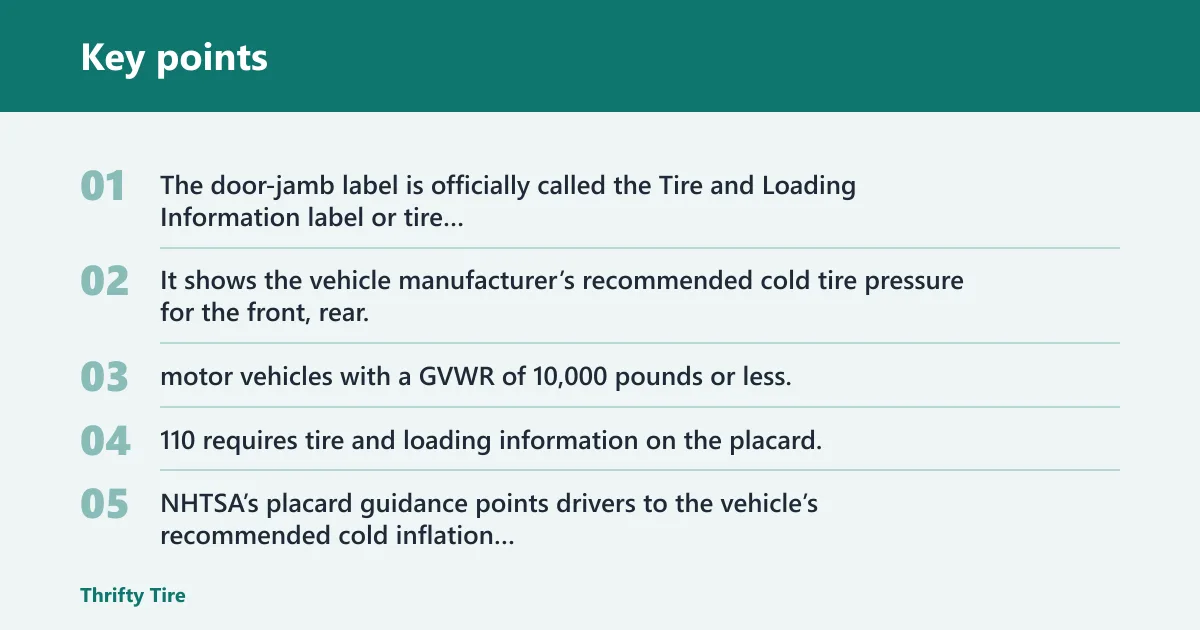
The door-jamb label is officially called the Tire and Loading Information label or tire placard. It shows the vehicle manufacturer’s recommended cold tire pressure for the front, rear, and sometimes spare tires, along with the original tire size, seating capacity, and the combined occupant-and-cargo limit.
For U.S. motor vehicles with a GVWR of 10,000 pounds or less, Federal Motor Vehicle Safety Standard (FMVSS) No. 110 requires tire and loading information on the placard. NHTSA’s placard guidance points drivers to the vehicle’s recommended cold inflation pressure rather than the tire sidewall, because that label is set for the specific vehicle load and setup.
Why the listed PSI can differ front to rear
Front and rear tires do not always carry the same load. A front-heavy vehicle, a rear cargo area, or a towing setup can change the recommended pressure by axle. That is why the placard may list two different PSI numbers, or PSI and kPa, instead of a single value for all four tires.
If the numbers differ a lot, do not treat that as a typo. It is the vehicle maker telling you how that chassis should be inflated in normal use. The owner’s manual can add vehicle-specific guidance for load or towing conditions when the placard alone is not enough.
Where does the owner’s manual fit in?
The owner’s manual is the next place to check when the placard does not cover your exact situation. It can explain load, towing, spare-tire use, or other vehicle-specific conditions that affect inflation guidance.
Cold tire pressure vs. sidewall PSI
What’s the difference between sticker PSI and sidewall PSI?
The sticker number is the vehicle maker’s recommended cold inflation pressure. The sidewall number is the tire maker’s maximum inflation pressure, not the vehicle’s normal operating target. For daily driving, the sticker wins.
That difference matters because a sidewall maximum is a limit, not a routine fill target. Use the placard for normal inflation. Use the sidewall only to understand the tire’s ceiling, not where to set pressure day to day.
Why the sticker wins for daily driving
The vehicle maker sets the placard pressure around ride, handling, wear, and load. The tire maker sets the sidewall maximum around what the tire can safely contain. Those are different jobs. Filling to the sidewall max can leave you with a tire that is overinflated for the vehicle.
Suppose your placard says 35 PSI front and 33 PSI rear, while the tire sidewall says 44 PSI max cold. The correct daily target is still 35 and 33, not 44 all around. The higher number does not replace the sticker.
What does cold tire pressure mean?
When are tires considered “cold”?
Cold tire pressure means the tire has not been warmed by driving and has had time to settle near the outside air temperature. In practice, that usually means checking pressure before the vehicle has driven more than a mile or two, or after it has sat long enough overnight for the tires to cool.
Temperature changes pressure. A common rule of thumb is about 1 PSI for every 10 degrees Fahrenheit, but that varies with the tire, the starting pressure, and how the vehicle’s TPMS is calibrated. A cold snap can lower the reading enough to trigger TPMS warnings even when the tire has no puncture.
How cold is cold enough to check
Check pressure before the tires warm up from road use. If you have driven to a gas station or work, the reading will be higher than the true cold value. That can hide an underinflation problem if you add air based on a hot reading.
The safest approach is to check when the tires are cold, ideally before driving more than a mile or two. That is the best way to match the placard number and avoid chasing a moving target caused by heat from the road.
How to check pressure the right way
What is the correct checking process?
Use a gauge on cold tires. Then compare the reading to the door sticker. That simple sequence gives you the actual PSI, not the guesswork from a dashboard light or a warm tire.
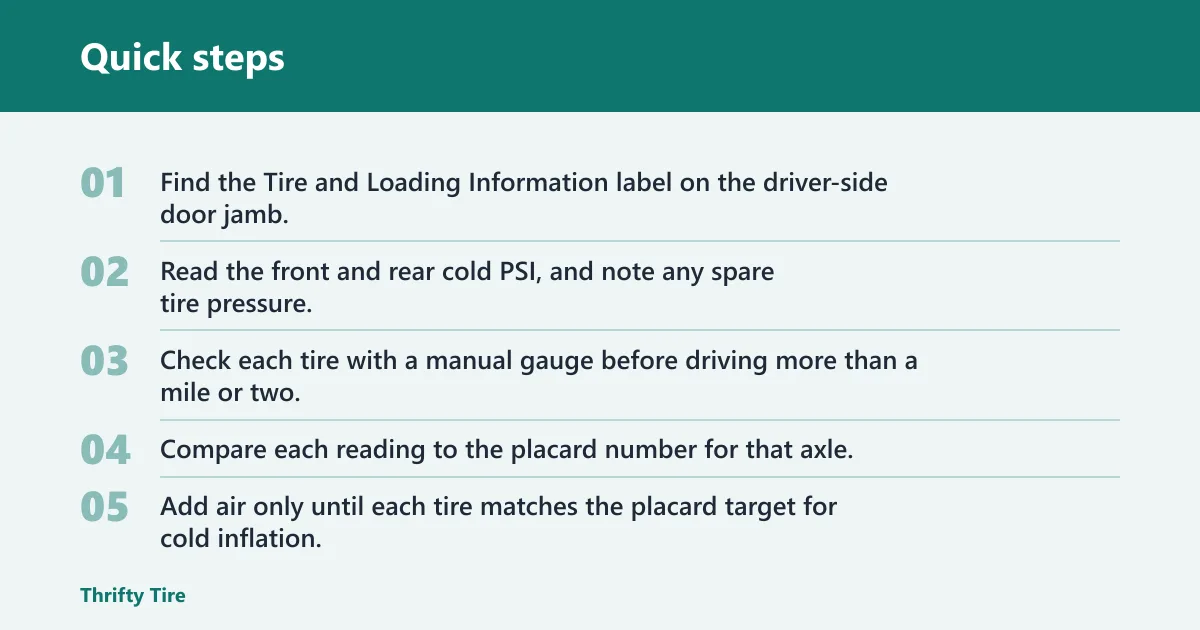
- Find the Tire and Loading Information label on the driver-side door jamb.
- Read the front and rear cold PSI, and note any spare tire pressure.
- Check each tire with a manual gauge before driving more than a mile or two.
- Compare each reading to the placard number for that axle.
- Add air only until each tire matches the placard target for cold inflation.
- If your vehicle has TPMS, confirm whether the light clears or whether a reset is needed after adjustment.
TPMS is a warning system, not a precision inflator. Depending on the vehicle, the warning may come on when one or more tires fall below a calibration threshold rather than telling you the exact PSI for each wheel. The gauge gives the number you actually need.
A common first-timer mistake is topping off a warm tire to match the sticker without waiting for it to cool. That can leave you underinflated the next morning. If the tire is warm, treat the reading as temporary and recheck it cold.
What should you check in the owner’s manual?
The owner’s manual can override generic advice when the vehicle has alternate tire sizes, heavy loads, or towing conditions. The placard is the starting point, but the manual may tell you to use a different setting for those cases.
That matters on vehicles with non-stock wheel setups too. If the tire size on the car does not match the original tire size on the placard, follow the vehicle-specific guidance before changing pressure.
Why the tire light comes on in cold weather
Why does the tire light come on when temperatures drop?
A TPMS warning often appears after a temperature drop because the air inside the tire contracts. That can push pressure low enough to turn on the light even when no tire is damaged. The low-pressure warning is a prompt to check, not proof of a puncture.
Do not assume the light means a flat tire. It can mean normal weather-related shrinkage, a slow leak, or damage. A gauge is the only way to separate those possibilities with confidence.
What TPMS can and cannot tell you
TPMS is a warning system. Some vehicles show per-tire readouts, but many only alert you when one or more tires fall below a threshold. That means the light can warn you without telling you the exact PSI on every wheel.
The warning symbol is usually a yellow or amber horseshoe-shaped icon with an exclamation mark. That symbol tells you to check pressure, not to guess at the correction. If the light stays on after you set the tires to the placard pressure, inspect for damage or seek service.
Can you rely on TPMS instead of a gauge? No. TPMS helps catch underinflation, but it does not replace a manual check. The gauge confirms whether the tire is at the door-sticker target.
Normal drop or likely leak?
Cold weather usually affects all four tires in a similar way. If every tire is a little low after a cold snap, the cause is often temperature change. If one tire is much lower than the others, look harder for a nail, valve issue, bead leak, or sidewall damage.
Picture a sedan with a placard of 35 PSI front and rear. After a cold morning, all four read 32 PSI. That looks like weather shrinkage. If the left rear reads 27 PSI while the others stay near 32, that tire deserves a closer inspection.
Door Sticker PSI vs. cold morning reading
| Sticker PSI | Current gauge reading | Temperature change | Likely cause | Next action |
|---|---|---|---|---|
| 35 front / 33 rear | 32 front / 30 rear | Cold snap, about 20°F lower | Normal temperature-related pressure drop | Add air to the placard target when tires are cold, then recheck |
| 35 front / 33 rear | 32, 32, 32, 27 | Same cold morning, one tire much lower | Likely slow leak or damage in one tire | Inspect the low tire for puncture, valve leak, or sidewall damage |
| 35 front / 33 rear | 39 after highway driving | Warm tire from road use | Heat raised the reading above the cold target | Do not bleed air to match this warm reading; recheck cold later |
When the sticker is not the whole answer
When should you rely on more than the placard?
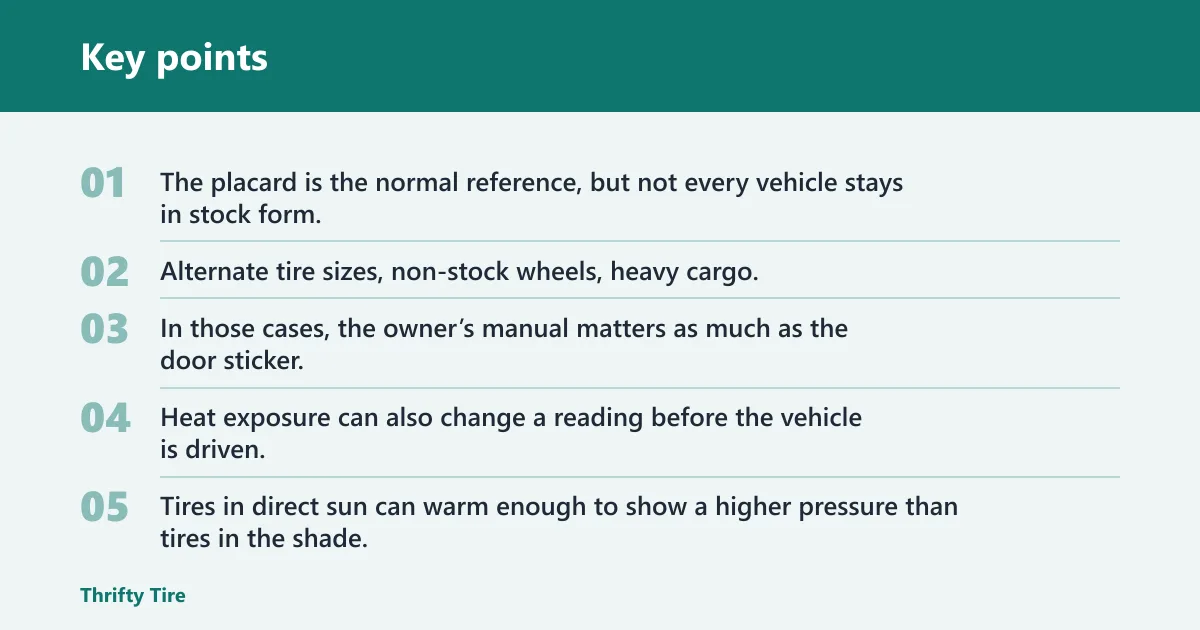
The placard is the normal reference, but not every vehicle stays in stock form. Alternate tire sizes, non-stock wheels, heavy cargo, and towing can change the right pressure target. In those cases, the owner’s manual matters as much as the door sticker.
Heat exposure can also change a reading before the vehicle is driven. Tires in direct sun can warm enough to show a higher pressure than tires in the shade. That is another reason to avoid setting pressure from a warm tire.
How does the owner’s manual help with load or tow conditions?
The manual may list pressure changes for hauling passengers, carrying cargo, or towing. Do not assume the everyday placard setting is right for every load. When the vehicle is loaded differently from normal, follow the vehicle-specific instruction that applies to that use.
If the car has non-stock tires, the placard still tells you the factory baseline, but the tire maker’s load tables and the vehicle manual may become more important. That is especially true when the original tire size is no longer on the vehicle.
Frequently asked questions
What does cold tire pressure mean on the door sticker?
It means the PSI the vehicle maker wants when the tires are cold, before driving warms them up. That number is the daily baseline for the front, rear, and sometimes spare tires. It is the starting point for normal inflation, not a hot-road reading.
Is the PSI on the door sticker the pressure I should use when it’s cold?
Yes. The door sticker gives the recommended cold inflation pressure for normal driving. Check it with a gauge before the tires warm up, then add air until each axle matches the placard target. Do not use the tire sidewall maximum as the routine fill number.
Why does my tire pressure light come on when it gets cold?
Cold air lowers tire pressure, often by around 1 PSI for every 10 degrees Fahrenheit, though the exact change varies. That can push a tire below the TPMS warning threshold even if there is no puncture. Check the tires with a gauge and compare them with the door sticker before assuming there is damage.
What’s the difference between the door sticker PSI and the tire sidewall PSI?
The door sticker shows the vehicle maker’s recommended cold pressure for daily use. The sidewall shows the tire maker’s maximum inflation pressure, not the normal operating target. Use the sticker for inflation, and use the sidewall as a limit, not a routine setting.
How cold do tires need to be before I check pressure?
Check them before driving, or after they have sat long enough to cool to ambient temperature. If the tires are warm, the reading will be higher than the true cold baseline. A short drive can already change the number enough to matter.
What should I do if one tire is much lower than the others in cold weather?
Add air only after checking that tire with a gauge, then inspect it if the gap is large or keeps returning. A single tire that is much lower than the others is more likely to have a leak or damage than to be reacting only to temperature.