What Are the Symptoms of Low Transmission Fluid?
Low transmission fluid can cause delayed shifts, slipping, shuddering, whining, a burning smell, leaks, overheating, and warning lights. If you see a leak, a warning light, or the transmission stops engaging, treat it as same-day or stop-driving urgent. Ignoring it can overheat the transmission and turn a fluid issue into internal damage. This guide groups symptoms by urgency so you know what is mild, what needs a same-week inspection, and what means stop driving now.
The most common symptoms of low transmission fluid are slipping, delayed engagement, hard or jerky shifts, whining or humming, a burning smell, leaks, overheating, and warning lights. In practical terms, monitor mild slipping or noise, get service soon for delayed engagement, hard shifts, or visible leaks, and stop driving now for a strong burning smell, grinding, overheating, or major slipping.
Low-fluid symptoms feel like
Low fluid usually means lower hydraulic pressure, weaker lubrication, and more heat. Those problems can trigger several symptoms at once, so the vehicle may slip, shift late, or make noise before any puddle appears. The same symptoms can also come from dirty, aerated, overheated, or internally damaged fluid.
How slipping and delayed shifts start
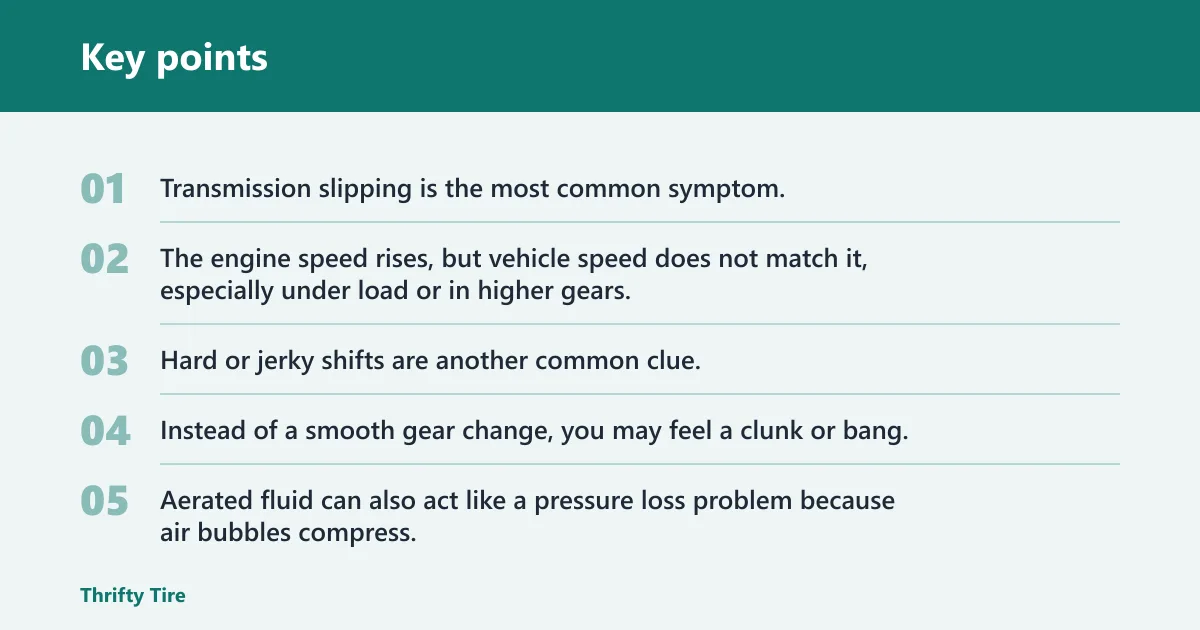
Transmission slipping is the most common symptom. The engine speed rises, but vehicle speed does not match it, especially under load or in higher gears. Delayed engagement often feels like a pause after selecting Drive or Reverse, which usually points to low hydraulic pressure.
Hard or jerky shifts are another common clue. Instead of a smooth gear change, you may feel a clunk or bang. That can mean the transmission is losing pressure, the fluid is too hot, or lubrication is no longer doing its job.
Why one symptom can mean more than one fault
Dirty fluid can look like low fluid because contaminated fluid moves poorly and protects internal parts less effectively. Aerated fluid can also act like a pressure loss problem because air bubbles compress. Overheated fluid may smell burnt and shift badly even when the level is near normal. If the unit is already damaged, topping off fluid may not change the symptom pattern much at all.
Picture a sedan that hesitates when shifted into Reverse, then clunks into gear and later whines on a hill. That pattern points more toward pressure loss than a single bad shift event. If a burning smell joins the list, the concern rises fast.
Transmission fluid urgency matrix
| Symptom | Usual clue | More likely cause | Action |
|---|---|---|---|
| Light slipping on acceleration | Engine revs rise before speed does | Low fluid first, but dirty fluid or wear can also do it | Service soon |
| Delayed engagement | A pause in Drive or Reverse | Low hydraulic pressure | Service soon |
| Hard or jerky shifts | Clunk, bang, or harsh gear change | Low fluid, dirty fluid, or overheating | Service soon |
| Whining or humming | Noise rises with speed or load | Low fluid, aeration, or pump cavitation | Service soon |
| Leak with no major symptoms yet | Red or brown fluid near pan, seals, or cooler lines | Low fluid from an external leak | Service soon |
| Burning smell | Hot, acrid odor after driving | Overheated fluid | Stop driving now |
| Grinding noise | Metal-on-metal sound | Internal damage or severe lack of lubrication | Stop driving now |
| Warning light plus severe symptoms | Check-engine or transmission light with slip, heat, or noise | Pressure fault, ratio fault, overheating, or damage | Stop driving now |
This matrix separates warning signs that justify a same-week inspection from signs that mean you should stop driving. The most important distinction is whether the symptom looks like a pressure or leak issue, or whether it already points to heat, grinding, or internal damage. A mild slip may still be service soon, but a burning smell, grinding, or a major loss of drive should be treated as stop driving now.
Which symptoms point to low fluid first?
Slipping, delayed engagement, and hard shifts are the first symptoms many drivers notice. They are the clearest low-fluid clues because they track directly with hydraulic pressure and lubrication loss. If those symptoms appear alone or with a small leak, low fluid rises to the top of the list.
Transmission slipping
Slipping is the classic early warning. It often shows up during acceleration, while climbing a hill, or when the transmission shifts into a higher gear. The engine sounds busy, but the car does not pull as strongly as expected. That usually suggests pressure loss, though worn clutches or dirty fluid can produce a similar feel.
Delayed engagement
A pause after shifting into Drive or Reverse often means the transmission is taking extra time to build pressure. If the delay grows longer, or if it becomes inconsistent, the chance of low fluid, a restricted pickup, or internal wear goes up. A short delay with no other symptoms usually points to service soon rather than immediate stop driving.
Hard or jerky shifts
Hard shifts can feel like the transmission is hitting each gear instead of gliding into it. Low fluid can cause that, but so can dirty or overheated fluid. If the shifts also slip or delay, the case for low fluid gets stronger. If the harshness is joined by a burning smell, the concern moves toward overheating.
Which warning signs mean stop driving now?
Burning smell, grinding noise, overheating, and severe slipping are the red flags. A strong burnt odor, grinding, a major leak, or a transmission that stops engaging means you should stop driving. At that point, continuing to drive can damage clutches, seals, and the pump very quickly.
Burning smell and overheating
A hot, acrid odor often means the fluid is overheated. Heat breaks down fluid fast, and every extra mile can make the damage worse. Overheated fluid may still move through the system, but it loses the protection needed to keep clutches and seals alive for long.
Grinding noise
Grinding is more serious than whining or humming. It often means metal is contacting metal, or the pump is cavitating because it is not getting enough fluid. That is a stop-driving-now symptom, not a wait-and-see symptom.
Transmission warning light
A transmission warning light or check-engine light can sometimes mean a pressure fault, ratio fault, or overheating condition. An OBD-II scan tool is often needed to read the transmission codes. If the light appears with slipping, harsh shifts, or heat, the safest move is to stop driving and have the vehicle checked.
Suppose a crossover starts to shudder on the highway, then shows a transmission warning light and a burnt smell. That is not a case for hoping the light goes away. It needs immediate inspection, because the heat and friction may already be harming the unit.
Where do transmission fluid leaks show up?
Leaks often show up at cooler lines, the pan, the drain plug, and seals. The fluid may be red or brown. Low fluid can also exist without a driveway puddle, because some leaks only show while driving or collect on an undertray instead of the ground.
Common leak points
- Cooler lines and fittings.
- Pan gasket or pan edge.
- Drain plug and crush washer.
- Front or rear seals.
- Axle seals on some transaxles.
Hidden leaks matter
Do not assume the absence of a puddle means the level is fine. An undertray can trap fluid, and airflow can spread a leak so it never lands in one obvious spot. A leak that appears only while driving may leave little or no evidence where the car was parked.
A common first-timer mistake is checking for a spotless driveway and deciding there is no leak. A sealed undertray can hide the evidence. Look at the pan edges, line connections, and the underside of the car, not just the parking spot.
How do you check the fluid level correctly?
Vehicle-specific procedure matters. Some transmissions use a dipstick, while others use a controlled fill arrangement. The exact service information, fluid spec, and fluid temperature all matter. Using the wrong procedure can create a false reading or lead to the wrong fluid being added.
-
Confirm the exact transmission type.
Check the owner’s manual or service information to identify whether the unit is dipstick-equipped, sealed, CVT, automatic, or manual. The wrong procedure can give a false level reading or lead to the wrong fluid being added.
-
Set the vehicle in the correct condition.
Many checks require the engine running, the transmission warm, and the selector cycled through the gears before the reading is taken. The position of the shifter and fluid temperature affect how much fluid sits in the pan and how the level reads.
-
Use the specified fluid only.
Fill with the exact fluid spec for that transmission. A close-looking fluid may still have the wrong friction properties, which can create slipping, shudder, or shifter complaints that look like a low-level problem.
-
Inspect for leaks after checking.
If the level is low, inspect the pan, cooler lines, seals, drain plug, and undertray before topping off. A top-off may help short term, but it does not solve a leak or internal fault.
Dipstick-equipped transmissions
Use the manufacturer’s warm-check procedure if a dipstick is present. Some units read low when cold and normal when hot, while others require the engine to be idling in Park or Neutral. The exact method matters more than the label on the dipstick handle.
Sealed transmissions and fill procedures
Sealed units usually require checking through a fill or overflow plug at a specific temperature. That procedure is not universal. Some transmissions use a dipstick while others use a controlled fill arrangement, so the correct service information must match the exact transmission.
What should you do next?
Act based on severity. A small slip, a mild leak, or a slight delay often calls for a same-week inspection. A strong burning odor, grinding, major slipping, or overheating usually means to stop driving now. If the vehicle only needs a top-off, use the exact fluid spec and still inspect for the source of the loss.
-
Check symptoms and level.
Note whether the problem is slipping, delayed engagement, harsh shifts, noise, smell, or a warning light. Then verify the level using the correct method for that transmission. Symptom pattern plus level gives a better clue than either one alone.
-
Inspect for the leak source.
Look at cooler lines, the pan, drain plug, seals, and the undertray. If the fluid is low again after a top-off, the leak needs diagnosis rather than repeated topping off.
-
Scan codes if warned.
If a check-engine or transmission light is on, read the codes with an OBD-II scan tool or have a shop do it. Codes can point to pressure faults, ratio errors, or overheating, which helps separate low fluid from internal damage.
-
Stop driving when symptoms escalate.
Severe slipping, grinding, strong burnt odor, a major leak, or obvious overheating means the risk of more damage is high. At that point, getting the vehicle towed is safer than trying to nurse it home.
Frequently asked questions
What are the first signs of low transmission fluid?
The first signs are usually slipping, delayed engagement, and harder shifts. You may also notice whining or humming as the transmission struggles to build pressure. If the fluid is dirty or aerated, the same symptoms can appear even before the level is obviously low.
What are the symptoms of low transmission fluid automatic?
An automatic transmission with low fluid often slips, shifts late, or bangs into gear. You may also see a warning light, smell burnt fluid, or spot red or brown leaks near the pan, seals, or cooler lines. Severe slipping or grinding means stop driving now.
What does low transmission fluid feel like?
It can feel like the car hesitates after you select Drive, then surges or slips when you accelerate. Shifts may feel harsh instead of smooth. On some vehicles, the change is subtle at first and gets worse under load or at higher speeds.
What happens when transmission fluid is low?
The transmission loses hydraulic pressure, lubrication drops, and heat rises. That can lead to slipping, delayed shifts, noise, and eventually internal wear or damage. Higher heat speeds up fluid breakdown and makes the problem worse the longer the vehicle is driven.
How do I know if my transmission needs fluid?
You need to verify the level with the correct procedure for your vehicle. Some transmissions use a dipstick, while others use a sealed fill or overflow check, and temperature matters. If the level is low, inspect for leaks before adding fluid, because a leak may be the real problem.
Is it safe to drive with low transmission fluid?
Only for very short, cautious movement if symptoms are mild and there is no burning smell, grinding, overheating, or major leak. Severe slipping, grinding, a strong burnt odor, or a warning light with worsening symptoms means stop driving now. Driving farther can turn a repair into a rebuild.