Brake Fluid: What It Does and When to Change It
Brake fluid transmits pedal force through the braking system, lubricates internal components, and usually needs replacement every 2 years, or sooner if the level drops, moisture content rises, the fluid is contaminated, or the pedal feels soft. Leave those issues alone and the result can be boiling fluid, internal corrosion, leaks, or air in the system, all of which reduce braking force. This guide covers what brake fluid does, how to check level and condition, and when a top-up, leak inspection, or full flush makes sense.
The main distinction is straightforward: a low reservoir, moisture-aged fluid, and contamination or hydraulic faults are separate issues. They can overlap, but they do not call for the same repair. One case may justify a top-up, while another needs inspection or a complete fluid change.
What does brake fluid do in a car?
Brake fluid carries force from the brake pedal through the master brake cylinder to the brakes at each wheel, and it also lubricates internal moving parts. If age or moisture lowers its boiling point, heat can weaken pedal feel and reduce stopping performance.
How hydraulic force reaches the brakes
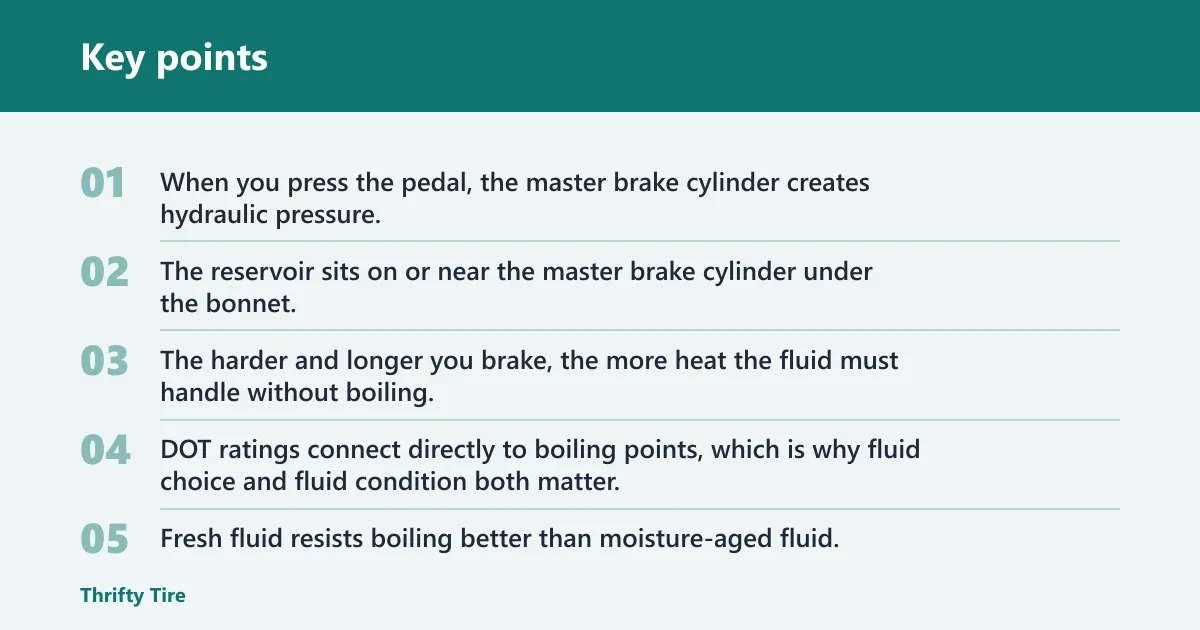
When you press the pedal, the master brake cylinder creates hydraulic pressure. That pressure moves through the brake lines to the calipers or wheel cylinders, where pads or shoes clamp rotating parts and slow the car.
The reservoir sits on or near the master brake cylinder under the bonnet. It stores the brake fluid supply, and you remove its cap when the system is drained and refilled.
Why heat and boiling point matter
Brakes generate heat. The harder and longer you brake, the more heat the fluid must handle without boiling. DOT ratings connect directly to boiling points, which is why fluid choice and fluid condition both matter.
Fresh fluid resists boiling better than moisture-aged fluid. If fluid boils, vapour can form in the hydraulic system. Vapour compresses far more than liquid, so the pedal can feel weak, long, or inconsistent during heavy braking.
That is why the service interval tells only part of the story. A car used for towing or repeated mountain descents puts more thermal load into the fluid than a lightly used commuter car, even if both have covered similar mileage.
Why does brake fluid absorb moisture over time?
Most road-car brake fluids gradually pull moisture from the air during normal service. As water content rises, the fluid’s wet boiling point drops, so it can boil sooner once brake temperatures climb. That can cause fade, internal corrosion, and in some cases a softer pedal.
Why most road-car fluids take on water
Glycol-based brake fluids such as DOT 3 and DOT 4 are commonly reported to absorb moisture from the atmosphere over time in normal use. That is expected, not unusual. It is also why time matters even when mileage stays low.
FixMyCar says brake fluid is hygroscopic. That single property explains why a low-mileage car can still need brake fluid service after months of humidity, temperature swings, and routine venting at the reservoir.
How moisture changes pedal feel
As moisture builds, boiling resistance drops. Mobil lists DOT 3 brake fluid with a dry boiling point of approx. 401°F and a wet boiling point of approx. 284°F. That spread shows why old fluid can boil sooner than fresh fluid under the same braking load.
If the fluid gets hot enough, vapour pockets can form and the pedal may feel soft. Bosch says old brake fluid can lead to a spongy brake pedal. That symptom is a warning sign, not a diagnosis by itself, because air in the system or other faults can create a similar feel.
Moisture is not the only fluid problem
Moisture-aged fluid is different from contaminated fluid. Dirt, rust, rubber debris, or the wrong fluid type can cause a separate problem. So can a leak that simply lowers the reservoir.
If a pedal feels normal in city traffic but gets longer after a steep downhill section, that pattern points more strongly to heat and lower boiling resistance than to a simple low-fluid issue. The next step is inspection and likely fluid replacement, not an automatic top-up.
How do you check brake fluid level and condition?
Check the brake fluid reservoir under the bonnet, compare the level with the MIN and MAX marks, and inspect the fluid’s colour and clarity through the reservoir wall or cap opening if the design allows it. The level can suggest pad wear or a leak, while the fluid’s appearance can point to age or contamination.
Where to look and what the marks mean
The reservoir is mounted at the master brake cylinder. On many vehicles, it is a translucent plastic container with molded MIN and MAX fill lines. The same source says the reservoir should sit between minimum and maximum fill lines.
Low fluid does not automatically mean the fluid is worn out. As pads wear, caliper pistons extend farther, and reservoir level can fall as a normal result. But a low level can also point to an external leak or an internal hydraulic fault.
What colour can tell you, and what it cannot
The same source says fresh brake fluid is usually clear or light amber. Darker fluid can suggest age, heat exposure, or contamination. It is a clue, not proof.
Colour alone is an imperfect test. Some fluid darkens in normal service, and some badly aged fluid may not look dramatic. Use colour along with service history, pedal feel, heat-related symptoms, and, if available, moisture or boiling-point testing.
If the reservoir sits just above MIN, the fluid still looks light amber, and the pedal is firm, start by checking pad wear and looking for leaks before assuming the fluid itself is the main issue.
Quick check steps
- Park on level ground. Switch the engine off and let the car sit steady so the reservoir reading is not distorted by slope. Open the bonnet and locate the reservoir at the master brake cylinder.
- Read the level marks. Compare the fluid level with the MIN and MAX lines on the reservoir body. If it is below MIN, do not assume a fluid change alone will solve it, because the drop in level needs an explanation.
- Check colour and clarity. Look for clear or light amber fluid rather than very dark, cloudy, or dirty-looking fluid. Dark or murky fluid suggests age or contamination, but judge it alongside service history and symptoms.
- Read the cap or owner information. Confirm the required DOT specification before adding anything. The correct fluid type may be printed on the reservoir cap or listed in the owner information.
- Escalate urgent symptoms. If the pedal is spongy, if braking fades when hot, or if the pedal drops toward the floor, arrange diagnosis promptly. A floor-bound brake pedal can mean air in the system, a leak, or master cylinder trouble.
Fluid service decision table
Brake fluid: top up, inspect, or change?
| Symptom/sign | Likely cause | Recommended next step |
|---|---|---|
| Low reservoir | Normal pad wear, external leak, or internal hydraulic problem | Inspect pad thickness, lines, calipers, wheel cylinders, and master cylinder area first. Top up only after the fluid type is confirmed and the reason for the drop is understood. |
| Dark fluid | Age, heat exposure, suspended debris, or contamination | Check service history and pedal feel. If service age is unknown, the fluid looks dirty, or other symptoms are present, plan a fluid change and system inspection. |
| Spongy pedal | Moisture-aged fluid, air in the system, contaminated fluid, hose expansion, or hardware faults | Do not rely on a top-up alone. Inspect for leaks and trapped air, and if fluid is old or contaminated, change and bleed the system with the correct specification. |
| Brake pedal going to the floor | Major leak, air in the system, master cylinder trouble, or severe hydraulic fault | Treat as urgent. Do not keep driving until the system is diagnosed and repaired, because a fluid change by itself may not fix it. |
| Moisture-related fade | Reduced boiling point from absorbed water, causing vapour under heat | Replace the fluid and inspect the system, especially if fade appears during long descents, towing, or repeated hard braking. |
Earlier interval guide
| Driving pattern | Why interval shifts earlier |
|---|---|
| Towing | Higher brake temperatures increase demand on boiling resistance and expose moisture-aged fluid faster. |
| Hot climates | Repeated high ambient heat adds thermal stress to the braking system and can speed fluid deterioration in service. |
| Short trips | Frequent heat cycling without long steady runs can age fluid in time even when mileage stays low. |
| Performance driving | Repeated hard stops create the highest fluid temperatures, so wet-boiling performance matters sooner. |
When should brake fluid be changed?
Many vehicles land around every 2 years, but the better answer is to follow the vehicle schedule and move earlier when heat, moisture, symptoms, or unknown service history point that way. Aged fluid, contamination, hot-brake fade, and a soft pedal matter more than mileage alone.
Baseline interval versus actual condition
The same source says many manufacturers recommend replacement every 2 years, and Mobil says change brake fluid at least every two years. Bosch also says mileage-based replacement is often advised after 20,000–30,000 miles.
Those figures are useful starting points, but brake fluid service is driven more by time and condition than by mileage. A car can travel very little and still age its fluid. Another can cover more miles in gentle use and put less heat into the system.
Symptoms that point toward a true change
Change or flush moves to the front of the list when the fluid is dark or dirty, the service age is overdue or unknown, braking performance drops when hot, or the pedal feels soft. Water contamination and moisture-related fade also point that way.
A pedal going to the floor is different. That is not a routine maintenance clue. It can indicate air in the system, a leak, or master cylinder trouble and should be treated as urgent.
When driving pattern shortens the interval
Earlier service makes sense for towing, mountain driving, repeated short trips with heat cycling, hot climates, and performance driving. DOT 4 is often specified where higher temperatures are expected, but only if the vehicle calls for it.
If your SUV tows a small trailer through hilly routes each summer and the fluid is already near the time limit, there is little reason to wait for the calendar alone. Heat exposure has already shifted the decision toward earlier replacement.
Can you top up brake fluid instead of changing it?
You can top up brake fluid only when the correct fluid type is confirmed and the reason for the low level is understood. A top-up is not a fix for aged, moisture-laden, or contaminated fluid, and it will not correct leaks, trapped air, or master cylinder faults.
When a top-up is reasonable
If the fluid level is modestly low, the fluid still appears serviceable, the specification is confirmed, and inspection shows no leak, a small top-up can make sense. Even then, the low level should be explained, not ignored.
Normal pad wear is one common explanation. As friction material wears down, caliper pistons sit farther out, and the reservoir level can slowly fall without any leak at all.
When low level means inspect first
Repeated fluid loss is different. If the level keeps dropping, the system needs inspection. Possible causes include a line leak, caliper leak, wheel cylinder leak, or a problem around the master brake cylinder.
A common first-timer mistake is seeing fluid below MIN and filling to MAX without checking the pads. If the pads are worn and then replaced later, the returning pistons can raise the reservoir level again, leaving too much fluid in the system.
When topping up is not enough
A top-up is the wrong response when the fluid is dark or contaminated, the service age is unknown, the brakes fade when hot, the pedal is spongy, or the pedal drops toward the floor. Those symptoms point beyond simple fluid loss.
- Dark or cloudy fluid suggests age or contamination.
- Hot-brake fade suggests boiling resistance has fallen.
- A soft pedal can indicate moisture-aged fluid, air, or another hydraulic problem.
- A floor-bound pedal can indicate a leak or master cylinder fault and needs urgent attention.
What brake fluid does your car need?
Your car needs the DOT specification listed on the reservoir cap or in the owner information. The right choice depends on the system design and temperature demands, not on which bottle sounds better. Using the wrong fluid can damage compatibility, performance, or both.
DOT 3 basics
DOT 3 is common in mass-produced cars.
Those figures explain why DOT 3 works well for many normal-duty applications yet still needs replacement as moisture builds. Once water content rises, the fluid reaches its wet-boiling condition sooner under brake heat.
DOT 4 differences
DOT 4 generally offers higher boiling points than DOT 3. The same source says DOT 4 has higher boiling points than DOT 3. That is why many vehicles specify it for higher top speeds, heavier use, or towing.
There is a tradeoff. DOT 4 often absorbs moisture faster than DOT 3, so its higher fresh-boiling performance does not remove the need for timely service. It is not a universal upgrade. Use it only when the vehicle approves that specification.
DOT 5 differences
DOT 5 uses different chemistry. The same source says DOT 5 fluids are silicone based. Unlike glycol-based DOT 3 and DOT 4, DOT 5 does not absorb moisture in the same way.
That does not make it the right choice for ordinary road cars. DOT 5 is unsuitable for many cars, especially those designed around glycol-based fluid and often those with ABS. Mobil warns never to mix DOT 5 brake fluid with other DOT types.
Simple selection rules
- Check the reservoir cap first.
- Confirm the same DOT specification in the owner information.
- Do not swap fluid types based on guesswork.
- Never mix DOT 5 with DOT 3 or DOT 4.
What happens during a brake fluid change
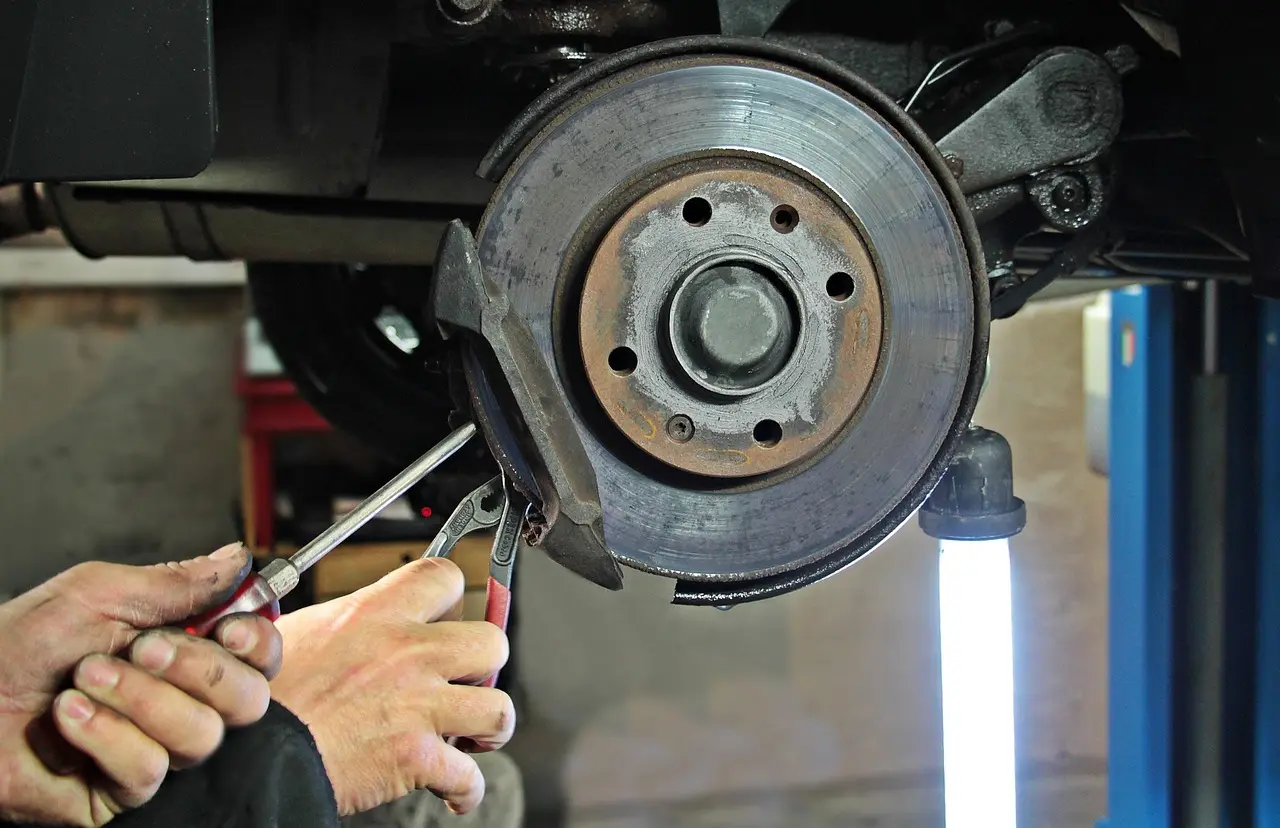
A brake fluid change removes old fluid, refills the system with the correct type, and bleeds each wheel circuit so fresh fluid replaces old fluid without drawing air into the lines. The exact time depends on vehicle layout, bleed method, and whether faults or stuck hardware complicate the job.
Drain, refill, and bleed
The reservoir cap at the master brake cylinder is removed so old fluid can be extracted and the system refilled. During bleeding, the reservoir must be kept topped up. If it runs low, air can be drawn into the system and the job can take longer.
Bleed nipples are located at the calipers or wheel cylinders. They are opened one at a time to release old fluid from each corner until the outgoing fluid runs clean and free of air.
Basic process
- Confirm the fluid spec. Read the reservoir cap and owner information before opening any container. Using the wrong DOT type creates compatibility and performance risks, especially if silicone DOT 5 is involved.
- Access the reservoir. Remove the cap at the master brake cylinder and extract as much old fluid from the reservoir as practical without exposing ports or introducing debris. Refill with the correct fresh fluid before bleeding begins.
- Bleed one corner. Open the bleed nipple at one caliper or wheel cylinder and push old fluid out into a container. Close that nipple before moving to the next corner so the system stays controlled and air entry is limited.
- Keep the reservoir topped up. Check the fluid level repeatedly during the process and refill as needed. This step matters because letting the reservoir run low can pull air into the master cylinder and lines.
- Finish and verify. Set the final reservoir level between MIN and MAX, secure the cap, and confirm a firm pedal. If the pedal still feels spongy or sinks, the problem may include trapped air, a leak, or a master cylinder issue.
How long it usually takes
The same source says brake fluid replacement takes around 30 to 90 minutes. Simpler layouts and pressure bleeding can shorten that range. Stuck bleed nipples, hard-to-access components, or extra bleeding to clear air can push the job toward the longer end.
Frequently asked questions
How often should brake fluid be changed?
The better rule is to follow the vehicle schedule and move earlier if the fluid is old, dark, heat-stressed, contaminated, or causing a soft pedal.
What are the signs that brake fluid needs changing?
Common signs include dark or dirty-looking fluid, unknown or overdue service age, a soft or spongy pedal, reduced braking performance when the brakes get hot, and moisture-related fade. A pedal that goes to the floor is more urgent and may indicate air, a leak, or master cylinder trouble.
What is the difference between DOT 3, DOT 4, and DOT 5 brake fluid?
DOT 3 and DOT 4 are usually glycol-based fluids that absorb moisture over time, while DOT 5 is silicone based. DOT 4 generally has higher boiling points than DOT 3, but DOT 5 should never be mixed with either and is unsuitable for many ordinary cars.
Can old brake fluid cause a spongy brake pedal?
Yes. The same source says old brake fluid can lead to a spongy brake pedal because moisture lowers boiling resistance and can affect hydraulic feel under heat. That said, a soft pedal can also come from air in the system, leaks, hose expansion, or other brake faults.
How long does a brake fluid change take?
A typical brake fluid change takes around 30 to 90 minutes, according to Bosch. Vehicle layout, the bleed method used, and whether any problems appear during bleeding all affect the final time. A routine service is faster than a job complicated by seized hardware or trapped air.