Speed Rating Chart: What S, T, H, V, W, and Y Mean
S, T, H, V, W, and Y are tire speed ratings: S = 112 mph, T = 118 mph, H = 130 mph, V = 149 mph, W = 168 mph, and Y = 186 mph; for replacement, meet or exceed the vehicle placard rating unless the manufacturer allows a change. Pick the wrong rating, and you can lose heat tolerance, ride feel, or legal compliance, and you may risk tire failure. This guide explains what each rating changes in daily driving and how to choose the right one.
What a tire speed rating means
A tire speed rating is the letter in the sidewall service description that shows the maximum safe sustained speed under specified conditions for a properly inflated, undamaged tire. It is not a target speed. It is one part of the tire’s rating code, and it works alongside the load index number.
The practical point is simple: the letter sets the tire’s speed ceiling, but that ceiling assumes correct inflation, no damage, the right load, and road conditions that do not add extra stress. Heat matters. Construction does too.
Why the letter matters for replacement
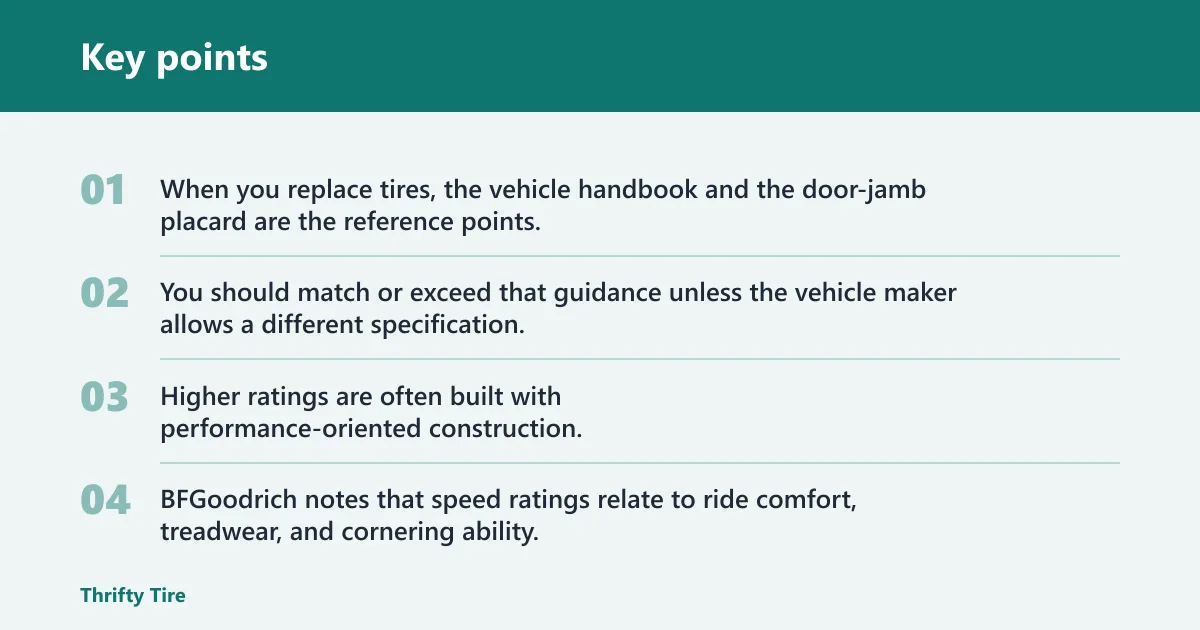
When you replace tires, the vehicle handbook and the door-jamb placard are the reference points. They tell you the minimum size and service description the vehicle expects. You should match or exceed that guidance unless the vehicle maker allows a different specification.
Higher ratings are often built with performance-oriented construction. That can change grip, stopping behavior, ride comfort, and tread life. BFGoodrich notes that speed ratings relate to ride comfort, treadwear, and cornering ability.
Where to find the speed rating on the tire sidewall
The speed rating appears in the tire’s service description on the sidewall. The load index number comes first, and the speed rating letter follows it. Common examples are 98H and 91V.
Do not confuse the two. The load index covers carrying capacity. The speed rating covers sustained speed capability under specified conditions. They are separate parts of the code.
-
Find the full service description.
Look for a sequence such as 98H, 91V, or similar on the sidewall. The number is the load index; the letter after it is the speed rating. Use both parts together when comparing replacement tires. -
Check the placard rating.
Read the driver-door placard or the owner’s handbook for the recommended tire specification. If the replacement tire’s speed rating is below that guidance, do not treat it as an equivalent swap. -
Verify size and type too.
Match the size and construction the vehicle expects, then confirm that the new tire meets or exceeds the minimum speed rating. A correct letter on the wrong size still misses the mark.
Speed rating comparison chart
| Letter | Max speed | Typical use case | Ride feel | Tread-life tendency | Daily-driver upgrade or downgrade? |
|---|---|---|---|---|---|
| S | 112 mph / 180 km/h | Many standard passenger applications | Usually comfort-oriented | Often longer than higher-performance ratings | Upgrade only if the vehicle allows it; downgrade only if the placard permits |
| T | 118 mph / 190 km/h | Common all-season fitment | Comfort-biased | Often longer than H, V, W, or Y | Good daily choice when it matches the placard |
| H | 130 mph / 210 km/h | Touring and sport-touring applications | Stronger cornering feel than T | Often shorter than T | Common upgrade if the vehicle allows H or lower is not required |
| V | 149 mph / 240 km/h | Performance sedans and some sporty crossovers | Firmer, more responsive | Often shorter than H or T | Appropriate when the placard calls for V or lower is not allowed |
| W | 168 mph / 270 km/h | High-performance vehicles | Firmest of this group for many daily drivers | Often shorter than V, H, or T | Usually not a casual downgrade or upgrade; buy only if specified |
| Y | 186 mph / 300 km/h | Very high-performance fitments | Typically performance-first | Often shortest of this group | Only sensible when the vehicle calls for it or allows it |
The chart is not strictly alphabetical. H sits between U and V in the standard lettering system, so the sequence looks odd if you expect a straight A-to-Z pattern. That is normal.
What each letter means on the road
S and T tires
S and T ratings fit many normal passenger cars, minivans, and sedans that spend most of their time at everyday speeds. They usually lean toward comfort and tread life. A T-rated tire at 118 mph is common for routine use, but that number is still a ceiling, not a cruising goal.
Say your compact sedan came with 91T tires and the placard lists T as the minimum. Staying with T keeps you inside the manufacturer’s range and usually preserves the ride character the vehicle was tuned for.
H and V tires
H and V ratings move the tire toward more responsive handling. H is 130 mph, and V is 149 mph. Drivers often notice firmer turn-in and better cornering support, but the tradeoff can be a shorter tread life and a harsher ride.
Picture a midsize sedan that originally used 215/55R17 94H. If a replacement set moves to V because the handbook allows it, the car may feel tighter in corners. It may also wear faster, depending on the compound and construction.
W and Y tires
W and Y ratings are aimed at higher-performance applications. W is 168 mph, and Y is 186 mph. These tires often use construction and compounds that support higher speed capability and more grip, but daily drivers often do not need that extra margin.
For most commuters, W or Y is not automatically better. If the vehicle does not call for that level, the extra performance can come with cost, noise, and tread-life tradeoffs that do not help ordinary driving.
Is a higher speed rating always better?
No. A higher speed rating can bring firmer handling and better grip, but it can also shorten tread life and reduce ride comfort. For a daily driver, “better” means the rating that matches the vehicle’s needs and the way you actually drive, not the highest letter available.
Ride comfort and tread life
The same source notes that speed ratings affect ride comfort and treadwear. In plain terms, tires with higher ratings often use stiffer construction and performance-focused compounds. That can make them feel sharper, but it often means less cushioning and shorter tread life.
Grip and stopping behavior
BFGoodrich also notes that speed ratings can relate to grip and stopping behavior. That does not mean every higher-rated tire stops shorter in every situation. Braking distance depends heavily on the specific tire model, compound, tread design, temperature, and road conditions.
When a lower rating makes sense
A lower rating can make sense only when it still meets the vehicle’s minimum specification. In that case, a T or H tire may be a better daily-driver choice than a V, W, or Y tire because it can ride better and last longer.
Can you use a lower speed rating than the placard says?
Usually, no. The vehicle handbook and door-jamb placard set the manufacturer’s minimum guidance. If the placard calls for a certain speed rating, a lower one is not a like-for-like replacement unless the manufacturer specifically allows it for that vehicle.
Checking the handbook and placard
Start with the placard on the driver door frame or the owner’s handbook. Match the original size, load index, and speed rating as closely as possible. If the new tire falls below the listed speed rating, it should not be treated as an acceptable substitute without manufacturer approval.
What to do when matching is not possible
-
Confirm the required rating.
Read the placard and handbook first. Write down the size, load index, and speed rating so you compare the whole specification, not just the letter. -
Choose equal or higher.
If an exact match is unavailable, pick a tire that meets or exceeds the listed speed rating and still matches the required size and load index. -
Keep the set consistent.
Use the same size and type on all four positions when possible.
How to choose the right replacement tire

The safest replacement starts with the placard, not with the highest number on the shelf. Match or exceed the manufacturer’s minimum. Keep the load index and speed rating separate in your comparison. Then decide whether the ride, tread life, and handling tradeoffs fit your driving.
-
Read the placard first.
Check the driver-door placard and the handbook for the original tire size and minimum service description. This is the baseline for replacement. -
Match the full code.
Compare the size, load index, and speed rating together. A tire marked 98H is not interchangeable with 98V unless the vehicle permits the higher rating and the size still matches. -
Pick the right use case.
Choose T or H for many normal daily drivers, V for sporty sedans or crossovers that need more response, and W or Y only when the vehicle specification points there. Higher is not automatically better. -
Inspect before mounting.
Look for damage, age concerns, and proper inflation after installation. A tire’s speed capability depends on being properly inflated and undamaged, not on the letter alone.
A common first-timer mistake is buying a tire because the speed rating sounds “better” than the original. A car that calls for 91H does not automatically gain safety from 91W, and a car that calls for 94V should not be fitted with a lower rating just because it is cheaper. The correct tire is the one that fits the vehicle’s specification and the way the car is used.
Frequently asked questions
What do S, T, H, V, W, and Y mean on tires?
They are tire speed ratings. The letters show the maximum safe sustained speed for a properly inflated, undamaged tire under specified conditions.
What is the max speed for a T-rated tire?
A T-rated tire is rated to 118 mph, which is 190 km/h. That number is the tire’s sustained speed limit under specified conditions, not a speed to aim for on the road. The tire still depends on correct inflation, load, and condition.
What is the max speed for an H-rated tire?
An H-rated tire is rated to 130 mph, or 210 km/h. That rating often appears on touring and sport-touring fitments. It can bring firmer handling than T-rated tires, but it is still only one part of the replacement decision.
What is the max speed for a V-rated tire?
A V-rated tire is rated to 149 mph, or 240 km/h. V ratings are common on performance-oriented sedans and some sporty crossovers. They often improve response and grip, but tread life may be shorter than with lower ratings.
What is the max speed for a W-rated tire?
A W-rated tire is rated to 168 mph, or 270 km/h. It is intended for higher-performance applications and is usually not needed for ordinary commuting. Match the vehicle placard before choosing W over a lower rating.
What is the max speed for a Y-rated tire?
A Y-rated tire is commonly rated up to about 186 mph, or 300 km/h. That rating belongs on very high-performance fitments and is usually chosen because the vehicle calls for it. For most daily drivers, Y is more tire than needed.
Does speed rating affect tread life or grip?
Yes. Speed rating can affect both. Higher ratings often improve grip, but they may shorten tread life and can make the ride firmer. The actual result also depends on the tire’s compound, construction, inflation, and load.