Tire Size Guide: How to Read, Compare, and Choose
A common approach is to start with the driver-door placard or owner’s manual, then choose alternates that keep overall tire diameter within roughly 3% of OEM and meet or exceed the vehicle’s load index and speed rating. Ignore that and you can skew the speedometer, create clearance or ABS issues, and cut load capacity. This guide shows you how to read the sidewall code, compare legal alternate sizes, and choose the best fit for ride, handling, and tolerance.
Start with the placard, not the old tire
The tire placard inside the driver-side door jamb sets the baseline for replacement sizing. Use it first, because the tires already on the vehicle may reflect a previous owner’s choice, a winter setup, or a wheel package that does not match the original recommendation.
Use the placard as the OEM baseline
The placard lists the manufacturer-recommended tire size and inflation information for that vehicle configuration. For replacement tires, that is your starting point, not the sidewall on the tire currently mounted.
If the vehicle has different front and rear sizes, a towing package, or trim-specific wheels, the placard ties the choice to the actual vehicle setup. It also separates two different jobs: matching the original fitment and choosing an alternate size for a specific goal.
When the tire on the car may be wrong
A common first-time mistake is reading the sidewall, buying the same size again, and never checking the placard. If you bought the car used with non-OEM wheels, that repeats someone else’s sizing choice, correct or not.
Use the old tire as a clue. Use the placard as the authority for replacement size.
Replacement matching and upgrade sizing are different decisions
For a stock replacement, the simplest rule is to match the placard size and then confirm load index and speed rating. For an alternate or upgrade size, you need extra checks: overall diameter, wheel-width compatibility, rubbing clearance, and speedometer change.
That split avoids a common error. A size that physically mounts on the wheel is not automatically a good replacement.
How do you read the numbers on a tire?
A metric tire size such as 225/65R17 gives four fitment clues in order: section width in millimeters, aspect ratio as a percentage, construction type, and wheel diameter in inches. Read it left to right, then check the placard to confirm that the size matches the vehicle’s baseline.
Breaking down 225/65R17
Use 225/65R17 as the example.
- 225: section width in millimeters
- 65: aspect ratio, meaning sidewall height is 65% of section width
- R: radial construction
- 17: wheel diameter in inches
Passenger vehicle tires are usually metric, and larger truck tires can be metric or standard size. That is why a sedan often shows a metric code like 225/65R17, while some truck and off-road setups use an inch format instead.
Section width in millimeters
Section width is the tire’s overall width in millimeters, measured on a mounted rim. That detail matters. Published section width depends on the rim width used for measurement, so the same nominal tire can sit a little differently on different wheel widths.
A wider approved wheel tends to pull the sidewalls straighter. A narrower approved wheel rounds them more. That changes the tire’s shape and can affect steering feel, rim protection, and clearance to struts or fenders.
Aspect ratio and sidewall height
Aspect ratio is sidewall height relative to section width. In a 225/65R17, the sidewall height is 65% of 225 millimeters, which equals 146.25 millimeters.
More sidewall usually means a softer ride and more compliance over broken pavement. Less sidewall usually sharpens response but can make impacts feel harsher. It also leaves less cushion against pothole strikes.
Construction type and wheel diameter
A radial tire is marked with the letter R in the size code. A D indicates diagonal or bias-ply construction, which is far less common on modern passenger vehicles.
Wheel diameter is measured in inches and generally needs to match the wheel size exactly. A 17-inch tire fits a 17-inch wheel, full stop. No calculator, tire machine, or sidewall flex changes that basic fitment requirement.
What do load index and speed rating mean?
Load index and speed rating are the sidewall markings that tell you whether a replacement tire can carry the vehicle’s weight and meet its speed capability. They appear after the size code, and replacement tires should meet or exceed the OEM requirement unless the vehicle maker allows otherwise for dedicated winter tires.
Where these markings appear
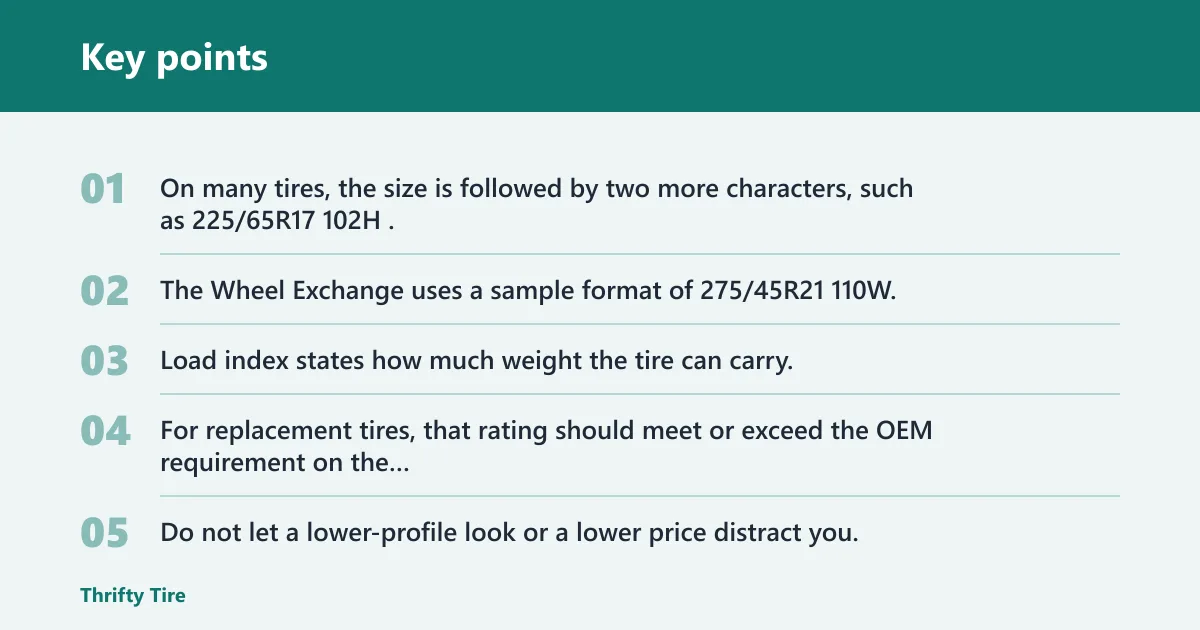
On many tires, the size is followed by two more characters, such as 225/65R17 102H. The number is the load index. The letter is the speed rating.
The Wheel Exchange uses a sample format of 275/45R21 110W, which shows the same pattern on a larger tire. Read the load index before the speed rating.
Why load index is a hard minimum
Load index states how much weight the tire can carry. For replacement tires, that rating should meet or exceed the OEM requirement on the placard or in the owner’s manual.
Do not let a lower-profile look or a lower price distract you. If the alternate size reduces load capacity below the vehicle requirement, it fails the comparison even if the diameter looks right.
How speed rating affects the choice
Speed ratings show the tire’s maximum speed capability under proper conditions. For normal replacements, choose a tire that meets or exceeds the vehicle recommendation.
Some vehicle makers allow a different speed rating for dedicated winter tires, often with a labeling or usage condition in the manual. If winter sizing is the goal, verify the vehicle guidance before treating a lower speed rating as acceptable.
What is the difference between metric and inch tire sizes?
Metric sizing gives width, aspect ratio, construction, and wheel diameter, while inch sizing gives overall diameter, section width, construction, and wheel diameter. Passenger vehicles usually use metric sizing; some truck and off-road tires use standard inch sizing such as 33×12.50R15, which still requires load, wheel-width, and clearance checks.
Metric tire sizing
Metric sizing is common on passenger vehicles. It is compact, but it hides one useful number: overall diameter. You have to calculate that from the width, aspect ratio, and wheel diameter or use a tire size calculator.
That calculator can compare diameter, width, sidewall, circumference, and revolutions per mile. It also estimates speedometer error from changing one size to another.
Standard inch tire sizing
Inch sizing is common on some truck tires and off-road tires. The format is usually overall diameter x width x wheel diameter, such as 33×12.50R15.
That looks simpler because overall diameter is already shown, but the same limits still apply. The wheel diameter must match exactly, the wheel must be approved for that width, and the vehicle still needs adequate clearance through steering and suspension travel.
How to compare metric and inch formats
Suppose you are comparing 225/75R16 with 31×10.50R15. The first is metric on a 16-inch wheel, the second is inch sizing on a 15-inch wheel. Even before diameter and width math, they cannot substitute for each other unless the wheel size changes too.
That is the first filter: compare wheel diameter first, then overall diameter and width, then load and clearance.
How do you compare two tire sizes before buying?
Compare two sizes in a sequence, not by width alone: check wheel diameter, then overall diameter change, sidewall height, width, load index, speed rating, approved wheel-width range, and rubbing clearance. A tire size calculator helps by comparing diameter, circumference, revolutions per mile, and estimated speedometer difference in one view.
The five measurements that matter
For metric sizes, compare these numbers:
- Section width
- Sidewall height
- Overall diameter
- Circumference
- Revolutions per mile
Those measurements tell you more than the size code alone. A small width change with a larger sidewall change can alter overall diameter enough to affect the speedometer, gearing, and clearance.
Use diameter change as the speedometer rule
Going beyond manufacturer size changes alters gearing and speedometer reading. In practice, the speedometer difference tracks the percentage change in overall diameter.
If a new tire is about 2% larger in diameter, the vehicle travels about 2% farther per wheel revolution. That means when the speedometer shows 60 mph, actual road speed is about 61.2 mph. If the tire is about 2% smaller, the speedometer may read about 60 mph when actual speed is about 58.8 mph.
A common rule of thumb is to keep overall diameter within roughly 3% of OEM. That is a screening rule, not blanket approval. A size inside that range can still fail on load, wheel width, or clearance.
Check wheel-width compatibility before checkout
Every tire size has an approved wheel-width range from the tire maker. The relationship matters because sidewall shape changes with wheel width, and that changes how close the tire runs to suspension parts and fender edges.
Say your OEM size is 225/65R17 on a wheel width approved for that size, and you are considering 235/65R17. The diameter change may be modest, but if the wheel is already at the narrow end of approved width, the wider tire can bulge more and move closer to the strut.
Clearance checks should include full steering lock on the front axle and full suspension compression where possible. Vehicles with close clearances, suspension modifications, staggered fitments, or limited wheel-width ranges need professional verification before a size change.
Tire size worksheet

Size decision table
Use one OEM size and two realistic alternates on the same wheel diameter. The example below uses 225/65R17 as the placard baseline, with one smaller and one larger alternate. Sidewall height and overall diameter are calculated from the size code, and speedometer difference is estimated from diameter change.
| Size | Width | Aspect ratio | Overall diameter | Sidewall height | Wheel diameter | Estimated speedometer difference | Fitment risk | Ride/handling impact | Best-use scenario |
|---|---|---|---|---|---|---|---|---|---|
| 225/65R17 OEM | 225 mm | 65 | 28.52 in | 5.76 in | 17 in | 0% | Low if placard-matched | Baseline comfort and response | Stock replacement with least guesswork |
| 215/65R17 smaller alternate | 215 mm | 65 | 28.00 in | 5.50 in | 17 in | -1.82% | Low to moderate; verify load and wheel-width range | Quicker turn-in feel, slightly firmer impact, narrower footprint | Budget replacement or winter-focused setup where narrower width is desired |
| 235/65R17 larger alternate | 235 mm | 65 | 29.03 in | 6.01 in | 17 in | +1.79% | Moderate; check strut, fender, and full-lock clearance | Softer edge compliance, slower steering response, more width | Drivers prioritizing ride comfort or a fuller wheel-well look |
How to fill the worksheet
- Write the placard size in the first row.
- Add only alternates with the same wheel diameter unless wheel changes are part of the plan.
- Calculate sidewall height from width x aspect ratio.
- Calculate overall diameter from wheel diameter plus two sidewalls.
- Use a tire size calculator to compare circumference and revolutions per mile.
- Estimate speedometer difference from the percentage change in overall diameter.
- Reject any size that fails load index, speed rating, wheel-width range, or clearance.
Fitment checklist table
This final screen keeps replacement matching separate from upgrade sizing. If any upgrade box fails, stop and verify fitment before buying.
| Check | Pass when | Fail when |
|---|---|---|
| Placard match | Replacement size matches the driver-door placard or owner’s manual recommendation | Choice is based only on the old tire sidewall |
| Wheel-width compatibility | Chosen size is within the tire maker’s approved wheel-width range | Wheel is outside the approved range or sidewall shape creates clearance concerns |
| Load index | Replacement meets or exceeds OEM requirement | Replacement load index is lower than OEM requirement |
| Speed rating | Replacement meets or exceeds vehicle recommendation, or follows winter-tire guidance from the vehicle maker | Rating is lower without a vehicle-approved winter exception |
| Rubbing clearance | No contact risk at full lock and suspension travel | Any likely interference with strut, liner, fender, brake line, or bodywork |
What tire size information tells you
Tire size is more than a random code on the sidewall: it identifies the tire’s width, aspect ratio, construction, and wheel diameter, and it may also include load index and speed rating. That matters because the wheel diameter must match the rim exactly, while the other numbers affect fitment, handling, speedometer accuracy, and how much weight the tire can safely carry.
The supporting guide breaks down each part of the code, shows which details can vary, and explains which ones must stay the same when you replace a tire. If you want a clear breakdown of the code itself, see tire size meaning.
How does a bigger or smaller tire change driving and fitment?

A bigger or smaller tire changes more than appearance. Diameter affects speedometer and odometer readings, width affects clearance and water evacuation, and sidewall height changes ride and steering feel. Even legal alternates can alter braking feel, gearing, and winter behavior enough to make one size the better choice.
Speedometer, odometer, and gearing
Larger diameter tires travel farther per revolution, so the speedometer and odometer tend to read low. Smaller diameter tires do the opposite. The same change also alters effective gearing: larger tires can soften acceleration feel, while smaller tires can make the vehicle feel shorter-geared.
That is why the diameter percentage matters. It turns a vague warning into a usable decision rule.
Ride quality and handling
More sidewall usually adds compliance over rough roads. Less sidewall usually sharpens response and reduces sidewall flex. Width changes matter too. A wider tire can improve dry-road grip potential, but it may track road grooves more and can raise fitment risk.
Picture a crossover used for commuting on patched city pavement. Between the three worksheet sizes above, the OEM size stays the safest default, while the larger alternate may soften sharp-edge impacts a bit. The smaller alternate may feel tidier in steering but less cushioned over potholes.
Winter use, hydroplaning, and load needs
For mixed-use driving, narrower alternates can make sense in winter because they cut through slush and snow more effectively than a wider tire of the same diameter. That does not make every smaller size the right choice. Load index still has to meet the vehicle requirement.
Wider tires can improve dry-road footprint but may be less helpful in deep snow or standing water, depending on tread design and vehicle setup. If the vehicle regularly carries passengers, cargo, or towing load, load capacity should outrank cosmetic preferences.
What happens if you choose the wrong size?
The failure points are predictable: rubbing, reduced clearance, wheel-width mismatch, incorrect speedometer and odometer readings, gearing changes, and possible ABS or traction-control issues from altered rolling diameter. A poor choice can also cut load capacity below what the vehicle requires.
Those are fitment and safety checks, not style opinions. If the size change is large, the clearances are tight, or the wheel setup is unusual, the right move is verification before purchase.
How do you choose between the OEM size and an alternate?
The best choice depends on whether the job is replacement or upgrade. For replacement, match the placard size and meet the OEM load index and speed rating. For an alternate, choose only a size that stays near the OEM diameter, fits the wheel properly, clears the body and suspension, and supports the driving goal.
Best choice for stock replacement
For most drivers on stock wheels and stock suspension, the placard size is the cleanest answer. It preserves the intended speedometer calibration, likely ride balance, and factory clearance assumptions.
If two tires in the same OEM size differ in comfort, winter performance, or cost, make that decision within the OEM size first. That carries less fitment risk than changing size.
When a smaller alternate makes sense
A smaller alternate can make sense for winter use, a narrower approved footprint, or a lower-cost replacement when load and speed requirements are still met. The better smaller alternate is the one with the fewest side effects, not simply the narrowest or cheapest option.
Use the worksheet logic: keep wheel diameter constant, keep overall diameter near OEM, then confirm load index, speed rating, and approved wheel width.
When a larger alternate makes sense
A larger alternate can make sense when the goal is a little more sidewall compliance, a different stance, or a specific tire model that fits better in a nearby size. The right larger alternate is the one that stays within a modest diameter window and clears at full lock and compression.
Do not treat “it mounts” as “it fits.” Width growth, shoulder shape, and sidewall bulge can create problems before the diameter limit does.
When to stop and get professional verification
Get fitment verification when any of these apply:
- Close inner or outer clearances
- Suspension modifications or lift/lowering changes
- Staggered front and rear sizes
- Wheel width near the edge of the approved range
- Large diameter changes
- Uncertainty about winter-tire load or speed requirements
That step matters most on vehicles where a small paper difference can become a rubbing problem in the actual wheel well.
Frequently asked questions
How do I read tire size numbers on the sidewall?
Read the code left to right. In 225/65R17, 225 is section width in millimeters, 65 is aspect ratio, R means radial construction, and 17 is wheel diameter in inches. Then read the service description after it, such as 102H, for load index and speed rating.
What does the tire width, aspect ratio, and rim diameter mean?
Width is the tire’s section width in millimeters, measured on a specified rim width. Aspect ratio is sidewall height as a percentage of that width. Rim or wheel diameter is measured in inches and must match the wheel exactly, or the tire will not fit the wheel.
Where do I find my car’s correct tire size?
The baseline size is on the tire placard inside the driver-side door jamb, and it is usually repeated in the owner’s manual. Use that recommendation first for replacement tires. The sidewall on the current tire may reflect a past change, so it is not the best authority by itself.
Can I compare two tire sizes before buying?
Yes. Compare width, sidewall height, overall diameter, circumference, and revolutions per mile, then estimate speedometer difference from the diameter change. A tire size calculator helps organize those numbers, but the final decision still needs wheel-width compatibility, load index, speed rating, and clearance checks.
How does a bigger or smaller tire affect speedometer accuracy?
Larger overall diameter makes the speedometer read lower than actual road speed, while smaller diameter makes it read higher. The change roughly follows the percentage difference in diameter. That is why many shoppers use about 3% of OEM diameter as a screening limit before doing full fitment checks.
How do load index and speed rating affect replacement tires?
Load index sets the tire’s weight-carrying capacity, and speed rating sets its maximum speed capability under proper conditions. For replacements, both should meet or exceed the vehicle recommendation unless the vehicle maker allows a different speed rating for dedicated winter tires. Size alone does not guarantee either requirement.