How Much Can You Plus Size Before Tires Rub?
A practical starting point is to keep overall tire diameter within about 3% of stock. Beyond that, rubbing risk climbs quickly unless you verify wheel width, offset, and suspension clearance. Skip that math and you can end up with rubbing at full lock, during suspension compression, or both, along with speedometer error and faster wear. This guide shows how diameter, section width, wheel width, and offset interact so you can judge where fitment moves from workable to rub-prone.
How much can you plus size before tires rub?
Plus sizing can work with no rubbing, but only when the new tire stays inside the car’s clearance envelope. Most cars can handle up to 3% more overall diameter, while width and offset often decide whether the tire clears the strut, liner, and fender lip. Once one variable moves too far, rub risk rises fast.
Find your starting tire size
Start with the current size from the sidewall, the door jamb label, or the owner’s manual. A size like 225/50R17 gives you section width, aspect ratio, and wheel diameter in one code, and you need all three before any comparison makes sense.
-
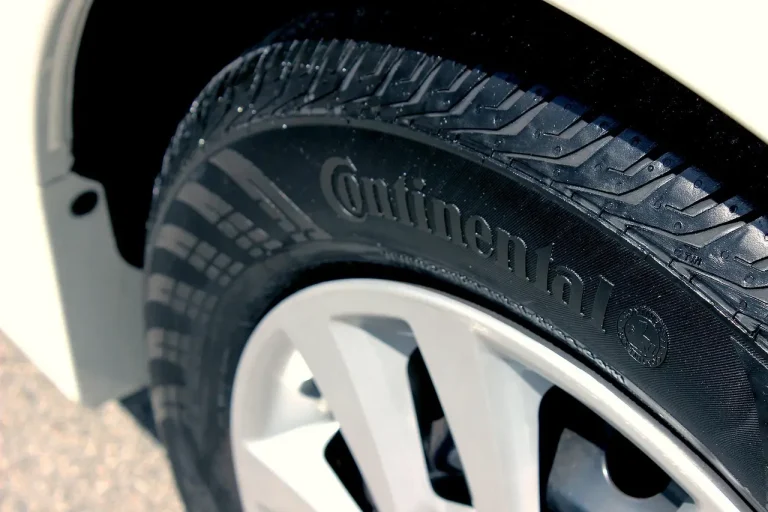
Read the tire sidewall.
Find the full size marking, such as 225/50R17. The first number is nominal section width in millimeters, the second is aspect ratio, and the last number is wheel diameter in inches. -
Confirm the factory size.
Check the driver-door jamb label or owner’s manual if the tire has been replaced before. The vehicle label is the better reference when you want the stock fitment for comparison. -
Note load and speed ratings.
Record the load index and speed rating from the current tire. The replacement should meet or exceed both, because lower ratings can raise heat and failure risk at highway speed.
Suppose your stock tire is 225/50R17 and you are looking at 245/45R18. The change is not a single size number; it changes diameter, width, and the way the tire sits relative to the suspension and bodywork.
How percent change is calculated
Overall diameter is the cleanest first check for plus sizing. A 3% larger tire is a common upper guide for daily-driver fitment, because larger changes can affect speedometer reading, gearing, ABS wheel-speed comparison, and clearance at the same time.
Why about 3% is a common daily-driver limit
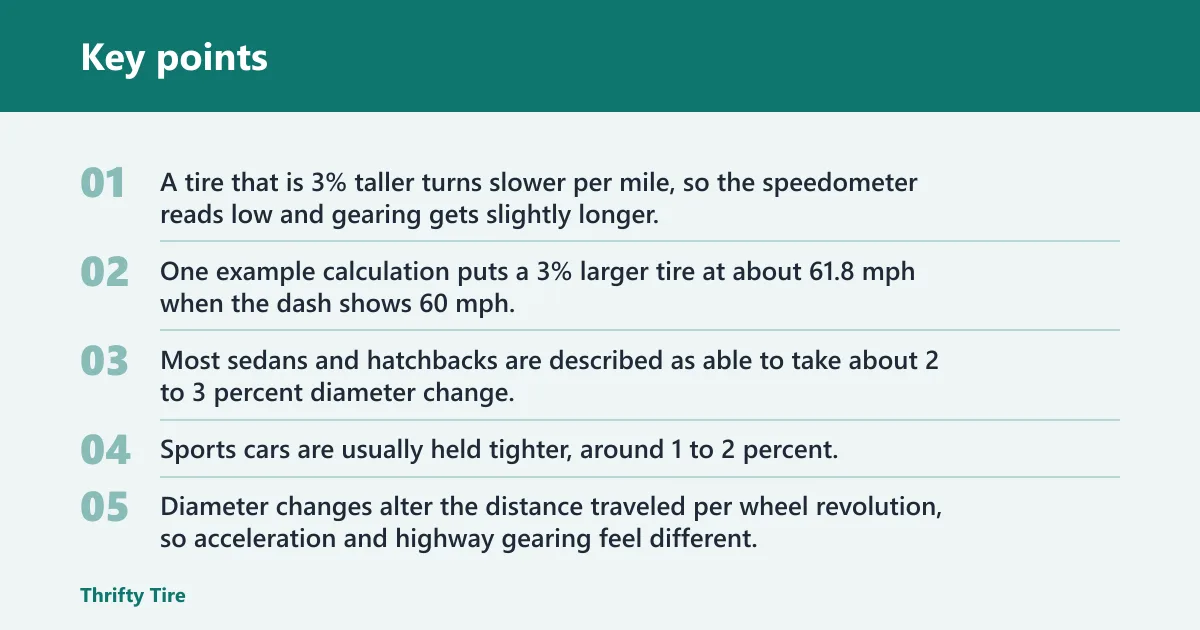
A tire that is 3% taller turns slower per mile, so the speedometer reads low and gearing gets slightly longer. One example calculation puts a 3% larger tire at about 61.8 mph when the dash shows 60 mph. That is small enough for many drivers, but not always small enough for every suspension and body shape.
Most sedans and hatchbacks are described as able to take about 2 to 3 percent diameter change. Crossovers and small SUVs can go to 3 percent stock, and trucks and body-on-frame SUVs are also listed at 3 percent stock. Sports cars are usually held tighter, around 1 to 2 percent.
How gearing and ABS can be affected
Diameter changes alter the distance traveled per wheel revolution, so acceleration and highway gearing feel different. ABS and stability control also compare wheel speeds, so a larger diameter can change that comparison enough to matter, especially when one axle changes more than the other.
That does not mean any 3% change is automatically safe. A tire can be within the diameter guide and still rub because the section width is larger, the wheel offset moves it inward, or the suspension compresses farther on one axle than the other.
How width and offset limits that cause rubbing
Width and offset often decide fitment before diameter does. Most cars can handle 0.5–1 inch more width, and the guide says a width increase of 0.5 to 1.0 inch often fits on stock wheels. Wheel offset change within 3 to 5 mm is usually fine, but more than 10 mm needs careful checks.
Inner clearance at the strut or spring perch
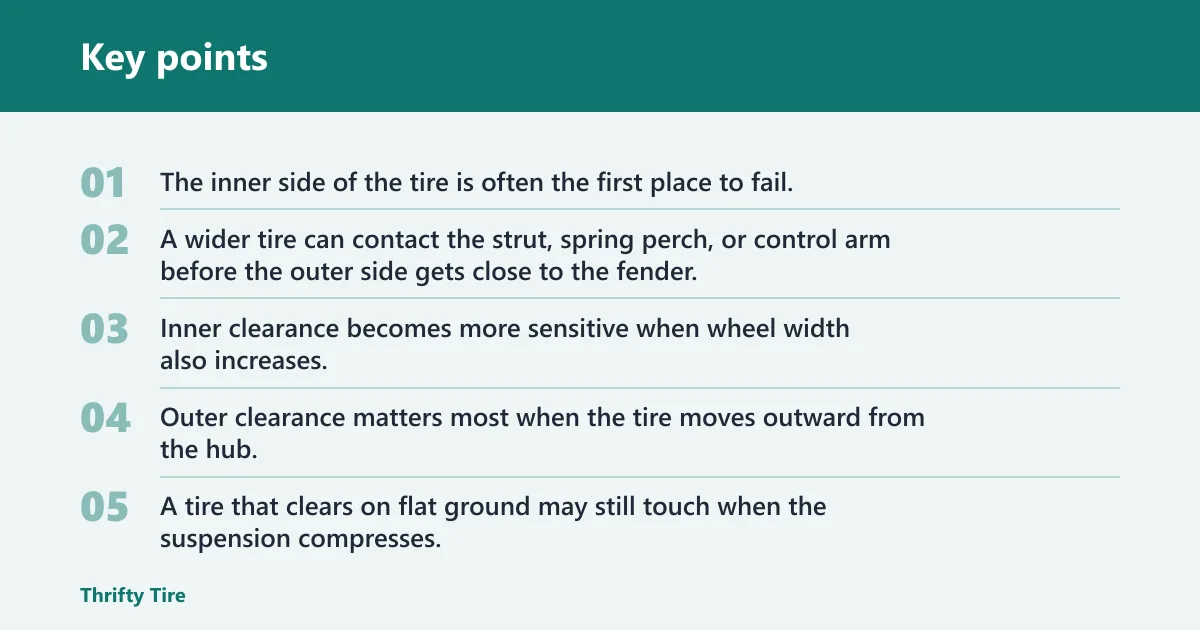
The inner side of the tire is often the first place to fail. A wider tire can contact the strut, spring perch, or control arm before the outer side gets close to the fender. This is why a tire can look acceptable from outside and still rub when turned or loaded.
Inner clearance becomes more sensitive when wheel width also increases. If the wheel is wider and the offset moves inward, the tire can shift closer to suspension hardware by enough to make a previously safe size rub-prone.
Outer clearance at the fender lip
Outer clearance matters most when the tire moves outward from the hub. That can push the sidewall toward the fender lip or liner, especially at full bump or with passengers and cargo on board. A tire that clears on flat ground may still touch when the suspension compresses.
How wheel offset moves the tire in or out
Offset is measured in millimeters and tells you where the wheel sits relative to the hub face. Lower offset usually moves the wheel outward, while higher offset moves it inward. Even a small 3 to 5 mm shift can change clearance enough to matter on tight fitments.
A common first-timer mistake is choosing a wider wheel and a lower offset at the same time. The width adds bulk, and the offset moves that bulk outward, so the tire may hit the liner on turns or the lip on compression even if the diameter is still within 3%.
Can the front and rear rub in different ways?
Yes. Front and rear clearances are often different, so the front can rub on steering lock while the rear rubs on bump travel or load. That is why a fitment that looks fine at the rear can still touch the liner or strut in front. The reverse can happen too.
Front-axle pinch points at full lock
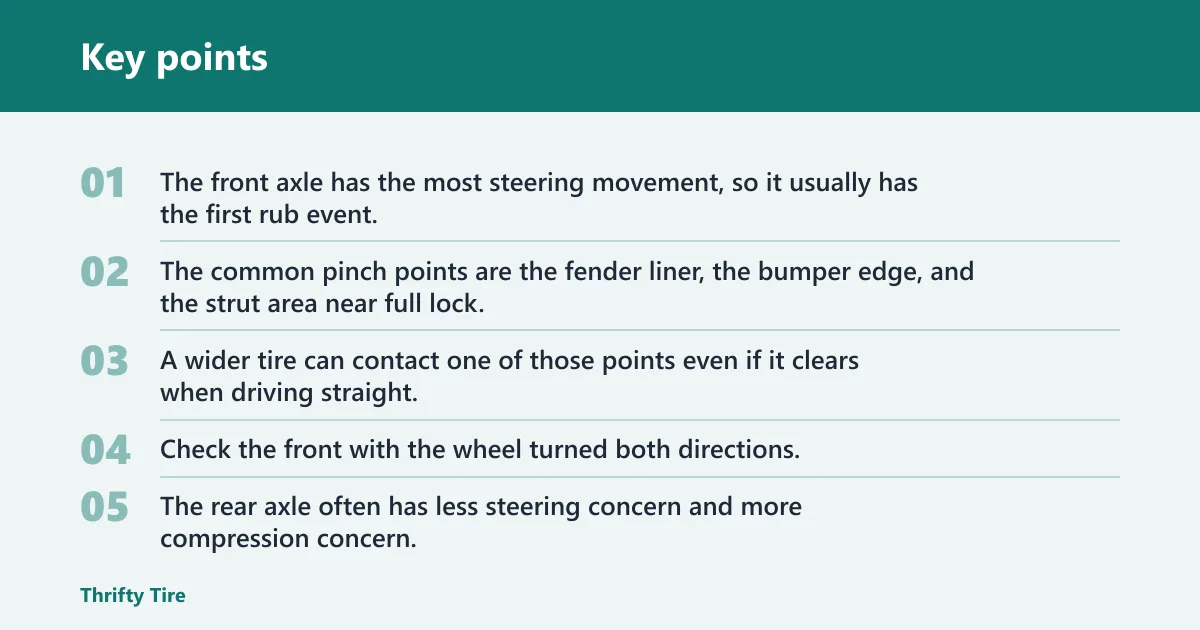
The front axle has the most steering movement, so it usually has the first rub event. The common pinch points are the fender liner, the bumper edge, and the strut area near full lock. A wider tire can contact one of those points even if it clears when driving straight.
Check the front with the wheel turned both directions. If rubbing appears only at one lock angle, that often points to liner shape, tire width, or offset rather than overall diameter alone.
Rear-axle pinch points at full bump
The rear axle often has less steering concern and more compression concern. Full bump, loaded suspension, and a deeper suspension squat can bring the tire into the liner or fender lip. On many cars, the rear is where passengers and cargo change the fitment from safe to rub-prone.
Trim and suspension differences that change fitment
Sport suspension, larger brake packages, AWD driveline packaging, and different trim levels can change clearance in ways that matter. A size that fits one version of the car may not fit another, even with the same body shell. Always compare the exact trim and wheel package, not just the model name.
Tire size compare table
The table below shows how to compare stock and candidate plus sizes. Use it as a fitment screen, not a final promise. A tire size calculator is still useful for checking diameter and width before you buy.
| Stock size | Candidate size | Diameter change | Section width growth | Rub-risk flag |
|---|---|---|---|---|
| 225/50R17 | 235/50R17 | About +2% | About +0.4 inch | Low, but still check liner and strut |
| 225/50R17 | 245/45R17 | About +1.5% | About +0.8 inch | Medium for inner clearance and full-lock rub |
| 225/50R17 | 245/45R18 | 3.2% | About +0.8 inch | High on tight front fitments; verify offset carefully |
| 245/40R18 | 255/40R18 | About +1.7% | About +0.4 inch | Medium; rear bumps and liner contact are the main checks |
| 255/35R19 | 265/35R19 | About +1.4% | About +0.4 inch | Medium; offset and wheel width matter more than diameter |
The 245/45R18 example is described as about 26.68 inches and an approximate 3.2 percent gain. That matters because it sits near the common daily-driver limit, which means the rest of the fitment math has to be right for the size to work.
What to check before you buy
Before buying, verify load index, speed rating, diameter, width, wheel width, and offset together. A calculator helps compare the numbers, but it does not know your brake package, liner shape, or suspension travel. Treat it as a screen, then measure the car.
-
Match load and speed.
Choose a tire with a load index that meets or exceeds stock, and a speed rating that meets or exceeds stock. That protects highway use and reduces the chance of heat-related failure. -
Compare the dimensions.
Use a tire size calculator to check overall diameter and section width against stock. If diameter is past about 3% or width is beyond the typical 0.5 to 1.0 inch gain, fitment needs closer review. -
Measure loaded clearances.
Check the strut, spring perch, liner, and fender lip with the suspension loaded. Pay special attention to full lock in front and full bump in rear, because those are the first places rubbing usually appears. -
Review offset changes.
Keep offset changes within 3 to 5 mm when possible. If the change is more than 10 mm, inspect the car carefully because the tire may move inward or outward enough to rub even when diameter looks acceptable.
Picture a sedan that clears a 225/50R17 easily. Swap to a 245/45R18 and the diameter may still be near the accepted limit, but the extra width and a lower-offset wheel can make the front liner touch on parking-lot turns. The math says “maybe”; the clearance says “check first.”
Frequently asked questions
How much bigger tires can I put on my car?
Most cars can handle up to 3% more overall diameter, but that is only the starting point. Width, offset, wheel width, and suspension travel can make a smaller change rub. Sedans and hatchbacks are usually kept closer to 2 to 3 percent, while sports cars often stay within 1 to 2 percent.
Will bigger tires rub on turns or bumps?
Yes, they can. Turns usually expose front-axle liner and strut clearance issues, while bumps and load expose rear-axle fender and liner contact. Rubbing often shows up first at full lock or full bump, especially when the tire is wider or the wheel sits farther out.
How do I know if my tires will rub?
Compare the new tire’s diameter, section width, wheel width, and offset against stock, then measure the actual car. If the tire is near 3% larger, more than 0.5 to 1.0 inch wider, or the offset changes by more than 3 to 5 mm, inspect the pinch points before buying.
What size tire can I fit without modifying my car?
There is no universal size, because trim, brake package, and suspension geometry change the answer. As a broad starting point, many cars stay within about 3% diameter change and 0.5 to 1 inch more width on stock wheels, but tight fitments can fail earlier at the strut or liner.
Do I need to reprogram my speedometer after plus sizing?
Not always, but the need rises as diameter change grows. A small change may be acceptable, while a larger change can throw off speedometer readings and wheel-speed calculations used by ABS and stability control. If the tire is near or past 3% larger, verify whether recalibration is needed.
Should I use a tire size calculator before buying?
Yes. A tire size calculator is a useful first check for diameter and width, and it helps you compare stock and candidate sizes before you spend money. It does not replace physical clearance checks, especially at full lock, full bump, or with offset changes.
What clearances should I measure to prevent rubbing?
Measure the inner gap to the strut or spring perch, the outer gap to the fender lip, and the space at the fender liner. Check front clearance at full lock and rear clearance at full bump, with the suspension loaded and the vehicle sitting at normal ride height.