How to Check Brake Fluid Level in the Reservoir
Check brake fluid with the car on level ground and the engine off. The fluid should sit between the MIN and MAX marks on the reservoir. If brake fluid is below MIN, inspect for a leak or worn pads before driving. Low or dirty fluid can mean longer stopping distances or brake failure. This guide shows you how to find the reservoir, read the level correctly, and tell normal pad wear from a problem.
What the reservoir reading tells you
A correct reading starts with the reservoir itself. On many modern cars, the brake fluid reservoir is a translucent or semi-transparent container near the master cylinder, with MIN and MAX marks molded into the side. The level should sit between those marks. If it is below MIN, treat that as a warning, not a reason to guess and keep driving.
The number on the side matters because brake pad wear can lower the level gradually over mileage. That can be normal. A sudden drop, a very low level, a soft pedal, or a warning light points to a leak or another hydraulic problem instead.
What you’ll need
- Owner’s manual
- Clean flashlight
- Clean gloves
- Lint-free cloth or paper towel
- Correct brake fluid type from the owner’s manual or reservoir cap
- Fresh water for spill cleanup
📊 wikiHow says DOT 3, DOT 4, and DOT 5 are the main brake fluid specifications. Source: Wikihow.
How to check brake fluid level
Read the reservoir without opening it unless you must add fluid. The correct level is between MIN and MAX, and the cap should stay closed because brake fluid absorbs moisture from air. If the reservoir is hard to see, use a flashlight and clean the outside first so dust does not fall into the opening later.
- Park level and secure. Park on level ground, set the parking brake, and switch the engine off. A level car keeps the fluid reading honest, while a tilted parking spot can make the level look higher or lower than it really is.
- Find the reservoir. Open the hood and look near the back of the engine bay, where the reservoir usually sits above the master cylinder. On newer cars it is often a small translucent container with MIN and MAX markings on the side.
- Read the markings. Check where the fluid line sits against MIN and MAX without removing the cap. The level should be within that range; if it is at or just above MIN, monitor it closely, and if it is below MIN, plan an inspection.
- Inspect color and clarity. Look at the fluid through the reservoir wall. Brake fluid is often light amber to brown when fresh; dark or black fluid can suggest it is aged and may need replacement. Cloudy fluid or visible debris is a stronger reason to book service.
- Open only if needed. If the level is low, clean around the cap before removing it, then keep the opening exposure as short as possible. This limits contamination from dust and humid air.
What the level means
Use the level, pedal feel, and fluid condition together. A reservoir between MIN and MAX with a normal pedal often points to routine wear, especially on older pads. A reservoir below MIN, a pedal that feels soft or spongy, or a fluid level that keeps dropping means something needs attention beyond a simple top-up.
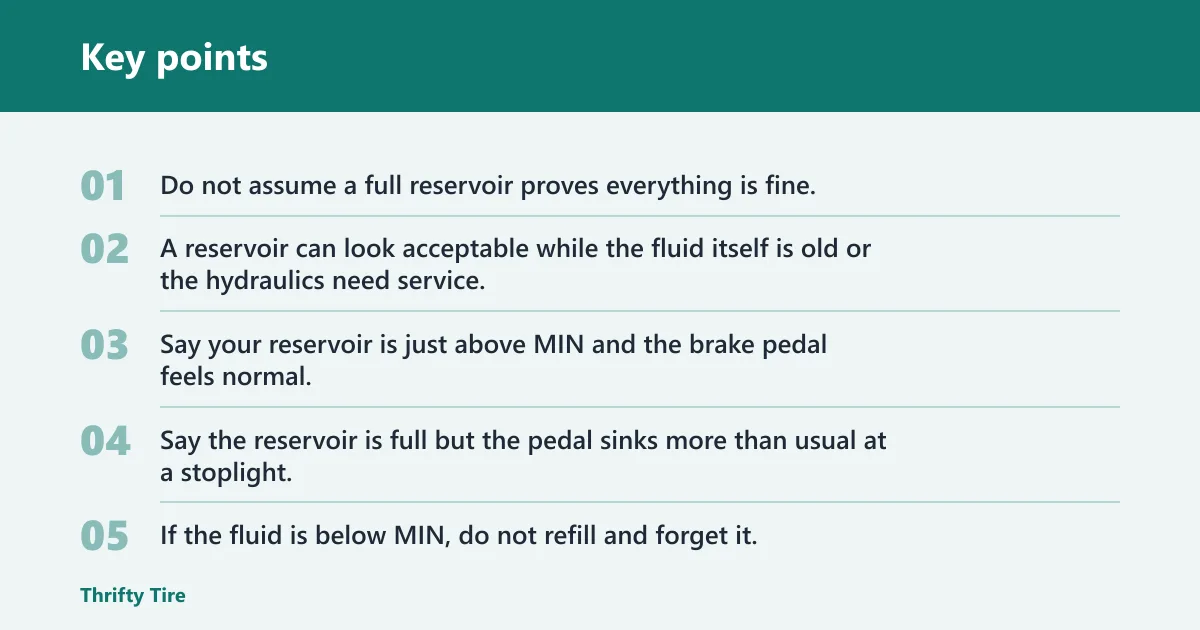
Do not assume a full reservoir proves everything is fine. If the pedal feels wrong, if the brake warning light stays on, or if the fluid looks very dark, the system still needs diagnosis. A reservoir can look acceptable while the fluid itself is old or the hydraulics need service.
Brake fluid decision table
| Reservoir reading | Pedal feel | Fluid color | Next action |
|---|---|---|---|
| Between MIN and MAX | Normal firm pedal | Light amber to brown | Monitor at the next fuel fill or service interval. |
| Near MIN, but not below it | Normal pedal | Brown | Check pad wear soon and recheck the level after service. |
| Below MIN | Normal pedal | Brown or dark | Top up only with the correct DOT fluid, then inspect for leaks or worn pads. |
| Below MIN or drops again after topping up | Soft or spongy | Dark or black | Book service immediately. |
| Between MIN and MAX | Soft or spongy | Any color | Inspect for leaks or hydraulic faults; do not rely on the reservoir reading alone. |
What the level means in practice
Say your reservoir is just above MIN and the brake pedal feels normal. That can fit pad wear, so a check of pad thickness and a later recheck of the fluid level makes sense. Say the reservoir is full but the pedal sinks more than usual at a stoplight. That is not a normal level issue; the braking system needs inspection.
If the fluid is below MIN, do not refill and forget it. Excessive pad wear can mimic low fluid, and adding fluid before pad replacement can overflow the reservoir when the caliper pistons are pushed back later.
How to top up brake fluid reservoir
Top up only after you confirm the correct fluid type in the owner’s manual or on the reservoir cap. Most cars use DOT 3 or DOT 4, and those two are generally compatible, but DOT 5 silicone is different and should not be mixed with them. Never guess from color alone.
- Confirm the fluid spec. Check the owner’s manual and reservoir cap for the required DOT rating. DOT 3, DOT 4, and DOT 5 are common specifications, but the wrong choice can damage the system or make braking unsafe.
- Clean the cap area. Wipe dust and grime from around the reservoir cap before opening it. Kia advises cleaning around the cap first, and that step matters because contamination goes straight into the fluid path if debris falls inside.
- Add a little at a time. Pour in about 30 to 50 mL at a time, then pause and recheck the level. Stop at the MAX mark. Do not overfill, especially if the pads are already worn and may be replaced soon.
- Wipe spills immediately. Brake fluid can damage paint, so clean any spill at once and rinse the area with water. Keep fluid off painted panels, hoses, and wiring connectors.
- Close and recheck. Refit the cap securely, then press the brake pedal a few times and confirm the level still sits in range. If the fluid drops again, or the pedal changes feel, stop and schedule inspection.
When should you book service?
Book service immediately if the reservoir is excessively low, if the level keeps falling, if the pedal feels soft or spongy, or if the brake warning light stays on. Kia recommends professional inspection when the fluid is excessively low, and a recurring low level usually means a leak, worn parts, or both.
Brake fluid color also matters. Dark or black fluid may need replacement because brake fluid absorbs moisture over time, and moisture lowers boiling point. A reservoir that looks “okay enough” but contains very dark fluid should still go in for service.
Common first-timer mistake: topping up a low reservoir before checking pad wear. If the pads are near replacement, the pistons will be pushed back during brake work and the reservoir can overflow. Check pads first if the level is near MIN and there is no obvious leak.
If that didn’t work, try this next
- Inspect visible brake lines. Look for wet fittings, damp calipers, or fresh drips near each wheel. Any sign of fluid outside the reservoir means the problem is not normal wear.
- Check pad thickness. Look through the wheel or remove the wheel if needed. Thin pads explain gradual fluid loss over mileage; very thin pads mean the car needs brake work soon.
- Book a brake inspection. If the reservoir is low again after a top-up, or the pedal still feels off, have the system inspected before driving further.
Common mistakes
- Opening the cap too soon. Read the outside of the reservoir first. Opening it unnecessarily adds moisture and contamination risk.
- Using the wrong fluid. Use only the DOT type listed in the owner’s manual or on the cap. DOT 5 silicone should not be mixed with DOT 3 or DOT 4.
- Chasing the level past MAX. Fill only to MAX. Overfilling leaves no room for pad wear changes and can create a mess during later brake service.
- Ignoring pedal feel. A reservoir in range does not cancel a soft pedal or warning light. Those signs need diagnosis.
- Reading the level on a slope. Always check on level ground. A slanted driveway can skew the reading.
Frequently asked questions
Should the brake fluid reservoir be full?
No. It should be within the marked operating range, not forced to the top. MAX is the upper limit. A reservoir at MAX with normal pad wear is fine; a full-looking reservoir does not rule out a leak or a brake problem if the pedal feels wrong.
How to top up brake fluid reservoir: use the correct DOT fluid
Use the correct DOT fluid named on the reservoir cap or in the owner’s manual, clean around the cap first, and add only enough to reach MAX. Add about 30 to 50 mL at a time, then recheck. Stop if the level rises again after driving.