Brake Rotor Resurfacing vs Replacement Cost: Which Is Cheaper?
Resurfacing is often cheaper by roughly $25 to $75 per rotor, but replacement can be the better choice once machining would leave the rotor below minimum thickness or any labor savings are no longer meaningful. Done wrong, you pay twice: once for machining and again for new rotors, plus you may keep brake pulsation, noise, or heat problems. This guide compares true total cost and shows when resurfacing stops making sense.
This guide is part of our Brake rotor replacement cost: what you should pay series.
| Factor | Brake rotor resurfacing | replacement cost | Winner |
|---|---|---|---|
| Cost | Usually cheaper by roughly $25 to $75 per rotor; lower sticker price because it removes a thin layer with a lathe. | Usually higher up front because you buy new rotors and pay labor; replacement costs more up front. | Brake rotor resurfacing |
| Lifespan / remaining life | Depends on remaining thickness; each cut makes the rotor thinner and can bring the next service sooner if it is near minimum thickness. | New rotor restores the part to new-part thickness and resets the wear clock. | replacement cost |
| Maintenance / future visits | Higher risk of a second visit if the rotor is already near minimum thickness or heavily worn. | Lower risk of repeat work if the new rotor matches the vehicle spec; replacement avoids paying for repeated work later. | replacement cost |
| Performance / heat capacity | Lower heat capacity after each cut because material is removed; may not hold enough heat safely if too thin. | Restored to new-part thickness, which better supports heat management after repair. | replacement cost |
| Best-fit use | Best for light grooves and mild surface noise on a rotor with plenty of thickness left. | Best for warping, heavy scoring, or any rotor at or below minimum thickness. | Tie |
| Minimum thickness / safety | Only makes sense if machining still leaves the rotor above minimum thickness; otherwise it can be a false economy. | Preferred when machining would leave the rotor below minimum thickness or the rotor is already at or below minimum thickness. | replacement cost |
| Surface damage | Works when surface damage is light and the problem is tied to surface wear rather than deep damage. | Better when the rotor is cracked, heavily scored, or warped enough that machining cannot clean it safely. | replacement cost |
| Vehicle / rotor design | Can be done on some rotors if they are thick enough and the design allows machining. | Often recommended for luxury/performance or modern rotors that are thin, model-specific, soft, or not meant to be machined. | replacement cost |
Brake rotor resurfacing vs replacement cost
Resurfacing is usually the lower sticker price because it removes a thin layer with a lathe instead of buying a new rotor. Replacement costs more up front, but the total can be better when the old rotor is close to minimum thickness or the shop would need to charge for repeated work later.
Rotor-only cost versus full brake service
Keep the quote types separate. Rotor-only work compares resurfacing against rotor replacement alone; a brake job that also includes pads is a different cost bucket, and it should be priced that way on the estimate. When pads are worn, the combined-service economics change, because brake pad replacement may need to happen at the same visit.
For context, rotor replacements average $574 to $698 per axle, brake pad replacement averages $335 to $394 per axle, and a full brake job can cost $909 to $1,092 per axle. The total for all pads and rotors averages $1,818 to $2,184. Those figures are best read as axle-based estimates, not per-rotor quotes, because shops often bundle labor into the axle price.
The cost trade-off in one sentence
If machining keeps the rotor within spec and gives you meaningful life, resurfacing is usually the cheaper choice. If machining would leave the rotor too thin, or if the rotor is already likely to need attention again soon, replacement is the cheaper total buy.
How much does brake rotor resurfacing cost compared with replacement?
Resurfacing is usually the lower sticker price because it removes a thin layer with a lathe instead of buying a new rotor. Replacement costs more up front, but the total can be better when the old rotor is close to minimum thickness or the shop would need to charge for repeated work later.
Typical shop pricing for machining rotors
Many shops price resurfacing per rotor or per axle, and the labor rate can change the total a lot. The key point is not the shop’s base number alone; it is whether the rotor can be machined safely and whether the result still has enough metal to handle heat. Midas says rotors can be resurfaced one or more times, but it also warns that each resurfacing makes rotors thinner, and that mechanics must replace rotors below minimum thickness.
Vehicle segment
Price is not one-size-fits-all. Economy cars usually sit at the lower end of the range, midsize SUVs are often near the middle, trucks tend to run higher because of size and load demands, and luxury or performance vehicles can cost more because the parts and labor are more specialized.
Why labor charges change the total
Labor charges can differ from parts cost, and independent shops and dealerships may price the same brake visit differently. A quote that looks cheap can stop being cheap if it hides labor, pad replacement, or inspection charges that another quote lists separately.
-
Confirm the labor line.
Ask whether the estimate includes removing the rotors, machining them, reinstalling them, and rechecking brake operation. A quote that covers only the cut can look lower than the true invoice. -
Ask for axle pricing.
Find out whether the number is for one wheel, one axle, or both axles. Front and rear axle pricing often differs, and a quote for one axle should never be treated as a quote for the whole car. -
Check pad status too.
If the pads are near the wear limit, the shop may recommend pad replacement at the same visit. That can change the comparison because pads can damage or groove rotors when they wear unevenly.
Rotor cost decision table
| Scenario | Likely shop action | Expected cost direction | Reuse risk | Next brake service sooner? |
|---|---|---|---|---|
| Light grooves | Resurface if thickness remains comfortably above minimum | Lower now | Low to moderate | No, if the rotor still has plenty of life |
| Pulse/warping | Check thickness first; resurface only if the rotor still has enough metal | Mixed, depends on thickness | Moderate | Maybe, if the rotor was already near limit |
| Near-minimum thickness | Replace | Higher now, lower risk later | High if resurfaced; usually not acceptable | No, because replacement resets the wear clock |
| Heavy scoring | Replace | Higher now | Very high if resurfaced; not worth the gamble | Yes, if resurfacing would only delay the fix |
| Luxury/performance rotors | Often replace, especially if the rotor is thin or the design is not meant to be machined | Usually higher now | Moderate to high | Depends on vehicle spec and rotor design |
Light grooves and mild brake noise
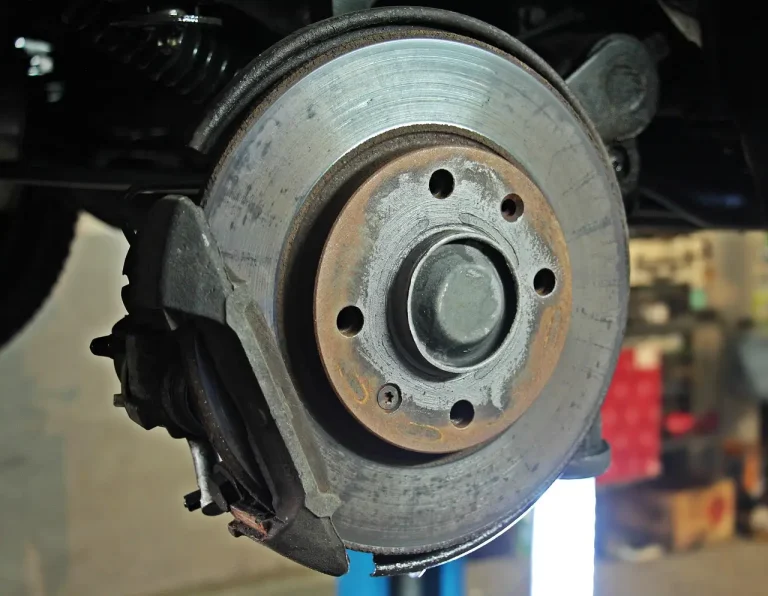
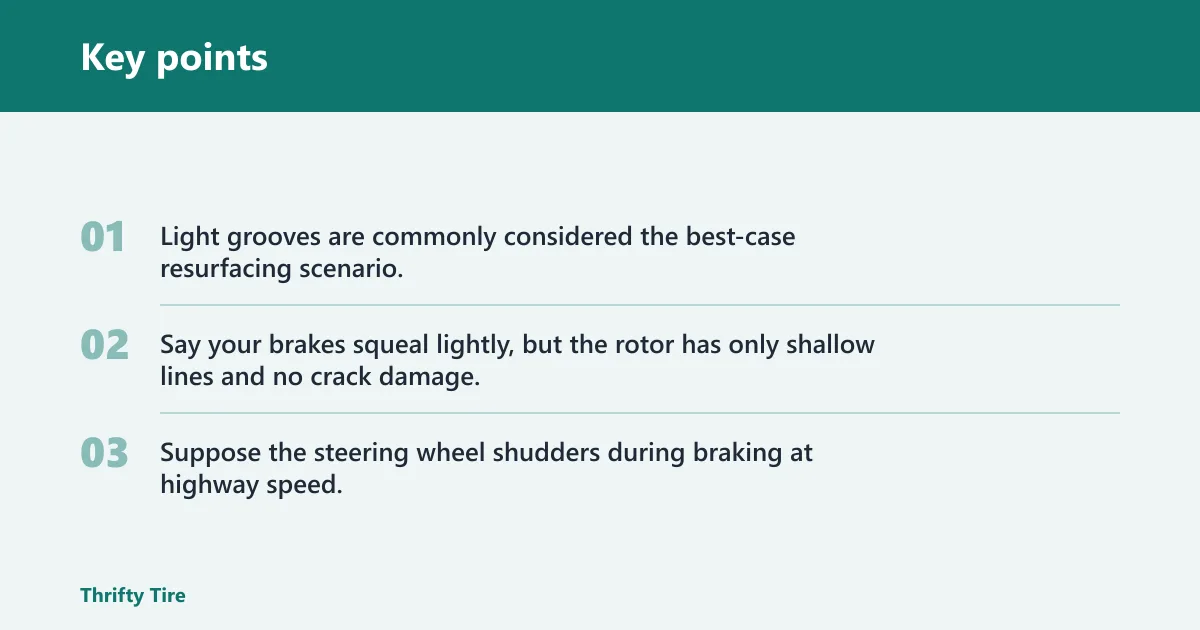
Light grooves are commonly considered the best-case resurfacing scenario. If the rotor is still safely above the manufacturer’s minimum thickness, machining can remove the uneven surface and let the pads bed in again without buying a new rotor.
Say your brakes squeal lightly, but the rotor has only shallow lines and no crack damage. Resurfacing may fix the contact surface at a lower price than replacement, as long as the rotor remains thick enough after machining.
Pulse/warping and vibration
Pulsing in the pedal or jittery braking is a common rotor sign, and Midas lists vibrations or jittery braking as a rotor sign. That symptom can come from rotor shape issues, but the repair still depends on thickness, because a thin rotor may not have enough metal left to machine safely.
Suppose the steering wheel shudders during braking at highway speed. If the rotor is well above minimum thickness, resurfacing can be the cheaper fix; if it is already thin, replacement is the better buy because the rotor may not hold enough heat after machining.
When can rotors be resurfaced?
Rotors can be resurfaced when the surface damage is light, the rotor is still above minimum thickness, and the brake problem is likely tied to surface wear rather than deep damage. In that case, resurfacing can restore a usable braking surface at a lower price than replacement.
Minimum thickness and heat capacity
Before approving machining, ask the shop to measure rotor thickness and compare it with the manufacturer’s minimum. If the rotor is close to the limit, resurfacing can become a false economy because the next brake service may come sooner.
Brake pads often get replaced with rotors, but they do not have to be if the pads still have usable material and are wearing evenly. If the pads are worn enough to damage the rotor again, saving the rotor alone does not save much.
When replacement is the cheaper choice
Replacement is often the lower total-cost choice when the rotor is warped enough to keep causing vibration, scored too deeply to machine cleanly, cracked, or already at or below minimum thickness. It is also the better buy when resurfacing would be so close to the limit that the next brake visit is likely soon.
Warping, heavy scoring, and thin rotors
Heavy scoring can force a deeper cut than a safe rotor allows. If the shop would have to remove too much metal to clean the surface, replacement avoids paying for machining that cannot solve the problem.
Warped, cracked, or heavily worn rotors need replacement. That is not a preference call; it is a safety and thickness issue. Modern rotors are often avoided for machining for the same reason: once thickness is gone, there is not enough material left to manage heat safely, even if the surface looks serviceable.
Luxury and performance rotors
Vehicle make and model matter a lot. Smaller economy cars can cost less than national averages, while luxury and performance vehicles often cost more because the rotors are model-specific and sometimes less likely to be resurfaced at all.
Many modern rotors cannot be resurfaced because they are too soft or thin. Some modern brake designs leave too little margin for machining, so the shop may recommend replacement even when the rotor still looks usable from the outside.
Choose Brake rotor resurfacing if… / Choose replacement cost if…
Choose Brake rotor resurfacing if the rotor has light grooves, stays comfortably above minimum thickness after machining, and the brake pads still have enough life to avoid a second brake visit right away. Choose replacement if the rotor is near minimum thickness, heavily scored, warped enough to keep pulsing, or likely to need attention again soon.
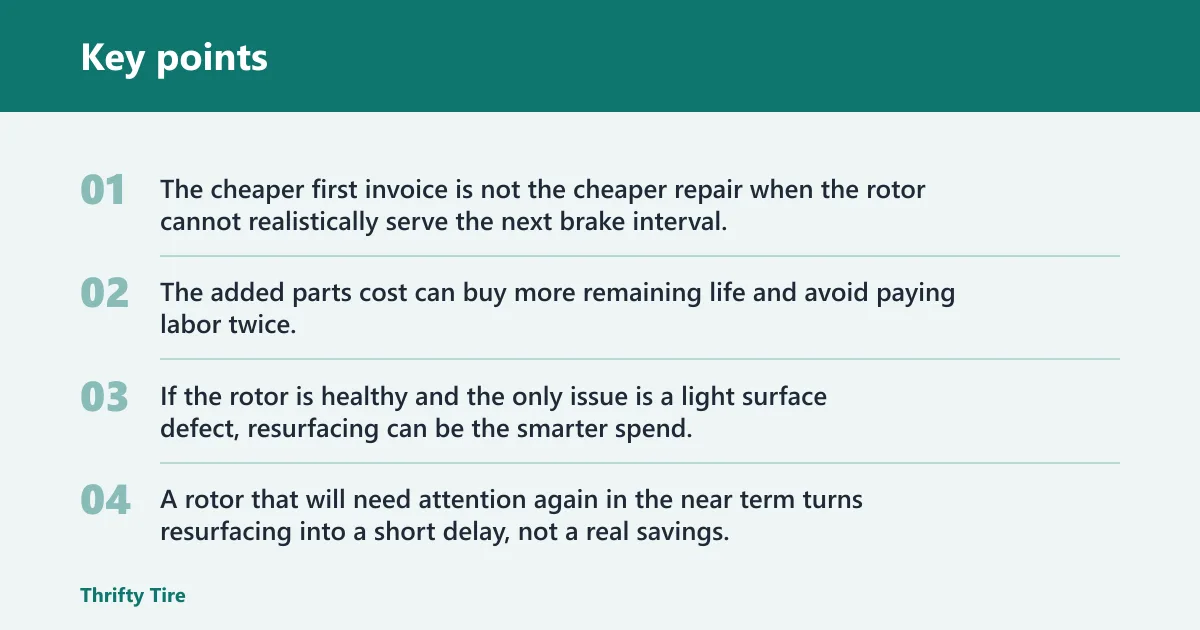
A clear break-even rule helps: if resurfacing does not leave enough thickness for normal heat handling, or if the machining savings are small compared with the chance of another brake job soon, replacement wins. The cheaper first invoice is not the cheaper repair when the rotor cannot realistically serve the next brake interval.
What to choose when the quote is close
If the resurfacing quote and replacement quote are close, replacement usually gives better value when the rotor is already worn. The added parts cost can buy more remaining life and avoid paying labor twice.
If the rotor is healthy and the only issue is a light surface defect, resurfacing can be the smarter spend. That is the point where the lower sticker price also has a good chance of becoming the lower total cost.
What to choose when the next brake service is likely sooner
If the shop expects the pads to need replacement soon, or the rotor is already near the wear limit, replacement is often the safer choice. A rotor that will need attention again in the near term turns resurfacing into a short delay, not a real savings.
What should I ask a shop before approving rotor resurfacing or replacement?
Ask for the rotor thickness measurement, the manufacturer’s minimum thickness, and the exact line items in the estimate. You also want to know whether the number covers one wheel, one axle, or both axles, and whether pad replacement is included or separate.
-
Ask for measured thickness.
Have the shop state the current rotor thickness and the minimum spec they are using. If the rotor is near the cutoff, the decision changes fast. -
Ask what the quote includes.
Make sure the estimate lists resurfacing or new rotors, labor, pads, and any additional brake hardware. Separate lines make comparison easier. -
Ask which axle is priced.
Confirm whether the price is for the front axle, rear axle, one wheel, or both axles. Front and rear pricing can differ enough to change the choice. -
Ask why the rotor failed.
If the rotor is scored, warped, or thin, ask whether the shop expects resurfacing to solve the symptom or only hide it briefly. That answer tells you whether the lower price is real value.
Frequently asked questions
Is resurfacing brake rotors cheaper than replacing them?
Usually yes, but only when the rotor has enough thickness left to machine safely. Resurfacing is typically the lower up-front cost, while replacement becomes the better value if machining would push the rotor below minimum thickness or leave too little metal for heat handling.
When can rotors be resurfaced instead of replaced?
Rotors can be resurfaced when the damage is light, the surface can be corrected with a lathe, and the rotor remains above the manufacturer’s minimum thickness after machining. If the rotor is cracked, heavily scored, warped beyond correction, or already too thin, replacement is the right choice.
Do all rotors qualify for resurfacing?
No. Many modern rotors cannot be resurfaced because they are too soft or thin, and some designs do not leave enough material for safe machining. Even when a rotor can be cut once, each resurfacing makes it thinner, so the remaining thickness has to be checked every time.
Will resurfacing save money if I also need brake pads?
Sometimes, but not always. Brake pads often get replaced with rotors, and brake pad replacement averages $335 to $394 per axle, so the combined bill can rise quickly. If the rotor is already near minimum thickness, replacing both parts at once can be the cheaper total decision.