What Happens If You Ignore a Failing TPMS Sensor for Too Long?
If you ignore a failing TPMS sensor too long, you can miss a low-pressure tire for days or weeks. That raises crash risk and tire-damage risk fast. Delayed repairs can also cause uneven tread wear and turn a simple sensor swap into deeper diagnosis. This guide explains the warning signs, what can happen next, and when to inspect the tire versus replace the sensor.
Why a failing TPMS sensor matters
A TPMS sensor watches the pressure in one tire on a direct TPMS system. Most use a sealed internal battery, and many last about 5 to 10 years before age, corrosion, impact, or valve-stem damage starts to interrupt the signal.
That matters because a bad sensor can report the wrong pressure or stop reporting altogether. If the warning stays on, it may hide a tire that is losing air, and you may keep driving on underinflated tires without noticing the change.
How a dead battery or damaged stem changes the signal
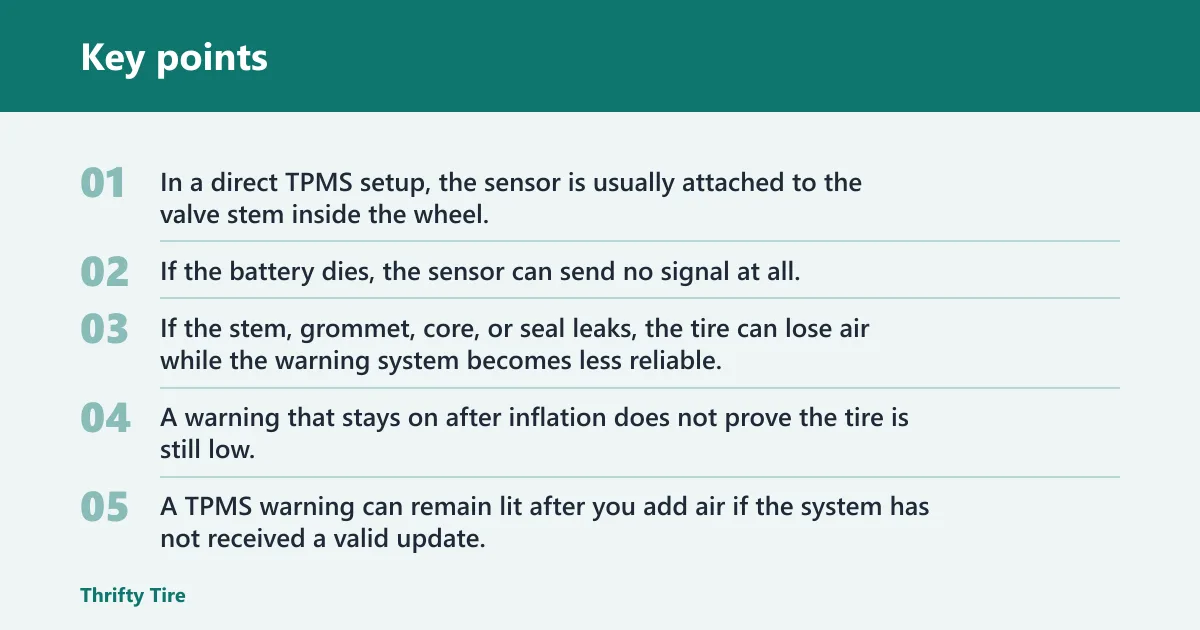
In a direct TPMS setup, the sensor is usually attached to the valve stem inside the wheel. If the battery dies, the sensor can send no signal at all. If the stem, grommet, core, or seal leaks, the tire can lose air while the warning system becomes less reliable.
A warning that stays on after inflation does not prove the tire is still low. It may mean the sensor is bad, the system needs a relearn, or the vehicle has a separate fault in the module or wiring.
Why the warning can stay on after inflation
A TPMS warning can remain lit after you add air if the system has not received a valid update. That is common when a direct sensor is failing, when a wheel was recently replaced, or when the relearn procedure was skipped.
On many vehicles, a flashing light after startup points to a TPMS system fault rather than simple low pressure. A solid light more often points to a tire pressure issue, but you still need to check actual pressure first.
How do you tell sensor trouble from a real air leak?
Check cold tire pressure against the door-jamb placard before you blame the sensor. If one tire is below the listed PSI and the others are close, treat that as a tire issue first. If all four match and the warning remains, look harder at the sensor or the TPMS system.
The difference matters because a dead sensor can hide a slow leak, while a real leak can look like sensor trouble if the warning never updates correctly. A gauge gives you the facts the light cannot.
Check cold pressure first. Use a tire pressure gauge when the tires are cold, then compare each reading with the door-jamb placard. The placard lists the manufacturer-specific PSI for your vehicle, and that is the baseline for diagnosis.
Compare all four tires. Look for one tire that is clearly lower than the others, or one that keeps dropping after refill. A single tire losing air points toward a puncture, bead leak, valve issue, or stem problem more than an electronic fault.
Watch the pattern after refill. If the light returns after a proper inflation and the same tire is low again, stop treating it as a sensor-only issue. Repeated loss usually means the tire or valve assembly needs inspection.
Say your left front tire is 28 PSI and the placard calls for 35 PSI cold. That is a real underinflation problem, even if the sensor is also failing. Inflate to spec, then inspect for a nail, sidewall damage, valve leak, or bead seepage before assuming the warning is only electronic.
Suppose all four tires read within 1 PSI of the placard, but the TPMS light flashes for a minute after startup and then stays on. That pattern points more toward a TPMS fault than a tire leak. A scan tool is often needed to see which sensor, module, or signal path is failing.
What happens if you keep driving with it?
If you keep driving with a failing TPMS sensor, the biggest risk is not the sensor itself. It is the tire problem you may not notice soon enough. Missed underinflation can build heat, shorten tire life, and make a blowout more likely if the pressure drops far enough.
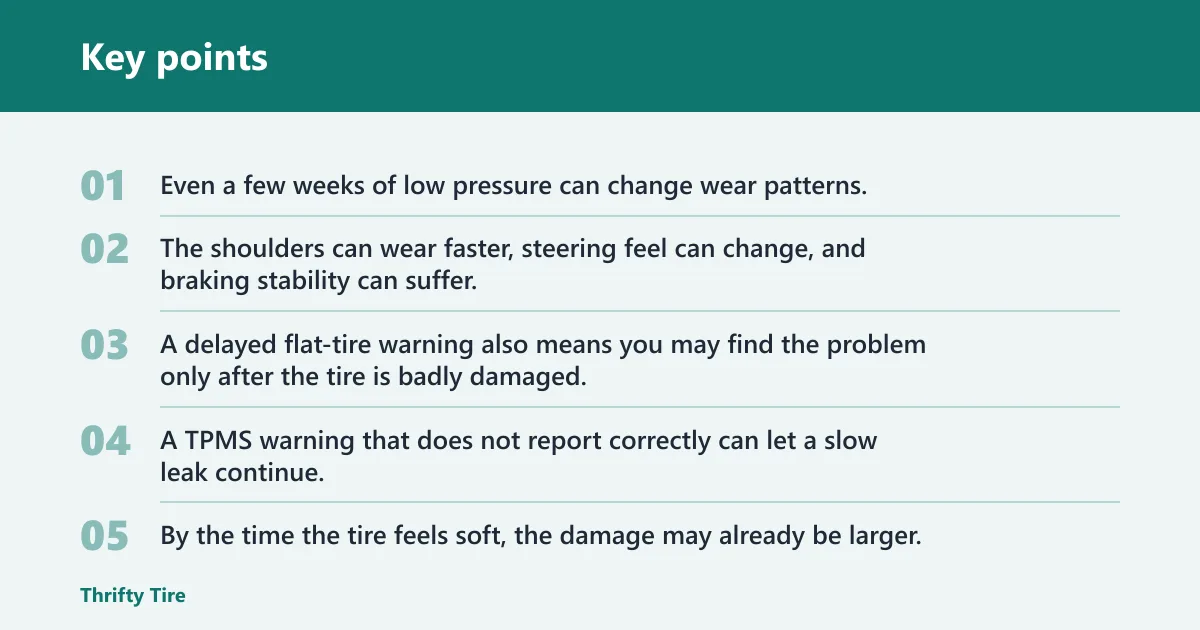
Even a few weeks of low pressure can change wear patterns. The shoulders can wear faster, steering feel can change, and braking stability can suffer. A delayed flat-tire warning also means you may find the problem only after the tire is badly damaged.
Missed underinflation
A TPMS warning that does not report correctly can let a slow leak continue. Tires can lose pressure from a puncture, a leaking valve core, or a damaged stem without a dramatic ride change at first. By the time the tire feels soft, the damage may already be larger.
Uneven tread wear
Low pressure changes how the tread sits on the road. The outside edges can wear faster, and the tire may run hotter than it should. That can reduce the useful life of the tire long before the tread is gone.
Delayed flat-tire detection
A sensor that reports no signal or wrong pressure can delay the warning that should tell you to stop. That delay is most dangerous when the tire is already losing air at speed. The longer the delay, the more likely the carcass and wheel can be damaged.
TPMS sensor decision matrix
This table helps sort common symptom combinations into likely outcomes. It is not a substitute for a pressure check, but it does show when the problem is likely the tire, the sensor, or the relearn process.
| Symptom combination | Immediate action | Likely cause | Driving risk |
|---|---|---|---|
| Solid light, all tires match the placard | Schedule a scan and relearn check | Sensor fault, dead battery, or module issue | Medium |
| Flashing light after startup | Have the system scanned soon | TPMS system fault, missing signal, or relearn failure | Medium to high |
| One tire is low on a gauge | Inflate to placard and inspect for a leak | Puncture, valve leak, bead leak, or stem damage | High if pressure is far below spec |
| Repeated alerts after refill | Recheck pressure, then inspect the tire and valve | Slow leak or failing sensor that is not updating correctly | Medium |
| Post-service relearn failure | Confirm sensor IDs and complete relearn | Wrong sensor ID, missed reset, or bad sensor signal | Medium |
Can a bad TPMS sensor pass inspection?
It depends on where you live and how the inspection is written. In some regions, an inoperative TPMS warning can fail a safety or emissions-related check. In others, the light status may be advisory unless the vehicle has another tire or safety defect.
That means a broken sensor can move from nuisance to compliance issue. If the warning light is on, flashing, or inoperative, the vehicle may not pass until the fault is repaired and the system works as required in that jurisdiction.
Why the light status matters
A solid light usually means the system has detected low pressure or a related condition. A flashing light usually means the TPMS itself has a fault. Inspection rules often care about whether the warning system works, not just whether the tire pressure looks normal.
Why rules vary by jurisdiction
Inspection standards are not identical everywhere. Some places check for a working TPMS warning as part of safety compliance, while others allow different fault patterns. Always verify local rules before assuming a warning will be ignored during inspection.
Repair path and relearn issues
Direct TPMS uses in-wheel sensors that read individual tire pressure. Indirect TPMS does not use pressure sensors in the wheel. It estimates changes from ABS wheel-speed data and can often be reset after inflation on many vehicles.
That difference changes the repair path. A direct system may need sensor replacement, valve-stem parts, and a relearn procedure. An indirect system may only need the tires set to the right pressure and the reset performed correctly.
Sensor replacement and valve-stem parts
When a direct sensor is serviced, the valve stem, grommet, core, and seal may also be replaced. Rubber and metal stems both can leak if a sealing part fails. Reusing worn sealing hardware can leave you with the same warning after the new sensor is installed.
When a scan tool or relearn is needed
A tire shop diagnostic scan tool can read sensor IDs, battery status where supported, signal strength, and fault codes. That helps separate a dead sensor from a module or wiring issue. Some vehicles also need the sensor IDs registered before the warning will clear.
Confirm the TPMS type. Check whether the vehicle uses direct TPMS or indirect TPMS. Direct systems use in-wheel sensors; indirect systems use ABS wheel-speed data and often reset after inflation.
Inspect the wheel hardware. Look at the valve stem, core, grommet, and seal for damage or corrosion. If the stem hardware is worn, replace it with the sensor service instead of reusing old sealing parts.
Complete the relearn. Follow the vehicle-specific reset or relearn procedure, which may require a scan tool or a drive cycle. If the IDs are not registered correctly, the warning can stay on even when the tires are properly inflated.
Frequently asked questions
What happens if you ignore a failing TPMS sensor for too long?
A failing TPMS sensor can let a slow leak go unnoticed long enough for a tire to run underinflated, wear unevenly, or overheat. The sensor problem can also hide a tire problem, which means the warning light loses value as a safety check. That is why delay matters.
Can you drive with a bad TPMS sensor?
Sometimes, yes, but only after you verify actual tire pressure with a gauge and confirm the tires match the placard. If the light is flashing, if one tire is losing air, or if the pressure is low, driving becomes much riskier and should not be treated as routine.
Will a failing TPMS sensor affect tire safety?
Yes, indirectly. The sensor does not change tire structure, but it can hide pressure loss. That delay can lead to underinflation, shorter tire life, poorer handling, and a higher chance of damage if the tire drops too far below the recommended pressure.
How long can a TPMS sensor last before it fails?
Most TPMS sensors last about 5 to 10 years, though that varies by vehicle, usage, and environment. The sealed battery is a common limit, and corrosion, impact, or valve-stem damage can shorten service life even before the battery reaches the end of its normal range.
How do you know if the TPMS sensor is failing and not the tire?
Start with a cold pressure check against the door-jamb placard. If the pressure is correct but the light stays on or flashes, the sensor, relearn, module, or wiring may be at fault. If one tire keeps losing air, the tire or valve is the first suspect.
Will an inspection fail if the TPMS light stays on?
It may, depending on local rules. Some inspection systems reject an inoperative TPMS warning, while others treat it differently. Because requirements vary by jurisdiction, a light that stays on can become a compliance issue even if the tires themselves are properly inflated.