TPMS Light: Meaning, Causes, Reset, and Fixes
A TPMS light usually means one or more tires are at least 25% below the vehicle maker’s cold-pressure placard, while a flashing light points to a sensor or system fault rather than simple low air. Ignore it and you risk rapid tire wear, longer stopping distances, a blowout, or paying for sensors and tires you did not need to replace. This guide maps light behavior to the next step: inflate, inspect for leaks, relearn sensors, or diagnose failed hardware.
The warning is the amber or yellow horseshoe-shaped dashboard icon with an exclamation point in the center, meant to resemble a tire cross-section. On many vehicles built after September 2007, that same light can signal either low pressure or a TPMS fault, so its behavior matters more than the icon by itself.
How the TPMS warning light works
The TPMS warning light tells you either that one or more tires are significantly under-inflated or that the tire-pressure monitoring system has malfunctioned. A solid light usually points to low pressure. A light that flashes for about 60 to 90 seconds and then stays on points to a system fault instead.
Read the light before touching anything
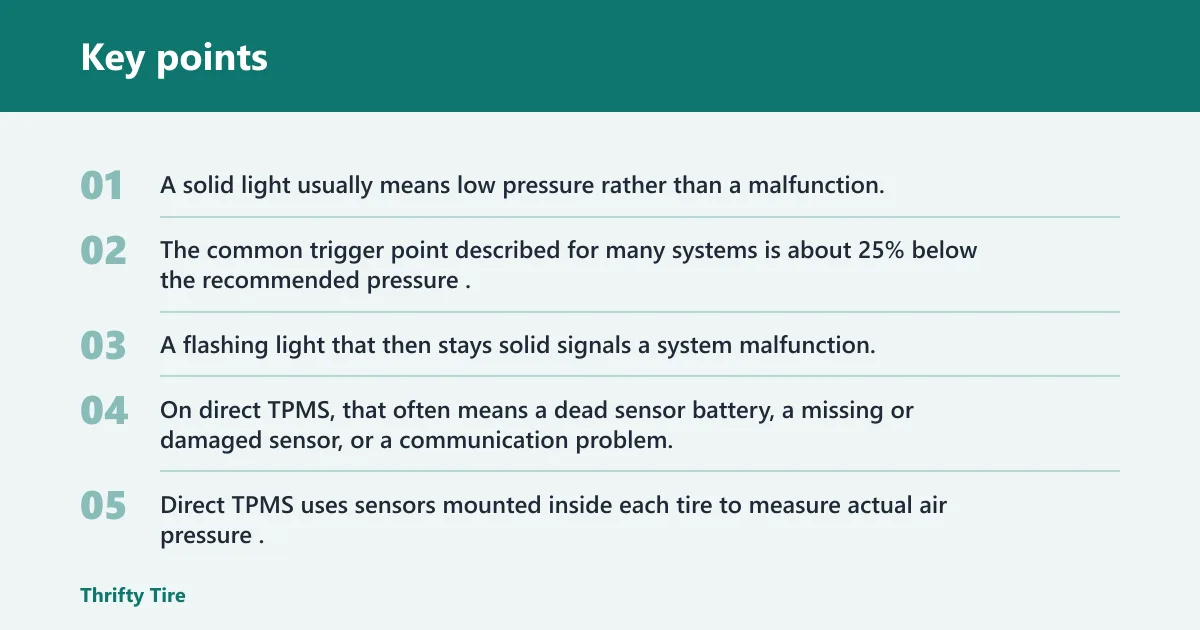
A solid light usually means low pressure rather than a malfunction. The common trigger point described for many systems is about 25% below the recommended pressure. That threshold is based on the driver-side door-jamb placard, not the maximum pressure molded into the tire sidewall.
A flashing light that then stays solid signals a system malfunction. On direct TPMS, that often means a dead sensor battery, a missing or damaged sensor, or a communication problem. On indirect TPMS, it can mean the recalibration failed or the ABS wheel-speed data does not match what the system expects.
Direct vs. indirect TPMS changes the diagnosis
Direct TPMS uses sensors mounted inside each tire to measure actual air pressure. Many direct systems can show each tire’s PSI on the dash, but they depend on sealed sensor batteries that are typically non-replaceable and commonly last 5 to 10 years.
Indirect TPMS uses wheel speed sensors from the anti-lock brake system. It does not measure actual tire pressure, usually cannot identify which specific tire is low, and is generally less precise than direct TPMS. After inflation, rotation, or tire replacement, an indirect system often needs recalibration rather than sensor programming.
Pressure changes can trigger the light without a puncture
A 10°F drop in ambient temperature typically cuts tire pressure by about 1 PSI. Natural air permeation can also bleed off 1 to 2 PSI per month. That is why a light can appear on the first cold morning of the season even when no tire has visible damage.
TPMS light decision table
| Light behavior | After airing up behavior | After rotation or wheel service | Most likely cause | Reset or relearn needed | Tool needed? | Stop driving? |
|---|---|---|---|---|---|---|
| Solid from startup | Turns off after correcting all cold pressures | No recent service | One or more tires were low | Usually none beyond driving briefly | No | No, if pressure is stable and no tire is visibly damaged |
| Solid from startup | Stays on after air was added | No recent service | One tire still underfilled, warm-tire reading fooled the fill, slow leak, or low monitored spare | Recheck all cold pressures against door-jamb placard | No | Stop if a tire is losing air quickly or shows damage |
| Flashes 60 to 90 seconds, then stays solid | No change after inflation | No recent service | Sensor battery failure, dead sensor, RF communication fault, module issue | Diagnosis first, then sensor replacement or system repair | Usually yes | Usually no immediate stop, but pressure must still be checked manually |
| Solid after pressure correction | Light remains on after several miles | Indirect TPMS vehicle | System was not recalibrated to the new baseline | Manual recalibration or menu reset | No, on many vehicles | No, if tires are correctly inflated and stable |
| Solid or flashing after tire rotation | Pressure is correct | Rotation just performed | Required relearn not done, wrong wheel positions stored | Automatic, stationary, or tool-triggered relearn depending on model | Sometimes | No, unless a tire is actually low |
| Flashing after new wheels or new sensors | No change | Wheel or sensor replacement just performed | Incompatible sensors, sensors not programmed, IDs not learned, non-cloned sensors not registered | Programming and relearn | Yes, often dedicated TPMS tool and sometimes OBD-based tool | No, but service is needed soon |
| Solid with all four road tires correct | Light stays on | No recent service | Underinflated monitored full-size spare | Inflate spare to placard or spare specification | No | No, unless the spare itself is damaged |
| Solid light plus pulling, thumping, or visible sidewall issue | Pressure drops again quickly | Any time | Puncture, valve leak, bead leak, wheel damage, or severe tire failure | Repair tire or wheel before any reset matters | No for diagnosis, maybe shop tools for repair | Yes |
Is it safe to drive with the TPMS light on?
It can be safe to drive a short distance if the light is solid, the vehicle feels normal, and the tire is only modestly low and holding air. It is not safe to keep driving if the tire is visibly low, losing pressure fast, damaged, or if handling changes suddenly.
When a short drive is reasonable
A short, slow trip to the nearest air pump is usually reasonable if the light is solid, the vehicle tracks straight, and no tire looks badly low. Check pressure as soon as possible. A TPMS warning does not tell you how far pressure has fallen unless the vehicle also shows individual PSI readings.
When to stop and inspect right away
Stop if you hear flapping, feel vibration that was not there before, see sidewall bulges, or find a tire visibly low. A severe puncture, bead leak, or bent wheel can dump pressure fast enough that even a short drive is a bad bet.
If the light is flashing, the safety issue changes. The flashing itself points to a monitoring-system fault, not necessarily a flat tire. But because the system may no longer warn correctly, manual pressure checks become the only reliable way to confirm the tires are safe.
How to judge whether to keep driving
If the TPMS light comes on, the key question is whether the tire still looks and feels normal. The supporting guide gives a simple answer-first rule: a steady light may mean you can drive a short distance to inspect or inflate the tire, but a flashing light, visible low tire, pulling, or odd handling means stop and check it immediately. That matters because even a small pressure loss can overheat the tire, damage the wheel, and increase blowout risk. For a clear step-by-step breakdown of what to do next, see TPMS light safety.
Why is my TPMS light on but the tires look fine?
Tires can be several PSI low and still look normal, especially on modern low-profile tires. The light may also be caused by colder weather, a low monitored spare, or a sensor fault. Appearance is a weak test; an accurate gauge and the placard pressure are what matter.
Looks can mislead
A tire can be low enough to trigger TPMS without obvious sidewall sag. That is common when pressure has dropped gradually. It is also common on stiffer sidewalls where the visual change is small until the pressure loss becomes more severe.
Cold weather and morning readings
Check pressure before driving, when the tires are cold. If the temperature dropped overnight, the tires may have lost enough pressure to trigger the warning even though they were fine the afternoon before. Roughly 1 PSI for every 10°F drop is enough to matter across a large weather swing.
Say your door-jamb placard calls for 35 PSI and a tire was sitting at 36 PSI in mild weather. A 20°F drop can trim about 2 PSI, and natural monthly loss can shave off more. The tire may now be low enough to trigger the light while still looking normal.
Do not forget the spare
Some vehicles monitor the spare tire, especially with a full-size spare setup. A full-size spare can trigger TPMS if it is monitored and underinflated. If all four road tires check out, the spare becomes the next place to look.
When the issue is electronic
If the light flashes first and then stays on, the problem is more likely the system than the inflation. Sensor batteries are sealed in many direct sensors, and dead batteries usually mean replacing the whole sensor. Signal path faults, antenna issues, or an unrecognized replacement sensor can create the same dash behavior.
When the tires are fine but TPMS stays on
If your tire pressures match the door-jamb spec and the TPMS light still won’t go out, the issue is usually not an underinflated tire. More often, the cause is a bad sensor, a system fault, or a relearn/reset problem after tire service. The supporting guide on TPMS warning light causes explains how to narrow it down so you do not waste time replacing the wrong part.
That matters because an active TPMS warning can hide a real pressure loss later, especially if the system is already misreading one wheel. The article also shows what to check before heading to a shop, including threshold pressure, sensor errors, and relearn issues.
How do you check pressure the right way?
The right way is to compare each tire’s cold pressure to the driver-side door-jamb placard, not the sidewall maximum, then correct each tire before judging the warning light. This avoids overinflation errors and gives the TPMS the baseline the vehicle maker intended for load, handling, and braking.
Use the correct target
The sidewall number is a maximum rating for the tire, not the normal operating target for your vehicle. The placard on the driver-side door jamb is the reference for diagnosis, inflation, and reset checks.
Check all monitored positions
That includes the spare if the vehicle monitors it. On direct TPMS, compare gauge readings with any PSI shown on the dash if available. On indirect TPMS, the dash cannot measure actual pressure, so the handheld gauge is the real source of truth.
Pressure-check procedure
- Park and let tires cool. Check pressure before driving or after the vehicle has sat long enough for the tires to return to ambient temperature. Warm tires read higher, which can make an underfilled tire look correct when it is not.
- Read the door-jamb placard. Find the front and rear cold-pressure targets on the driver-side door jamb. Use those numbers for every reset check instead of the maximum PSI molded into the tire sidewall.
- Measure every tire. Use a reliable gauge on all four road tires and the spare if monitored. Write the readings down if the warning has been coming back, because a single tire that repeatedly loses pressure points to a leak rather than a reset issue.
- Inflate to placard pressure. Add air until each tire matches the listed cold target. If one tire needs noticeably more air than the others, inspect it more closely for a puncture, valve-stem leak, bead leak, or wheel damage.
- Drive and recheck. Drive briefly if the vehicle normally clears the light on its own, then recheck the warning. If the light stays on, verify the pressures again when cold, then move to recalibration, relearn, or sensor diagnosis based on the light behavior.
Suppose all four road tires are set correctly after a fill-up, but the light stays on the next morning. The first retest should be cold pressure, not another random reset attempt. That separates a true leak from a failed reset or a bad sensor.
How do you reset the TPMS light?
You reset the TPMS light by correcting pressure first, then using the reset method your vehicle actually supports: automatic clear after driving, a button or menu-based recalibration, or a relearn routine after service. There is no single universal reset, and many vehicles do not have a manual TPMS button.
No-tool reset methods that may work
Some vehicles clear a low-pressure warning after all monitored tires are set correctly and the vehicle is driven. Some also support a menu-based recalibration or a dash-button reset, especially on indirect TPMS systems that need a fresh wheel-speed baseline.
Many vehicles need 10 to 50 miles to auto-relearn after service, and some support auto-relearn after installation and driving at above about 20 mph. Those are vehicle-dependent behaviors, not a guarantee.
Reset and recalibration procedure
- Correct all cold pressures. Inflate every monitored tire to the door-jamb placard. If one tire was far lower than the rest, inspect for leaks before assuming the light will stay off.
- Check for a reset control. Look for a TPMS reset button, a vehicle-settings menu item, or an indirect-TPMS calibration option. If the vehicle has none of these, it may rely on automatic clearing or a service-tool relearn.
- Run the reset method. Use the button or menu only after pressures are correct. On indirect systems, this stores the current wheel-speed pattern as normal so the system can detect a future underinflation event.
- Drive to confirm. Drive long enough for the vehicle’s normal clear or relearn behavior. If the light flashes, if it returns immediately, or if it stays on after correct inflation and the required drive cycle, the issue is not solved by another simple reset.
How to reset the TPMS light without a tool
Without a tool, the path is limited to pressure correction, any built-in reset button, any infotainment or dash recalibration menu, and the drive cycle the vehicle requires. That works on many low-pressure cases and some indirect systems. It will not fix a dead sensor battery or program new sensors.
Why is the TPMS light flashing or not resetting?
A flashing TPMS light often means the system cannot trust one or more sensor signals. If the light is solid but will not reset after correct inflation, the usual causes are underfilled tires, a missed spare-tire check, failed recalibration, wrong relearn after service, or hardware the vehicle cannot recognize.
Flashing points to hardware or communication
Direct TPMS sensors use low-frequency wakeup signals and UHF transmission frequencies. If a sensor battery is dead, the sensor is damaged, or the vehicle cannot hear that transmission, the light often flashes for about 60 to 90 seconds and then stays on.
Because many direct-sensor batteries are sealed, replacement usually means replacing the entire sensor. A standard OBD2 scanner often cannot trigger sensors, read TPMS-specific IDs, or program replacements, so diagnosis commonly needs a dedicated TPMS tool.
Solid but still on after inflation
When the light stays solid after airing up, the reset step usually failed for a reason. Common ones are warm-tire readings that led to underfilling, one missed tire, an ignored monitored spare, or an indirect system that never got recalibrated after pressure was corrected.
A common first-timer mistake is inflating a warm tire to the placard number after highway driving. Once the tire cools, the true cold pressure is lower, so the warning returns. The fix is to set pressure cold, then judge the light.
New wheels and replacement sensors
New wheels can create a TPMS warning even when the tires hold air perfectly. Some aftermarket wheels are installed without compatible sensors. Some replacement sensors must be programmed first, then learned by the vehicle. Cloned sensors copy an existing ID; non-cloned sensors need the vehicle to accept a new ID set.
Why did the TPMS light come on after a tire rotation or new tires?
After a rotation, wheel swap, or new tire install, the system may need a relearn to match sensor IDs to wheel positions or to confirm that all sensors are present. If that step is skipped, the light may stay on, flash, or report the wrong tire location.
What relearn means
A relearn procedure tells the vehicle which sensor ID belongs at which wheel location, or simply confirms sensor presence depending on design. Some vehicles do this automatically. Others need a stationary routine, a trigger-tool sequence at each wheel, or an OBD-based programming step.
When a tool is needed
A dedicated TPMS tool may be required to wake or trigger each sensor, read sensor IDs, or program a universal replacement sensor. An OBD-based TPMS tool may also be needed to write those IDs to the vehicle. A standard OBD2 code reader often cannot do those jobs.
Post-service relearn procedure
- Confirm the service change. Note whether the vehicle had a rotation, a full wheel swap, new tires on existing wheels, or entirely new sensors. The exact change points to whether the likely need is recalibration, relearn, or programming.
- Verify all pressures first. Set every monitored tire to the placard cold pressure before any relearn attempt. A relearn can succeed while the system still keeps the light on for a real low-pressure condition.
- Identify the relearn type. Check whether the model uses automatic relearn, a stationary sequence, or an OBD-based routine. Many post-rotation issues come from using the wrong procedure rather than from a failed sensor.
- Use the right tool if required. Trigger-tool relearns and programming jobs need a dedicated TPMS tool, not a basic code reader. If new universal sensors were installed, they may need programming before the vehicle can learn them at all.
- Retest after the drive cycle. After the relearn or programming step, drive the vehicle through the required cycle. If the light still flashes, suspect a dead sensor, incompatible sensor, damaged sensor, or a module or antenna fault.
Picture a vehicle that gets winter wheels installed with new universal sensors. The tires hold pressure, but the light flashes every startup. That symptom points away from inflation and toward sensors that were not programmed, were programmed incorrectly, or were never learned by the car.
What fixes solve the problem for good?
The lasting fix depends on the failure mode: repair the air leak if pressure keeps dropping, recalibrate or relearn if service changed wheel positions, or replace the sensor if its sealed battery has failed. Repeated resets do nothing if the tire still leaks or the sensor cannot transmit.
Fixes for real air loss
If one tire keeps losing pressure, the permanent fix is the leak repair. Common causes are punctures, leaking valve stems, bead leaks where the tire seals to the wheel, corrosion on the wheel seat, and bent or cracked wheels. TPMS only reports the symptom; it does not repair the cause.
Fixes for failed sensors
When a direct TPMS sensor battery dies, replacement usually means replacing the whole sensor because the battery is sealed. Sensor life commonly runs 5 to 10 years, so failures tend to cluster as the vehicle ages. Replacing one failed sensor may be enough, but vehicles close to that age range sometimes see more failures later.
Tool and cost guidance
Shop pricing varies by vehicle, wheel type, and sensor brand, so exact numbers are not universal. In practice, the low-cost path is pressure correction or a no-tool recalibration. The mid-cost path is a shop relearn with a trigger tool. The higher-cost path is sensor replacement, tire dismounting, new seals or service kits where required, and programming or relearn labor.
- Pressure correction or indirect-system recalibration is often a quick owner task.
- Trigger-tool relearns are usually a short shop job if the sensors are healthy.
- Sensor replacement adds parts cost, tire dismount labor, and a relearn or programming charge.
- New wheels without compatible sensors can turn a simple tire swap into a sensor-parts-and-programming job.
When to schedule service now
Schedule service soon if the light flashes, if the light returns after proper cold inflation, if the warning started right after tire service, or if the vehicle has new wheels or sensors the system may not recognize. Replace parts now, rather than waiting, if a tire is leaking, a wheel is damaged, or the TPMS cannot monitor pressure reliably.
Frequently asked questions
What does the TPMS light mean?
The amber or yellow tire-shaped symbol with an exclamation point means either one or more tires are significantly under-inflated or the system has malfunctioned. A solid light usually means low pressure. A flashing light that stays on usually means a sensor, communication, or control fault.
Why is my TPMS light on but tires are fine?
The tires may only look fine. A small pressure drop can trigger the warning without obvious sidewall sag. Other common causes are colder weather, a low monitored spare, an indirect system that needs recalibration, or a direct sensor fault that makes the light flash first.
How do I reset the TPMS light without a tool?
Without a tool, the realistic options are correcting pressure, checking the spare, using any built-in reset button or menu-based recalibration, and completing the needed drive cycle. That works for many low-pressure and indirect-system cases, but it will not program new sensors or revive a dead one.
Why is my TPMS light flashing?
A flashing TPMS light that then stays solid usually means a system malfunction rather than simple low air. Common causes are a dead sensor battery, damaged sensor, incompatible replacement sensor, missed relearn, or a communication problem between the wheel sensors and the vehicle’s TPMS receiver.
Why did the TPMS light come on after a tire rotation?
Many vehicles need a relearn after rotation or wheel service so the car can match sensor IDs to wheel positions or confirm sensor presence. If that step was skipped, the light may stay on, flash, or point to the wrong tire even though pressures are correct.