Center Bore Mistakes to Avoid When Buying Used Wheels
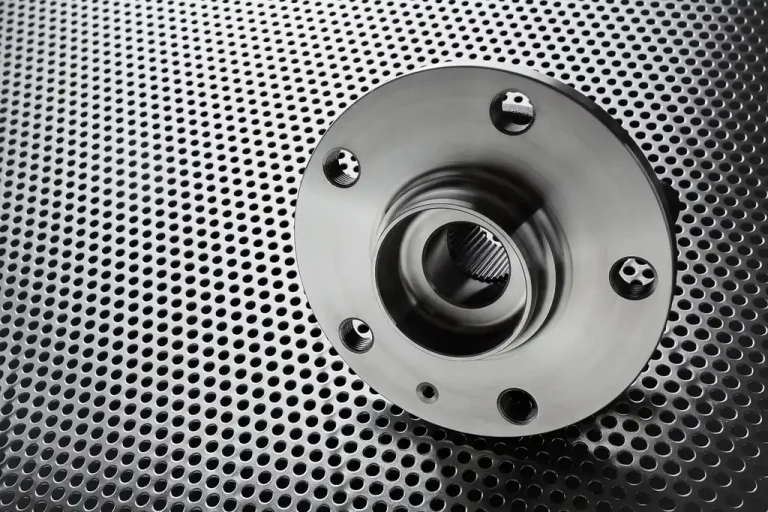
The center bore must match your hub, or the wheel must use the correct hub-centric ring; if the bore is smaller than the hub, the wheel is a no-go. Miss this, and you can end up with vibration, uneven wheel loading, or a wheel that will not mount at all. This guide covers center bore mistakes to avoid when buying used wheels, plus the checks that tell you whether the deal is safe or should be skipped.
Spotting bore fit and damage problems
The biggest center bore mistake is treating “looks clean” as proof of fit. On used wheels, the real risks are a bore that is too small, too large, ovalized, machined too much, or cracked at the hub area. Those problems can create highway-speed vibration, poor centering, and a damaged wheel-to-hub interface.
Too small, too large, or ovalized bore
A bore that is too small will not seat on the hub at all. A bore that is too large may still bolt on, but it can lose concentric location unless the wheel is correctly supported by hub-centric rings or by the proper wheel-centering system. Ovalized bores are worse than a simple size mismatch because the wheel can sit off-center even when the diameter looks close.
Fitment problems often come from tolerances and compatibility details buyers overlook. A wheel can be the right diameter and bolt pattern, yet still shake at speed if the bore does not center correctly. Wheel fitment mistakes can cause vibrations at highway speed.
Bad machining and hidden damage
Used wheels sometimes show evidence of prior machining around the bore. That can be harmless if it is factory-level finishing, but it is a red flag when the bore looks enlarged, uneven, or hand-turned. Any sign of cracks, rough gouges, or a distorted seat area should move the wheel toward a no-buy decision.
Photos can miss stress cracks near the bore. Used parts can hide stress cracks that photos may not reveal, so a seller’s clean image is not enough if the bore edge looks suspect or the wheel has a history of impact damage.
When rings are acceptable and when they are not
Hub-centric rings are acceptable only when the wheel bore is larger than the hub and the wheel itself is otherwise sound. They are not a repair for a cracked, ovalized, or badly machined bore. If the wheel needs rings because the bore is too large, the ring still has to match the inner and outer diameters exactly.
Say the car uses a 66.6 mm hub and the used wheel has a 73.1 mm bore, which can work with a matching ring if nothing is damaged. That can be fine if the ring matches both sizes and the bore shows no damage. If that same wheel has a chipped or egg-shaped bore, the ring is not a cure.
What should I check before buying used wheels?
Check the center bore first, then confirm bolt pattern, offset, seat type, and load rating. Do not rely on a seller’s “should fit” claim. For used wheels, the key question is not only whether the wheel can bolt on, but whether it will center correctly, clear the hub, and meet the vehicle’s load needs.
Fitment specs to confirm first
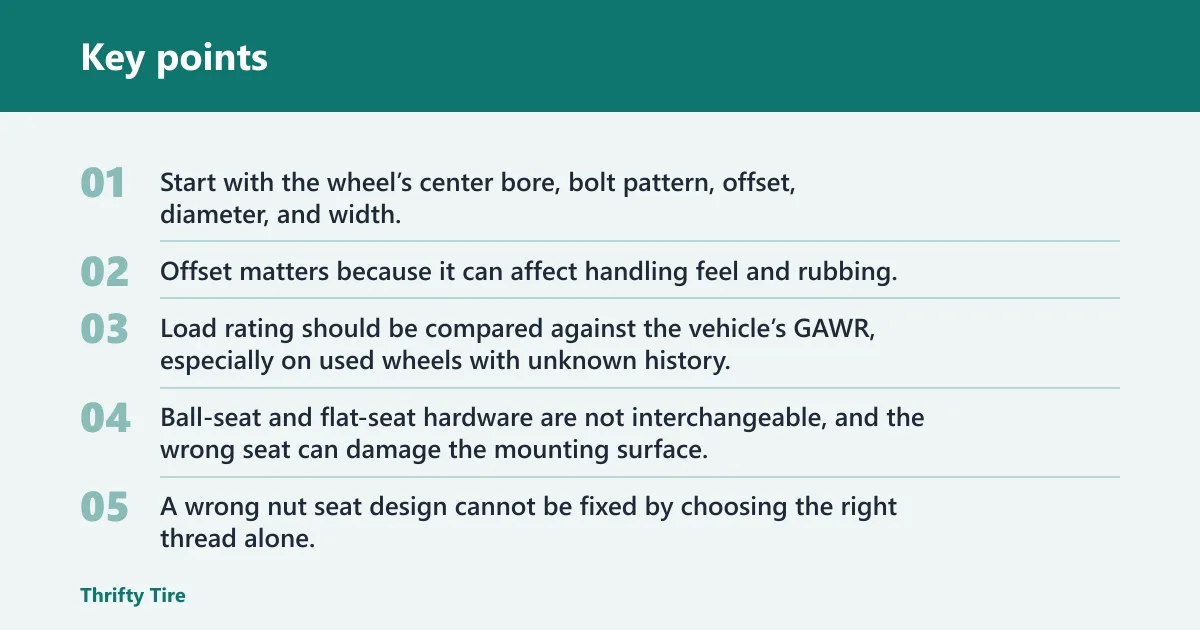
Start with the wheel’s center bore, bolt pattern, offset, diameter, and width. Offset matters because it can affect handling feel and rubbing. Load rating should be compared against the vehicle’s GAWR, especially on used wheels with unknown history.
Wheel seat type matters too. Ball-seat and flat-seat hardware are not interchangeable, and the wrong seat can damage the mounting surface. A wrong nut seat design cannot be fixed by choosing the right thread alone.
Damage signs around the hub area
Inspect the bore edge, hub face, and mounting pad for cracks, corrosion, rough casting, and evidence of over-machining. The hub face should sit flat and even. Corrosion on the hub face can interfere with seating, while rough casting or gouges around the bore can point to prior damage or poor repair work.
Seller proof to request before you meet
Ask for the bore measurement in millimeters, the ring size if rings are included, photos of the hub face and bore, and any history of machining or repair. Request a clear photo of the back side of the wheel too, because damage often shows there before it is obvious from the front.
If a seller will not allow a pre-purchase mechanic inspection, a common rule of thumb is to walk away. That is especially true when the seller cannot produce measurements or gives vague answers about prior work.
How do you know if the center bore fits your car?
You know the center bore fits when the wheel bore matches the vehicle hub or is correctly supported by a hub-centric ring. In hub-piloted systems, the wheel center bore is one of the key components. In lug-centric or stud-piloted setups, the wheel may rely more on the fastener geometry, but the bore still cannot be damaged or grossly oversized.
Vehicle hub measurement versus wheel bore
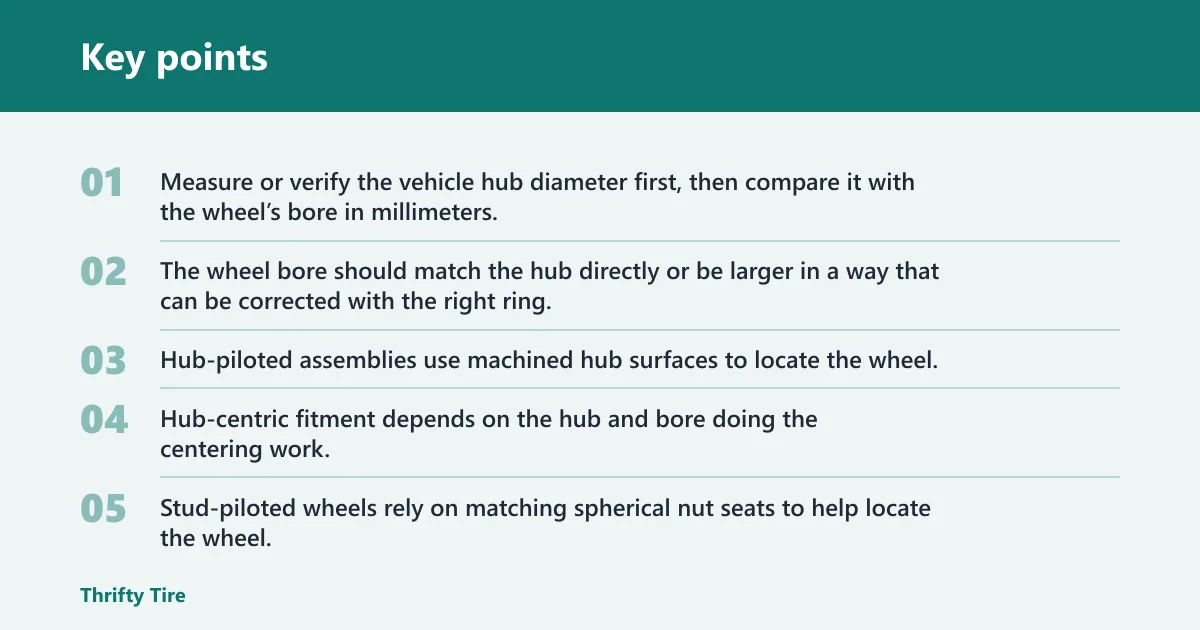
Measure or verify the vehicle hub diameter first, then compare it with the wheel’s bore in millimeters. The wheel bore should match the hub directly or be larger in a way that can be corrected with the right ring. A smaller bore is a hard stop.
Hub-piloted assemblies use machined hub surfaces to locate the wheel. That means the hub and bore relationship is not optional detail; it is part of the centering system itself.
Hub-centric and lug-centric fitment
Hub-centric fitment depends on the hub and bore doing the centering work. Stud-piloted wheels rely on matching spherical nut seats to help locate the wheel. A wheel can be technically mounted and still be wrong if the seat geometry does not match the hardware.
Think of the bore as the first fitment gate. If that gate fails, the rest of the specs do not matter much. If it passes, the rest still need verification.
Clearance around the hub lip and face
Check that the wheel clears the hub lip and seats flat against the hub face. A wheel can have the right bore number but still hang up on corrosion, burrs, or a damaged lip. That can cause a false fit that looks fine until vibration starts.
Hub-centric rings and used wheels
Hub-centric rings can make a larger wheel bore usable when the ring size is correct and the wheel is otherwise sound. They are a temporary fit aid, not a cure for damage. Plastic and aluminum rings each have a place, but neither one fixes a bad bore.
Correct inner and outer diameters
The ring’s inner diameter should match the hub, and the outer diameter should match the wheel bore. If either number is wrong, the wheel will not center correctly. Keep the measurement in millimeters, and verify both numbers before buying.
- Measure the hub first. Get the vehicle hub diameter in millimeters before you look at ring options. That number sets the inner diameter you need.
- Verify the wheel bore. Confirm the wheel’s bore measurement from the seller or from the wheel itself. The outer ring diameter must match that number without slop.
- Check ring fitment. Make sure the ring seats fully and evenly, with no cracks or deformation. A ring that rocks or binds is not acceptable.
Plastic versus aluminum rings
Plastic rings can work as a temporary fit aid, but they are more vulnerable to heat and age. Aluminum rings are more durable, especially on wheels that see frequent removal. Neither material can compensate for an enlarged, cracked, or badly machined bore.
Suppose a seller includes plastic rings for a 73.1 mm bore. If the wheel bore is round and clean, that may be acceptable for fitment. If the bore has a gouge or oval shape, the ring only hides the problem.
Temporary fit aid, not a repair
Hub-centric rings correct centering only. They do not restore structural strength, fix corrosion loss, or repair an out-of-round bore. If the wheel depends on the ring to mask damage, it is better to walk away.
Which wheel specs can make a good deal unsafe?
Offset, bolt pattern, seat type, and load rating can turn a clean-looking wheel into a bad buy. Offset can affect both handling feel and rubbing. Load ratings should be compared against the vehicle’s GAWR. The right bore does not rescue a wheel that is wrong in the rest of the fitment stack.
Offset and rubbing risk
Verify offset before purchase because small millimeter changes can alter inner and outer clearance. A wheel with the wrong offset may rub suspension parts, fenders, or brake components even if the bore is perfect. It can also change steering feel in ways buyers often notice only after mounting.
Bolt pattern and wheel seat type
Bolt pattern has to match exactly. Seat type has to match too. Ball-seat hardware used on a flat-seat wheel can damage the mounting surface, and the reverse can leave the wheel improperly supported. That is a fitment failure, not a cosmetic issue.
Load rating and GAWR
Used wheels should meet or exceed the vehicle’s load requirement, with GAWR as the comparison point. That matters because a wheel with unknown service history may already have fatigue, repair work, or hidden damage. If the seller cannot provide a believable load rating or the markings are unclear, treat that as a warning.
Missing certifications are treated as missing testing. Look for JWL, VIA, TÜV, and DOT marks when the wheel design and market normally carry them. Their absence is not proof of failure, but it does remove one layer of confidence.
Center bore checklist
Use this checklist before you pay. Every item is a yes/no check, and a single no can be enough to stop the purchase. The goal is to separate a clean, compatible used wheel from one that only looks good from a distance.
| Check | Yes | No | Buy or no-buy cue |
|---|---|---|---|
| Bore size matches the hub or the correct ring is available | Yes | No | No means no-buy if the bore is smaller or unsupported |
| Prior machining evidence is explained and limited | Yes | No | No means caution; bad machining is a walk-away signal |
| Ring compatibility is confirmed by inner and outer diameter | Yes | No | No means the ring cannot be trusted to center the wheel |
| Hub lip clearance is clean and even | Yes | No | No means the wheel may not seat flat |
| Concentric seating is possible without rocking | Yes | No | No means the wheel can vibrate |
| Seat type matches the lug hardware | Yes | No | No means mounting damage risk |
| Offset matches the vehicle need | Yes | No | No means rubbing or handling risk |
| Bolt pattern matches exactly | Yes | No | No means do not buy |
| Load rating meets or exceeds the vehicle need | Yes | No | No means unsafe for use |
| No cracks are visible at the bore | Yes | No | No means no-buy |
| Hub face is free of corrosion that affects seating | Yes | No | No means inspect further or walk away |
| Seller provides measurement proof before meeting | Yes | No | No means do not rely on verbal claims |
How should you inspect a used wheel before paying?
Inspect the bore, the hub face, the mounting pad, the spokes, and the back side of the wheel. Look for cracks, corrosion, rough casting, and signs of impact or repair. Cosmetic scuffs are usually less important than damage around the bore and mounting surface.
Cracks, corrosion, and rough casting
Cracks around the bore or spokes are the biggest red flag. Corrosion on the hub face can stop proper seating, and rough casting near the bore can point to a poor-quality finish or previous damage. If the wheel has pitting deep enough to affect the contact surface, that is more than cosmetic wear.
Mounting pad and spoke inspection
Check the mounting pad for flatness, gouges, and uneven wear. Then inspect the spokes where they meet the hub area, since that is where stress often shows up first. A wheel can look fine from the face and still be weak where the load transfers.
Certifications and what they can tell you
Look for JWL, VIA, TÜV, and DOT where relevant. These marks are not a guarantee that a used wheel is perfect, but they signal that the wheel was built with some level of testing or quality control in mind. Missing certifications are treated as missing testing.
A common first-timer mistake is buying a polished wheel with a clean front face and ignoring the bore edge. That wheel may still be wrong if the back side shows machining marks, a cracked lip, or corrosion on the hub face.
Frequently asked questions
How do I know if a used wheel center bore fits my car?
Compare the wheel bore in millimeters with the vehicle hub diameter. The bore must match the hub or be correctly supported by the right hub-centric ring. If the bore is smaller than the hub, the wheel does not fit. If it is larger, the ring still has to be correct.
What happens if the center bore is too small or too big?
A bore that is too small will not seat on the hub. A bore that is too big may rely on rings or on the wheel’s centering system, and if that support is wrong, vibration can follow. Fitment problems often show up as highway-speed shake or poor centering.
Can I use hub-centric rings with used wheels?
Yes, if the wheel bore is larger than the hub and the wheel is structurally sound. The ring must match the inner and outer diameters exactly. Do not use rings to hide cracks, ovalization, or bad machining, because rings do not repair damage.
What measurements should I ask a seller for on used wheels?
Ask for the bore measurement, ring size if rings are included, offset, bolt pattern, wheel width, and diameter. Also request photos of the hub face, bore edge, and back side of the wheel, plus any history of machining or repair. Clear measurements reduce the risk of a bad fit.
How do I inspect used wheels for damage or bad machining?
Look closely at the bore edge, mounting pad, spokes, and hub face. Search for cracks, rough casting, gouges, corrosion, and signs of material removal that looks uneven or excessive. If the seller will not allow a pre-purchase mechanic inspection, walk away.
Are used wheels safe if the specs look right?
Not automatically. The specs can line up and the wheel can still have hidden stress cracks, corrosion, or prior machining that weakens the bore area. Used parts can hide damage that photos miss, so fitment verification must be paired with a careful inspection.
What mistakes do people make buying used aftermarket wheels?
The most common mistakes are trusting vague fitment claims, ignoring the center bore, overlooking offset, and using the wrong seat type with the hardware. Buyers also overvalue cosmetic condition and undercheck the bore and mounting pad, where damage matters most. That is how a “good deal” turns into a no-buy.