Speed Rating on Tires: What It Means and What to Buy
A tire’s speed rating is the tire maker’s stated maximum sustained speed for that tire when it is carrying its rated load and inflated correctly, and your replacement should meet or exceed the automaker’s original rating, so buy the lowest rating that still matches the door-jamb or owner’s-manual spec. Go lower and you can reduce heat tolerance, change handling, and create insurance or inspection problems. This guide explains the letter ratings, where to verify OEM spec, and when a higher rating is worth paying for.
What does tire speed rating actually mean?
Tire speed rating is the tire’s maximum sustained speed under proper inflation and load, but that is only the practical starting point. The rating matters because higher speed, heavier loading, and long highway runs build heat, and the service description ties that heat tolerance to the tire’s load-carrying requirement.
The service description matters more than the letter alone
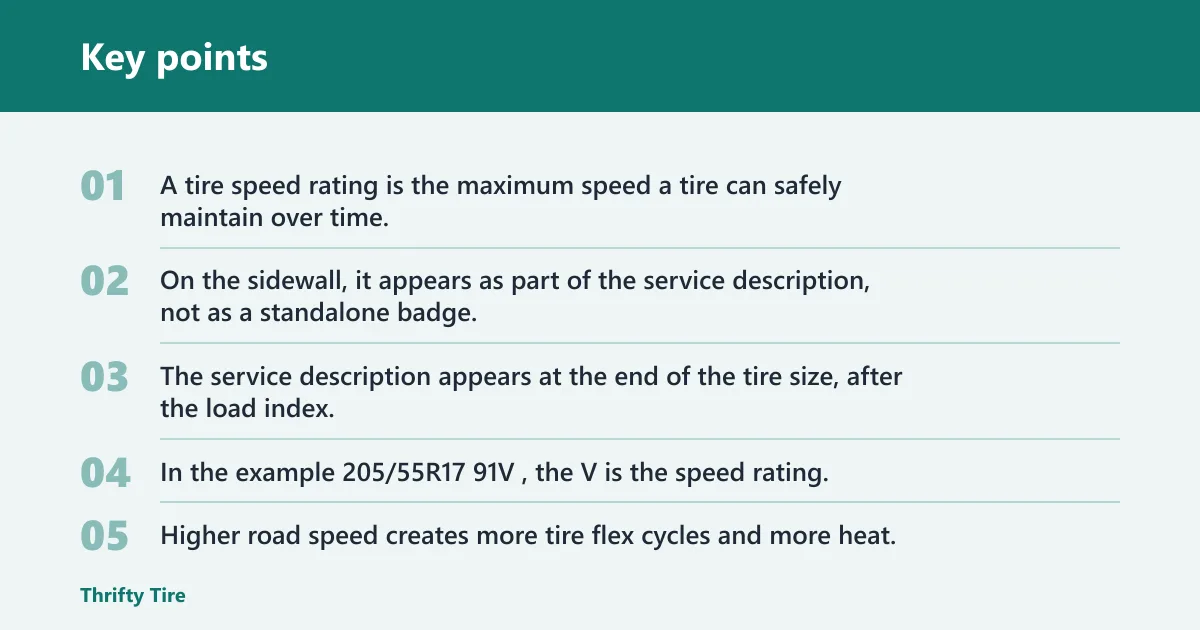
A tire speed rating is the maximum speed a tire can safely maintain over time. On the sidewall, it appears as part of the service description, not as a standalone badge. The service description appears at the end of the tire size, after the load index.
That means a marking such as 205/55R16 91V should be read as one package. The 91 is the load index. The V is the speed symbol. In the example 205/55R17 91V, the V is the speed rating.
Why the rating is really about heat
Higher road speed creates more tire flex cycles and more heat. Add a full cabin, luggage, a long interstate run, or hot pavement, and the heat margin matters more than the posted speed limit on the sign. A lower-rated tire can be working closer to its thermal limit even when the driver never approaches the letter’s top number.
That is why you should not read a speed rating as approval to drive 130 mph or 149 mph on public roads. It is a fitment and heat-control spec tied to sustained operation, load, and inflation. Replacement choice starts with the factory minimum, then checks whether the vehicle’s real use asks for the same rating or a higher one.
How do you find the speed rating on a tire?

Find the speed rating by reading the sidewall service description at the end of the tire size, where the load index is followed by a letter. Then verify that marking against the driver’s door-jamb placard and the owner’s manual, because the current tires may not match the original requirement.
Read the sidewall correctly
Look for the full size and service description stamped on the tire. A common format is 205/55R16 91V. In that string, the speed rating is the final letter in the complete service description, and the number immediately before it is the load index.
Say your car has 205/55R16 91V on the sidewall. That does not mean any 205/55R16 tire will do. A 205/55R16 89V would match the speed symbol but fall short on load capacity if the placard calls for 91.
Use factory references, not the current tire alone
The driver’s door-jamb placard is the best quick reference for factory tire size, load index, and pressure. The owner’s manual is the backup check, especially if the vehicle came with more than one wheel-and-tire package or if the current set looks mismatched.
A common first-timer mistake is assuming the existing tires must be correct because they fit the wheels. Used-car purchases, partial replacements, and bargain installs can leave a vehicle wearing the wrong service description without any obvious warning on the sidewall.
How to verify replacement spec
- Read the placard first. Open the driver’s door and copy the tire size, load requirement, and cold inflation pressure exactly as listed. This gives the factory baseline even if the tires on the car are the wrong model or wrong service description.
- Check the owner’s manual. Confirm whether the vehicle has alternate OEM sizes for another trim, wheel diameter, or seasonal setup. Use the spec that matches the wheel package actually on the car, not a larger or smaller option from a different trim.
- Inspect the current sidewall. Compare the installed tire’s service description with the placard spec. If size matches but load index or speed symbol is lower, shop to the factory minimum instead of repeating the mismatch.
- Match or exceed both. Buy a replacement with a load index and speed rating that meet or exceed the factory requirement. If one goes up and the other goes down, it is not an equal replacement.
What to verify before you buy or mount a tire
The fastest way to avoid a mismatch is to read the full tire service description on the sidewall, not just the last letter. The supporting guide shows how to find the speed rating on your tires, interpret the load index beside it, and confirm the size and rating against the placard and owner’s manual. That matters because the wrong combination can affect fitment, vehicle compliance, and safety.
If you’re comparing replacements, this speed rating guide helps you spot the exact marking, avoid common reading mistakes, and decide whether a tire meets your vehicle’s requirements before you install it.
What do S, T, H, V, W, and Y mean?
These letters are speed symbols within the tire’s service description, and each one corresponds to a listed maximum sustained speed. For passenger vehicles, the common letters to compare are S, T, H, V, W, and Y, with H and V often sitting at the center of real replacement decisions.
Speed rating chart
| Speed symbol | Listed speed | Listed speed | Typical use notes |
|---|---|---|---|
| S | 112 mph | 180 km/h | Often associated with family sedans and vans |
| T | 118 mph | 190 km/h | Often associated with family sedans and vans |
| H | 130 mph | 210 km/h | Common on midsize and sport sedans; often used for performance-touring applications |
| V | 149 mph | 240 km/h | Common on performance cars; often paired with a stiffer sidewall than H-rated tires |
| W | 168 mph | 270 km/h | Higher-speed fitments on performance vehicles |
| Y | 186 mph | 300 km/h | Highest common passenger-car symbol in this group |
Where these ratings usually show up
The S speed rating is listed as 112 mph and is associated with family sedans and vans. The T speed rating is listed as 118 mph and is associated with family sedans and vans. H-rated tires are common once vehicles move into firmer-handling sedan and touring applications.
V-rated tires show up more often on performance-oriented cars and some crossovers with larger wheel packages. W and Y are less common in ordinary daily-driver replacement shopping because relatively few passenger cars need that much heat and speed margin from the factory.
Temporary spares are a separate case. The M speed rating is listed as 81 mph and is described as a temporary spare. The N speed rating is listed as 87 mph and is described as a temporary spare.
How does speed rating relate to load index?
Speed rating and load index work together, and both must meet or exceed the vehicle’s placard requirement. A tire with enough speed rating but too little load capacity is still the wrong tire, because heat, structure, and weight carrying are linked in real driving conditions.
Load index is the first gate
The load index is the two- or three-digit code before the speed letter. It indicates the maximum weight the tire is rated to carry. Replacement tires should meet or exceed the vehicle placard spec for load index and speed rating.
Suppose a compact SUV’s placard specifies a V speed rating, but the tempting replacement set on sale is rated T. A replacement in the same size with a V speed symbol but a lower load index may look like an upgrade on paper. It is not. The tire would exceed the speed requirement while missing the vehicle’s weight requirement.
Why the two specs interact
Heat rises when a tire carries more weight, runs faster, or runs underinflated. That is why the sidewall service description combines load and speed. Reading the speed letter without checking the preceding load index misses the point of the spec.
This is also why towing, full-passenger use, and packed cargo areas matter. Even if the tow vehicle itself is not traveling fast, added load and sustained summer highway driving raise the need to stay at or above the factory service description.
When the current tires do not match OEM
If the current tires are lower-rated than the placard, do not use them as the shopping reference. Start over with the door-jamb placard and owner’s manual. If the current tires are higher-rated, that does not automatically mean the vehicle needs that higher letter; it may simply be what the last owner bought.
What speed rating does your car need?
Your car needs a replacement tire that meets or exceeds the automaker’s original speed rating and load index for the specific tire size on the placard or in the owner’s manual. After that, choose the lowest rating that still fits real use, especially heat, load, highway time, and driving style.
Start with the factory minimum
For most drivers, the correct target is simple: meet the OEM spec, do not go below it, and do not pay extra for a much higher symbol unless the vehicle or use case calls for it. That keeps the replacement aligned with the suspension tuning, weight, and expected heat margin.
When real-world use may justify staying high
Long interstate runs in hot weather, repeated high-speed travel where legal, mountain driving with a loaded vehicle, and frequent towing can all make a lower-rated substitute a poor choice even if the driver says, “I never go that fast.” The issue is sustained heat, not bragging rights.
Speed rating checklist
- Check the placard minimum. If the replacement’s speed symbol or load index falls below the door-jamb requirement, stop there. That tire is the wrong fitment even if the size matches.
- Account for hot highway use. If the vehicle regularly does long summer interstate trips, avoid dropping to a lower speed rating. Sustained heat load matters more than occasional city driving.
- Consider passengers and cargo. A vehicle that often carries family, luggage, tools, or work gear should not trade down in load index or speed symbol. Added weight raises stress and heat.
- Flag towing duty. If the vehicle tows, use extra care before considering any lower-rated replacement. Trailer load, tongue weight, and long grades can push tire temperature higher even at moderate road speeds.
- Watch for policy issues. The page says using a lower speed rating than recommended can affect insurance coverage in an accident. That is another reason to stay with the factory minimum or above.
What changes when you move up or down a rating?
Moving one speed-rating step up or down often changes how a car feels, but not in the same way on every tire line. A higher rating commonly brings firmer response and more heat margin, while a lower one may ride softer and sometimes wear longer if the vehicle allows it.
Ride, steering, and braking feel
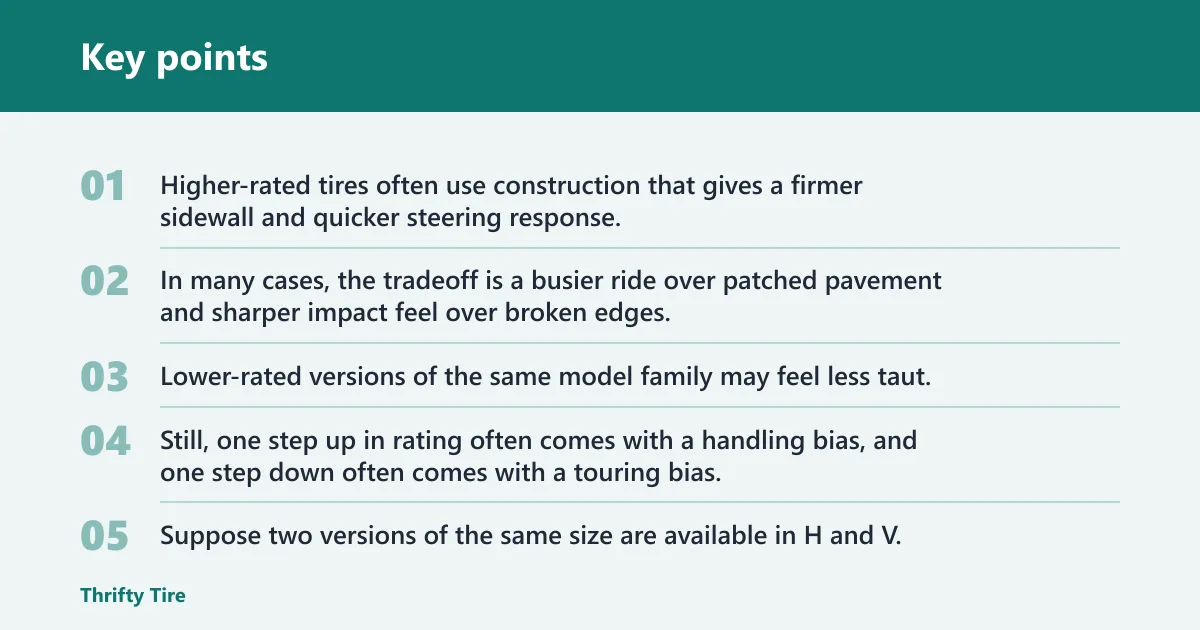
Higher-rated tires often use construction that gives a firmer sidewall and quicker steering response. That can make the car feel more direct in lane changes and transitions. In many cases, the tradeoff is a busier ride over patched pavement and sharper impact feel over broken edges.
Lower-rated versions of the same model family may feel less taut. Some drivers prefer that in city commuting. But dropping below the vehicle requirement to chase comfort is the wrong move, because the factory spec already assumes the vehicle’s weight, speed potential, and thermal needs.
Noise and treadwear tendencies
Tread life and noise do not change in one fixed direction every time, because compound and tread design matter as much as the speed symbol. Still, one step up in rating often comes with a handling bias, and one step down often comes with a touring bias. Those tendencies can mean firmer feel, different road noise, and different wear behavior.
Suppose two versions of the same size are available in H and V. The V-rated version may steer more sharply and feel more settled at interstate pace, while the H-rated version may ride a bit softer. That does not make the V automatically better for an ordinary commuter if the car only requires H.
H-rated vs V-rated in real purchases
The H speed rating is listed as 130 mph. The V speed rating is listed as 149 mph. H-rated tires are common on midsize and sport sedans and are often used for performance-touring applications. V-rated tires are common on performance cars and typically have a stiffer sidewall than H-rated tires.
If the placard specifies H, an H-rated replacement is usually the value choice for daily use. If the placard specifies V, dropping to H is usually a bad plan even if the car never sees triple-digit speeds, because the vehicle was tuned and approved around that higher service description.
Use-case decision matrix
Common scenarios and minimums
| Driving scenario | Recommended rating range | Why it fits | One reason not to overbuy | Caution |
|---|---|---|---|---|
| Daily commuting | Meet OEM minimum; often S, T, or H | Matches the factory heat and handling target for normal mixed driving | A higher letter may add cost and firmer ride without a real benefit | Do not ignore load index when comparing bargain replacements |
| Family hauling | Meet OEM minimum; often T or H, with placard load index met or exceeded | Passenger and cargo weight make load capacity as important as the speed symbol | Jumping to V will not fix an underloaded tire choice | A higher speed symbol does not compensate for a lower load index |
| Hot-weather interstate driving | Meet OEM minimum; if close calls exist, favor H or higher where the vehicle spec already allows it | Long sustained highway runs in heat increase tire temperature | Buying W or Y for an H-spec car usually pays for unused margin | Do not drop one step to save money if the car spends hours at highway speed in summer |
| Sporty driving | Meet OEM minimum; commonly H or V, sometimes W | Firmer construction often supports steering precision and stability | Going above the factory spec may bring harsher ride with little gain on public roads | Match the axle pair and avoid mixing a soft touring tire with a sharper performance tire |
| Towing | Meet OEM minimum exactly or exceed it, with close attention to load index | Tongue weight, cargo, grade climbing, and summer road heat raise stress | A higher speed symbol alone is wasted if the load index is still wrong | Never treat “I tow slowly” as a reason to drop below placard spec |
| Temporary spare use | M or N only when supplied as the vehicle’s temporary spare | These ratings are listed for temporary spare service, not regular full-set driving | There is no benefit to buying a higher-letter temporary spare for normal tire rotation use | Do not mix a temporary spare into regular long-term service on the vehicle |
Can you mix speed ratings on the same vehicle?
Mixing speed ratings on one vehicle is a compromise, and the lowest speed rating governs the set. It may be acceptable only as a temporary fix in limited cases, but it complicates handling balance, heat margin, and replacement planning, especially on staggered or performance-oriented vehicles.
Why the lowest rating governs
If one tire is rated lower, the vehicle’s effective limit is the lower-rated tire because that tire reaches its design envelope first. This matters most in sustained highway heat, emergency maneuvers, and fully loaded use, where one weak point can shape the behavior of the whole vehicle.
Partial replacement and staggered setups
Replacing only two tires with a different speed rating can change steering feel and breakaway behavior front to rear. On staggered setups, owners sometimes focus on matching size and overlook service description. That is risky. Matching the OEM minimum on each axle is the cleaner plan, and matching all four is better when possible.
Say your rear tires on a V-spec sedan wear out early and a shop offers an H-rated pair in the same size. The size fit may be fine, but the lower rear rating still becomes the weak point for the vehicle, and the front-to-rear response may no longer feel as the car was tuned to feel.
When mixing is temporary and when it is a bad plan
A single mismatched replacement to get home is different from running mixed ratings for months. Temporary situations happen. Deliberately building a mixed set to save money is harder to justify, especially when the lower-rated tire also has a different load index, construction, or seasonal category.
Frequently asked questions
What does the speed rating on a tire mean?
It is the tire’s listed maximum sustained speed under proper inflation and load, shown by a letter in the sidewall service description. For buying decisions, treat it as a heat-management and fitment spec that must be read together with load index, not as permission to drive at that speed.
How do I find the speed rating on my tire sidewall?
Read the service description at the end of the tire size. In a format such as 205/55R16 91V, the number before the final letter is the load index and the final letter is the speed symbol. Then confirm that marking against the door-jamb placard and owner’s manual.
What speed rating does my car need?
Use the automaker’s original minimum from the driver’s door-jamb placard or owner’s manual, then buy the lowest rating that still meets that spec and your real operating conditions. If the current tires differ from OEM, ignore them and shop from the factory references instead.
Can I use tires with a lower speed rating than stock?
Usually no. Dropping below the manufacturer’s recommended speed rating can cut heat tolerance, alter how the car responds, and create fitment problems even if the driver never plans to exceed normal highway speeds. The page also says it can affect insurance coverage in an accident.
Is a higher speed rating better for daily driving?
Not automatically. A higher rating often brings firmer sidewalls and quicker response, but it can also bring more cost and a busier ride. For daily use, the better value is usually the lowest speed rating that still meets or exceeds the OEM requirement and actual duty cycle.
What is the difference between H and V speed ratings?
H is listed at 130 mph and is common on midsize and sport sedans in performance-touring applications. V is listed at 149 mph and is common on performance cars, often with a stiffer sidewall. If the car requires H, H is usually enough; if it requires V, stay with V or above.