Cold Tire Pressure: What It Means and How to Set It
Cold tire pressure is the PSI your vehicle specifies before driving, usually after at least 3 hours parked. Use the driver’s door-jamb label, not the tire sidewall. A common rule of thumb is about 1 PSI of pressure change for every 10°F change in ambient temperature. Get it wrong and you can trigger TPMS warnings, speed up tire wear, and cut braking grip. This guide covers the right target, how warm or garage readings change the number, and what to do right now.
What does cold tire pressure mean?
Cold tire pressure is the pressure you check after the vehicle has sat for at least 3 hours or been driven less than 1 mile. That is the condition automakers use for the recommended PSI on the door-jamb placard, so it is the correct baseline for routine inflation and rechecks.
Cold is about recent driving, not outside temperature
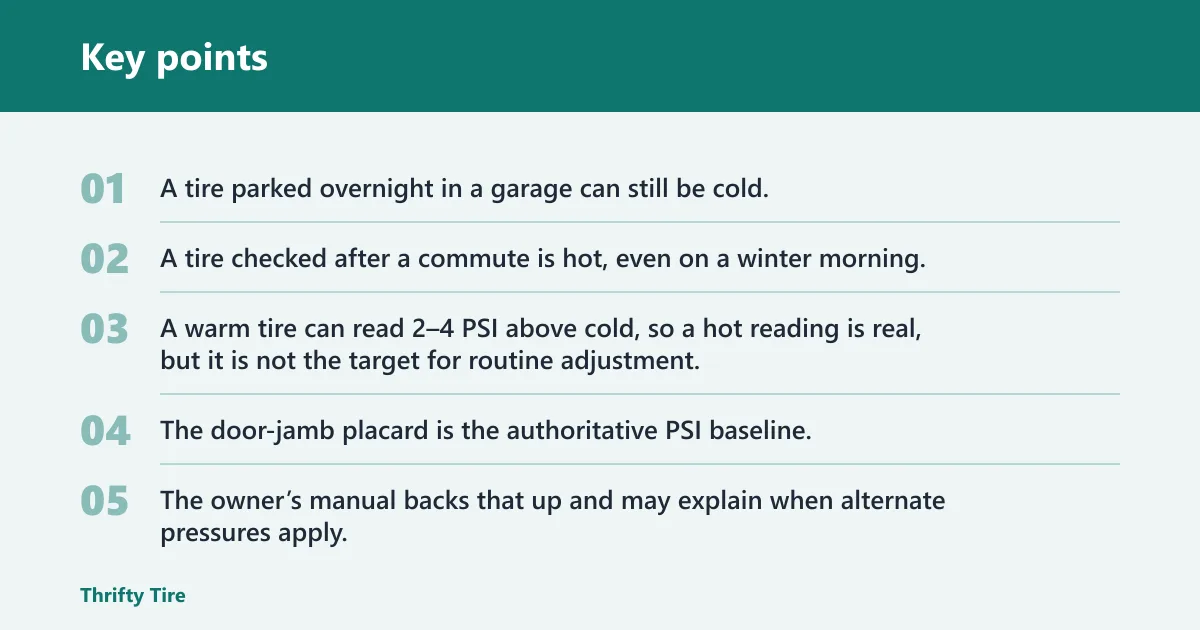
Cold does not mean freezing weather. It means the tire has not been heated by driving. A tire parked overnight in a garage can still be cold. A tire checked after a commute is hot, even on a winter morning.
That distinction matters because hot tire pressure reads higher simply because driving heats the tire and the air inside it. A warm tire can read 2–4 PSI above cold, so a hot reading is real, but it is not the target for routine adjustment.
Why the vehicle maker uses cold PSI
The door-jamb placard is the authoritative PSI baseline. It lists the vehicle-specific cold pressure the car, SUV, or truck was designed around. That placard may show different front and rear values, and some vehicles may also list alternate settings for heavier loads or, less commonly, sustained higher-speed driving.
The owner’s manual backs that up and may explain when alternate pressures apply. Some vehicles also repeat the recommendation in the glovebox or fuel door, but the driver’s door jamb should be your first reference point.
Which PSI number should you follow?
You should follow the cold PSI on the driver’s door-jamb placard first, then the owner’s manual if you need load-specific or speed-specific guidance. Do not use the tire sidewall maximum pressure as your normal target, because that number states the tire’s limit, not your vehicle’s everyday setting.
Placard first, then the manual
The proper cold pressure should be set to the vehicle’s placard value on the driver’s door jamb. Many vehicles list one pressure for the front axle and another for the rear. That mismatch is normal. It reflects weight distribution, suspension tuning, and load-carrying needs.
Suppose the door-jamb sticker calls for 32 PSI when the tires are cold, but the gauge shows 28 PSI after the car has sat overnight. The right move is to set the tires to 32 PSI when cold, not split the difference at 34 all around. Matching the placard matters more than making all four numbers identical.
When alternate pressures apply
Some placards or manuals list a second set of pressures for added passengers, cargo, towing, or sustained higher-speed use. If your vehicle includes those instructions, follow them exactly as written for that use case. If it does not, stay with the standard cold PSI listed on the placard.
Why the sidewall number is different
The sidewall lists the tire’s maximum pressure, not the vehicle maker’s recommended everyday pressure. It should not be used as the daily target unless the vehicle manufacturer specifically says so, which is uncommon. Inflating to the sidewall number because it is printed on the tire is a common mistake.
Why pressure changes with temperature
Tire pressure changes with ambient temperature by about 1 PSI for every 10°F change. That is why a cold snap often turns on a low-pressure warning even when the tires were fine a few days earlier, and why a warmer garage can make a cold reading slightly higher than outside air would.
The practical rule of thumb
A common rule of thumb is about 1 PSI per 10°F. If a tire was set correctly during warmer weather, a big temperature drop can pull it below the placard target without any puncture at all.
That example helps because it shows how a seasonal change can trigger a warning with no damage involved. It also shows why small air losses feel bigger in winter.
Why cold mornings trigger TPMS alerts
Many tire pressure monitoring systems illuminate when one or more tires falls below 25% of the recommended pressure, though exact thresholds vary by vehicle.
TPMS is a warning system, not a precision setup tool. A tire may warm up during driving and the light may turn off, but that does not mean the cold inflation was correct. It means the pressure rose temporarily as the tire heated up.
What a garage changes and what it does not
A garage does not make a tire “not cold” if the vehicle has been sitting; it mainly changes the surrounding air temperature. If the garage is warmer than outside air, the reading may be slightly higher than the same tire would show parked outdoors.
That does not make the garage reading wrong. It means you should not try to mentally correct the number for the weather outside. Set the tire to the placard value in the conditions where you measure it, then recheck after a bigger seasonal swing.
If your garage is about 15°F warmer than outside, the same cold tire might read about 1 to 2 PSI higher in the garage than it would on the driveway. That is enough to explain a small difference, but not a tire that keeps dropping well below the others.
When should you trust a reading as cold?
You should trust a reading as cold when the vehicle has sat at least 3 hours or has been driven less than 1 mile. Overnight outside qualifies, overnight in a garage qualifies, and a quick trip to the corner store usually does not give you a full hot reading but still may nudge pressure upward.
Overnight outside and overnight inside
If the car sat overnight, the tires are cold whether it was parked outside or in a garage. The reading may differ a little because the tire temperature differs, but both are still valid cold-condition readings.
Short trips versus longer drives
A common guideline is that the cold-pressure window is less than 1 mile driven. Once you go beyond that, especially at normal road speeds, the reading starts moving away from the placard baseline. After a short drive, the pressure may be only slightly elevated. After a longer drive, it can be meaningfully higher.
Picture a school drop-off that covers only a few blocks at low speed. The tires are no longer strictly cold by the standard, but they also may not be fully heat-soaked. That is why the safest routine is to use a gauge, add air only if the tire is clearly low, and recheck later when the tires are fully cold.
How to check and set pressure correctly
Use a gauge, not the warning light
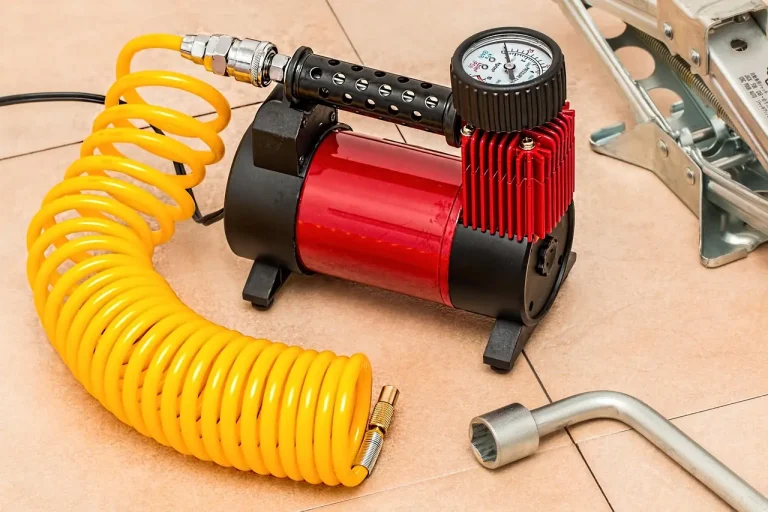
A digital or analog tire pressure gauge gives the actual PSI at the valve stem. TPMS does not replace that.
Check all four tires, and the spare if your vehicle has one that requires inflation monitoring. Seasonal temperature change usually affects all tires in a similar way. One tire that is much lower than the others deserves extra attention.
Set the pressure with a simple routine
- Find the target. Read the driver’s door-jamb placard first. Note any different front and rear PSI values and any alternate settings for higher loads or sustained higher-speed use. Use the owner’s manual if you need clarification.
- Measure each tire. Remove the valve cap, press the gauge squarely onto the valve stem, and read the PSI. Repeat once if the number looks odd or you heard air escape during the first try. Check the spare if it is an inflatable spare the vehicle relies on.
- Add air gradually. Inflate for a second or two, then stop and check the gauge again. Repeat in small steps until the tire reaches the placard target for that axle while cold. If the front and rear targets differ, set them separately.
- Recheck all caps. Reinstall the valve caps firmly by hand. Caps do not hold the main air seal, but they help keep dirt and moisture out of the valve core.
- Track repeat losses. Recheck monthly and at season changes. If one tire loses pressure faster than the rest, inspect it for puncture, wheel sealing problems, or a valve issue instead of assuming weather is the only cause.
Tire pressure checklist
Pressure decision checklist
| Scenario | What the reading means | Add air now? | Release air? | Wait until cold? | When to inspect for a leak |
|---|---|---|---|---|---|
| Before driving | Best time to compare directly to the placard because the tire is cold if it sat at least 3 hours or was driven under 1 mile. | Yes, set to the exact placard PSI for front and rear. | Only if the tire is above placard while truly cold. | No, this is the target condition. | If one tire is repeatedly lower than the others at cold checks, or keeps dropping between monthly checks. |
| After a short drive | Reading may be slightly above true cold PSI, so it is only a rough guide. | Yes, if a tire is clearly low or the TPMS light is on, add enough for a safe temporary correction, then recheck cold later. | No. | Yes, for final setting accuracy. | If one tire stays lower than the rest after cooling, or drops again the same day or next morning. |
| After a long drive | Reading is a hot value and can be several PSI above cold, so it is not the routine target. | Only if the tire is obviously underinflated and needs a temporary safety correction before more driving. | Never bleed a hot tire down to the placard number. | Yes, let it cool and reset to placard PSI later. | If the tire was low before the drive, still looks low after warming, or is the only tire losing pressure repeatedly. |
Warm-reading comparison
| Placard PSI | Warm reading you see | What not to do |
|---|---|---|
| 35 PSI cold | 37 PSI after a short drive | Do not bleed it down to 35 PSI while warm. |
| 35 PSI cold | 39 PSI after a longer drive | Do not treat 39 PSI hot as overinflation by itself. |
| 35 PSI cold | 31 PSI on a cold morning after a major temperature drop | Do not assume a puncture before checking all four tires and comparing patterns. |
How long tires should sit before you check pressure
For a true cold reading, tires should usually sit for about 3 hours, or be checked first thing in the morning before the vehicle has been driven. That pause lets the air temperature inside the tire settle so the PSI reading reflects the starting point you should inflate to, not a temporary warm-up spike. The supporting guide explains the timing rule, what counts as “cold,” and why checking too soon can make a tire look properly inflated when it is actually low.
If your schedule makes that impossible, the article also covers what to do when you only have time to check warm tires, plus the most common mistakes to avoid. See the full details in cold pressure timing.
What should you do if you already drove before checking?
If you already drove, treat the reading as warm and use it to make a decision, not for perfect final calibration. Add air only when the tire is clearly low or the warning light is on, never bleed air from a hot tire to match the placard, and plan a cold recheck later.
Use a warm reading as a safety check
Warm readings are useful for spotting a problem tire. If all four are close together and slightly above the placard, that is normal heat gain. If one tire is much lower than the others even after driving, that points more toward a leak or damage than simple temperature change.
What to do right now
- Compare all four. Measure every tire with a gauge, not just the one that triggered the light. If all four are down by a similar amount on a cold morning, weather is the first suspect. If one is the clear outlier, inspect that tire sooner.
- Add air if needed. If a warm tire is obviously below the likely safe range for the vehicle or the TPMS light is on, add air now a little at a time, checking the gauge after each short burst. The goal is to restore a safer temporary level before more driving, then confirm the exact placard setting when the tire is cold.
- Do not bleed hot air. Never let air out of a hot tire just to make it match the door sticker. Once the tire cools, the pressure will drop again and may end up underinflated.
- Recheck when cold. After the vehicle has sat at least 3 hours, set each tire exactly to the placard value. This is the point where front and rear differences should be corrected precisely.
- Inspect repeat loss. If the same tire is low again at the next cold check, look for a nail, sidewall damage, wheel sealing issue, or leaking valve stem. Repeated loss in one tire is not explained by normal weather if the others stay stable.
A common first-timer mistake is seeing 39 PSI on a tire whose placard target is 35 PSI after highway driving, then releasing air to “fix” it. Once that tire cools, it can drop below 35 PSI and create the underinflation the driver was trying to avoid.
What does a cold-weather TPMS light really mean?
A cold-weather TPMS light often means the temperature drop pushed one or more tires below the system’s warning threshold, not that the sensor is bad. Still, the next step is the same, check all four tires with a gauge, compare them, and separate a whole-vehicle seasonal drop from one-tire repeat loss.
When the warning is probably seasonal
If the weather changed sharply and all four tires read similarly low, that pattern fits normal temperature-related pressure loss. Inflate all of them back to the placard target when cold. Monthly checks and season-change checks help prevent that surprise.
When the warning needs same-day leak attention
If one tire is much lower than the others, or if the light returns quickly after inflation, treat it as more than a nuisance warning. The likely causes include a puncture, wheel bead leak, or valve problem. That tire should be inspected the same day.
Suppose three tires are close to their usual readings and one is several PSI lower again the next morning. Weather did not single out one corner of the car. That pattern is a leak pattern until proven otherwise.
When repeated low pressure means more than weather
Repeated low pressure in one tire, while the others stay near target, points more toward a puncture, wheel leak, or valve issue than normal seasonal change. Weather affects all tires in the same general direction. A single repeat offender deserves inspection before another top-off.
Patterns worth taking seriously
Watch for one tire that keeps needing air between monthly checks, a tire that drops again overnight, or a tire that remains visibly or measurably lower than the other three after similar driving and parking conditions. Those are pattern clues, not random noise.
What to inspect before adding air again
- Check the tread. Look for nails, screws, or other embedded objects. Do not pull anything out on the spot, because that can turn a slow leak into a fast one.
- Inspect the sidewall. Look for cuts, bulges, or abrasion. Sidewall damage is not a normal temperature issue and should be assessed promptly.
- Look at the valve. Make sure the valve cap is present and the stem is not cracked or bent. A leaking valve core or damaged stem can cause repeat loss without any tread puncture.
- Check the wheel edge. Corrosion or damage where the tire seals to the wheel can leak slowly. If pressure loss continues with no obvious puncture, this area needs service inspection.
- Schedule service. If the same tire keeps losing pressure faster than the rest, stop treating it as routine seasonal adjustment. Have it inspected and repaired or replaced as needed.
Frequently asked questions
How long should tires sit before checking cold pressure?
Tires should sit at least 3 hours to count as cold, or the vehicle should have been driven less than 1 mile. That standard matters because the placard PSI is based on a cold tire, and even a short normal drive can raise the reading enough to blur the target.
Should tire pressure be checked cold?
Yes. Tire pressure should be checked cold when the goal is to set the correct PSI accurately. Warm readings are still useful for spotting a low tire that needs immediate air, but final adjustment should be made when the tire has cooled and can be matched to the placard.
What temperature is considered cold tire pressure?
There is no single outside temperature that counts as cold tire pressure. “Cold” refers to tire temperature relative to recent driving, not whether the day is warm or freezing. A tire can be cold in a garage, on a summer morning, or outside in winter if it has been sitting long enough.
Should I go by the door sticker or the tire sidewall?
Go by the door-jamb placard for normal driving. That label gives the vehicle-specific recommended cold PSI and may list different front and rear values or alternate loaded settings. The tire sidewall shows a maximum pressure for the tire itself, which is not the everyday target for your vehicle.
Can I let air out of a hot tire to match the sticker?
No. Do not release air from a hot tire just to make it match the placard number. Driving raises pressure temporarily, so bleeding it down while warm can leave the tire underinflated after it cools. Wait and recheck cold unless the tire is truly overinflated when cold.
Does parking in a garage change a cold pressure reading?
Yes, a warmer garage can make a cold reading slightly higher than the same tire would read outside, but the tire can still be considered cold if it has been sitting. Use the placard target where you measure it, and do not correct by guessing from the number molded into the tire sidewall or by estimating outdoor temperature unless a later cold recheck shows a clear mismatch.