Is It OK to Drive with the TPMS Light on?
Yes, but only if the tire still looks normal and the car drives normally. You can usually go a few miles to air up or inspect it, but stop right away if a tire looks low, the car pulls, or the warning flashes. A real pressure loss can damage the tire, ruin the wheel, and raise blowout risk. This guide explains when to keep driving, when to pull over, and what to check before you move again.
This guide is part of our TPMS light: meaning, causes, reset, and fixes series.
Quick answer
A TPMS warning means tire pressure needs checking soon. It does not tell you how much air is missing, and it can come on after a cold night or during a long drive. If the tire is only slightly low and still holding air, a short trip to a nearby air source is usually reasonable. If it is very low, nearly flat, damaged, or changing how the vehicle drives, stop.
The split is simple: slight pressure loss may allow a short, careful drive. A large loss should not. That is true whether the light came on for one tire, multiple tires, or after temperature changes with no obvious puncture.
What the TPMS light means
TPMS stands for tire pressure monitoring system, but the dashboard warning is only a prompt to check pressure. It can appear even when a tire does not look flat. It can also turn on without a visible puncture, because a slow leak, a leaking valve, or a temperature drop may be enough to trigger it.
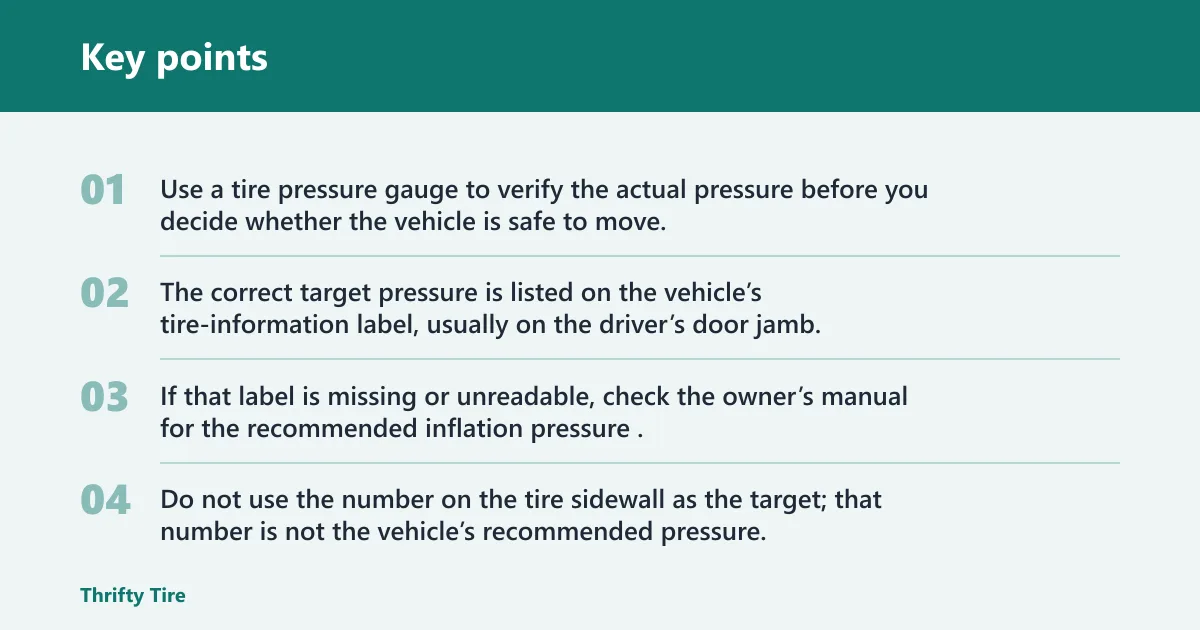
The warning is not a pressure reading. It does not show whether a tire is about 2 psi low or about 12 psi low, so relying on the dashboard alone is a bad move. Use a tire pressure gauge to verify the actual pressure before you decide whether the vehicle is safe to move.
The correct target pressure is listed on the vehicle’s tire-information label, usually on the driver’s door jamb. If that label is missing or unreadable, check the owner’s manual for the recommended inflation pressure. Do not use the number on the tire sidewall as the target; that number is not the vehicle’s recommended pressure.
TPMS light safety table
| Warning scenario | Drive? | Maximum acceptable goal | First action | Call roadside assistance? |
|---|---|---|---|---|
| Light on but tire looks normal | Yes, briefly, if the vehicle drives normally | Reach a nearby safe place or air source | Check all tires with a gauge as soon as practical | Usually no, unless pressure is dropping |
| Slightly low and holding air | Yes, cautiously for a short distance | Get to air without delay | Measure cold pressure and inflate to the door-jamb spec | No, if it is stable and undamaged |
| Very low/near flat | No | Do not drive on it | Stop, inspect for damage, and arrange help | Yes |
| Light plus vibration/pulling or visible damage | No | Pull over immediately in a safe place | Inspect for puncture, sidewall damage, or a damaged wheel | Yes |
What should you do first when the TPMS light comes on?
Slow down and find a safe place to inspect the tires. If the car pulls, vibrates, or the warning flashes, stop in a safe place right away. Then check the tires by sight and with a gauge. The dashboard light alone is not enough to decide whether you can keep driving.
-
Pull over safely.
Use a shoulder, parking lot, or other level space away from traffic. If the vehicle is pulling or vibrating, do not keep driving just to reach a farther spot.
-
Look for obvious damage.
Check for a tire that looks low, a cut sidewall, a nail, a bulge, or debris in the tread. A TPMS warning can come on even if the tire does not look flat, so a quick visual check is only the first pass.
-
Measure pressure with a gauge.
Use a tire pressure gauge on each tire, including the spare if your vehicle monitors it. The light is not a precise measurement, so the gauge is what tells you whether the tire is only slightly low or too low to drive on.
-
Compare to the placard.
Check the driver’s door-jamb label for the correct pressure, or use the owner’s manual if the label is unavailable. Inflate to the listed setting before you continue driving, unless the tire is damaged or losing air quickly.
Cold tire pressure gives the most accurate reading. For best results, check tires after the vehicle has been parked for at least three hours. That reduces the chance of a false low reading caused by heat from driving.
When is it unsafe to keep driving?
It is unsafe to keep driving when the tire is very low, nearly flat, damaged, or losing air quickly. A significantly underinflated tire should not be driven on. Continuing to drive on an underinflated tire creates heat and stress inside the tire, and that raises the risk of tire failure.
It is also unsafe when the warning comes with handling changes. If the vehicle is pulling, vibrating, or feels unstable, stop in a safe place. Underinflation can affect steering, braking, and grip, so the warning may be signaling a problem that goes beyond simple low pressure.
Picture a sedan with the TPMS light on after a highway merge. The front left tire looks a little soft, but the car tracks straight and the driver can reach a nearby station in a few miles. That is a short, careful drive case. The same car with a thumping tire, a visible sidewall cut, or a steady pull should not continue.
Say your SUV is loaded for a trip and the warning appears after a long stretch on the interstate. If one tire is much lower than the others, the load and speed add more heat and stress. In that case, roadside assistance is safer than trying to nurse the tire to the next exit.
Stop right away if you notice
- Very low or near-flat pressure.
- A tire that is losing air quickly.
- Vibration, pulling, or a sudden change in steering feel.
- Visible damage, such as a bulge, cut, or puncture.
How far can you drive?
Only far enough to reach a nearby air source or a safe stop if the tire is just slightly low and still holding air. There is no universal mile limit because the risk depends on how low the tire is, the road speed, the load, and whether the vehicle still handles normally. If the tire is very low, do not drive it at all.
Highway driving can raise the risk because sustained speed builds heat. That matters more when a tire is already underinflated, since heat and flexing increase stress inside the tire. A short city drive to a gas station may be acceptable for a slightly low tire. A long freeway run is a bad trade if the pressure loss is real.
A common first-timer mistake is to assume “just a little low” means “safe for any trip.” It does not. A tire that is only slightly below recommended pressure may be driven cautiously a short distance, but the goal is air or inspection, not normal use for the rest of the day.
Why low pressure needs attention fast
Underinflation changes how the tire carries load. The sidewalls flex more, heat builds faster, and the tire wears in ways it was not built to handle. That can shorten tire life, reduce grip, and make braking and steering less predictable.
The problem grows with speed and distance. A tire that seems only a little low in the driveway can become a much bigger issue on the highway or under a heavy load. If pressure keeps dropping after refilling, treat it as a leak until a shop finds the cause.
A warning that goes off while driving does not always mean the problem is gone. It may still indicate low pressure, especially if temperature changes or the tire warmed up enough to alter the reading. Check the tire anyway before assuming everything is fine.
That is why roadside assistance is appropriate when the tire is very low, damaged, or losing air quickly. It is safer than continuing to drive and risking a wheel, a blowout, or loss of control.
Frequently asked questions
Is it ok to drive with the tpms light on?
Yes, sometimes for a short distance, but only if the tire still looks normal, the vehicle drives normally, and the pressure is only slightly low. Use a gauge soon and head for a nearby air source. If the tire is very low, nearly flat, or the car changes how it drives, stop.
Is it okay to drive a car with the tpms light on?
It can be okay for a brief trip to inspect or inflate a slightly low tire. The warning means tire pressure needs checking, not that the car is automatically unsafe. The answer changes fast if the tire is losing air, damaged, or affecting steering, braking, or stability.
Is it bad to drive with the tpms light on?
It is bad to keep driving as if nothing is wrong, because low pressure can create heat and stress inside the tire. If the tire is only slightly low and holding air, a short drive is usually acceptable. If it is significantly underinflated, do not continue on it.
Is it safe to drive with a tire pressure sensor fault light on?
A sensor fault light means the system needs attention, but the tires still need a manual pressure check. Do not assume the tires are fine just because the warning is about the sensor. Use a gauge, check the placard pressure, and inspect for slow leaks or damage.
Can I drive with tire pressure light on?
Yes, if the tire is only slightly low and the vehicle still handles normally, you can usually drive a short distance to air it up. Do not rely on the light to judge severity. If the tire is very low, nearly flat, or visibly damaged, call for help instead.
When is it unsafe to keep driving with a low-pressure warning?
It is unsafe when the tire is very low, losing air quickly, or showing visible damage. It is also unsafe if the car pulls or vibrates. Those signs mean you should stop in a safe place and arrange roadside assistance rather than trying to reach the next station.
Does a TPMS warning always mean I have a flat tire?
No. A TPMS warning can come on after a cold night or during a long drive, and it may appear even when no puncture is visible. It means the system detected pressure that needs checking, not that the tire is necessarily flat.
Why might the TPMS light turn off while I’m driving?
Pressure can rise as the tire warms during driving, which may make the warning disappear even though the tire is still low. That does not prove the tire is fixed. Check it with a gauge when cold and confirm it matches the vehicle’s listed pressure. (Consumerreports)