How Long Should Tires Sit Before Checking Cold Pressure?
Wait about 3 hours, or check first thing in the morning, before reading cold tire pressure. Checking too soon after driving can give a high reading and leave tires underinflated later. For the target number, use the vehicle placard or owner’s manual guidance from the manufacturer, not the sidewall maximum, as NHTSA explains in its tire safety guidance: https://www.nhtsa.gov/equipment/tires. This guide explains the timing rule, what “cold” means, and what to do if you have to check sooner.
Cold pressure timing
Cold tire pressure means the tires have had time to cool to the outside air, so the reading is usually close to the vehicle’s target on the placard. Tire makers describe a cold tire as one that has not been driven recently, and most use a 3-hour or overnight sit as the practical cutoff; Michelin’s guidance on cold inflation pressure notes that the tire should be checked before driving or after sitting long enough to reach ambient temperature: https://www.michelinman.com/auto/auto-tips-and-advice/tire-maintenance/how-to-check-tire-pressure. The simplest rule is to check before you drive, or after at least 3 hours parked. Short drives, highway runs, and repeated stop-and-go use warm the air inside the tire and can raise the reading above the true cold value.
Use the PSI on the sticker inside the driver’s door, or in the owner’s manual. Do not use the sidewall number. The placard may list different values for the front and rear tires, so match each axle to the correct number. That placard-based approach is also the standard in OEM and federal guidance: https://www.nhtsa.gov/equipment/tires.
What you’ll need
- A trusted tire pressure gauge
- The vehicle placard or owner’s manual
- An air source for topping up if needed
- Access to the valve stems on all four tires and the spare
Can you check tire pressure right after driving?
You can, but the reading is not a true cold-pressure number. Warm tires usually read higher because pressure rises as temperature climbs; Bridgestone notes that tire pressure changes with temperature and that a change of about 1 psi for every 10°F is a useful rule of thumb: https://www.bridgestoneamericas.com/en/learn/fuel-efficiency/tire-pressure. A hot reading can look fine even when the tire will end up low once it cools, so treat it as a temporary check only.
If you must check right away, use the number as a stopgap, not the final target. Compare it with the placard pressure, note how far off it is, and plan to recheck after the tires have sat long enough to cool.
How to use a warm reading without overcorrecting
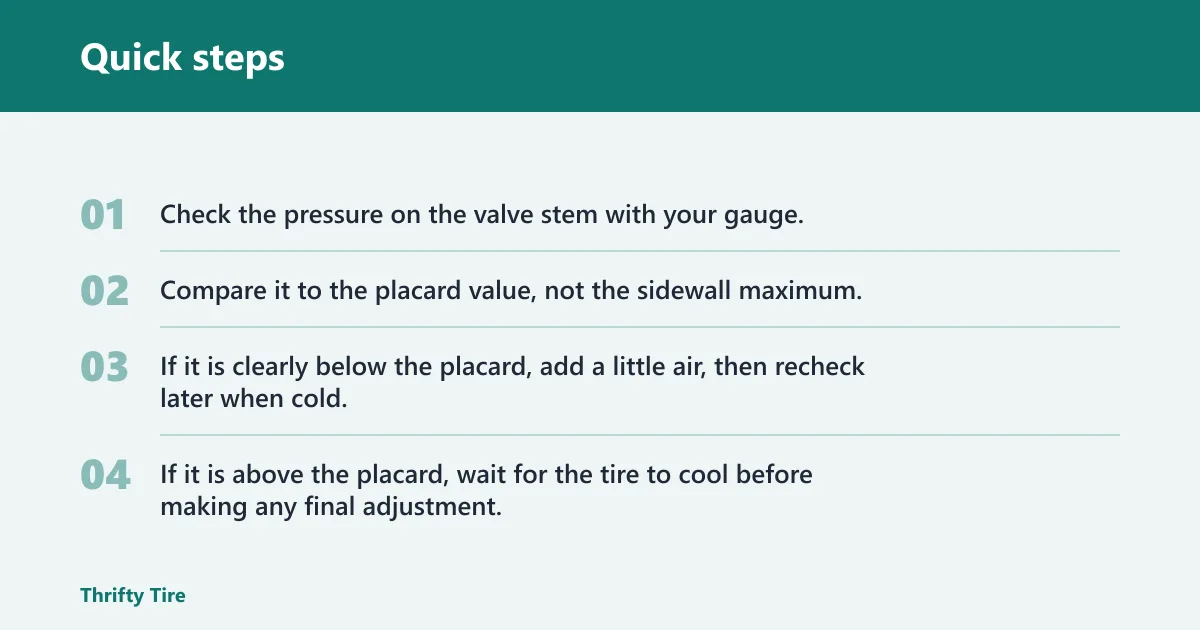
- Check the pressure on the valve stem with your gauge.
- Compare it to the placard value, not the sidewall maximum.
- If it is clearly below the placard, add a little air, then recheck later when cold.
- If it is above the placard, wait for the tire to cool before making any final adjustment.
For example, a door sticker may list 35 PSI, and a warm tire may read about 38 PSI after a roughly 12-minute errand. That reading may drop after cooling, so do not release air to 35 PSI right away unless it is still above target after a cold recheck.
How long after driving should you wait to check tire pressure?
For most drivers, 3 hours is enough time for a tire to be considered cold again. Longer trips, high speeds, and hot pavement can keep the tire warm for longer than a quick grocery run, so the full wait matters more after those conditions. First thing in the morning is the easiest reliable timing.
A short local drive may cool sooner than a long interstate run, but the 3-hour rule keeps the process simple and consistent. If you park in a garage or shade, the tire may cool a bit faster than in direct sun, but it still is not instant.
Parking in shade or a garage
Shade and a garage can slow heat gain, but they do not turn a warm tire into a cold one on command. The air inside still changes with temperature, so use the same timing rule. Cooler parking conditions help, yet the safest habit is still before driving or after at least 3 hours parked.
What if you can only check warm tires?
If you only have a warm reading, use it to decide direction, then confirm later when cold. A warm number that is below the placard usually means the tire needs air. A warm number that is a little high may fall into range after cooling, so avoid draining it too soon.
Common first-timer mistake: a driver checks after a 20-minute highway trip, sees 37 PSI on a 35 PSI tire, and lets air out immediately. After cooling, that tire may end up below 35 PSI. The safer move is to wait, then adjust to the placard pressure when cold.
Warm-reading decision tree
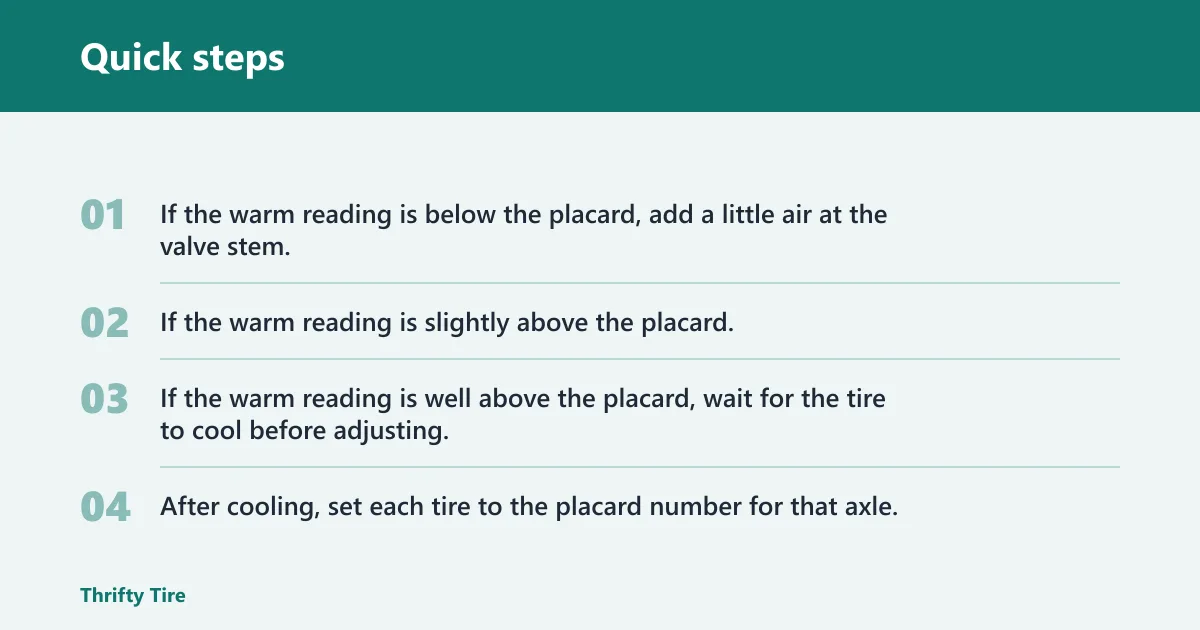
- If the warm reading is below the placard, add a little air at the valve stem, then recheck when cold.
- If the warm reading is slightly above the placard, leave it alone and recheck after 3 hours.
- If the warm reading is well above the placard, wait for the tire to cool before adjusting.
- After cooling, set each tire to the placard number for that axle.
Suppose a rear tire should be 33 PSI and reads 36 PSI after a long drive. That reading may fall as the tire cools, so the best move is to wait, then bleed air only if it is still above 33 PSI on a cold check. In general, final pressure should be set only when the tire is cold, and exact warm corrections vary by manufacturer and driving conditions.
Cold-pressure timing table
| Timing | Can the reading be trusted? | How long to wait before rechecking | Safest adjustment method |
|---|---|---|---|
| Checked before driving | Yes. This is the best reading to use. | Not needed unless the gauge seems inconsistent. | Set pressure to the placard value on the driver’s door sticker or in the owner’s manual. |
| Checked after a short trip | Partly. Useful as a temporary check, not the final target. | Wait at least 3 hours, then recheck cold. | If low, add 1 to 2 PSI and confirm later. If a little high, leave it for now. |
| Checked after a long drive | No. The reading is most likely inflated by heat. | Wait at least 3 hours, longer if the tires are still warm to the touch. | Do not set final pressure from the warm reading. Recheck cold and adjust to the placard. |
Common mistakes
Do not use the sidewall maximum as the target pressure. That number is the tire’s maximum structural pressure, not the vehicle setting. Using it can reduce grip and wear the center of the tread early if you overinflate.
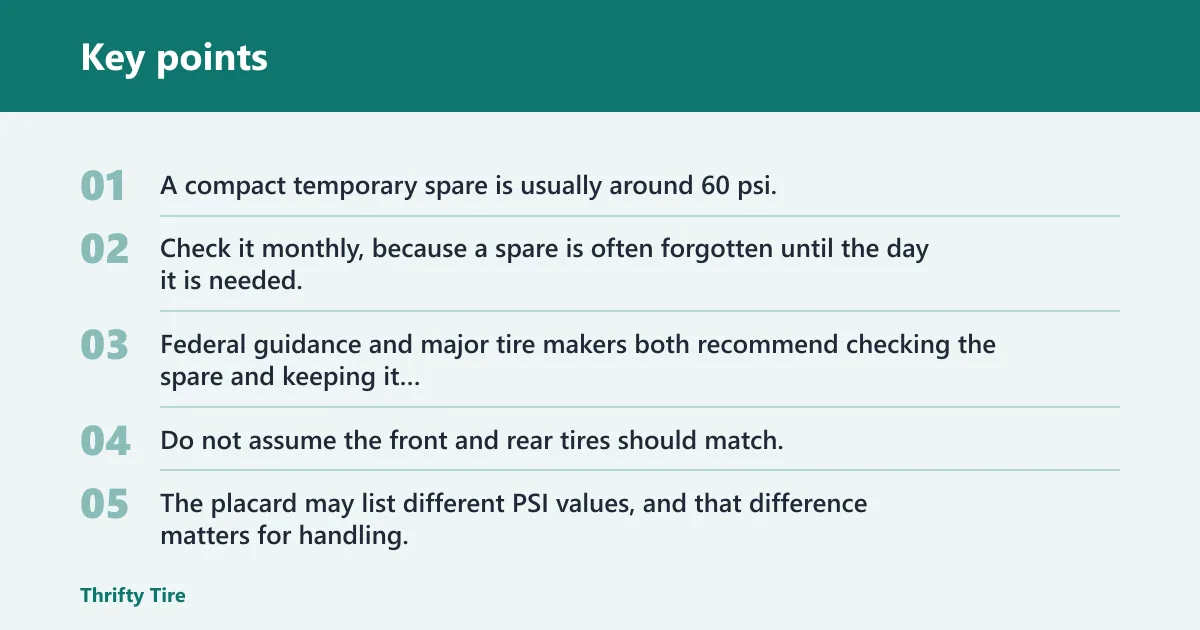
Do not skip the spare. A compact temporary spare is usually around 60 psi, and the correct pressure is printed on the spare itself. Check it monthly, because a spare is often forgotten until the day it is needed. Federal guidance and major tire makers both recommend checking the spare and keeping it at its labeled pressure: https://www.nhtsa.gov/equipment/tires.
Do not assume the front and rear tires should match. The placard may list different PSI values, and that difference matters for handling, load support, and wear.
How often should you check tire pressure?
Check all four tires once a month and before a long trip. Tires can lose up to 1 psi every month even with no puncture, and cold weather can make the drop show up sooner. A monthly check also helps catch a slow leak before it becomes a roadside problem. Continental’s tire care guidance also recommends regular checks and notes that temperature changes can affect pressure: https://www.continental-tires.com/products/b2c/tire-knowledge/tire-pressure/.
Why does tire pressure change with temperature?
Pressure drops as ambient temperature falls and rises as it climbs. That is why a tire can look fine in the afternoon and read low on a cold morning. Cooler weather usually means more frequent checks, especially if the vehicle sits outside overnight. A common rule of thumb is roughly 1 PSI for every 10°F change in temperature, though exact change can vary by tire and conditions.
What should you do if your tire pressure is above the sticker?
If the tire is cold and still above the placard, release air until it matches the sticker value. Use the tire pressure gauge on the valve stem, remove air in short bursts, and recheck each time. If the reading came from a warm tire, wait for it to cool before making the final adjustment.
Frequently asked questions
How long should tires sit before checking cold pressure?
Wait at least 3 hours after driving, or check first thing in the morning before the car moves.
Is 3 hours enough for tires to be cold?
Yes, 3 hours is the standard rule of thumb for a cold check. It works for most parked vehicles, including after a short commute.
What if I can only check tire pressure when the tires are warm?
Use the warm reading to decide whether you are obviously low or clearly high, then recheck cold before making the final adjustment.
Does parking in the shade or garage change cold tire pressure?
It can slow heat buildup, but it does not replace the 3-hour rule.
Can I compare cold pressure to the tire sidewall number?
No. The sidewall number is not the target inflation pressure. Use the placard on the driver’s door or the owner’s manual instead.
What should I do if my tire pressure is above the sticker?
If the tire is cold, release air until the gauge matches the placard pressure. If the tire is warm, wait and recheck before changing anything unless the pressure is far above the sticker.