Coolant: What It Does, Types, Level, When to Change
Coolant carries combustion heat from the engine to the radiator, keeps the mix from freezing in cold weather or boiling too early under load, and leaves a protective film on internal parts to slow corrosion. It should stay between the reservoir’s MIN and MAX marks when cold. Wrong coolant, low level, or overdue fluid can cause overheating, head-gasket damage, heater failure, water-pump wear, and expensive repairs. This guide covers coolant function, the main types, safe level checks, change timing, and how to separate bad fluid from bigger cooling-system faults.
What does coolant do in a car?
Coolant absorbs heat in the engine block and cylinder head, carries that heat to the radiator, and protects the system against freezing, boil-over, and internal corrosion. It works in a closed cooling loop with water, glycol, pressure, and circulation through the radiator, heater core, thermostat, hoses, and water pump.
Heat transfer in a closed loop
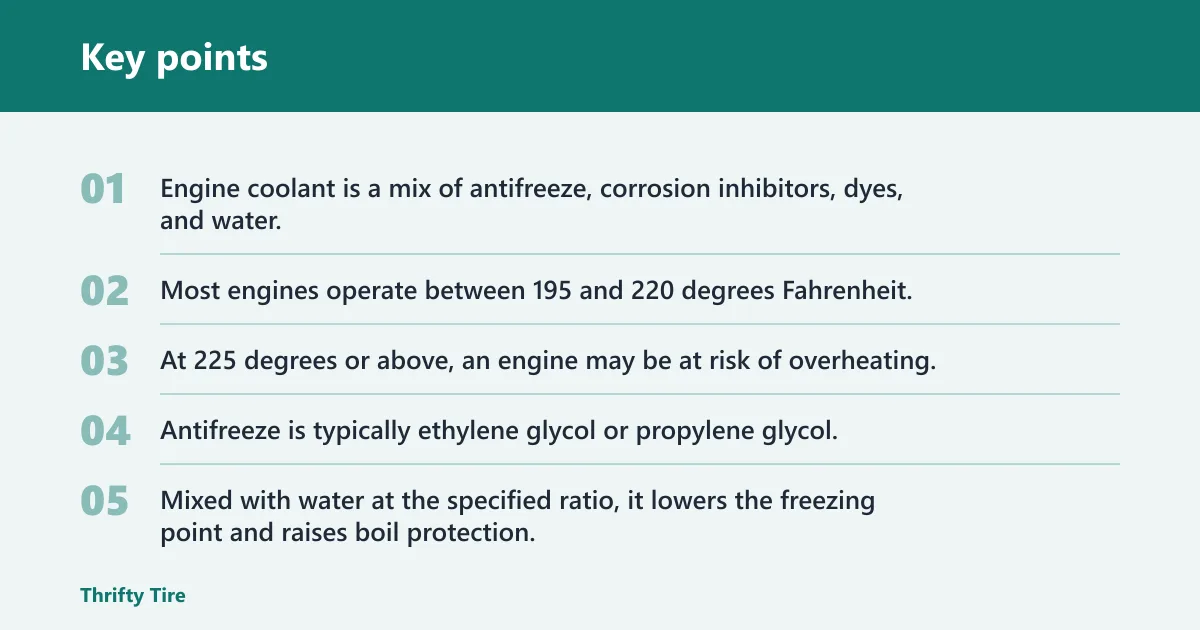
Engine coolant is a mix of antifreeze, corrosion inhibitors, dyes, and water. As it moves through passages in the block and head, it picks up heat from combustion, then releases that heat through the radiator to outside air.
The loop also includes the water pump, thermostat, heater core, hoses, reservoir, pressure cap, and the engine coolant temperature sensor, often abbreviated ECT. Most engines operate between 195 and 220 degrees Fahrenheit. At 225 degrees or above, an engine may be at risk of overheating. (Firestonecompleteautocare)
Freeze protection, boil protection, and pressure
Antifreeze is typically ethylene glycol or propylene glycol. Mixed with water at the specified ratio, it lowers the freezing point and raises boil protection. Fresh coolant helps maintain both limits.
Pressure matters too. The radiator cap or pressure cap helps keep the system pressurized, which raises the coolant’s boiling point and supports steady circulation. That is why the cap should never be opened hot. A hot system can release pressurized coolant suddenly.
Corrosion control for system parts
Coolant also protects metal and plastic parts from chemical attack. That includes the radiator, water pump, heater core, engine passages, and fittings. When corrosion inhibitors are spent, the fluid may still look usable at a glance, yet internal wear and deposits can increase.
Weak cabin heat can be part of this picture. The heater core uses hot coolant as the heat source for the cabin. If flow is restricted by aged coolant, low level, or trapped air, the cabin heat often drops before a major overheat event appears.
What is the difference between coolant and antifreeze?
Antifreeze is the concentrated glycol base, usually ethylene glycol or propylene glycol, while coolant is the ready-to-use heat-transfer fluid in the engine. Some products are premixed; others are concentrate that must be diluted with the right water and ratio for proper freeze, boil, and corrosion protection.
Concentrate vs premix
A premix is already diluted for use. A concentrate needs water added before it goes into the system unless the bottle and service information state otherwise. Many vehicles use about a 50/50 coolant-water mix because it balances freeze protection, boil protection, and heat transfer for normal climates.
More glycol is not automatically better. Too much antifreeze can reduce heat-transfer efficiency and move the final mix away from what the cooling system was designed to use. Some vehicles specify premix to avoid ratio errors and hard-water contamination.
Why distilled water matters
If dilution is required, distilled water is the safe choice. Mineral-heavy tap water can add scale, deposits, and corrosion problems inside the radiator, heater core, and engine passages.
Suppose a concentrate is topped off with hard well water several times over a year. The coolant chemistry may still be roughly correct, but mineral deposits can slowly restrict heater-core flow and reduce cabin heat long before the reservoir looks especially dirty.
What are the different types of coolant?
The main coolant families are IAT, OAT, and HOAT, shorthand for inorganic additive technology, organic acid technology, and hybrid organic acid technology. They differ in additive chemistry, service life, and approved applications. Color can overlap across these families, so the correct match comes from the vehicle’s specification, not from green, orange, yellow, blue, pink, or any other dye.
IAT coolant
IAT coolant is the traditional inorganic additive formula long associated with many older vehicles and often seen in green, though color alone is not proof. It has a shorter service life and often needs changes around 2 years or 30,000 miles.
OAT coolant
OAT coolant uses organic acid chemistry and is common in many newer vehicles. Examples on the market include orange, red, or dark green formulas depending on manufacturer labeling. Long-life OAT coolant can last up to 5 years or 150,000 miles.
HOAT coolant
HOAT coolant blends organic-acid chemistry with selected inorganic additives. It is used across many OEM applications and often appears in yellow or blue examples, again depending on the maker. HOAT coolant commonly lasts 5 years or 100,000 miles.
Why color is not a compatibility test
Common coolant colors include yellow, green, orange, and pink. That does not make color a reliable compatibility test. Dye is not standardized across brands or chemistries, and two coolants with similar color can have different additive packages and approval lists.
A common first-timer mistake is matching the bottle to the reservoir by color alone. If a dark green OAT is mixed into an older IAT fill because both look “green enough,” the system may end up with uncertain chemistry and no clear service baseline.
How do you know which coolant your car needs?
The right coolant is the one that matches the vehicle’s OEM specification in the owner’s manual or service information. Bottle color is secondary. Look for exact approval wording, the recommended chemistry, and whether the vehicle requires premix or concentrate with distilled water before topping off or refilling.
Use the owner’s manual and OEM spec
The owner’s manual is the first stop for coolant type, service interval, and fill notes. On some vehicles, under-hood labels or service information will repeat the required standard or approved coolant family. That specification overrides generic claims on universal coolant bottles.
How to read the bottle
Check the back label for manufacturer approvals, exact applications, premix or concentrate status, and any instructions on dilution. “Meets” or “compatible with” wording is less useful than a clear statement that the product is approved for the listed specification.
What to do if the current coolant is unknown
For a mixed-history used car, do not guess from color. If service records do not confirm what is already in the system, either verify the spec through reliable records and labels or service the system so the fill becomes known.
That is especially important if the vehicle has had a radiator, water pump, thermostat housing, or heater core replaced. Once the system has been opened and refilled by an unknown shop or previous owner, the only safe assumption may be that the fill history is uncertain.
How do you check coolant level safely?
Check coolant only when the engine is completely cool, then read the reservoir or overflow tank against its MIN and MAX marks. Below MIN when cold generally means the level is low. Near MIN but still above it may be normal if stable, especially across seasons or after recent air purging.
Reservoir reading and normal movement
Coolant should be checked only when the engine is completely cool. The coolant overflow tank should read between the MIN and MAX marks. On many vehicles, that reservoir is the normal inspection point and top-off point.
A small seasonal level change can be normal. Temperature swings affect fluid volume, and a slight shift toward the lower mark in cold weather is not the same as a fault. What matters is trend: stable near MIN is different from repeated drops below MIN.
Picture a reservoir that sits a finger-width above MIN all winter, then rises modestly during warmer months without any warning lights or smell of coolant. That pattern usually calls for monitoring, not panic, as long as the level stays above MIN when cold.
When the radiator matters
Some older systems require checking the radiator itself if the design does not use a fully sealed remote reservoir for level control. Even then, the radiator cap should only be approached when the engine is fully cool. Never remove it on a warm engine.
Safe checking and top-off steps
- Park and let it cool. Wait until the engine is completely cool before opening the hood. This avoids pressurized spray and gives a true reservoir reading.
- Find the correct tank. Identify the coolant reservoir or overflow tank, not the washer-fluid bottle. Look for coolant warnings and the molded MIN and MAX marks on the plastic.
- Read the level. Compare the fluid line to the marks with the vehicle on level ground. Below MIN when cold is low; between MIN and MAX is the normal target range.
- Confirm the fluid type. Check the owner’s manual and the bottle label before adding anything. Use the specified premix or the specified concentrate diluted with distilled water if dilution is required.
- Top off carefully. Add small amounts to the reservoir until the level returns to the proper cold range. Do not fill far above MAX, because the system needs room for expansion when hot.
- Recheck after use. After a few normal drives and full cool-downs, check the level again. If it keeps dropping, a pressure test is the right next step.
When is low coolant a fluid problem or a system fault?
Low coolant can mean anything from a routine top-off after repair to a leak, pressure loss, thermostat issue, flow restriction, or trapped air. The key distinction is whether the level stabilizes after correction. Repeated drops, heat problems, or boiling point to a system fault rather than simple fluid age.
One-time low level vs repeated loss
If the reservoir is slightly low once and then stays stable after a correct top-off, the issue may be minor. That can happen after a recent repair as trapped air leaves the system over the first few heat cycles.
If the reservoir keeps dropping, treat that as a fault. A low reservoir level should trigger a pressure test if it keeps dropping. The cause may be an external leak, cap problem, loose clamp, hose seep, radiator leak, water-pump leak, or an internal engine problem.
Weak cabin heat and trapped air clues
Weak cabin heat is often a coolant clue, not just an HVAC complaint. Low coolant can leave the heater core partly unfilled. Air in the system after repair can interrupt flow. A thermostat stuck open may also reduce heater output by keeping engine temperature too low.
If the cabin heat fades at idle but improves while driving, low coolant level or circulation issues move higher on the list. If heat stays weak and the coolant is rusty or muddy, heater-core restriction becomes more likely.
Boiling, pressure loss, and circulation problems
Boiling in the reservoir is more serious. It can point to overheating, a weak pressure cap, trapped air, a stuck thermostat, restricted radiator flow, collapsing hose, failed fan control, or water-pump circulation problems.
The ECT sensor can also shape what the driver sees on the dash. A bad sensor or wiring fault may misreport temperature, but it does not create actual boiling. If the reservoir is boiling or venting coolant, diagnose the mechanical cooling fault first.
Coolant decision table
| Symptom | Likely cause | What to check first | Next action |
|---|---|---|---|
| Low reservoir level when cold, first time noticed | Normal small variation, incomplete fill after prior service, or minor loss | Check whether the level is below MIN or still between MIN and MAX; review recent repair history | Top off with the correct spec coolant and monitor over the next few full cool-downs |
| Low reservoir level keeps returning | External leak, pressure-cap fault, hose seep, radiator leak, water-pump leak, or internal leak | Look for dried residue, sweet smell, damp hoses, wet pump area, and coolant under the vehicle | Arrange a pressure test; do not treat repeated top-offs as the fix |
| Rusty or muddy coolant | Depleted inhibitors, contamination, corrosion, or mixed coolant chemistry | Inspect fluid appearance in the reservoir and confirm service history and coolant type | Test coolant condition and plan an exchange if contaminated or out of interval |
| Weak cabin heat | Low coolant, trapped air, thermostat issue, or restricted heater core | Check reservoir level cold and note whether engine temperature reaches normal range | Correct the level first; if heat stays weak, inspect for air bleeding, thermostat behavior, and heater-core flow restriction |
| Boiling or surging in the reservoir | Overheating, cap unable to hold pressure, trapped air, thermostat sticking, radiator restriction, or poor pump flow | Check for actual high temperature, fan operation, and signs of coolant loss or recent repair | Stop driving until diagnosed; overheating can damage the engine quickly |
| Level drops after recent cooling-system repair | Air purging from the system after refill or an incomplete bleed | Confirm what part was replaced and whether the system was bled according to service procedure | Top off once with the correct coolant, then recheck after several heat cycles; if the drop continues, test for leaks |
| Oily film in coolant | Oil contamination from an engine or cooler problem | Inspect for milky residue, unexplained oil loss, or cross-contamination signs | Do not just flush and refill; diagnose the source before further driving |
| Particles or sludge in reservoir | Severe coolant degradation, stop-leak residue, or internal corrosion debris | Check maintenance history, coolant type, and whether mixed products were added | Test and inspect the system; exchange fluid and repair the cause of contamination |
When should coolant be changed or flushed?
Coolant should be changed by the vehicle maker’s schedule first, then adjusted for coolant family, contamination, unknown history, and repair events. Coolant exchange is recommended when the fluid reaches its service interval or is contaminated. A stable level alone does not prove the coolant is still chemically healthy.
Service timing by coolant family and OEM schedule
Start with the owner’s manual. If it specifies a shorter or longer interval than the general chemistry pattern, follow the manual.
Change now, test first, or monitor
Change now if the coolant is at interval, contaminated, rusty, sludgy, oily, or known to be the wrong type. Test first if the history is unclear but the fluid still looks clean and the system is otherwise behaving normally. Monitor if the level is stable, the coolant is in interval, and testing shows acceptable condition.
For a used car with unknown service history, the practical choice is often to service the system so the fill, chemistry, and interval become known. That removes guesswork about color, additive age, and what a prior owner may have mixed in.
After repairs or part replacement
If the system was opened for a radiator, water pump, thermostat, heater core, hose set, or major engine repair, a coolant exchange may make sense even if the old fluid was not fully due. The reason is simple: refill quality, trapped air, and contamination risk are part of the job now.
Severe use and closer monitoring
Towing, repeated short trips, very hot climates, very cold climates, long idling, and high thermal load justify closer coolant checks and earlier testing. Short trips can leave a mixed pattern of heat cycles without long steady operation. Towing and heat raise cooling demand and stress the additive package faster.
How do you test coolant condition?
Coolant condition is best judged by testing and context, not by color alone. A refractometer checks freeze-point strength, while test strips check pH and corrosion-inhibitor condition. Those results, plus appearance and symptoms, help separate old fluid from leak, circulation, or contamination problems.
Refractometer checks
A refractometer measures freeze-point protection from the sample actually in the system. That matters after repeated top-offs, partial refills, or dilution mistakes, because the resulting mix may no longer match what the label on the bottle promised.
Test strips and inhibitor condition
Test strips are useful for pH and corrosion-inhibitor condition. Coolant can be low on reserve protection even when it still looks fairly bright. That is why an apparently clean reservoir does not automatically mean the fluid is still fit for long service.
What appearance can tell you
Rusty coolant suggests corrosion or depleted additives. Muddy or sludgy fluid can point to severe age, contamination, or mixed chemistries. Oily coolant suggests a larger engine or fluid-cooler problem and should not be treated as a simple maintenance item.
Particles in the reservoir can come from internal corrosion, stop-leak products, or hose breakdown. Appearance is a clue, not the whole diagnosis. The right next move depends on whether the level is stable, the system is overheating, and testing backs up the visual warning.
Can you top up coolant yourself, and can you use water?
A careful top-off is reasonable when the engine is cold, the correct coolant spec is known, and the level is simply below target. Water is only an emergency short-term substitute if necessary. Plain water does not provide normal freeze protection, boil protection, or corrosion protection.
When a top-off makes sense
Top off the reservoir when the level is below MIN when cold and the correct coolant is available. Use the specified premix, or the specified concentrate mixed with distilled water if the product requires dilution. Then watch whether the level stabilizes.
When not to keep topping off
Do not rely on repeated top-offs if the level keeps dropping. That is when the fluid is acting as a symptom. Leaks, pressure loss, poor bleeding after repair, thermostat behavior, or water-pump issues need diagnosis.
Using water in an emergency
If the system is low and the right coolant is not available, plain water can be used only as a temporary emergency measure to reach safety or service. Restore the correct coolant mix as soon as possible. Do not leave a water-only fill in place through freezing weather or heavy heat load.
Say your reservoir is below MIN on a summer road trip and the only nearby option is water. A small emergency fill to get to service is safer than driving an overheating engine, but the mix should be corrected soon because the system has lost proper chemical protection.
Frequently asked questions
How often should coolant be changed?
Follow the owner’s manual first. Contamination or wrong coolant can shorten that timeline.
What happens if coolant is low or empty?
Low coolant can cause overheating, hot spots, boil-over, weak cabin heat, and poor circulation through the heater core and radiator. If the system becomes very low or empty, engine damage can follow quickly, including gasket failure and warped components. Stop driving if temperature climbs or the reservoir is boiling.
Do coolant colors mean anything?
They help identify what is in the bottle, but they do not prove compatibility. Common coolant colors include yellow, green, orange, and pink, and similar colors can belong to different chemistries. Match coolant by OEM specification and approved applications, not by dye alone.
When does coolant need a flush instead of a top-off?
A top-off fits a one-time low level with otherwise clean, correct coolant. An exchange makes more sense when the fluid is at its service interval, contaminated, rusty, sludgy, oily, chemically failed on testing, mixed with the wrong type, or from a vehicle with unknown maintenance history.
How do I know what coolant my car needs?
Check the owner’s manual and service information for the exact coolant specification, approved chemistry, and whether the product should be premix or concentrate. Then read the bottle for matching approval wording. If the coolant already in the vehicle is unknown, do not guess from color; verify or service it.
How do I check my coolant level safely?
Wait until the engine is completely cool, then read the coolant reservoir against the MIN and MAX marks on level ground. The normal target is between those marks. Below MIN when cold generally means the level is low. If the level keeps dropping after a correct top-off, the system needs leak or pressure diagnosis.