What Is Load Index on Tires?
Load index on tires is the standardized code that tells you how much weight a tire can carry at a specified inflation condition and speed condition. Use the vehicle placard as your baseline, then verify the tire’s load index, size, and speed rating before buying a replacement. Choose a tire that meets or exceeds the vehicle’s required load capacity, and remember that pressure, speed, and vehicle loading all affect usable capacity.
What is load index on tires?
Load index on tires is a standardized numerical code for maximum weight per tire when the tire is properly inflated and used within its rated conditions. It is part of the tire’s service description, and you should check it alongside speed rating and tire size before you buy replacements.
What the number tells you
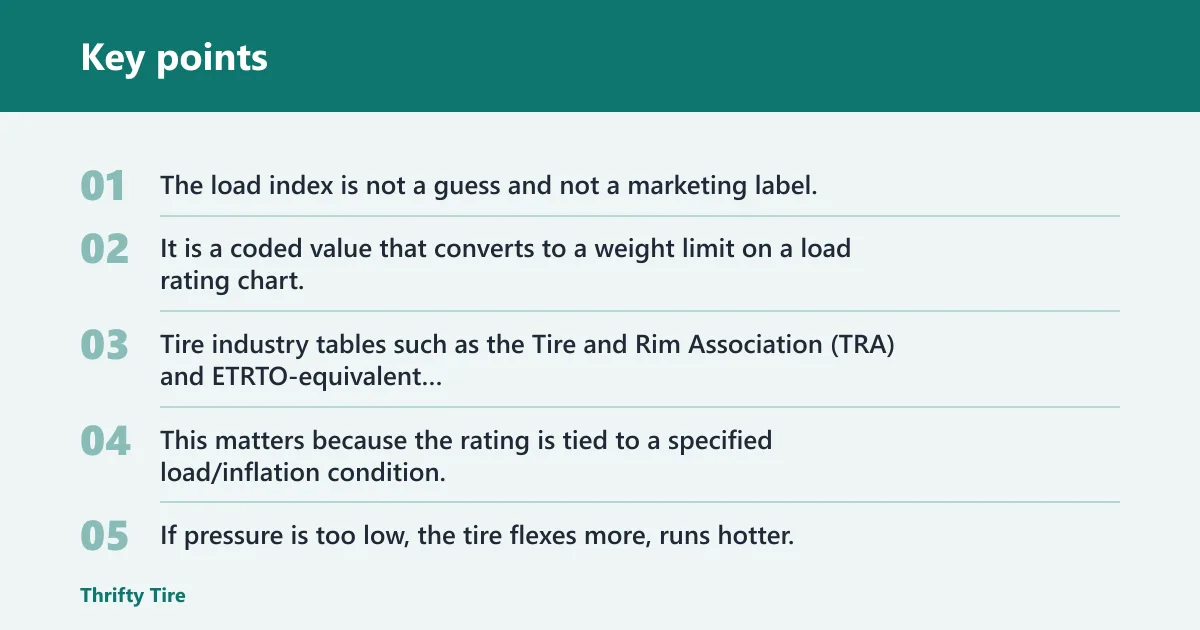
The load index is not a guess and not a marketing label. It is a coded value that converts to a weight limit on a load rating chart, usually shown in kilograms and pounds. Tire industry tables such as the Tire and Rim Association (TRA) and ETRTO-equivalent load index charts are the standard reference for these values.
This matters because the rating is tied to a specified load/inflation condition, not simply to the vehicle’s usual everyday pressure in every situation. If pressure is too low, the tire flexes more, runs hotter, and may not safely carry its intended load. If the tire is used at a different inflation pressure than the table’s reference condition, its usable load capacity changes.
Why it sits inside a bigger rating system
Load index is only one piece of the tire’s service data. Speed rating, inflation pressure, vehicle weight, and intended use all affect whether that tire is a fit. NHTSA’s tire guidance emphasizes matching the tire to the vehicle placard and the tire’s service description, not relying on one number alone.
Where is the load index on a tire sidewall?
The load index is found on the tire sidewall, typically following the tire size dimensions. It appears near the speed rating, so you will usually see it in the same sequence as the size code and service description.
How to spot it
Look for the tire size first, then the load index number, then the speed symbol. That placement is easy to miss if you are only scanning for the size. The sidewall marking is part of the full service description, so read it left to right.
For example, a marking may read like a size code followed by a number and letter pair. The number is the load index. The letter is the speed rating.
Why people misread the sidewall
Sidewall markings are crowded, and the load index can blend into the rest of the service description. Drivers sometimes read the first number after the size as part of the size itself, then miss the load code entirely. If you are unsure, read the whole service string from left to right.
How does a load rating chart work?
A load rating chart converts the index number into maximum supported weight, usually in kilograms and pounds. That lets you compare the tire’s capacity with the vehicle’s real load needs instead of relying on the number alone.
Common load index values readers search
The table below shows common passenger tire values in both pounds and kilograms, using standard load index chart references. These are the figures people most often need when comparing stock fitments with replacement tires.
| Load index | Maximum load | Approx. pounds |
|---|---|---|
| 91 | 615 kg | 1,356 lb |
| 95 | 690 kg | 1,521 lb |
| 100 | 800 kg | 1,764 lb |
| 105 | 925 kg | 2,039 lb |
| 109 | 1,030 kg | 2,271 lb |
| 114 | 1,180 kg | 2,601 lb |
Examples from common passenger values
TRA and ETRTO-equivalent charts show how quickly capacity rises as the index climbs. For example, a load index of 80 is 450 kg, 100 is 800 kg, 108 is 1,000 kg, and 140 is 2,500 kg.
| Load index | Maximum load | Source example |
|---|---|---|
| 80 | 450kg | Kwik Fit |
| 100 | 800kg | Kwik Fit |
| 108 | 1000kg | Kwik Fit |
| 140 | 2,500 kg | Nokian |
When the chart is not enough by itself
The chart tells you the tire’s rated ceiling, not whether that tire suits your vehicle at your normal pressure, speed, and cargo load. A tire can have a high number and still be a poor match if the fitment, pressure range, or speed rating is wrong for the car or truck.
Suppose a compact SUV normally uses tires with a lower index, but you tow a small trailer every weekend and carry tools in the rear. In that case, the chart helps you see whether the replacement tire still clears the vehicle’s real demand after cargo and hitch weight are added.
What does load index 114 mean?
Load index 114 means the tire is rated to carry 1,180 kg, or 2,601 lb, when it is used at its specified load/inflation condition and within its speed rating limits. It does not mean the tire should always carry that much at any pressure, and it does not override the vehicle placard.
In practice, 114 is a relatively high passenger-tire load index and often appears on heavier SUVs, crossovers, vans, and some light-truck fitments. It can be useful when the vehicle carries passengers, tools, towing tongue weight, or rear cargo regularly, provided the tire size and wheel specification are also correct.
Load index, load range, and speed rating
Load index, load range, and speed rating are related, but they do different jobs. Load index is the weight limit per tire. Load range is a construction or strength label often used on light truck and commercial tires. Speed rating shows the maximum speed category the tire can sustain under its rated conditions.
What load range means
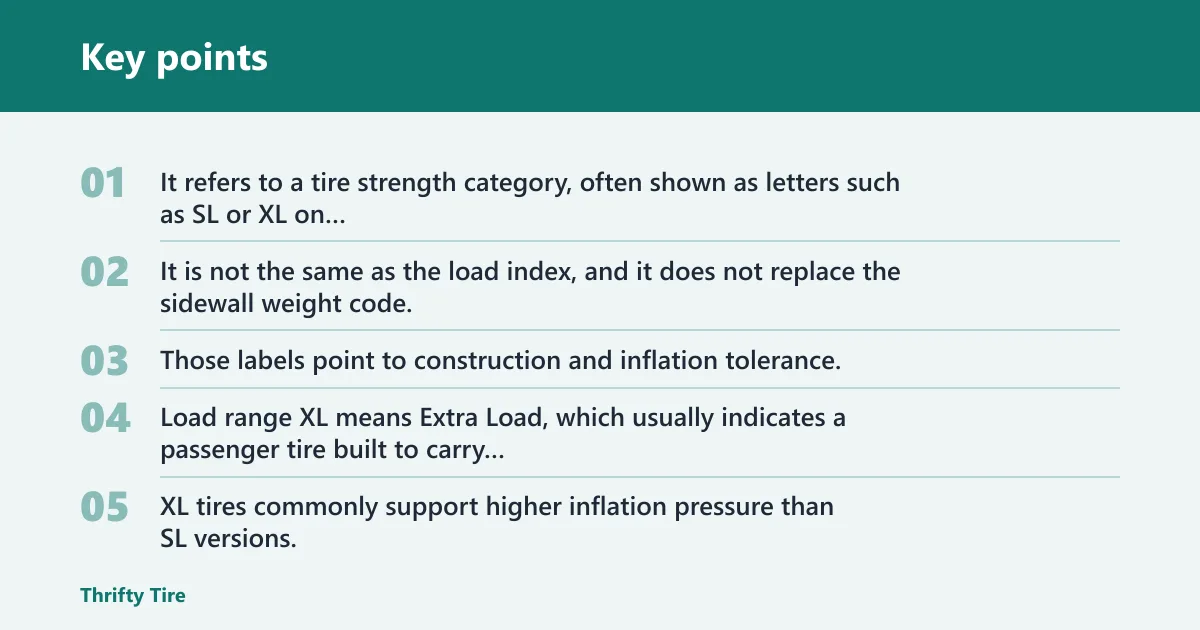
What is load range on tires mean? It refers to a tire strength category, often shown as letters such as SL or XL on passenger tires, or as load range letters on light truck tires. It is not the same as the load index, and it does not replace the sidewall weight code.
What is load range on tires sl? SL generally means standard load. XL usually means extra load. Those labels point to construction and inflation tolerance, but you still need the load index number for actual weight capacity.
What is load range on tires XL?
Load range XL means Extra Load, which usually indicates a passenger tire built to carry more load than a standard load tire of the same size when inflated to the specified pressure for that tire. XL tires commonly support higher inflation pressure than SL versions, which is part of why they can carry more load.
XL does not mean the tire can carry the same load at every pressure. Capacity still depends on the tire’s load index, the manufacturer’s pressure/load table, and the vehicle’s placard requirements. If the car calls for a specific placard pressure, that pressure remains the baseline for normal service even if the tire itself is XL-rated.
How speed rating changes the picture
Speed rating should be considered alongside load index because load capacity can change with speed. Tire makers note that higher operating speed can reduce tire load capacity, which is why speed and load are evaluated together rather than separately.
As an example of speed/load interaction, tire industry load-speed tables show lower allowable load at higher speed categories than at lower speed categories for the same tire size family. That is why a tire’s load index alone is not the whole story when you are choosing a tire for work, towing, or long highway driving.
Do you need a higher load index?
You may need a higher load index if your current tires sit close to the vehicle’s weight limit, if you tow often, or if you carry heavy cargo on a regular basis. The key test is whether the tire’s combined capacity and the vehicle’s own placard requirements leave enough margin for the way you actually drive.
Check GVWR and axle loading
Vehicle gross weight rating, or GVWR, is the starting point for judging total carrying need. Compare the combined tire capacity against the vehicle’s weight rating, and then look at axle loading if the cargo is not spread evenly. A tire that looks fine on paper may still be too close to the edge on one axle.
A common first-timer mistake is buying a tire with a higher size and assuming that means more safety across the board. If the axle load is already close to the limit, the real question is whether the replacement tire’s load index creates more usable margin at the pressure you will actually run. If axle GAWR is the limiting factor, the axle rating—not the tire’s headline load index—controls the outcome.
Look at towing and cargo frequency
If you only load the vehicle heavily once or twice a year, the stock index may be enough when it matches the placard minimum. If you tow on most trips or keep heavy gear in the vehicle, the safer choice can be a higher load index, provided the size, speed rating, and fitment are still correct.
Compare OEM minimums against the replacement tire
Higher-than-stock load index is generally acceptable if fitment is otherwise correct. Do not go below the manufacturer recommendation. The OEM minimum is the floor, not a suggestion. If the replacement tire meets or exceeds that floor, then the next question is whether the extra capacity helps your real use case.
Load index checklist
Do you need a higher load index? Use this checklist as a pass/fail check, not a chart-only shortcut. It helps you decide whether the stock rating is enough or whether a higher index is justified by the way the vehicle is used.
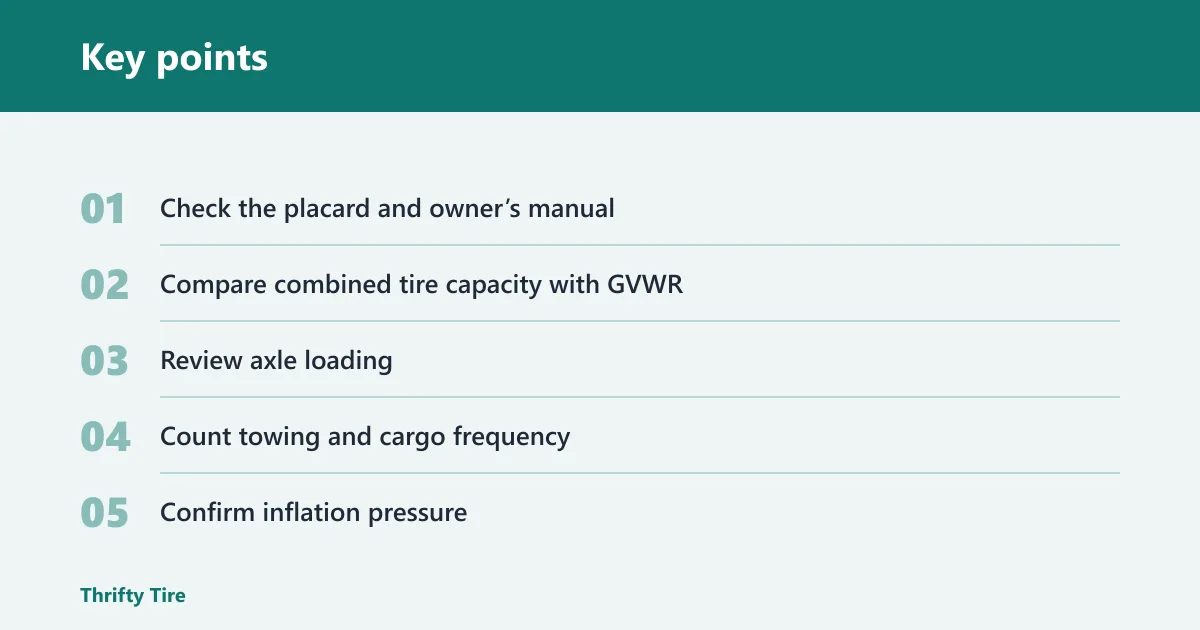
- Check the placard and owner’s manual. If the replacement tire meets or exceeds the listed minimum load index, mark this item as pass.
- Compare combined tire capacity with GVWR. If the total tire capacity leaves a practical margin above vehicle weight, mark this item as pass.
- Review axle loading. If one axle carries most of the cargo or towing load, confirm that axle still has margin at the chosen index.
- Count towing and cargo frequency. If you tow or haul heavy loads often, a higher load index may be useful. If not, stock may be enough.
- Confirm inflation pressure. If you can keep the tire at the manufacturer’s recommended pressure for normal use, mark this item as pass.
- Check speed rating beside the load index. If the replacement tire’s speed rating is appropriate for your driving, mark this item as pass.
- Verify fitment. If the tire clears the wheel, suspension, and brake package without rubbing or geometry problems, mark this item as pass.
| Check | Stock tire | Replacement tire |
|---|---|---|
| Load index meets placard minimum | Yes / No | Yes / No |
| Pressure can be held at recommended setting | Yes / No | Yes / No |
| Combined capacity fits GVWR margin | Yes / No | Yes / No |
| Axle load leaves usable reserve | Yes / No | Yes / No |
| Speed rating is appropriate | Yes / No | Yes / No |
| Fitment is correct | Yes / No | Yes / No |
Recommendation: if the replacement tire passes the placard, GVWR, pressure, speed, and fitment checks, a higher load index is acceptable and often useful for extra margin. If it fails any manufacturer minimum, do not choose it.
Worked example: stock vs replacement on a rear-axle-heavy setup
Consider a vehicle with a GVWR of 6,200 lb and a rear GAWR of 3,850 lb. The vehicle’s placard calls for a passenger tire with load index 109, which is 2,271 lb per tire. A rear-axle-heavy load case includes two adults, a bed full of tools, and a trailer tongue weight that pushes more demand onto the rear axle.
| Scenario | Per-tire capacity | Combined rear-axle capacity | Result |
|---|---|---|---|
| Stock tire, index 109 | 2,271 lb | 4,542 lb | Passes the rear GAWR on paper, but reserve is limited |
| Replacement tire, index 114 | 2,601 lb | 5,202 lb | Passes with more reserve, if wheel, size, and pressure are correct |
Pass/fail outcome: the replacement tire is a better fit for frequent towing or rear-cargo use because it adds reserve above the stock tire’s capacity. Warning: if the rear axle GAWR is already the limiting factor, increasing tire load index does not let you exceed the axle rating.
What happens if the load index is too low?
If the load index is too low for the vehicle’s real load, the tire works harder than it should. That extra stress shows up as overheating, more casing flex, and faster wear in the tire structure. Underinflation makes the problem worse because it adds heat and sidewall movement.
Failure modes to watch
Overheating is the first risk because a lightly rated or underinflated tire bends more under load. That extra bending creates casing strain, which can speed sidewall cord deterioration. Under heavy use, the end result can be a blowout risk that rises sharply as speed, weight, and heat stack up.
Picture a pickup set up for commuting, then loaded with construction material and a trailer on a hot day. If the tires are already near their limit and pressure is low, the sidewalls work harder on every mile. The tire may still look fine from a distance, but the internal strain keeps building.
Why inflation pressure matters so much
Proper inflation pressure is part of the rated load condition, but it should be understood correctly. The placard pressure is the vehicle maker’s recommended starting point for normal service; the sidewall maximum pressure is a limit, not a target. Load capacity is tied to the inflation/load table for that tire, and capacity changes if inflation changes.
SL and XL tires can behave differently here. An XL tire often carries more load than an SL tire of the same size, but only when inflated according to the tire’s own rated conditions. A tire’s maximum load is not simply “whatever the vehicle normally runs” and it is not safe to assume that any pressure change leaves capacity unchanged.
Frequently asked questions
What is load index on tires mean?
It means the numerical code that shows the maximum weight a tire can support when properly inflated. The number is standardized, so you can compare it with a chart and with your vehicle’s placard value before buying a replacement tire.
What is load rating on tires?
Load rating on tires is the capacity value tied to the load index. It translates the sidewall number into a weight limit, usually shown in kilograms and pounds. TRA and ETRTO-equivalent charts show how that conversion works.
Can I use tires with a higher load index than stock?
Yes, a higher load index is usually acceptable if the tire fits the wheel and vehicle correctly and the speed rating also works for your use. Do not go below the manufacturer minimum. A higher number is helpful only when the rest of the fitment is right.
What load index do I need for my car?
Use the vehicle placard and owner’s manual first, then compare the tire’s load index against your GVWR, axle loading, cargo habits, and inflation pressure. The right choice is the one that meets the manufacturer minimum and still leaves enough margin for your actual driving.
What does load index 105 mean on a tire?
It means the tire has a rated maximum load tied to index 105 on the load chart. You should not guess at the weight from the number alone; use a load rating chart and then confirm the tire also matches the vehicle’s pressure and speed requirements.