Bolt Pattern: How to Find, Measure, and Match Wheels
Your wheel’s bolt pattern has to match the hub exactly: first count the lugs, then measure the bolt-circle diameter (PCD) in millimeters. 5×114.3 means five lugs on a 114.3 mm bolt circle, and near matches are unsafe. If you miss the pattern, the wheel may not seat flat, hardware can loosen, vibration can start, and studs or hubs can be damaged. This guide shows you where to confirm the factory spec, how to measure 4-, 5-, 6-, and 8-lug patterns, and how to check full wheel fitment before you buy.
What you’ll need
- Tape measure or ruler with millimeter markings
- Straight edge
- Caliper, if available
- Phone camera for wheel stamps and reference photos
- Notepad or notes app
- Vehicle spec source such as the owner’s manual, a wheel listing, or fitment data by year, make, model, trim, and axle
How do you find your bolt pattern before removing a wheel?
You can often narrow down the likely pattern before removing anything by counting visible lugs, checking wheel-stamped markings, and matching that information against the vehicle’s published specs. That can get you close, but on used vehicles or swapped setups, you still need to verify the wheel and hub directly before you buy.
Use bolt pattern as the first gate
Bolt pattern, also called PCD, combines the lug count with the diameter of the bolt circle. In wheel-industry usage, PCD stands for pitch circle diameter, also called bolt-circle diameter (SAE J2530 wheel terminology uses pitch circle diameter; ISO wheel-marking references also use PCD terminology). It is usually written as two numbers with an x between them. The wheel’s PCD must be identical to the hub’s PCD, same lug count and same bolt-circle diameter.
That exact-match rule matters because similar-looking patterns are easy to confuse. A 5×100 wheel and a 5×114.3 wheel may look close, but they are different. The same goes for 5×114.3 and 5×120. Common examples published by major wheel manufacturers and fitment references include 5×100, 5×10⁸, 5×112, 5×114.3, 5×120, 6×139.7, 8×165.1, and 8×170.
Tire size does not tell you the wheel bolt pattern. The tire label inside the driver’s door usually does not list bolt pattern either, so use that label for tire size and pressure, not as the final answer for wheel fitment.
Follow these steps before you buy
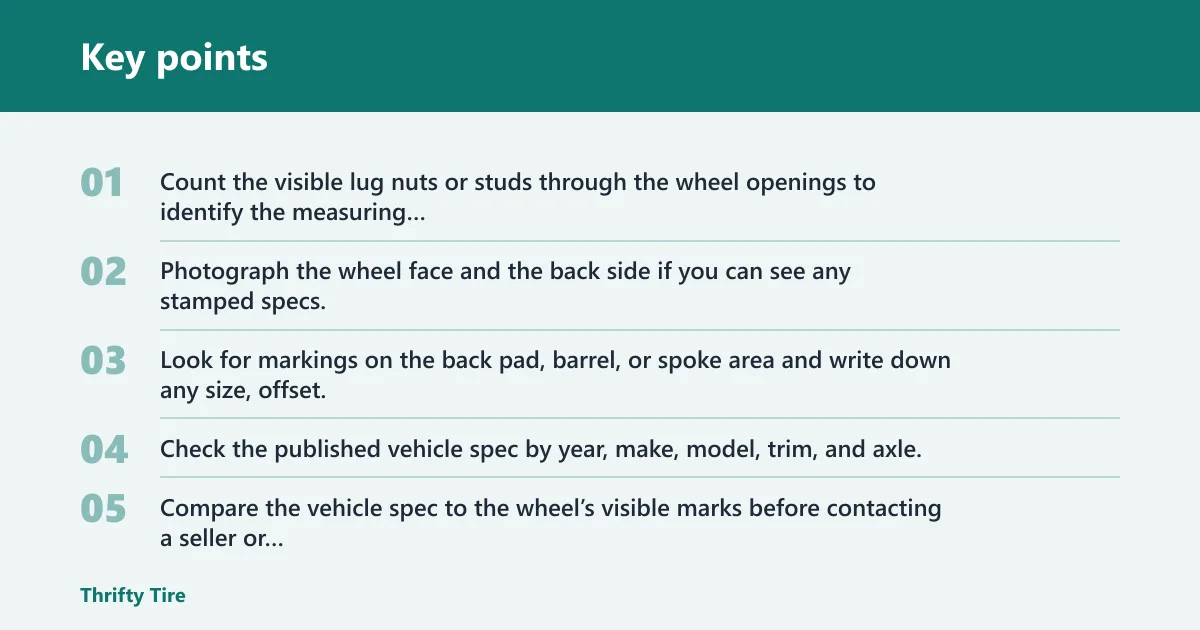
- Count the visible lug nuts or studs through the wheel openings to identify the measuring method you will need later.
- Photograph the wheel face and the back side if you can see any stamped specs.
- Look for markings on the back pad, barrel, or spoke area and write down any size, offset, or PCD code.
- Check the published vehicle spec by year, make, model, trim, and axle, then treat it as a baseline to confirm against the actual wheel and hub.
- Compare the vehicle spec to the wheel’s visible marks before contacting a seller or placing an order.
- Flag any vehicle with spacers, adapters, mixed wheels, or axle swaps for direct measurement.
Read wheel markings without overtrusting them
Many aftermarket wheels may be marked with wheel size, bolt pattern, and offset together. A stamp might show diameter and width, a PCD marking, and an offset such as ET45. Offset is conventionally stated in millimeters, and “ET” is commonly used in wheel markings for offset value references in manufacturer catalogs and technical fitment guides.
Wheel stamps help, but they do not always show every fitment detail. Center bore may be missing. Lug seat type often is not obvious from the stamp. Used wheels may also have incomplete marks, paint over stamps, or seller descriptions copied from another listing.
If a used wheel is stamped with size and offset but the seller cannot show the PCD, treat that as incomplete data. Measure the pattern directly or walk away.
Why bolt pattern fitment matters
The bolt pattern determines whether a wheel will seat and clamp correctly on your vehicle, so it is one of the first checks to make before buying rims. The supporting guide explains what the numbers mean, how to measure them, and why even a small mismatch can lead to vibration, damaged studs, poor centering, or brake interference. It also shows what to verify beyond the pattern itself, including hub centering and clearance, so you can avoid buying a wheel that looks right but will not fit safely.
For a straightforward breakdown of the measurements and fitment risks, see bolt pattern guide.
How do you measure 4-, 5-, 6-, and 8-lug patterns?
Start by counting the lugs so you use the right measuring method. Four-, six-, and eight-lug wheels are measured straight across from the center of one hole to the center of the opposite hole. Five-lug wheels are measured differently because there is no directly opposite hole, so record those in millimeters whenever possible.
Measure even-numbered patterns straight across
A bolt pattern tells you how many lug holes the wheel has and the circle diameter they form. Four-, six-, and eight-lug wheels are the easiest to measure because one hole sits directly opposite another.
For even lug counts, measure from the center of one hole straight across to the center of the opposite hole. That applies whether you are measuring the wheel holes or the studs on the hub.
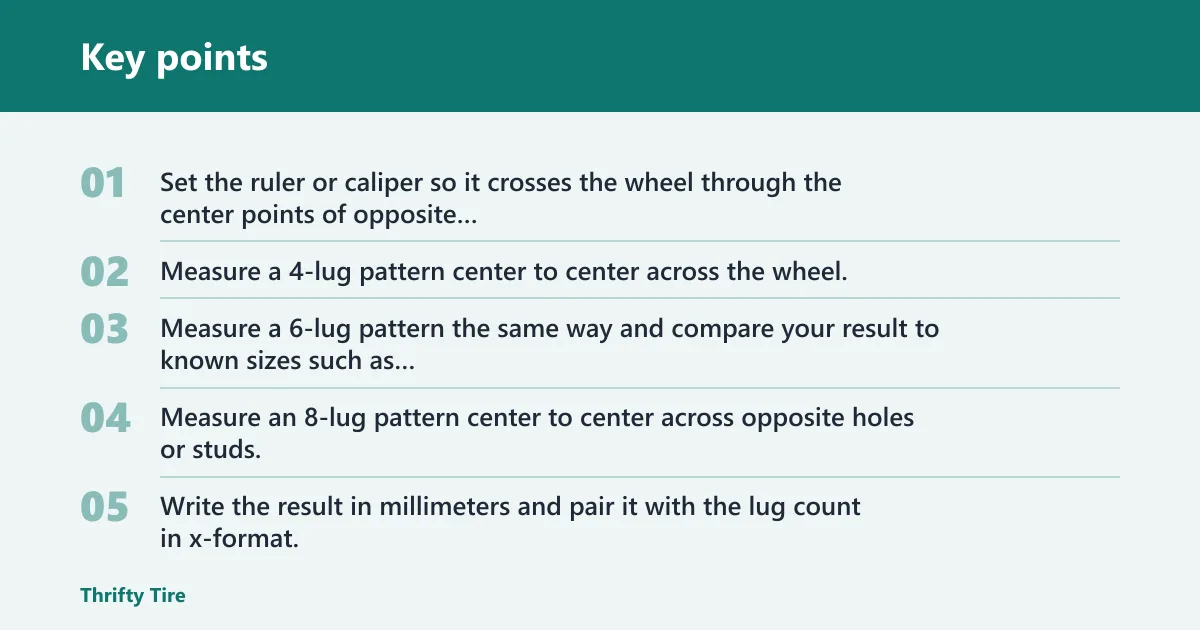
- Set the ruler or caliper so it crosses the wheel through the center points of opposite holes or studs.
- Measure a 4-lug pattern center to center across the wheel.
- Measure a 6-lug pattern the same way and compare your result to known sizes such as 6×139.7.
- Measure an 8-lug pattern center to center across opposite holes or studs.
- Write the result in millimeters and pair it with the lug count in x-format.
On heavy-duty trucks, accuracy matters because close-looking 8-lug standards such as 8×165.1 and 8×170 are distinct PCDs. A matching lug count alone is not enough, and load rating still has to be verified separately from bolt-circle diameter.
Measure five-lug patterns the right way
For five-lug wheels, do not measure straight across between two holes because there is no direct opposite hole. Use one method consistently: measure from the center of one lug hole or stud to the outer edge of the third hole or stud, the farthest one across the circle. In wheel-fitment shorthand, that is the same as outside-of-one to center-of-third.
- Pick one lug hole or stud as the starting point.
- Place the ruler at the center of that starting hole or stud.
- Measure to the outer edge of the third hole or stud, the farthest one across the circle.
- Record the value in millimeters, not a rough inch estimate.
- Match the recorded value against common five-lug standards.
Example: [1] o -- o -- oStart at the center of lug 1 and measure to the outside edge of lug 3.If that reading corresponds to a standard 114.3 mm PCD, record it as 5x114.3.
If your reading lands near the usual split between 5×112 and 5×114.3, measure again with a caliper or a straighter reference line before you do anything else. Do not round toward the pattern you wanted.
Quick comparison of common measurement methods
| Pattern type | How to measure | Example value |
|---|---|---|
| 4x | Center to center across opposite holes or studs | 4×100 = four lugs on a 100 mm bolt-circle diameter |
| 5x | Center of one hole or stud to the outer edge of the third hole or stud | 5×114.3 = five lugs on a 114.3 mm bolt-circle diameter |
| 6x | Center to center across opposite holes or studs | 6×139.7 = six lugs on a 139.7 mm bolt-circle diameter |
| 8x | Center to center across opposite holes or studs | 8×170 = eight lugs on a 170 mm bolt-circle diameter |
What if your 5-lug measurement lands between two close patterns?
An in-between five-lug reading is a stop sign, not a green light. Use millimeters, recheck the start and end points, and compare only against standard patterns. If the wheel seems to fall between close sizes such as 5×112, 5×114.3, and 5×120, assume the measurement is wrong until you repeat it carefully.
Resolve close 5-lug readings
Five-lug patterns are where shoppers get into trouble because several standards sit close together.
- Switch to a ruler or caliper with millimeter markings if you started in inches.
- Re-measure from the same starting point twice and record both numbers.
- Clean the edge of the hole or stud if dirt or corrosion makes the edge hard to see.
- Take a photo straight on and zoom in to confirm your start and end points.
- Reject the wheel if the result still does not align cleanly with a standard pattern.
What matters here is an exact pattern match, not a close one. A few millimeters on the bolt circle is enough to cause poor seating, hardware stress, and alignment problems at the hub.
Know why 5×114.3 and 5×120 are different
5×114.3 means five lug holes on a 114.3 mm bolt circle. 5×120 is five lugs on a 120 mm bolt circle. Same lug count, different bolt-circle diameter.
That difference is why same-lug-count shopping goes wrong so often in the used market. A seller may describe both as “5-lug wheels,” and visually they can look close on a screen. They are still different patterns and should be treated as a no-go match.
A buyer comparing a 5×114.3 sedan wheel and a 5×120 wheel from a different platform can be fooled by a quick test fit. The wheel may hang on two studs, but that does not make it compatible. The seat geometry and stud loading are wrong from the start.
Why the lug pattern must match exactly
A wheel can look close and still be wrong if the lug pattern is off by even a small amount. This guide explains how to measure 4-, 5-, 6-, and 8-lug bolt patterns so you can identify the correct wheel before you buy, avoid return hassles, and reduce the risk of wobble, damaged studs, or a wheel that will not seat properly. The key is using the right measuring method for each lug count, especially the different rule for 5-lug wheels. For a quick, practical walkthrough, see the bolt pattern guide.
How do you confirm the wheel will actually fit?
Matching the bolt pattern only clears the first gate. A wheel still needs the correct center bore, lug seat type, offset, diameter, width, and load rating for the vehicle. If any of those are wrong, the wheel can fail to mount, fail to center correctly, rub suspension or bodywork, or carry the wrong load.
Check center bore first
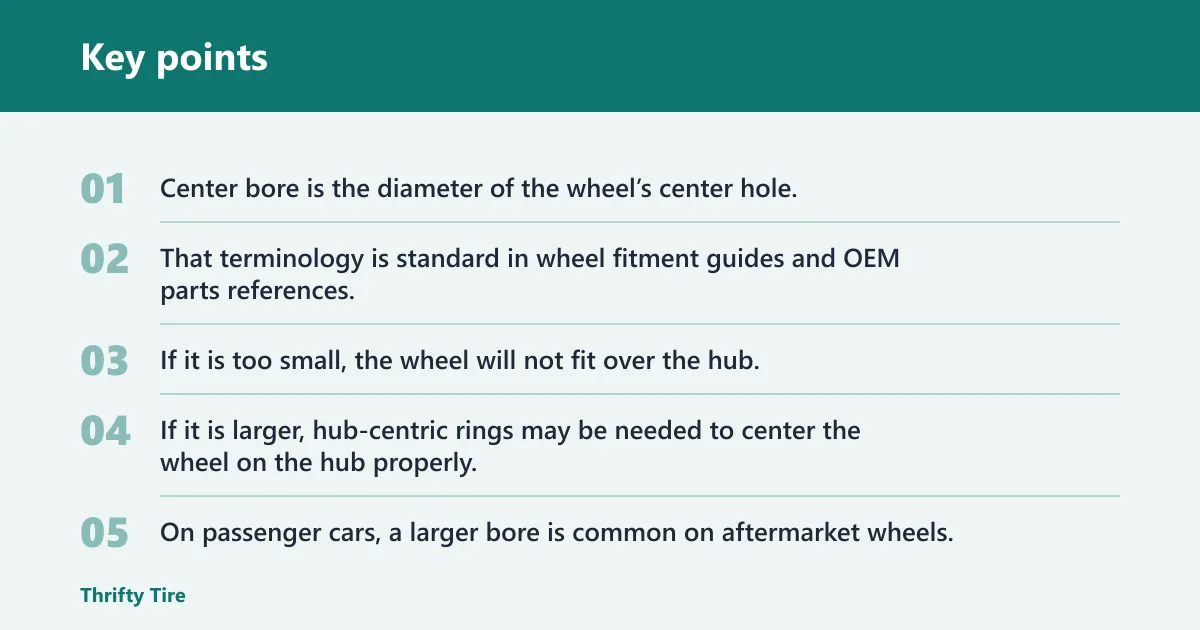
Center bore is the diameter of the wheel’s center hole. That terminology is standard in wheel fitment guides and OEM parts references. If it is too small, the wheel will not fit over the hub. If it is larger, hub-centric rings may be needed to center the wheel on the hub properly.
On passenger cars, a larger bore is common on aftermarket wheels. On trucks and SUVs, a larger bore plus a heavier tire-and-wheel package can make poor centering easier to notice if the setup depends only on the lugs.
Match the lug seat type
Lug seat shape has to match both the wheel and the hardware. Common seat types are conical, ball, and flat seats, which are the standard categories used by wheel and lug-hardware manufacturers.
This is an easy failure point with used wheels because the wheel may come from one brand family and the lug hardware from another. A conical nut on a ball-seat wheel, or the reverse, can prevent proper clamping even when the bolt pattern is correct.
Confirm offset, diameter, and width
Offset is measured in millimeters and controls where the wheel sits. Positive offset places the mounting pad farther toward the outside face of the wheel, negative offset moves the wheel farther outward, and zero offset centers the pad roughly on the wheel width. Wheel-industry references and OEM service information typically list offset in millimeters rather than inches.
Wheel diameter and width must clear brakes, suspension, and body. That includes caliper face clearance, inner suspension clearance, and fender or liner clearance at full steering lock and suspension travel.
Passenger cars often run into brake-caliper or inner-strut issues first. Trucks and SUVs more often add concerns around steering lock, liner contact, and larger tire packages. Work vehicles and trailers add another check: whether the wheel’s stated rating meets the application’s actual axle and tire-load demands.
Verify load rating by vehicle type
Load rating matters most on trucks, SUVs, trailers, and work vehicles, where a wheel with the correct PCD may still have insufficient capacity for the intended use. Heavy-duty applications also bring more 8-lug patterns into play, including examples such as 8×165.1 and 8×170.
For any vehicle that tows, carries cargo, or has upgraded tires, compare the wheel’s stated load rating with the vehicle’s requirements before buying. A practical check is to compare the wheel’s marked capacity against the vehicle’s axle ratings and intended tire load range, as referenced in vehicle certification labels and tire-and-rim industry load tables. If the rating is missing from the listing or the stamping, treat that as incomplete fitment data rather than assuming it is adequate.
Wheel fitment checklist
| Measurement method | What to record | Go/no-go decision |
|---|---|---|
| 4-lug: measure center to center across opposite holes or studs | Lug count, bolt-circle diameter, unit used | Go only if the lug count and diameter match the vehicle spec exactly; no-go if either differs |
| 5-lug: measure from the center of one hole or stud to the outer edge of the farthest hole or stud | Lug count, measured diameter in millimeters, closest standard compared against such as 5×100, 5×10⁸, 5×112, 5×114.3, or 5×120 | Go only if the result matches one standard clearly; no-go if it falls between close patterns or relies on rounding |
| 6-lug: measure center to center across opposite holes or studs | Lug count, bolt-circle diameter, example match or mismatch against sizes such as 6×139.7 | Go only on an exact PCD match; no-go for same-lug-count wheels with a different diameter |
| 8-lug: measure center to center across opposite holes or studs | Lug count, bolt-circle diameter, heavy-duty fitment notes | Go only if the PCD and load needs both match; no-go if the pattern is close but different, such as 8×165.1 versus 8×170 |
| Wheel-stamped markings on back pad, barrel, or spokes | Any size, PCD, and offset stamp; note missing data such as center bore, seat type, or load rating | Go only as a cross-check with direct measurement and vehicle spec; no-go if the stamp is incomplete, unreadable, or conflicts with the vehicle data |
| Final compatibility check for center bore, lug seat type, offset, diameter, width, and load rating | Center bore size, conical/ball/flat seat, offset in millimeters, diameter and width, load rating | Go only if every item matches the vehicle’s needs; no-go if any one item fails, even with a correct bolt pattern |
Common mistakes
Confusing lug count with actual fit
A five-lug wheel is not automatically right for another five-lug vehicle. Same lug count only tells you which measuring method to use. The bolt-circle diameter still has to match exactly.
Mixing inches and millimeters
Listings can mix units. Offset is measured in millimeters. Bolt pattern may appear in millimeters or inches depending on the source, so confirm the unit before comparing numbers. If a listing does not state the unit, ask for the exact stamped spec or pass.
Trusting catalog fitment on modified vehicles
Catalog data is useful on stock vehicles. It gets weaker when the vehicle has spacers, adapters, swapped axles, or a mixed OEM and aftermarket history. Those changes alter the fitment equation and require direct measurement at the wheel and hub.
Ignoring seat type, bore, and load rating
A correct PCD does not fix the wrong lug seat type. It does not make a too-small center bore fit. It does not solve a wheel that clears the studs but hits the brake caliper or carries too little load.
If that didn’t work
If the listing, stamp, and first measurement still do not agree, move up this ladder: remove one wheel for direct access, measure again with a caliper, check the hub and brake clearance, and verify whether spacers or adapters are present. If the vehicle has unknown axle history, confirm the actual axle and hub parts before buying wheels.
Prevention
Before buying used or aftermarket wheels, save a note with the key items: bolt pattern, center bore, seat type, offset, wheel size, and load rating. That single list prevents most bad purchases faster than tire-size guessing or seller shorthand.
Frequently asked questions
How do I find my bolt pattern without removing the wheel?
Count the visible lugs first, then look for wheel-stamped specs on the back pad, barrel, or spoke area. Compare that with vehicle fitment data by year, make, model, trim, and axle. Use the owner’s manual, factory vehicle specs, or fitment data tied to the exact year, make, model, trim, and axle to verify what the vehicle should use, then confirm against the actual wheel or hub before buying.
How do I measure a 5-lug bolt pattern correctly?
Measure from the center of one lug hole or stud to the outer edge of the farthest hole or stud. Do not measure straight across on a five-lug wheel.
What is the difference between 5×114.3 and 5×120?
Both patterns have five lugs, but the bolt-circle diameter is different. One uses a 114.3 mm circle and the other uses a 120 mm circle. Because the PCD is different, they are not interchangeable, even if the wheel looks close in photos or shares the same lug count.
Can I use wheels with the same lug count but a different bolt pattern?
No. Same lug count does not mean the wheel fits. The lug count only identifies the number of holes; the bolt-circle diameter still must match the vehicle hub pattern exactly. A close mismatch can keep the wheel from seating correctly and place the studs, nuts, and hub under the wrong loads.
What other wheel measurements must match besides bolt pattern?
Check center bore, lug seat type, offset, wheel diameter, wheel width, and load rating. Center bore that is too small will not fit, a larger bore may need hub-centric rings, the seat type must match the hardware, and diameter and width must clear brakes, suspension, and body.
Why is bolt pattern important when buying used wheels?
Used-wheel listings often omit details, mix units, or rely on shorthand like “5-lug.” Vehicles may also have swapped wheels, spacers, adapters, or axle changes that make catalog fitment wrong. Checking the exact PCD first helps you rule out unsafe options before you spend time on center bore, offset, and load checks.
Sources
- SAE J2530, Aftermarket Wheels—Passenger Cars and Light Truck—Performance Requirements and Test Procedures.
- Tire and Rim Association Year Book, wheel and load-rating terminology.
- ETRTO standards and wheel/tyre technical terminology references for PCD, offset units, and fitment language.
- Major OEM wheel and parts catalogs for center bore, lug seat, and offset notation conventions.