Do You Need Bigger Wheels for Plus Sizing?
No, plus sizing does not require bigger wheels if your goal is to keep overall tire diameter close to stock; in many cases, the better move is a wider tire on the same wheel size. Get the fit wrong, and speedometer readings, ride quality, clearance, and ABS or traction control behavior can all move out of spec. This guide explains when wheel upsizing helps, when tire-only changes make more sense, and how to keep sizing within safe limits.
What does plus sizing mean?
Plus sizing means increasing wheel diameter while reducing tire sidewall height so the overall tire diameter stays close to stock. That is the tradeoff. A plus-one setup means a 17-inch wheel becomes 18 inches, while plus-two moves 18 inches to 19 inches. The wheel gets larger, the sidewall gets shorter, and the rolling diameter stays near the factory target.
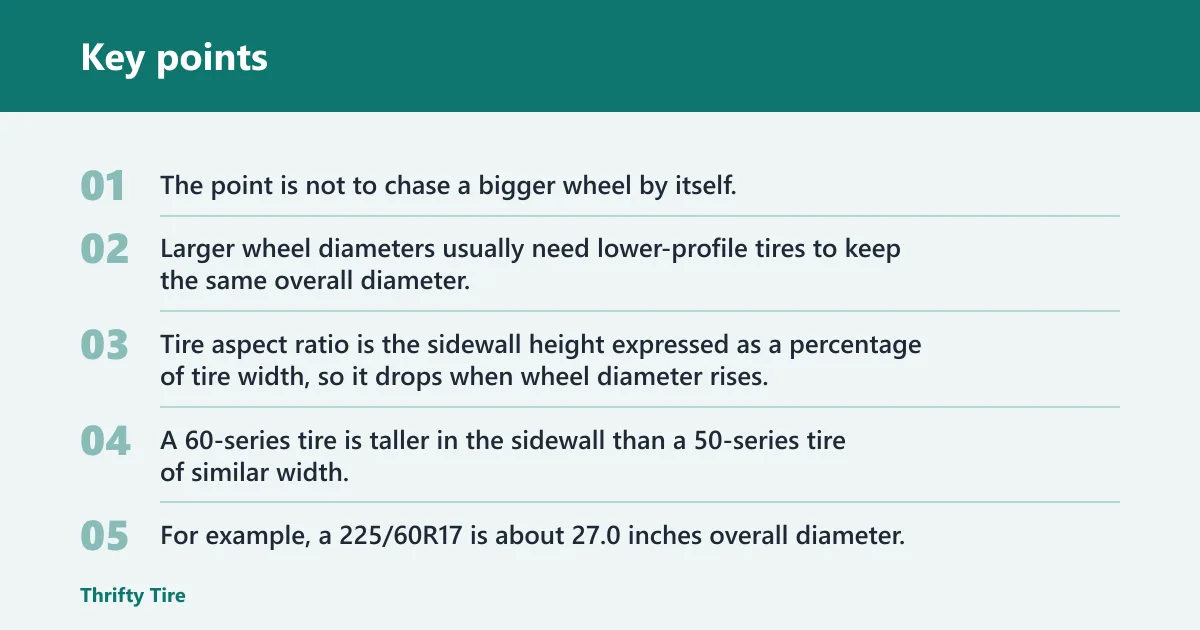
The point is not to chase a bigger wheel by itself. It is to change the package in a controlled way. A taller wheel with a lower-profile tire can clear larger brakes, change steering feel, and change appearance while keeping the speedometer and gearing close to original.
How the size change works
Wheel diameter is measured in inches. Larger wheel diameters usually need lower-profile tires to keep the same overall diameter. Tire aspect ratio is the sidewall height expressed as a percentage of tire width, so it drops when wheel diameter rises. A 60-series tire is taller in the sidewall than a 50-series tire of similar width.
For example, a 225/60R17 is about 27.0 inches overall diameter. A 225/50R18 is about 26.8 inches overall diameter. That is why the wheel changed, but the total diameter stayed close.
Do you need bigger wheels for plus sizing?
If you mean true plus sizing, yes, a bigger wheel is part of the recipe. Plus sizing requires a larger wheel diameter with a shorter tire sidewall. If you only want to keep overall diameter near stock, though, a bigger wheel is not the only path to consider, because the best choice depends on brake clearance, tire availability, and ride quality.
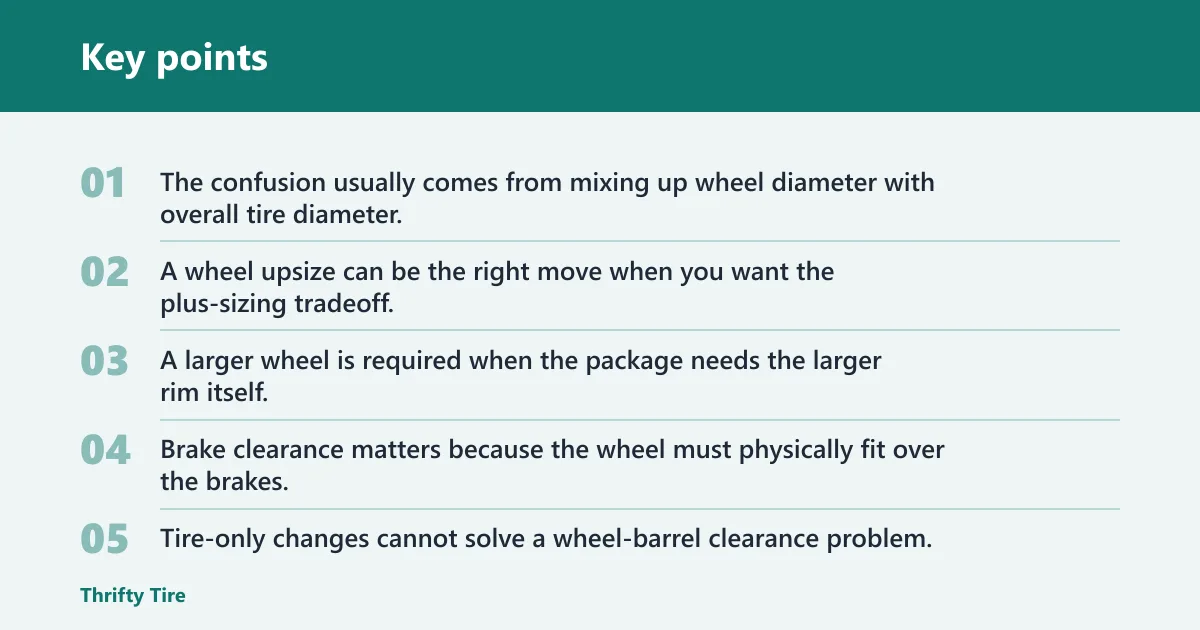
The confusion usually comes from mixing up wheel diameter with overall tire diameter. A wheel upsize can be the right move when you want the plus-sizing tradeoff. But if your goal is simply to keep the car close to factory rolling diameter, the wheel change may be unnecessary or may not be worth the cost and comfort penalty.
When a larger wheel is required
A larger wheel is required when the package needs the larger rim itself. That can happen when brake calipers need more barrel clearance, when the chassis has room for a plus-one or plus-two setup, or when the buyer wants the appearance and steering response that often come with a lower-profile tire.
Brake clearance matters because the wheel must physically fit over the brakes. Tire-only changes cannot solve a wheel-barrel clearance problem.
When a tire-only change is the better move
If the existing wheels already clear the brakes and the goal is to stay near stock diameter, a tire-only change is often the better fit. That path can preserve more sidewall, which helps ride comfort and pothole tolerance. It can also avoid the cost of new wheels when the current size already works.
Picture a driver with 17-inch wheels who wants slightly more grip for daily use. A wider tire in the same diameter class may meet the goal without moving to 18-inch wheels and a shorter sidewall.
Wheel size versus tire size
Wheel size and tire size are related, but they do different jobs. Wheel diameter sets the rim size in inches. Tire dimensions then have to match that wheel, and the sidewall height determines whether the overall diameter stays near stock. That overall diameter is the fitment number that matters most for speedometer accuracy, gearing, and clearance.
Speedometer and odometer systems are calibrated to factory revolutions per mile. If the new tire has a larger overall diameter, the speedometer will read low. If the diameter is smaller, it will read high. Even a change that looks small on paper can matter if it falls outside the normal range.
Offset, width, and rubbing risk
Rubbing usually comes from wider tires, lower offset, or both rather than wheel diameter alone. That is why fitment checks need more than a diameter comparison. Full steering lock and full suspension compression can reveal contact points that do not show up in a simple driveway look.
Very low-profile tires, including 35-series and below, can ride harsher. They are also more prone to pinch flats and bent wheels from potholes. Bigger wheels can make that sidewall shorter, so the road surface matters more.
Plus sizing decision table
| Path | Purpose | Required sidewall change | Likely speedometer impact | Ride comfort | Pothole risk | Cost/complexity | When it makes sense |
|---|---|---|---|---|---|---|---|
| Keep wheel size | Preserve factory wheel diameter and avoid extra cost | No wheel-diameter change; sidewall can stay similar if tire diameter stays close | Minimal if overall diameter stays within the safe range | Usually best of the three | Lowest of the three if sidewall stays taller | Lowest | You want OEM-like behavior, better daily comfort, or you do not need more brake clearance |
| Go plus-one | Fit a larger wheel with a shorter sidewall while keeping diameter close to stock | Sidewall gets shorter; wheel diameter rises one step | Usually small if the final diameter stays near stock | Stiffer than stock | Higher than stock | Moderate to high | You want a modest visual change, brake clearance, or a firmer steering feel |
| Change tire size without changing wheel diameter | Adjust grip, comfort, or diameter while keeping the same wheels | Sidewall may grow or shrink depending on the new tire size | Can be small or noticeable depending on final diameter | Can improve or worsen depending on sidewall change | Can improve with more sidewall or worsen with less | Low to moderate | You want to tune the fit without buying new wheels, and your brake clearance already works |
When does a bigger wheel make sense?
A bigger wheel makes sense when you need the wheel itself, not just a different tire. Brake clearance is commonly a main reason to use a larger wheel. A larger wheel can also suit a driver who wants a firmer response and is willing to give up some comfort. On rough roads, though, that trade can become expensive fast.
Plus sizing is also limited by available tire combinations. Plus-three and beyond gets harder because size combinations become limited. That is one reason many daily drivers stop at plus-one or plus-two, where there are still practical tire choices and the fit is easier to manage.
Common tradeoffs on daily drivers
On a pothole-heavy commute, low-profile tires can make the ride busier and the wheel more exposed. The smaller sidewall has less cushion, so impact energy reaches the wheel sooner. If the car spends most of its time on broken pavement, the appearance benefit may not justify the durability loss.
Suppose a driver moves from 17-inch wheels to 18-inch wheels but keeps the overall diameter close to stock. The speedometer may stay close, but the ride will usually feel firmer because the sidewall is shorter. That is a deliberate trade, not a free upgrade.
What should you check before changing sizes?
Before you change anything, compare the new setup against stock diameter and check the actual fit. A fitment calculator is the fastest way to compare diameters automatically and flag changes outside the safe range. Most tire engineers and shops treat plus or minus 3% as the safe zone, and 1% to 2% is the ideal range for matching diameter.
That matters because a size that looks close on paper can still hit the fender, liner, or suspension once the wheel turns and the body moves.
-
Record the stock size.
Start with the exact tire size on the door placard or sidewall, then note the wheel diameter in inches. If you are comparing to the example here, 225/60R17 is about 27.0 inches overall diameter. -
Check the replacement diameter.
Use a fitment calculator to compare the new size to stock and keep the result within plus or minus 3%. If you can stay inside 1% to 2%, that is even better for speedometer and gearing accuracy. -
Verify brake and suspension clearance.
Look at the wheel barrel, caliper space, and inner suspension clearance. Then check fit at full steering lock and full suspension compression, because rubbing often appears only when the wheel is turned or the suspension is loaded. -
Confirm offset and width.
Make sure the wheel offset and tire width do not push the package outward or inward too far. Rubbing usually comes from wider tires, lower offset, or both rather than wheel diameter alone. -
Choose the comfort level.
Decide whether the car needs more sidewall for comfort or a shorter sidewall for appearance and response. If the roads are rough, a taller sidewall can save the wheel and improve ride quality.
One common first-timer mistake is focusing on wheel diameter and ignoring the tire. A 19-inch wheel with the wrong tire size can fit worse than an 18-inch wheel with a better-matched tire. The fitment calculator catches that mismatch before money is spent.
Frequently asked questions
Are bigger wheels better on a car?
Not automatically. Bigger wheels can help with brake clearance and give a lower-profile look, but they usually reduce ride comfort and raise pothole risk. The better wheel size is the one that matches your brake package, tire availability, and road conditions without pushing diameter too far from stock.
Are smaller or bigger wheels better?
Neither is always better. Smaller wheels usually leave more sidewall, which can improve comfort and protection on rough pavement. Bigger wheels can sharpen response and clear larger brakes. The right answer depends on whether you value comfort, appearance, or fitment more.
Does wheel size matter?
Yes, but overall tire diameter matters more than wheel diameter alone. Wheel size changes what tire sidewall you can run, and that affects speedometer accuracy, gearing, and ride quality. If the overall diameter stays close to stock, the car will usually behave more predictably.
Do bigger or smaller wheels go faster?
Wheel size by itself does not decide top speed or acceleration. Overall tire diameter affects gearing, so a larger diameter can lower engine speed at a given road speed and make the speedometer read low. A smaller diameter does the opposite and can make the speedometer read high.
Why are bigger wheels less efficient?
Bigger wheels often need heavier assemblies and lower-profile tires, which can raise rolling resistance and reduce comfort on rough roads. They also leave less sidewall to absorb impacts, so the car may feel harsher. The effect depends on the full package, not the wheel alone.