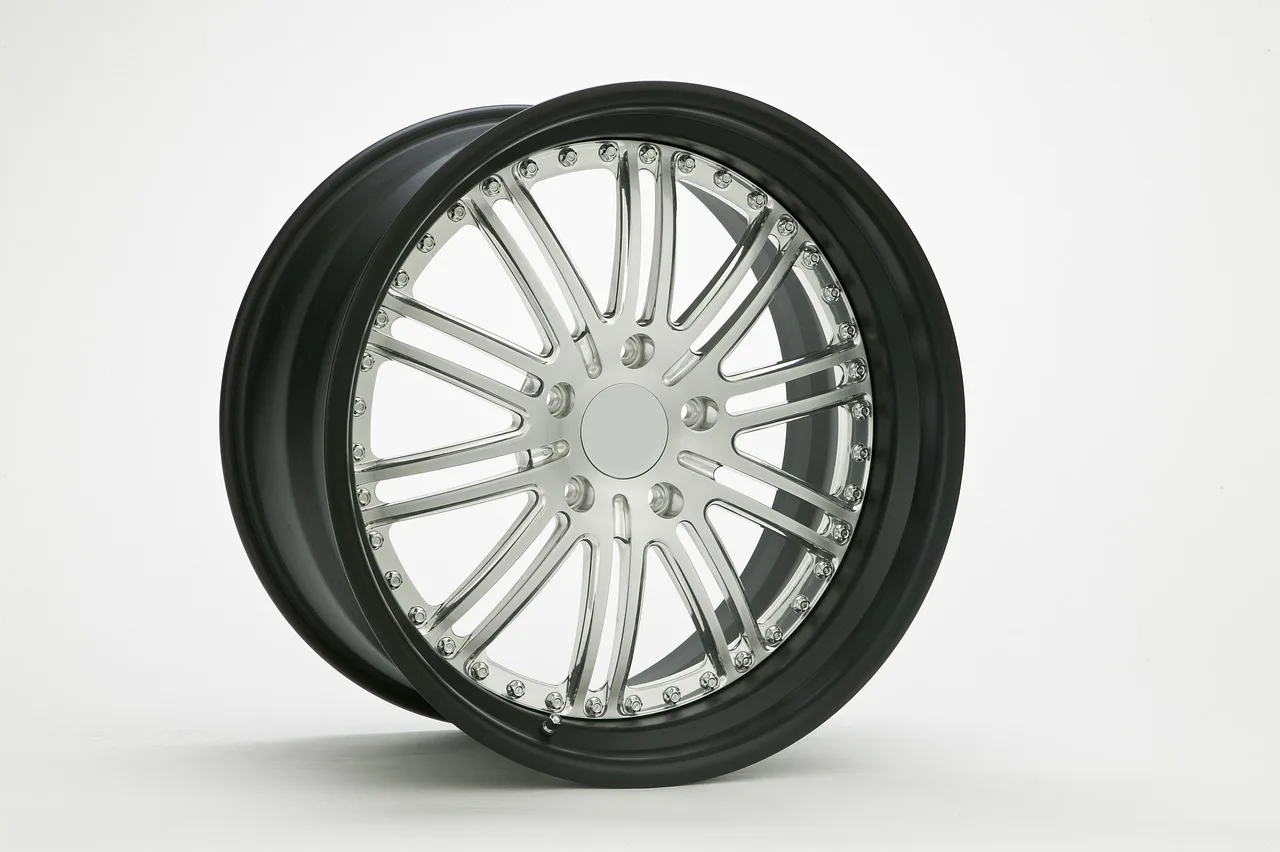
Wheel Offset Explained: How to Choose the Right Fit
Choose wheel offset by keeping inner and outer wheel position changes within your measured clearance budget; a common rule of thumb is that about 1 mm of offset change moves the wheel about 1 mm inboard or outboard. Get it wrong and you can hit struts or fenders, scrub tires, change steering feel, and waste money on wheels that do not fit. This guide gives you a repeatable method to compare offsets using wheel width, tire size, and daily-use clearance needs.
What is wheel offset and what does it change?
Wheel offset is the millimeter distance between the wheel’s hub-mounting pad and its centerline. That one number changes two things at once: inner clearance to struts, brakes, and control arms, and outer position relative to the fender, liner, and steering arc.
Offset changes wheel position, not just appearance
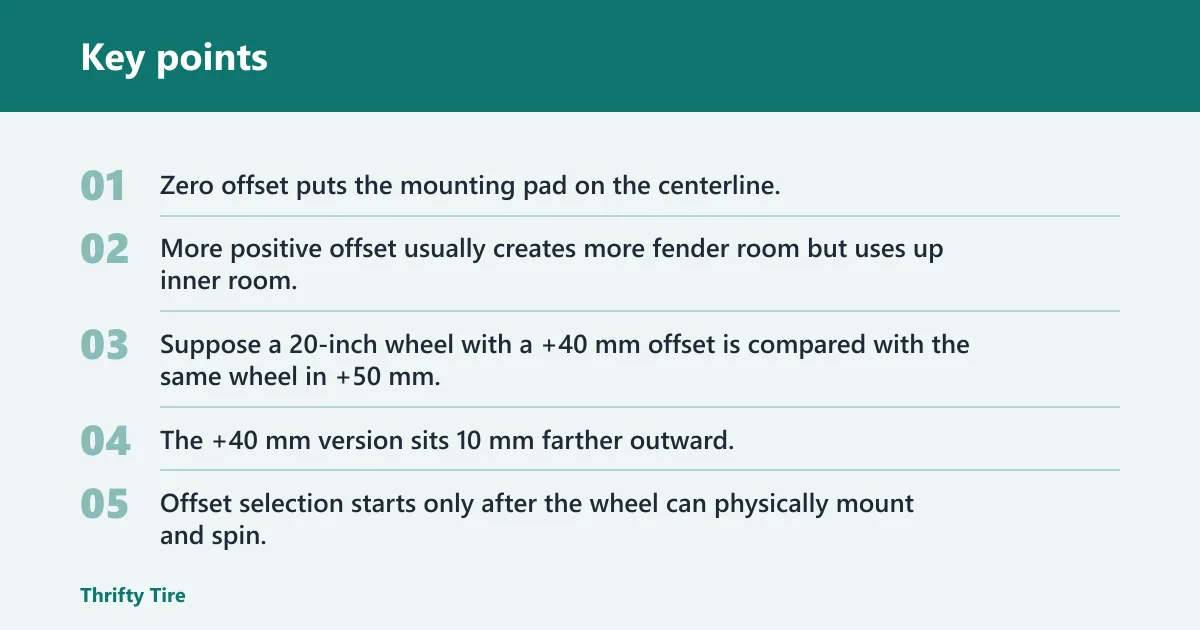
Positive offset places the mounting pad toward the street side of the wheel centerline, so the wheel and tire generally sit farther inward toward the suspension and brakes once bolted on. Zero offset puts the mounting pad on the centerline. Negative offset puts the pad toward the inboard side, which moves the wheel outward and is common on deep-dish wheels, older trucks, classic muscle cars, and widened off-road builds.
The practical point is simple. Offset is not a style number by itself. It is a location number, and that location decides whether the wheel clears the vehicle.
Think in inner clearance and outer clearance
Two wheels can share the same diameter and bolt pattern yet fit very differently because offset changes where the barrel and tire sit. More positive offset usually creates more fender room but uses up inner room. Less positive offset does the reverse.
Suppose a 20-inch wheel with a +40 mm offset is compared with the same wheel in +50 mm. The +40 mm version sits 10 mm farther outward. That sounds minor on paper, but it can be the difference between a safe fender gap and liner rub at full lock.
Offset only matters after basic fit is possible
Offset cannot make up for a wrong bolt pattern, a center bore that is too small, or a barrel that hits the brake caliper. Check those first. Offset selection starts only after the wheel can physically mount and spin.
How do wheel width and offset work together?
Wheel width and offset should be compared together because width changes both sides of the wheel while offset shifts the whole wheel inward or outward. A wider wheel can cut inner clearance and add outer poke at the same time, even if the offset number looks close to stock.
Wheel width is measured between the inner lips
Wheel width is generally measured between the bead seats, not across the outer face. That is why wheel specs are usually read as a package, such as diameter, width, and offset together. Change any one of those and fitment can change.
A wheel one inch wider gains 25.4 mm overall, or about 12.7 mm on each side of centerline. That is the base math for every offset comparison.
A simple fitment rule for comparing two wheel specs
Use this method when comparing the current wheel with a target wheel:
- Half of the width change affects the inner side.
- The other half affects the outer side.
- Offset change then shifts the entire wheel inward or outward.
If the target wheel is 1 inch wider and the offset stays the same, inner position moves inward by 12.7 mm and outer position moves outward by 12.7 mm. If the target wheel is also 5 mm lower in positive offset, add 5 mm more outward shift to both calculations: inner clearance improves by 5 mm, while outer poke increases by 5 mm.
That means the net result is not guessed from appearance. It is calculated, then checked against the real vehicle.
Tire section width can upset a wheel-only plan
Tire fitment is where many offset choices go wrong. Tire section width and shoulder shape vary by brand and model even when the labeled size is identical. A round-shoulder tire can clear where a square-shoulder tire in the same marked size rubs the liner or fender lip.
Picture an 18×8.5 wheel that clears on paper with a 235 tire. Change only the tire model, keep the same labeled size, and the shoulder can sit farther outboard than expected. The wheel spec did not change, but the final fitment did.
What happens if your wheel offset is too high or too low?
Too much positive offset moves the wheel inward and can create contact with struts, spring perches, control arms, or inner liners. Too little positive offset, or negative offset, pushes the assembly outward and raises the chance of fender rub, heavier steering feel, kickback, and extra scrub-radius change.
Too much positive offset: inner-side failures
When offset is too high, the wheel and tire move toward the suspension and brakes. Common failure points include strut bodies on many passenger cars, upper control arms on some trucks, inner liners at full lock, and calipers if spoke shape is marginal.
Symptoms tend to show up during turns, over bumps, or when the suspension compresses. A polished mark on the inner sidewall or a shiny scrape point on a strut tube is a strong clue that the wheel sits too far inboard.
Too little positive offset: outer-side failures
When offset drops, the wheel moves outward. That can look appealing, but the trade is less fender and liner clearance. The tire may catch the fender edge on compression, clip the liner at full steering lock, or throw more road spray and debris down the side of the vehicle.
A common first-timer mistake is treating “flush” as a fixed offset number. It is not. A flush result on one trim can become an aggressive result on another because ride height, camber, tire shoulder shape, and even factory fender liners differ.
Handling and steering effects come from scrub-radius change
Moving the wheel centerline changes scrub radius. That can alter steering effort, return-to-center feel, tramlining, kickback over bumps, and the loads carried by wheel bearings and suspension joints. The farther the wheel center moves from the original location, the more likely those effects become.
Daily-driven vehicles usually tolerate modest changes better than large ones. Off-road and track-focused builds may accept more steering tradeoff, but the choice should be intentional, not accidental.
Which specs must match before offset even matters?
Before comparing offsets, the wheel must match the hub pattern, center bore, and brake package. A wheel with the wrong PCD will not mount, a too-small center bore will not seat on the hub, and a barrel or spoke that hits the caliper fails regardless of offset.
PCD and bolt pattern
PCD is usually written like 5×114.3. On many PCD listings, the first number is the lug count, and the second is the bolt-circle diameter. Even a 1 mm PCD mismatch is a dealbreaker, because the wheel will not align correctly on the studs or bolts.
Center bore and hub-centric fit
The center bore is the hole in the middle of the wheel that fits over the hub. If it is too small, the wheel will not go on. If it is larger than the hub, hub-centric rings may be needed so the wheel centers correctly and avoids vibration that can come from hanging on hardware alone.
Center bore does not change offset, but it changes whether the wheel can seat correctly and run true. That makes it a basic fitment gate.
Brake and suspension clearance
Brake clearance is more than rotor diameter. Caliper shape, spoke design, barrel drop, and wheel width all matter. Suspension clearance also means more than a quick visual check; the tire must clear struts, control arms, liners, and wiring at full lock and through suspension travel.
Factory fitment can vary by year, trim, brake package, suspension package, and tire model. A wheel that clears a base model may fail on a larger-brake trim of the same vehicle.
How to choose the right offset
The right offset is chosen by measuring the current setup, calculating how the new wheel and tire will move, and deciding whether the result fits an OEM-like, flush, or aggressive goal. That method is repeatable because it uses real clearances, not appearance alone.
Use a repeatable measuring process
- Record the current specs. Note the current wheel width, diameter, offset, tire size, and tire model if possible. This gives the baseline location that already clears, or already rubs, so every later change has context.
- Measure inner clearance. With the vehicle at normal ride height, measure the smallest gap from the inner tire or wheel to the strut, spring perch, control arm, and liner. Turn the steering from lock to lock on the front axle because many rubbing problems show up only during steering.
- Measure outer clearance. Check the gap from the outer tire sidewall to the fender edge and liner. Then look at compression points, because static garage clearance can disappear once the suspension loads in a driveway dip or corner.
- Compare wheel widths. Calculate half of the width difference between the current wheel and the target wheel. If the target is wider, part of that width goes inward and part goes outward before offset is even considered.
- Apply the offset change. Compare the current offset with the target offset. Every 1 mm of offset change moves the wheel 1 mm inboard or outboard, so add or subtract that amount from the inner and outer position change you calculated from width.
- Add tire reality. Account for tire section width and shoulder shape, because the same labeled size can run wider or squarer depending on brand and model. Most manufacturers list measured section width and approved rim-width range, and those details can decide a borderline fit.
- Check the use case. Decide how much rub risk, steering change, and liner contact is acceptable for the way the vehicle is used. A daily commuter should keep more clearance in reserve than a fair-weather stance build.
- Verify hard fitment gates. Confirm PCD, center bore, brake clearance, hub-centric support, and legal fender coverage before ordering. A wheel that clears on offset math alone can still be wrong in every practical sense.
Pick the goal before the number
OEM-like fitment prioritizes clean steering behavior, lower rub risk, and margin for passengers, cargo, and rough roads. Flush fitment uses more of the outer clearance budget to bring the tire closer to the fender line. Aggressive fitment pushes farther outward and often accepts more steering compromise, stricter tire choice, or body and liner work.
Say your current setup has only a small gap to the front strut but plenty of room at the fender. Lower offset may help because it moves the wheel outward, buying inner clearance. If the fender gap is already tight, the same move solves one problem and creates another.
Offset fitment decision table
This table turns fitment goals into buying choices. Use it after measuring the real vehicle. It separates daily-driver priorities from stance priorities, and it frames offset as a clearance and steering decision rather than a styling shortcut.
Decision table
| Fitment goal | Inner clearance target | Outer clearance target | Steering impact | Rub risk | Ideal use case |
|---|---|---|---|---|---|
| OEM-like | Keep close to current proven setup; avoid spending most of the inner gap | Leave visible room to fender and liner for compression and steering | Smallest scrub-radius and return-to-center change | Lowest, assuming tire model stays reasonable | Daily driving, winter use, passengers, poor roads, least drama |
| Flush | Accept a measured reduction only if strut, arm, and caliper room remains at lock | Bring tire near fender line without crossing it through normal travel | Noticeable but usually manageable on many street builds | Moderate; depends heavily on tire shoulder, alignment, and ride height | Street-focused aftermarket look with usable daily manners |
| Aggressive | Often improved by moving outward, but only if brake and spoke clearance still work | Uses most or all outer budget and may exceed it under compression | Largest steering feel change, more kickback and tramlining potential | Highest; common with wide tires, square shoulders, or lowered suspension | Show builds, stance-first choices, some off-road looks, owners willing to accept tradeoffs |
Wheel offset table
| Check | Yes/No |
|---|---|
| Current wheel width, offset, and tire size recorded from the vehicle | Yes / No |
| Inner clearance measured to strut, control arm, liner, and brake hardware | Yes / No |
| Outer clearance measured to fender edge and liner at normal ride height | Yes / No |
| Front checked at full steering lock in both directions | Yes / No |
| Suspension compression or travel considered, not just static parking clearance | Yes / No |
| Target wheel PCD confirmed to exactly match the vehicle hub | Yes / No |
| Center bore confirmed to fit hub, or correct hub-centric rings identified | Yes / No |
| Brake caliper and barrel/spoke clearance confirmed for the exact trim | Yes / No |
| Tire model checked for section width and shoulder shape, not label alone | Yes / No |
| Local fender coverage, spacer, and inspection rules checked | Yes / No |
How are offset and backspacing different?
Offset measures mounting-face location relative to the wheel centerline, while backspacing measures from the inner wheel edge to the mounting surface. They describe related fitment facts, but they are not interchangeable because backspacing also depends on wheel width and wheel construction.
Backspacing is common in truck and off-road fitment
Truck and off-road buyers often discuss backspacing because inner-side clearance to suspension, frame parts, and steering components is a common concern. It is usually expressed in inches rather than millimeters, and it directly describes how far the wheel extends inward from the mounting pad.
A common shortcut is: Backspacing ≈ (Stated Wheel Width / 2) + (Offset / 25.4) + about 0.5 inch, because stated wheel width is usually measured at the bead seats while backspacing is taken to the inner outer edge. Using that practical estimate, a 9-inch-wide wheel with a +12 mm offset works out to about 5.47 inches of backspacing.
When offset is the better comparison tool
Offset is usually easier when comparing two wheels for the same vehicle because it shows how much the mounting pad location changes from one wheel to the next. Backspacing is still useful, but it can hide the bigger picture if width changes at the same time.
How positive, zero, and negative offset differ
Wheel offset is what decides whether a wheel sits tucked in, centered, or pushed outward in the wheel well. The supporting guide on wheel offset types breaks down the three main offsets in plain terms so you can tell how each one changes fitment.
That matters because the wrong offset can cause rubbing, brake clearance problems, heavier steering effort, or extra stress on suspension parts. Understanding the difference between positive, zero, and negative offset helps you compare wheel specs before you buy, instead of guessing based on appearance alone.
Can spacers fix the offset you want?
Spacers reduce effective offset by moving the wheel outward, so they can solve some inner-clearance problems or fine-tune a nearly correct fitment. They do not fix wrong bolt pattern, brake interference, poor tire choice, or a setup that already lacks outer fender clearance.
What a spacer changes
A spacer moves the wheel mounting face outward from the hub. That means the wheel sits farther outboard, just as if it had less positive offset. Inner clearance improves by the spacer thickness, while outer clearance shrinks by that same amount.
When spacers are practical and when they are not
Spacers can be a practical correction when the wheel already matches PCD, center bore, and brake clearance, and the vehicle has enough outer room left. They are a poor answer when the setup already sits close to the fender, when hub support is lost, or when stud length and thread engagement are not sufficient.
Hub-centric support matters here. So does hardware length. Any spacer choice should preserve proper centering, adequate stud or bolt engagement, and compliance with local inspection and road-use rules.
Frequently asked questions
How do I know if a wheel offset is too high or too low?
Check both measurement and symptoms. Too high usually shows up as inner rubbing on struts, liners, or control arms. Too low usually shows up as outer poke, fender contact, kickback, or heavier steering. Appearance alone is not enough; compare the target wheel against real inner and outer clearance on the vehicle.
What happens if my wheel offset is wrong?
The wheel may not clear suspension parts, brake components, liners, or fenders. The vehicle can also pick up tramlining, steering kickback, poor return-to-center, and higher loads on bearings and joints because moving the wheel centerline changes scrub radius and suspension geometry.
How does wheel offset affect handling and steering feel?
Offset changes wheel centerline position, which changes scrub radius. That can alter steering weight, self-centering, bump reaction, and how strongly the vehicle follows road grooves. Small changes are often manageable; larger outward moves tend to make steering feel busier and more reactive.
What offset range is typical for my vehicle type?
Typical ranges can help narrow the search, but they do not confirm fitment. Exact fit still depends on width, tires, brakes, and trim.
How do offset and backspacing differ?
Offset is a millimeter measurement from the mounting face to the wheel centerline. Backspacing is an inch measurement from the inner wheel edge to the mounting face. Because backspacing depends on wheel width, two wheels can share similar offsets but show different backspacing values.
Can I use spacers instead of changing wheel offset?
Sometimes, yes. A spacer effectively lowers positive offset by pushing the wheel outward, which can help when inner clearance is tight. It only works when outer clearance remains safe and when hub support, stud length, hardware engagement, and local legal requirements are all properly addressed.