Does Center Bore Have to Match Exactly?
No, the center bore does not have to match the hub exactly if the wheel is designed to fit hub-centrically and the bore is only slightly larger; that kind of oversize is commonly corrected with hub-centric rings. A poor fit can contribute to vibration, uneven clamping, and repeat looseness. This guide explains exact-match cases, safe oversize limits, ring use, and when machining or replacement is the better fix.
- Exact match is best when the wheel is designed to center on the hub flange.
- Slight oversize can work if the right hub-centric rings restore concentric fit.
- Undersized bores should not be forced; choose a different wheel or approved machine work.
- Big gaps need more than torque; if a ring cannot center the wheel reliably, replace the wheel.
What center bore means
The center bore is the opening in the wheel that locates it on the vehicle hub flange. In hub-centric fitment, that opening matches the hub closely, so the wheel is centered by the hub while clamp load and wheel design specifics also matter. If the fit is wrong, the wheel can sit off center even when the lug nuts are tight.
Center bore vs. hub bore
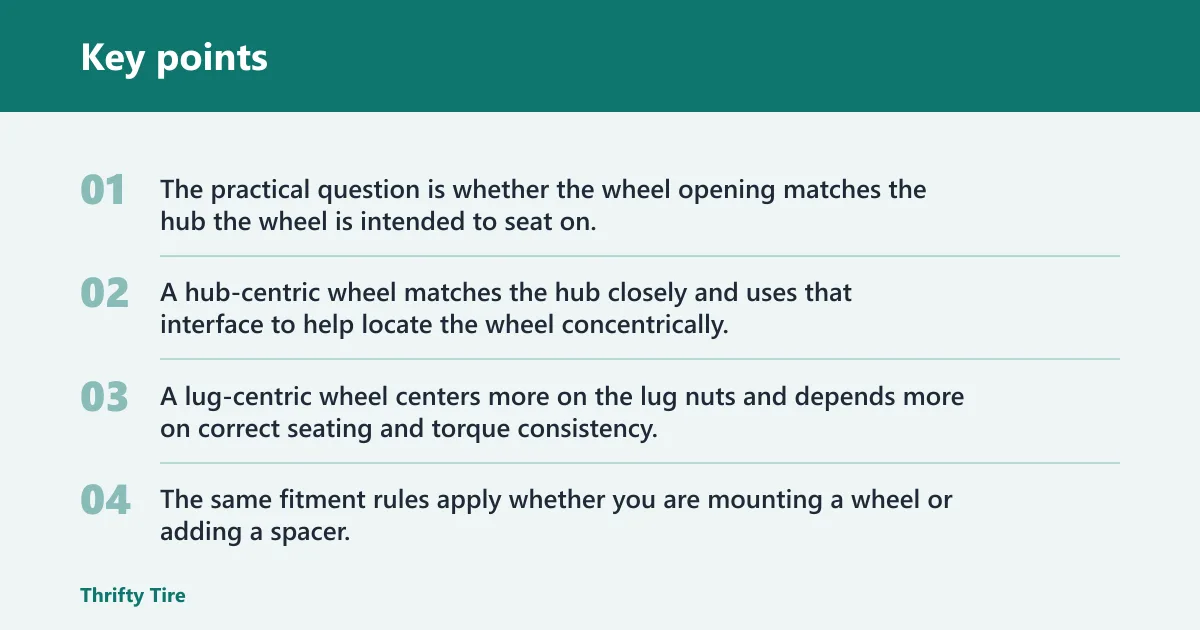
People often use “hub bore” and center bore to describe the same fitment point, but the wheel side is the center bore and the vehicle side is the hub flange. The practical question is whether the wheel opening matches the hub the wheel is intended to seat on. That fit controls centering, seating, and vibration risk.
Hub-centric and lug-centric fitment
A hub-centric wheel matches the hub closely and uses that interface to help locate the wheel concentrically. A lug-centric wheel centers more on the lug nuts and depends more on correct seating and torque consistency. Hub-centric fitment is generally more precise, while lug-centric fitment is more sensitive to wheel seat style, nut design, and installation quality.
Wheel spacers follow the same logic. A hub-centric spacer has a center bore that matches the vehicle’s hub flange, while a lug-centric spacer often has an oversized center bore and relies on the lugs to position it. The same fitment rules apply whether you are mounting a wheel or adding a spacer.
Does the center bore have to match exactly?
No. The center bore does not always need a metal-on-metal exact match, but it does need to suit the intended centering method. An exact match is ideal when the wheel is designed to locate on the hub flange. A slightly larger bore is common on aftermarket wheels and can often be corrected with hub-centric rings.
When exact match matters most
Exact match matters most on street-driven vehicles, heavier wheels, towing setups, and applications that already run close to acceptable runout. In those cases, the hub should seat the wheel firmly so the assembly rotates concentrically. That lowers vibration risk and reduces the chance of the wheel shifting under load.
When slight oversize is normal
Slight oversize is normal when the wheel is made to fit a range of vehicles and then adapted with rings. A small gap is not automatically a problem if the ring centers the wheel correctly and the wheel seats flat against the hub flange. The issue is not oversize by itself, but uncorrected oversize.
Say your aftermarket wheel has a center bore that is just larger than the hub flange. If the ring fills that gap cleanly, the wheel can still run hub-centric. If the gap is too large for a proper ring, the fit becomes unstable and should be corrected another way.
Center bore fitment decision table
| Wheel bore condition | Recommended next step | Why | Risk level | Rings, machining, or replacement? |
|---|---|---|---|---|
| Exact match to the hub flange | Install after confirming clean seating surfaces and proper torque | The wheel can center directly on the hub flange without relying on an adapter | Low, if the hub and wheel seat are undamaged | No ring needed; machining not needed; replacement not needed |
| Slightly oversized bore | Use hub-centric rings sized to the hub and wheel bore | A proper ring fills the gap and helps restore concentric fitment | Moderate if left uncorrected, low if ringed correctly | Rings appropriate; machining usually not needed; replacement only if the ring cannot fit correctly |
| Bore is too small | Do not force the wheel onto the hub; verify dimensions and choose a different wheel or have the bore machined by a qualified shop if safe and approved | A wheel that is undersized cannot seat flat, so centering and clamping are compromised | High | Machining or replacement appropriate; rings do not solve this |
| Bore is much too large | Check whether a proper ring exists for that gap; if not, replace the wheel | If the gap is beyond practical ring support, the wheel cannot be centered reliably | High if the wheel cannot be centered reliably | Rings only if the gap is within the ring’s usable range; otherwise replacement |
What happens when the bore is off
An off-size bore can create vibration, wheel runout, and poor centering under load. The wheel may feel fine at low speed and then shake as speed rises because even a small off-center condition becomes more noticeable as rotation increases. If the wheel is not centered by the hub or by a proper ring, the lug nuts can be left to do work they were not meant to do alone.
Vibration and runout
Runout is off-center rotation. Even a small amount can cause steering-wheel shake, seat vibration, or a humming feel that changes with speed. That is more likely in lug-centric setups or in any setup where the wheel is not seated flat before torque is applied. Bent wheels, contaminated mounting faces, and hub damage can make the problem worse.
Load support and centering errors
In a hub-centric system, the hub helps locate the wheel concentrically while the lug nuts provide clamp load. If the wheel is not centered correctly, the studs can see more stress than intended. That can contribute to repeat loosening, uneven clamping, and a wheel that never feels fully settled after installation.
Picture a wheel with a bore that is far larger than the hub and no ring installed. The lug nuts may pull it on, but the center can still sit off enough to create shake on the highway. The fix is not more torque; the fix is proper centering.
Can hub-centric rings fix a larger bore?
Yes, hub-centric rings can fix a larger center bore when the mismatch is modest and the ring matches both the wheel bore and the hub flange. They fill the gap and restore hub-centric fitment. They do not fix a bore that is too small, and they do not make an incompatible wheel usable if the gap is too large for stable support.
Plastic vs. aluminum rings
Hub-centric rings can be plastic or aluminum. Plastic rings are common for everyday street use and are easy to replace if damaged. Aluminum rings are also common and can suit higher heat or harsher service. The key point is fit, not material alone; the ring must seat cleanly and stay in place during installation.
When rings are the wrong fix
Rings are the wrong fix when the bore is undersized, when the gap is too large for a safe adapter, or when the wheel seats poorly on the hub flange. They also do not correct bent wheels, damaged hub flanges, or contamination on the mounting face. If the wheel cannot center reliably, replace it or have the fit rechecked by a qualified shop.
When is a wheel considered lug-centric instead of hub-centric?
A wheel is lug-centric when it centers on the lug nuts instead of the hub. That setup often uses tapered lug nuts to draw the wheel into position. It can work, but it is less forgiving than hub-centric fitment because the final position depends more on how the wheel is seated and tightened.
Tapered lug nuts
Lug-centric assemblies rely on tapered lug nuts to pull the wheel or spacer into position. The taper helps center the part as the nuts are tightened. If the taper does not match the wheel seat, or if dirt keeps the wheel from sitting flat, the assembly can end up slightly off center. The seat style has to match the wheel design.
Tightening pattern and torque consistency
Use a star pattern when tightening lug nuts. That helps the wheel seat evenly and reduces the chance of pulling one side of the wheel off center. Final torque should be consistent across all lugs so the wheel is clamped flat, not twisted into place by uneven tightening.
- Clean the hub flange. Remove rust, dirt, and debris from the hub face and locating lip before installation. A clean surface lets the wheel seat fully and reduces the chance of false centering.
- Check the bore size. Compare the wheel bore to the hub flange and confirm whether the wheel is exact match, slightly oversized, or undersized. That tells you whether rings, machining, or replacement is the right path.
- Install the ring or wheel. If the bore is slightly oversized, fit the correct hub-centric ring first, then place the wheel so it seats squarely on the hub. Do not force an undersized bore onto the hub.
- Tighten in a star pattern. Snug the tapered lug nuts in a star pattern before final torque. This keeps the wheel centered and limits the chance of runout from uneven clamping.
What to check before installation
Before installation, inspect the vehicle hub flange and the wheel’s center bore together. The hub flange must be clean and undamaged for proper seating. The wheel should match the intended fitment method, whether that means a close hub-centric fit, a proper ring, or a lug-centric arrangement with tapered lug nuts.
Wheel spacers deserve the same check. A hub-centric spacer should match the hub flange closely, while a lug-centric spacer depends on the lugs and correct torque. If the spacer changes brake clearance or stance, the fit still has to control centering and runout.
- Inspect the hub face. Look for rust scale, bent lips, or debris on the vehicle hub flange. Any of those can keep the wheel from seating flat and can create vibration later.
- Confirm wheel orientation. Make sure the wheel mounts in the correct direction and that the center bore is not binding. If the bore is too small, stop and select a different wheel or approved machine work.
- Verify centering parts. Install hub-centric rings only when the wheel bore is oversized and the ring dimensions match both parts. Use the correct lug nuts and torque sequence for the wheel design.
- Recheck after driving. After the first drive, inspect torque and feel for shake or wobble. A correctly fitted hub-centric wheel should stay smooth; any vibration means the fit needs to be checked again.
A common first-timer mistake is to assume more torque will cure a bad fit. It will not. If the bore is too small, the wheel will not seat properly. If the bore is too large and uncorrected, the lugs may clamp the wheel while the center stays off.
Frequently asked questions
Does center bore have to be exact?
No, not always. It has to match the intended fitment method. Exact match is ideal for hub-centric wheels, but a slightly larger bore is normal on many aftermarket wheels if hub-centric rings restore the proper fit.
Does the center bore size matter?
Yes. Center bore size matters because it affects how the wheel centers on the hub flange and how much stress the hub and studs may see in a hub-centric setup. A poor match can create runout, vibration, or repeat looseness even if the lug nuts are tight.
What happens if the wheel center bore is slightly bigger than the hub?
A slightly bigger bore can still work if the wheel uses the right hub-centric ring. The ring fills the gap and helps center the wheel on the hub flange. Without that correction, the wheel may sit off center and shake at speed.
Can hub-centric rings fix a larger center bore?
Yes, as long as the oversize is within the usable range for a proper ring. Plastic and aluminum rings both exist. They only solve oversize fitment, though, and they do not correct a bore that is too small or a damaged hub face.
Can you drive safely if the center bore is not an exact match?
Yes, if the mismatch is slight and corrected properly. A hub-centric ring can make a slightly oversized bore acceptable for normal use. A bore that is too small or a bore that is far too large is not a safe driving setup and should be corrected first.