Plus Sizing Tires: How to Do It Without Fit Problems?
Plus size tires by increasing wheel diameter while keeping overall tire diameter within about 3% of stock, then match tire width to the wheel and confirm offset, brake clearance, and load rating. Skip those checks and you can end up with rubbing, speedometer error, low load capacity, or wheels that contact the brakes or suspension. This guide lays out a fitment-first process, the diameter math, and the clearance points to verify before you buy.
What you’ll need
- Your vehicle’s OE tire size from the driver-door placard or owner’s manual
- Current wheel size and offset, if the car is not on factory wheels
- Wheel width, bolt pattern, and hub bore specs for the wheel being considered
- A tire-size calculator or simple calculator for diameter math
- A straightedge and tape measure
- A flashlight for strut, liner, and brake-caliper checks
- A floor jack or ramp access if a closer suspension check is needed
- The Find Tires tool to compare options by vehicle, size, or rim
What plus sizing changes
Start from the OE size
Original Equipment size is the baseline. It is the factory reference for wheel diameter, section width, and aspect ratio, so every plus-sizing decision should be checked against it before you think about style, tread pattern, or brand.
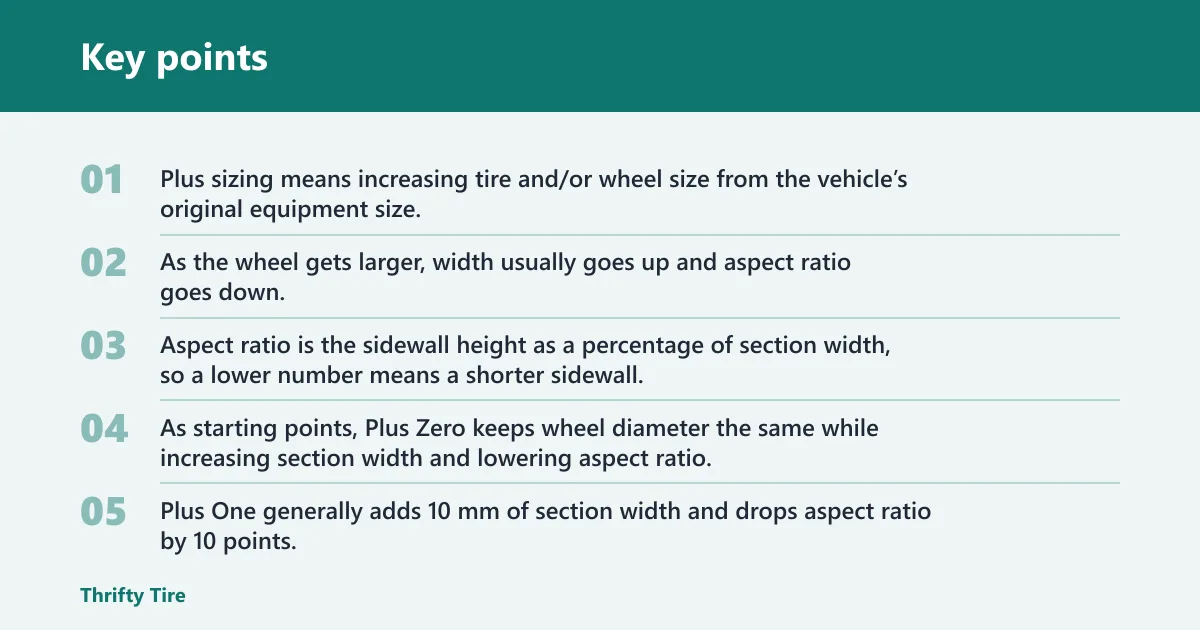
Plus sizing means increasing tire and/or wheel size from the vehicle’s original equipment size. You can get quicker steering response from the shorter sidewall, and many owners use it to reduce wheel-gap appearance, but fitment works only when the new package stays close to the OE rolling diameter and clears the car through its full range of motion.
How diameter, width, and aspect ratio move together
Wheel diameter is measured in inches. It is the main step-up metric: Plus Zero keeps the wheel diameter the same, Plus One uses wheels one inch larger than OE, Plus Two uses wheels two inches larger than OE, and Plus Three uses wheels three inches larger than OE.
Section width is measured in millimeters. As the wheel gets larger, width usually goes up and aspect ratio goes down. Aspect ratio is the sidewall height as a percentage of section width, so a lower number means a shorter sidewall.
As starting points, Plus Zero keeps wheel diameter the same while increasing section width and lowering aspect ratio. Plus One generally adds 10 mm of section width and drops aspect ratio by 10 points. Plus Two generally adds 20 mm. Plus Three generally adds 30 mm. Those are sizing rules, not fitment guarantees.
Why fitment fails even when the math looks right
Overall diameter is only one check. A tire that matches stock diameter can still rub because wheel width, offset, or suspension movement can create contact at full lock or over a bump.
Brake shape matters too. Larger wheel diameter does not always clear larger calipers, because spoke design and barrel shape decide whether the wheel actually passes over the brake package. Hub bore matters as well; the wheel must center correctly on the hub.
When Plus Sizing Starts to Rub
If you want a safe rule of thumb, the supporting guide explains why staying within about 3% of stock diameter is the usual starting point before rubbing risk climbs. It also shows that diameter is only part of the equation: section width, wheel width, and offset can push a setup from workable to rub-prone even when the size change looks modest on paper. That matters because rubbing can happen at full lock, over bumps, or during suspension compression, and it can also bring speedometer error and uneven wear. For a practical breakdown of where the line is, see plus size rubbing limits.
How do you keep the same overall diameter when plus sizing?
Keep the new tire’s overall diameter as close as possible to the OE diameter, with about 3% as a common upper limit and less change preferred. That protects speedometer accuracy, gearing, ABS behavior, and physical clearance while the suspension turns and compresses.
A simple tire-size math method
Use this formula: overall diameter = wheel diameter in millimeters + two sidewalls. Sidewall height is section width × aspect ratio.
For an OE size of 215/60R16, the wheel contributes 406.4 mm because 16 inches × 25.4 = 406.4. Each sidewall is 129 mm because 215 × 0.60 = 129. Total diameter is 664.4 mm.
If the target is 225/50R17, the wheel contributes 431.8 mm and each sidewall is 112.5 mm. Total diameter is 656.8 mm, which is 7.6 mm smaller than stock, or about 1.1% down. That stays close enough to the OE size to justify a clearance check.
Suppose the OE size is 215/60R16 and the tempting upgrade is 245/45R18 because the diameter looks close at a glance. The math gives about 677.7 mm, or roughly 2% larger than stock. That may still clear on one car, but the extra width and taller shoulder can raise fender and liner contact risk at steering lock.
What size change does to the speedometer
A larger-diameter tire travels farther per wheel turn, so the speedometer will read lower than actual speed. A smaller-diameter tire does the opposite. The farther you move from stock, the more that error grows, and the same diameter change also alters effective gearing and odometer readings.
That is why matching diameter should be the first screen, not the last one. A setup can pass the math and still fail the car.
How much wider can you go without rubbing?
There is no universal width increase that always fits. The safe answer depends on wheel width, wheel offset, tire model, and the room around the strut, liner, and fender. A common first pass is a modest width increase, then a manual clearance check before calling it safe.
Section width is not the whole story
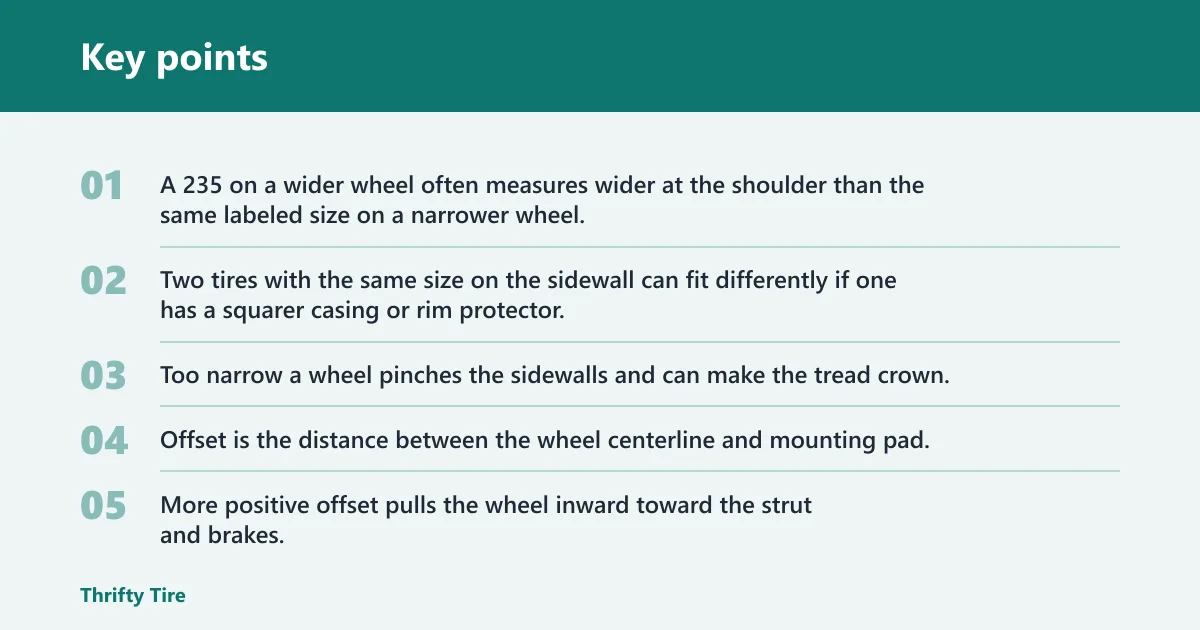
Section width is the tire’s stated width in millimeters, but the mounted width can change with wheel width and tire construction. A 235 on a wider wheel often measures wider at the shoulder than the same labeled size on a narrower wheel.
That shoulder shape matters because rubbing often starts at the sidewall bulge or the outer shoulder, not the center tread. Two tires with the same size on the sidewall can fit differently if one has a squarer casing or rim protector.
Wheel width and offset decide where the tire sits
Wheel width changes the tire’s shape. Too narrow a wheel pinches the sidewalls and can make the tread crown. Too wide a wheel stretches the sidewalls and can move the shoulder outward, reducing rim protection and changing how the tire clears the fender.
Offset is the distance between the wheel centerline and mounting pad. More positive offset pulls the wheel inward toward the strut and brakes. Less positive offset pushes it outward toward the fender. On many cars, offset changes create rub risk faster than a modest tread-width increase does.
Picture a car moving from a 7-inch wheel with a high positive offset to an 8.5-inch wheel with noticeably less positive offset. Even if the tire diameter stays near stock, the outer shoulder can move outward enough to touch the fender lip over compression while the inner side may gain strut room.
When to stop at a smaller change
Plus Zero or Plus One is often the safer move when you want cleaner steering response without chasing every last bit of wheel diameter. That is especially true for daily drivers, winter setups, pothole-prone roads, and cars that already have tight inner clearances from the factory.
How do you plus size without fit problems?
Start with the OE size, keep the new overall diameter close to stock, and treat wheel width, offset, brake clearance, and steering-lock clearance as equal checks. A setup is not safe until it clears the brakes, strut, fender, and liner through full lock and suspension movement.
Fitment process
- Record the OE size. Read the factory tire size from the door placard and note the OE wheel diameter, section width, load index, and speed rating. That gives the baseline for diameter math and load capacity.
- Choose a plus level. Decide whether Plus Zero, Plus One, Plus Two, or Plus Three fits the goal. If ride comfort, winter traction, or rough-road durability matters most, stop at the smallest change that meets the goal.
- Calculate target diameter. Compare candidate sizes against the OE overall diameter and keep the change within about 3% of stock. Closer is better because speedometer, gearing, ABS, and clearance all track that number.
- Match tire to wheel. Check that the wheel width suits the tire size you picked. Most manufacturers list approved wheel-width ranges for each tire size, and that range matters because sidewall shape changes real-world clearance.
- Check wheel offset. Compare the new wheel offset to the OE or current wheel. More inward position raises strut and spring-perch risk; more outward position raises fender and liner risk.
- Verify brake clearance. Confirm the wheel clears the caliper by diameter and by spoke shape. Barrel diameter alone is not enough because the spokes can contact the caliper face even when the rim clears the rotor.
- Verify hub fit. Confirm bolt pattern and hub bore before anything else. If the wheel uses a larger center bore, the correct centering hardware must be specified so the wheel seats and centers properly on the hub.
- Measure inner clearance. With the current wheel installed, use a straightedge and tape measure to estimate room between the tire and the strut, spring perch, and inner liner. Compare that room with the inward movement created by the new width and offset.
- Measure outer clearance. Check the gap from the current tire shoulder to the fender lip and outer liner. Compare that with the outward movement from the new width and offset so the shoulder does not hit on dips or loaded turns.
- Check full steering lock. Turn the steering from lock to lock and inspect the liner, sway-bar area, brake hose path, and front bumper liner edge. Front-end rubbing often shows up here first, especially after width increases.
- Check compression clearance. Look for bump marks in the liner and fender area, then inspect loaded clearance with passengers or cargo if the vehicle often carries weight. A fit that clears on level ground can still hit over compression.
- Confirm load and speed ratings. Keep the replacement tire at or above the vehicle’s load needs and suitable speed rating. This matters most on EVs, trucks, SUVs, and vehicles moving to heavier wheel packages or shorter sidewalls.
- Use the fitment tool. Search the Find Tires tool by vehicle, size, or rim to narrow the options, then compare the listed sizes against your OE diameter, wheel width, and measured inner and outer clearances. Toyo recommends using its Find Tires tool for plus-sizing options, but the tool does not replace manual clearance checks.
- Recheck in 5 mm moves. If a setup is very close, adjust tire width or wheel position in 5 mm width steps and recalculate the inner and outer movement before ordering. Small changes can decide whether a shoulder barely clears or rubs every full-lock turn.
- Confirm before purchase. Have a tire professional verify the wheel-and-tire combination, especially if the car is lowered, AWD, brake-upgraded, or already on non-OE wheels. That final review catches problems the size label alone cannot show.
If that did not settle it, use this next ladder
- Reduce plus level. Drop from Plus Two to Plus One, or from Plus One to Plus Zero, if clearance is marginal at more than one point. A smaller wheel step often fixes both brake-spoke conflict and fender risk at once.
- Reduce tire width. Keep the wheel diameter target but move down one width size if the main conflict is strut, liner, or fender contact. This usually changes clearance more predictably than chasing a different tread pattern.
- Revise wheel specs. If the tire size is right but position is wrong, revisit wheel width and offset instead of forcing the setup. A safer spec is better than relying on a borderline fit.
- Get a final fit check. Use a tire professional when brake shape, lowered ride height, or aftermarket suspension parts complicate the fit. Toyo advises working with a tire professional to find the right combination.
Which vehicles need extra caution?
Some vehicles have far less margin for error than others. AWD systems want closely matched rolling diameter across all four tires, trucks and EVs have higher load demands, lowered cars lose compression room, and large brakes can turn a seemingly correct wheel into an instant interference problem.
AWD vehicles
Keep all four tires closely matched in overall diameter and wear. A plus-sized setup that varies too much from stock, or mixes sizes carelessly, can put extra stress on driveline components. For AWD, diameter matching is a system requirement, not a styling choice.
Trucks and SUVs
Load index matters as much as fit. Lower-profile passenger-car sizes may physically mount but fail the vehicle’s load needs, especially with towing, cargo, or a high center of gravity. Check the placard and do not trade load capacity away for wheel diameter.
EVs
EVs are heavy and deliver strong low-speed torque. That raises the importance of load index, sidewall support, and rolling-diameter consistency. Heavier wheels can also affect ride and efficiency, so a mild plus size often makes more sense than a large jump.
Lowered cars and big-brake cars
Lowering reduces compression clearance, and big brakes reduce barrel and spoke room. Those cars need careful checks at full lock and full bump. A setup that clears on a stock suspension can rub or hit calipers once ride height and brake package change.
Prevention: Before buying wheels, measure current inner and outer clearance on the actual car as it sits now, not as it left the factory. Suspension and brake changes erase many OE fit assumptions.
Fitment checklist table
Sample combinations
| OE size | Target wheel diameter | Target tire width | Aspect ratio change | Expected diameter difference | Offset notes | Brake clearance check | Suspension clearance check | Final rub-risk verdict |
|---|---|---|---|---|---|---|---|---|
| 215/60R16 | 16 | 235 mm | 60 to 55 | 235/55R16 = +0.1% | Watch inner clearance if wheel width increases | Usually unchanged by diameter; caliper-spoke shape still matters | Check strut and liner because width grows by 20 mm | Low to medium if offset stays near OE |
| 215/60R16 | 17 | 225 mm | 60 to 50 | 225/50R17 = -1.1% | Compare new offset to OE before ordering | Confirm barrel and spoke clearance on front calipers | Check lock-to-lock liner clearance | Low if wheel width and offset are sensible |
| 215/60R16 | 18 | 235 mm | 60 to 40 | 235/40R18 = -2.9% | Offset becomes more sensitive as wheel width grows | More likely to clear barrel; spoke shape still needs checking | Check strut, outer fender, and bump clearance | Medium; verify on-car before calling it safe |
| 215/60R16 | 19 | 245 mm | 60 to 35 | 245/35R19 = -1.5% | Low offset can push shoulder into fender fast | Big diameter does not guarantee caliper-face clearance | Check full lock and compression carefully | Medium to high; best confirmed by a tire professional |
Common mistakes
What goes wrong and how to avoid it
The most common mistake is treating the size label as the whole fitment answer. It is not. Wheel width, offset, hub bore, and brake shape can turn a mathematically neat choice into a rubbing or interference problem.
- Choosing by diameter alone and ignoring wheel offset
- Assuming the width and aspect-ratio rules always fit every vehicle
- Skipping full-lock checks and only looking straight ahead
- Skipping compression checks and finding the rub only on bumps
- Ignoring load index when moving to a lower-profile tire
- Using a wheel that clears the barrel but hits the caliper spokes
- Forgetting hub bore and centering hardware details
- Running very wide tires on the wrong wheel width, causing stretched or pinched fitment
Say your sedan came with 215/60R16 and the plan is a 19-inch wheel for appearance. If the 19-inch package clears only at static ride height, the first hard dip can put the outer shoulder into the fender liner even though the diameter math looked fine on paper.
How to choose between appearance, response, and comfort
If the priority is sharper steering without giving up too much ride quality, Plus Zero or Plus One is usually the best balance. If the priority is filling the wheel well, remember the trade: shorter sidewalls reduce pothole tolerance and can make wheel damage more likely.
Winter use often favors more sidewall, not less. Rough roads do too. Plus Two and Plus Three should be treated as application-specific choices, not default upgrades for daily commuting.
Frequently asked questions
How do you plus size tires without rubbing?
Start with the OE size, keep the new overall diameter close to stock, then verify wheel width, offset, brake clearance, inner strut room, outer fender room, and lock-to-lock clearance. Do not call a setup safe until it also clears under suspension compression with the vehicle loaded as it is actually used.
What size tires fit after plus sizing?
The sizes that fit are the ones that stay near the OE rolling diameter and match the wheel’s width, offset, brake package, and hub fit. A fitment tool can narrow the list, but the final answer still comes from the car’s actual inner and outer clearances.
How much wider can I go with plus sizing?
There is no fixed number that always works because the answer depends on wheel width, offset, and the space around the strut and fender. A modest increase is the usual starting point, then the setup needs a real lock and compression check before approval.
What is plus zero sizing on tires?
Plus Zero keeps the wheel diameter the same while section width increases and aspect ratio drops. It is often a smart choice when the goal is a little more traction and response without the added brake-clearance and ride-quality tradeoffs that come with a larger wheel.
Should I work with a tire professional for plus sizing?
Yes, especially for AWD vehicles, EVs, trucks, lowered cars, and big-brake setups. A tire professional can confirm the wheel-and-tire combination, check load and speed ratings, and catch offset or caliper issues that the tire size alone and a simple tool search will not show.