Why Wheel Offset Matters for Fit, Handling, and Tire Wear
Wheel offset sets how far a wheel sits inboard or outboard of the hub. Staying near factory offset, usually within about 5–10 mm, is commonly used to keep changes in clearance, steering feel, and tire wear smaller. Go much farther and you can rub suspension parts, add steering kickback, and wear tires unevenly. This guide explains how offset changes fitment, steering geometry, and tire wear, plus the warning signs that the setup has gone too far.
What wheel offset means
Wheel offset is the distance, measured in millimeters, from the hub-mounting surface to the wheel centerline. Some wheels and spec sheets stamp it as ET. Positive, zero, and negative values tell you whether the wheel sits farther inward or outward relative to the hub face.
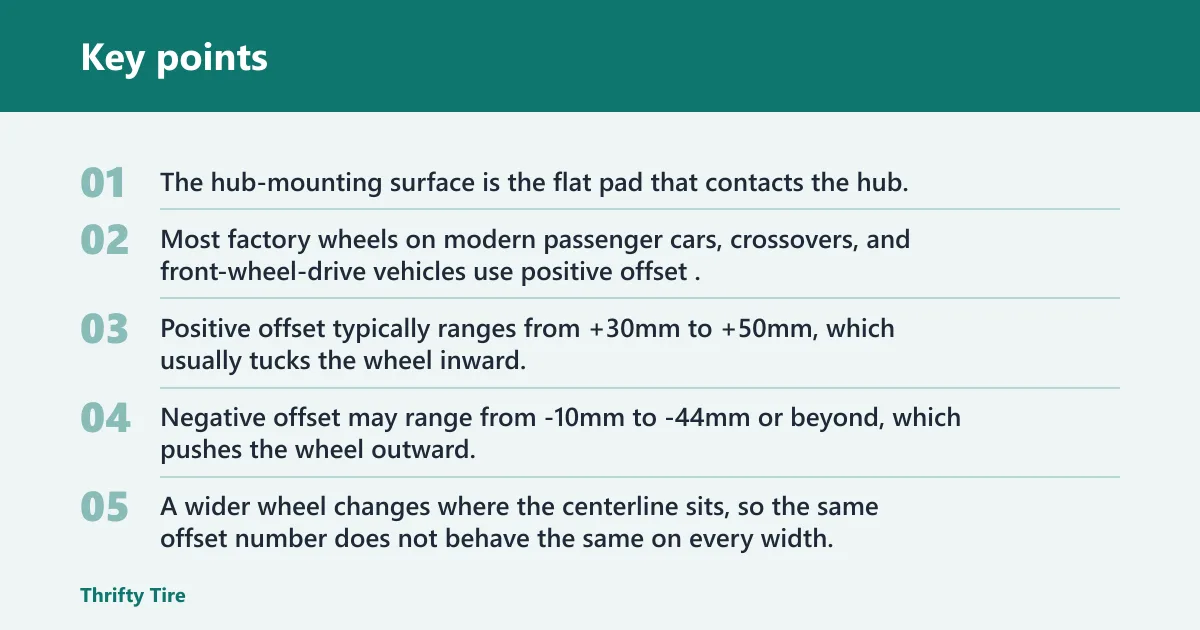
The wheel centerline is the imaginary midpoint of the wheel width, and offset math has to use bead-seat width, not the outer lips. The hub-mounting surface is the flat pad that contacts the hub. That reference point is what you compare against when checking fitment.
Positive, zero, and negative offset
Most factory wheels on modern passenger cars, crossovers, and front-wheel-drive vehicles use positive offset. Positive offset typically ranges from +30mm to +50mm, which usually tucks the wheel inward. Negative offset may range from -10mm to -44mm or beyond, which pushes the wheel outward.
Wheel width matters too. A wider wheel changes where the centerline sits, so the same offset number does not behave the same on every width. Wheel width is usually advertised as bead-seat to bead-seat width, not flange-to-flange width.
Why wheel offset affects fitment?
Offset changes where the wheel and tire sit relative to the suspension and fender. Move the wheel inward and you may gain outer clearance but lose room near the strut, coilover, or control arm. Move it outward and you may clear the inside better, but create fender-lip poke or rubbing at full lock and full compression.
Wheel width and tire size can magnify the effect. A wider tire shoulder can rub even when the wheel itself clears, so offset alone never decides fitment. Exact vehicle year, trim, brake package, and suspension layout still matter.
Inner clearance to suspension parts
Higher positive offset pulls the wheel toward the chassis. That can reduce the gap to the strut tube, spring perch, coilover body, sway bar links, and control arms. The risk is highest when the new wheel is wider or the tire has a square shoulder.
Outer poke at the fender lip
Lower or negative offset pushes the wheel outward. That increases the chance of rubbing the fender lip, liner, or outer bumper edge, especially at steering lock or when the suspension compresses. Cosmetic flush fitment is not the same as safe clearance.
If a stock 17×8 ET+45 wheel is changed to ET+25 on the same width, it sits about 20 mm farther out. The wheel sits 20 mm farther out. That may look flush, but the outer shoulder may now contact the fender on a deep dip or during a parking maneuver with the wheel turned.
Wheel width and tire size changes
Changing wheel width changes the centerline and alters how far the inner and outer lips sit from the hub. A wider tire can add more sidewall bulge, so the same offset change can be harmless on one tire size and noisy on another. Check wheel width, tire section width, and suspension clearance together.
How offset changes handling?
Offset changes handling by moving the wheel center relative to the steering axis, which changes scrub radius and the tire’s effect on the suspension. That affects steering effort, road kickback, and how the car feels at low speed and over bumps. Small changes may be subtle; large ones are easier to notice.
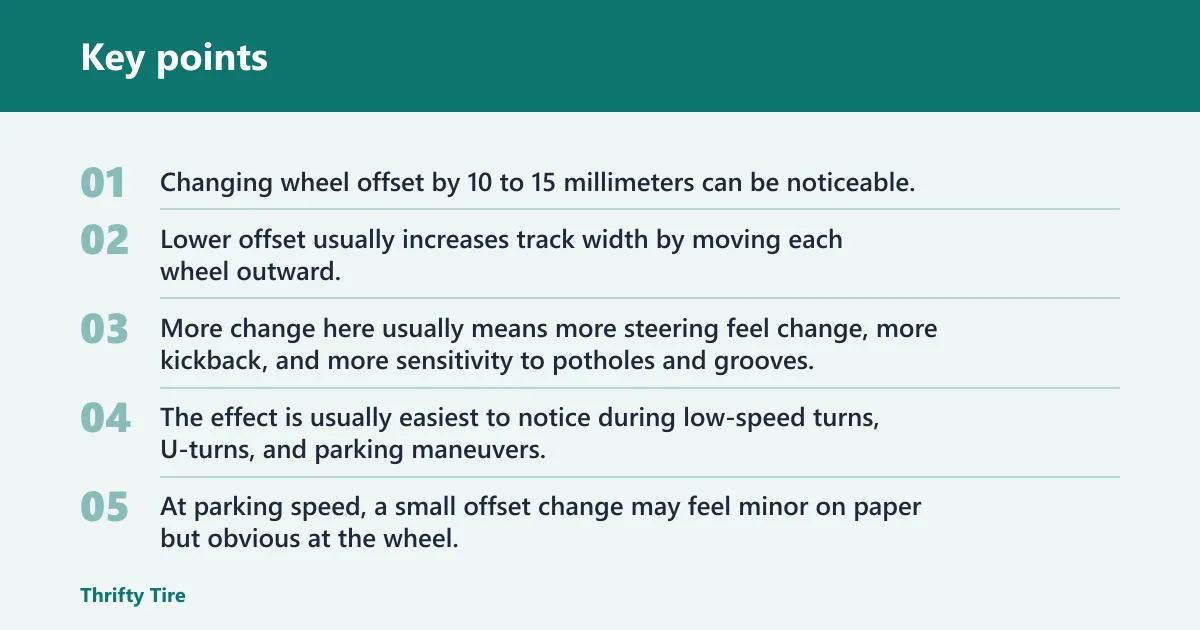
Changing wheel offset by 10 to 15 millimeters can be noticeable. ASM notes a safe delta rule of roughly 5 mm from factory offset unless spacer testing has confirmed clearance, and it also notes that a 5 mm change is often the margin between clean clearance and a caliper strike.
Track width and scrub radius
Lower offset usually increases track width by moving each wheel outward. That can change scrub radius, which is the geometric relationship between the steering axis and the tire contact patch. More change here usually means more steering feel change, more kickback, and more sensitivity to potholes and grooves.
Steering effort and kickback
A wheel pushed outward can increase steering effort at parking speed because the tire has more force against the steering system. It can also increase kickback over potholes and rough pavement. The effect is usually easiest to notice during low-speed turns, U-turns, and parking maneuvers.
Parking-speed feel and road feedback
At parking speed, a small offset change may feel minor on paper but obvious at the wheel. A more outward setup can feel heavier and more reactive to surface defects. A more inward setup can feel calmer, but may trade that for closer inner clearance.
Suppose a crossover keeps the same tire size but moves from ET+40 to ET+30. The wheel shifts outward 10 mm. That may make steering feel a bit heavier in a lot and add more nibble from road seams, even if the tire still clears both the strut and the fender.
Can wheel offset cause tire wear?
Yes. Offset can contribute to tire wear by changing scrub radius, bearing load, and how the tire loads during turns and bumps. The wear pattern often shows up as inner-edge wear, outer-shoulder wear, or wear that gets worse when alignment is already off. Offset does not replace alignment; it adds to it.
If the wheel sits too far inward, the tire can run closer to suspension parts and sometimes show inner-edge stress from the combined geometry. If it sits too far outward, the outer shoulder can load harder in turns and over bumps, and the extra force can raise wear on wheel bearings over time.
Toe and camber as wear multipliers
Toe and camber can turn a moderate offset change into a wear problem. Excess toe can scrub a tire no matter where the wheel sits. Negative camber can add inner-edge wear, while positive camber can push wear toward the outer shoulder. Offset changes do not fix those angles.
Bearing load and long-term wear risk
When the wheel is pushed outward, the center of the tire contact patch moves farther from the bearing and hub. That increases load on the wheel bearings and other suspension parts. Aggressive outward changes can speed up wear, especially on heavy vehicles and front axles that already carry a lot of steering load.
Offset vs backspacing
Backspacing is measured in inches from the mounting face to the inner edge of the wheel. Offset and backspacing describe the same wheel from different reference points, but they are not interchangeable without the wheel width in the math. Use bead-seat width and convert inches to millimeters with 25.4 mm per inch.
How backspacing is measured
Backspacing starts at the hub-mounting face and measures straight to the wheel’s inner edge. That makes it useful when comparing how close the wheel sits to the suspension. Offset uses the centerline, so the width number has to be known before you can convert between the two.
Simple conversion logic with wheel width
With bead-seat width known, half the width gives the centerline. Compare that midpoint to the mounting face to find offset, or reverse the process to estimate backspacing. The important point is that the same backspacing can produce different offset numbers on different wheel widths.
| Wheel spec | What it means | Why it matters |
|---|---|---|
| 17×8×+35 | 17-inch diameter, 8-inch width, +35 mm offset | Shows diameter, bead-seat width, and offset in one notation |
| Backspacing | Mounting face to inner edge, in inches | Useful for checking inner clearance near struts and control arms |
| Effective offset with spacer | Original offset minus spacer thickness | Lets you estimate how far the wheel moves outward |
Offset impact matrix
This matrix shows the common direction and size of offset changes from stock, including spacer-equivalent changes. Use it as a fitment screen, not a promise. Exact results still depend on wheel width, tire size, brake package, and suspension setup.
| Change from stock | Likely fitment outcome | Handling feel | Wear risk |
|---|---|---|---|
| +5 mm | Slightly more inner tuck; usually small clearance change | Often mild, sometimes hard to feel | Low if brakes and suspension still clear |
| -5 mm | Slightly more outer position; may help inside clearance | Small increase in steering response at low speed | Low to moderate if alignment is already close to the limit |
| -10 mm | Noticeable outward move; fender and liner checks matter | More kickback and heavier parking feel may appear | Moderate, especially with toe or camber outside spec |
| -20 mm | Often aggressive; poke, liner rub, or bearing load concerns rise | Clear scrub radius change is likely | Higher, with more long-term bearing stress |
| 10 mm spacer | Behaves like 10 mm less offset | Same steering and clearance direction as a -10 mm offset change | Same outward-load concerns as a reduced-offset wheel |
| 15 mm spacer | Behaves like 15 mm less offset | Stronger version of the same outward move | More likely to expose poke and bearing-load concerns |
How to check a wheel change before you buy
Use a plain go/no-go check before ordering wheels. First confirm inner clearance near the strut, coilover, and control arm. Then check outer clearance at the fender lip and liner. Finally, decide whether the new offset keeps steering and bearing loads within a range you can accept.
-
Measure inner clearance.
Compare the proposed wheel and tire against the nearest inside hard point. Leave room for full steering lock and suspension movement, not just a static garage check. If the inside gap looks tight on paper, do not assume it will pass once the vehicle rolls and compresses.
-
Check outer poke.
Look at the tire shoulder relative to the fender lip, liner, and bumper edge. The wheel should not rely on a stretched tire to avoid contact. A flush look is only acceptable if the tire still clears at lock and over compression.
-
Inspect steering and bearing load.
Ask whether the change is small enough to keep scrub radius close to stock. A major outward move can raise steering effort and bearing load even when nothing rubs. If the change is more than a small offset step, treat it as a geometry change, not just a style change.
A common first-timer mistake is to test fit only on level pavement with the wheel straight. That can miss the worst case, which is full-lock turning with the suspension compressed. If the setup touches there, it is not a safe fitment.
Frequently asked questions
Why does wheel offset matter for fitment?
Offset matters because it controls where the wheel sits relative to the hub, suspension, and fender. A small change can clear a brake caliper or create a rub point at the strut, coilover, or fender lip. Wheel width, tire size, and suspension layout still shape the final result.
How does wheel offset affect handling?
Offset changes scrub radius and track width, which affects steering effort, kickback, and low-speed feel. More outward offset often makes the wheel feel heavier at parking speed and more reactive to bumps. The effect is usually modest with small changes and more obvious with aggressive ones.
What happens if my offset is too positive or too negative?
Too positive usually tucks the wheel inward and can reduce space near the strut, spring perch, or control arm. Too negative pushes the wheel outward and can cause fender rub, steering kickback, and more bearing load. Both directions can be wrong if the rest of the setup is not matched.
How much can I change wheel offset from stock?
A small change is the safest place to start. Les Schwab’s published rule is to stay within 5 millimeters of the original offset, and ASM gives roughly the same guidance unless spacer testing has confirmed clearance. A 10 to 15 millimeter change can already be noticeable.
Is a spacer the same as changing wheel offset?
Functionally, yes in one key way: a spacer mimics reduced offset. A wheel on a 10 mm spacer behaves like the same wheel with 10 mm less offset. The difference is that the spacer changes the load path and should be checked for hub engagement, hardware fit, and clearance just like a wheel change.