Lug Nuts: Size, Torque, Types, and Problems
Match lug nuts by three key specs: thread size and pitch, seat type, and shank length if used; torque them to the vehicle or wheel maker’s spec, commonly about 80–150 ft-lb on passenger vehicles. The wrong nut or torque can strip studs, crack wheels, loosen the wheel, or warp brake rotors. This guide shows how to identify seat styles and sizes, confirm torque, and diagnose common lug nut and wheel-stud problems.
Lug nuts thread onto the wheel studs and clamp the wheel against the hub mounting surface. For unknown wheels, use a simple order: identify the stud diameter and thread pitch first, confirm the wheel seat shape second, then verify shank length, hex size, and socket clearance before final torque and a re-check after about 50 miles.
What do lug nuts actually need to match?
Lug nuts need to match four things that are easy to mix up: the stud’s thread diameter, the exact thread pitch or thread count, the wheel’s seat shape, and any shank or narrow-bore clearance requirement. If any one is wrong, the wheel can clamp poorly even if the nut starts threading on.
Stud diameter and thread pitch
Start at the stud, not the old lug nut. The stud determines the thread diameter and thread pitch, and both must match exactly whether the hardware is metric or SAE.
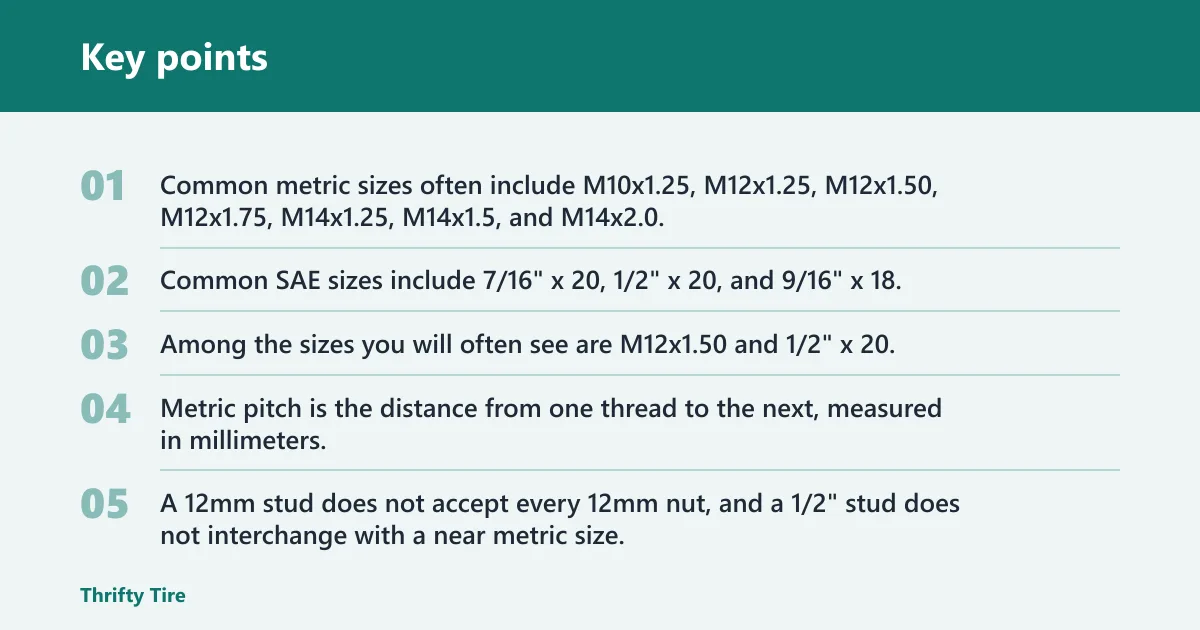
Common metric sizes often include M10x1.25, M12x1.25, M12x1.50, M12x1.75, M14x1.25, M14x1.5, and M14x2.0. Common SAE sizes include 7/16″ x 20, 1/2″ x 20, and 9/16″ x 18. Among the sizes you will often see are M12x1.50 and 1/2″ x 20.
Metric pitch is the distance from one thread to the next, measured in millimeters. SAE thread count is threads per inch. A 12mm stud does not accept every 12mm nut, and a 1/2″ stud does not interchange with a near metric size.
Seat type and wheel lug hole shape
The wheel determines the seat. Les Schwab says conical or tapered lug nuts feature a cone-shaped seat, while spherical or ball seat lugs have a rounded seat. Les Schwab also identifies flat seat and mag seat as two lug nut styles.
Do not judge by the nut alone. Look into the wheel’s lug hole and match the contact surface that actually centers and clamps the wheel.
Hex size, shank length, and socket clearance
Thread size and wrench size are different measurements. A lug nut can have the correct M12x1.50 threads yet still use a larger or smaller hex than the original, or require a special spline or tuner key.
Flat-seat and mag-seat designs may use a shank that passes into the wheel hole. If that shank is too long, too short, or too wide, clamp load and centering can be wrong even when the threads and seat family seem close.
Factory wheels versus aftermarket wheels
Factory alloy wheels often use a specific seat profile, while steel wheels may use a different seat on the same vehicle line. Aftermarket wheels often have narrower lug bores, which can require tuner or small-diameter hardware for socket clearance.
Suppose a factory wheel used a flat-seat nut with a washer-like face and you replace it with a generic 60-degree acorn because the thread fits. The nut may tighten, but the wheel will not clamp on the intended surface, and loosening or seat damage can follow.
What size lug nuts do you need for your car?

The size you need is the stud size, not the outside hex. Read the stud in diameter-and-pitch form for metric hardware or diameter-and-thread-count form for SAE hardware, then confirm that the wheel seat and any shank requirement match before you buy a set.
How to read metric sizes and pitches
A marking such as M12x1.50 usually means a 12 mm thread diameter and a 1.50 mm thread pitch. A 12mm x 1.25 nut may feel close on the same stud, but it is wrong and can damage the threads.
If the original hardware is missing, measure the stud diameter and use a thread gauge or verified parts data for pitch. Do not force a trial fit to see if it works.
How to read SAE sizes and thread counts
A marking such as 1/2″ x 20 means a half-inch stud diameter and 20 threads per inch. Another common example is 9/16″ x 18. SAE thread count works differently from metric pitch, so the numbers do not interchange.
Most common lug nut sizes by thread
| Thread size | System | Common use note |
|---|---|---|
| 10mm x 1.25 | Metric | Seen on some smaller passenger vehicles |
| 12mm x 1.25 | Metric | Common passenger-car size |
| 12mm x 1.50 | Metric | Very common passenger-car size |
| 12mm x 1.75 | Metric | Used on some cars and light trucks |
| 14mm x 1.25 | Metric | Common on some European and truck fitments |
| 14mm x 1.5 | Metric | Very common truck/SUV size |
| 14mm x 2.0 | Metric | Found on some heavier-duty applications |
| 7/16″ x 20 | SAE | Common older domestic size |
| 1/2″ x 20 | SAE | Very common domestic size |
| 9/16″ x 18 | SAE | Seen on larger domestic applications |
Why thread size and wrench size are different
A 19mm or 21mm socket size tells you only what fits over the nut’s hex. It does not tell you whether the threads are 12mm x 1.50, 14mm x 1.5, or 1/2″ x 20. Buy by thread and seat first, then verify the socket size needed to install it.
Identification workflow for unknown hardware
- Inspect the stud. Clean exposed threads with a brush so the thread shape is visible. Read the parts data if available, or measure diameter first because a dirty or swollen old nut can send the whole job in the wrong direction.
- Confirm thread system. Decide whether the stud is metric or SAE before comparing pitches. Use a thread gauge or verified catalog data rather than forcing several nuts on by hand.
- Check wheel seat. Look into the wheel hole for a cone, a rounded bowl, a flat pad, or a mag/shank opening. The wheel contact surface decides the seat style, not the look of the old hardware.
- Verify bore clearance. Test socket access and lug-hole width, especially on aftermarket wheels with narrow bores. Tuner-style seats may need a small-diameter body and a key.
- Match final hardware. Buy the exact thread, seat, and shank design, then torque to the vehicle or wheel maker’s spec. Re-check after about 50 miles because parts can settle after the first drive.
How do you identify the seat type?
Identify seat type by the shape of the wheel’s contact surface, not by thread size or nut finish. A cone-shaped recess takes a conical seat, a rounded recess takes a ball seat, a flat pad takes a flat seat, and a shank-style opening points to a mag seat.
Conical or tapered seat
The same source says conical or tapered lug nuts feature a cone-shaped seat. This is the common acorn style on many vehicles and many aftermarket wheels.
Look for angled walls in the wheel hole where the nut centers itself as it tightens. The angle must match the wheel seat design.
Spherical or ball seat
The same source says spherical or ball seat lugs have a rounded seat. These are common on some factory alloy wheel applications where the wheel hole has a curved, bowl-like contact surface.
Say your wheel has a smooth rounded recess and a conical nut seems to sit on a narrow ring instead of the full seat. That is a fitment warning, not a small mismatch.
Flat seat
Flat-seat nuts clamp against a flat wheel pad. They are often paired with a built-in washer or broad face that spreads clamp load over a flat mounting surface.
A conical nut on a flat-seat wheel can feel tight while actually contacting only a small edge. That often leads to loosening, fretting, or seat damage.
Mag seat
Mag-seat hardware uses a straight shank that passes into the wheel hole and a flat clamping surface at the outer face. The shank diameter and length matter here, not only the threads.
Factory wheels and older aftermarket designs sometimes rely on this style. If the shank bottoms out or is too short, the wheel can fail to clamp correctly.
Lug nut types and materials
Standard, spline, and tuner styles
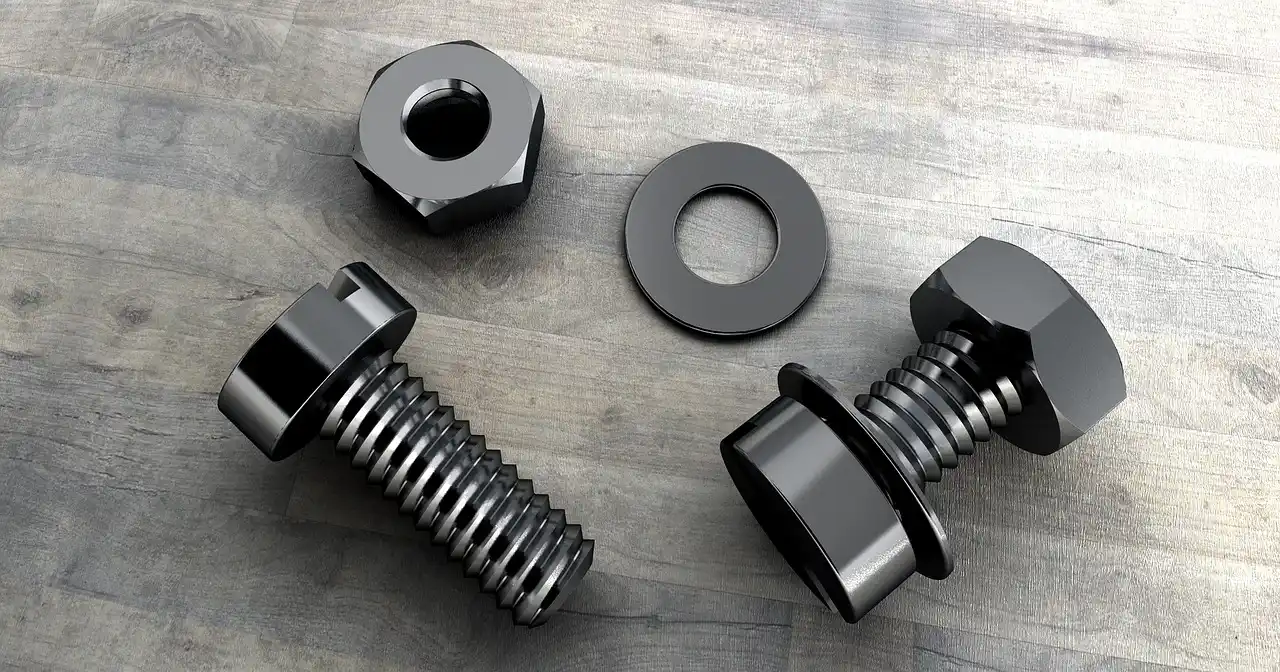
Standard acorn nuts are the common external-hex type. Spline-drive and tuner nuts use a narrower body to fit tight lug bores on some aftermarket wheels, and they often need a dedicated key or adapter.
The same source says tuner style seats require a special socket key for removal. Keep that key in the vehicle, not only in a toolbox at home.
Anti-theft lug nuts and key-based designs
Anti-theft sets replace one lug nut per wheel with a keyed pattern. They work only if the key is available and undamaged, so replacement planning matters.
A broken or missing key can turn a simple tire change into extraction work, towing, or shop labor. If the key pattern is already rounded, replace the lock set before a roadside emergency forces the issue.
Chrome steel, aluminum, titanium, and two-piece construction
Chrome steel is common because it balances cost, strength, and corrosion resistance. Aluminum saves weight but is more sensitive to thread damage and repeated service. Titanium is light and strong, but usually costs far more and belongs on applications where the maker specifies it.
Two-piece lug nuts have a steel core with a thin outer cap. That cap can deform, making the hex larger or uneven while the thread remains unchanged.
Why two-piece nuts swell
The same source says lug nuts can swell and become difficult to remove. On two-piece designs, corrosion and cap deformation are the usual reason the socket no longer fits correctly, leading to rounded corners and emergency removal problems.
Picture a truck with factory two-piece nuts that originally took a 21mm socket. After corrosion under the cap, the 21mm socket will not seat fully, a 22mm is sloppy, and a roadside lug wrench rounds the cap before the nut breaks loose.
How tight should lug nuts be in ft-lb?
Lug nut torque is the clamping force recommendation for that vehicle or wheel, measured in foot-pounds. The owner’s manual or wheel manufacturer spec is the authority; typical ranges are only context. Most passenger cars use 80–100 ft-lb, while most trucks and SUVs use 100–145 ft-lb.
Why vehicle spec overrides generic charts
Les Schwab defines lug torque as recommended force measured in foot-pounds, and Les Schwab says the correct torque can be found in the vehicle owner’s manual. If an aftermarket wheel maker gives a different hardware or torque specification, follow that wheel-specific requirement.
Do not pick a torque just because the stud is 12mm or 14mm. Clamp load depends on the vehicle, wheel design, stud, and hardware style.
Typical passenger car torque range
TheFixCar says most passenger cars use 80–100 ft-lb. That is a useful reality check when a result seems wildly high or low, but it is not a universal setting for all cars.
Typical truck and SUV torque range
The same source says most trucks and SUVs use 100–145 ft-lb. Trucks also show up more often with larger studs, factory two-piece nuts, and heavier wheels, all of which make correct torque and re-checks more important.
What over-torque and under-torque do
Over-torque can stretch studs, damage threads, crack caps, break lock keys, and create warped rotor complaints after service. TheFixCar warns impact guns can apply 2–3 times spec, which is why final tightening belongs to a calibrated torque wrench.
Under-torque reduces clamp load. That allows wheel movement, fretting at the seat, vibration, stud fatigue, and eventually loose hardware.
Installing and re-torquing lug nuts
Tools and tightening pattern
Use the correct socket, a lug wrench for initial snugging, a torque wrench for final tightening, and the anti-theft key if fitted. The same source says wheel nuts should be tightened in a star pattern so the wheel seats evenly against the hub.
Installation procedure
- Seat the wheel. Hold the wheel flush against the hub and hand-start every lug nut. If one nut binds early, stop and re-check thread pitch before any tool touches it.
- Snug in sequence. Tighten the nuts lightly in a crisscross or star pattern until the wheel is centered. This step draws the wheel in evenly and reduces the chance of a crooked seat.
- Lower for final torque. Bring the tire into firm contact with the ground so it cannot spin, then set the torque wrench to the exact spec. Apply final torque in the same star pattern.
- Re-check each nut. Make one more pass at the same torque setting in the same pattern. This confirms that a neighboring nut did not change clamp load as the wheel settled.
- Re-torque after driving. TheFixCar recommends re-torquing after 50 miles. That post-installation check matters because hardware and wheel seats can settle after the first drive cycle.
Common installation mistakes
A common first-timer mistake is running the nuts fully down with an impact gun and skipping hand-starting. Wrong-pitch damage often starts there, and the problem may not show until removal or until one nut refuses to torque evenly.
Another mistake is mixing one aftermarket nut into an otherwise factory set because it looked close. Mixed seat types on the same wheel can create uneven clamp load and repeat loosening.
Lug nuts diagnosis matrix
Lug nuts decision table
| Symptom | Most likely cause | Immediate risk | Next step |
|---|---|---|---|
| Stuck nut | Corrosion on threads or swollen two-piece cap | Rounded hex, broken stud during removal | Confirm socket fit first; replace swollen nuts, inspect studs after removal |
| Wheel wobble | Wrong seat style or loose hardware | Poor centering, seat damage, clamp loss | Stop driving; verify seat type against wheel hole and torque to spec |
| Wheel vibration after install | Uneven torque, wrong seat contact, or wheel not seated flat | Fretting, loosening, repeat vibration | Remove, clean mounting faces, re-install in star pattern with correct hardware |
| Stripped threads | Wrong pitch forced on, cross-threading, or over-torque | False torque reading, stud failure | Replace the damaged nut and usually the stud; do not reuse partially stripped threads |
| Swollen cap | Two-piece lug nut cap deformation and corrosion | Socket mismatch, roadside removal failure | Replace the full set with quality one-piece or correct OE-style hardware |
| Broken key | Over-torque, seized lock, or worn anti-theft pattern | Wheel cannot be removed for tire service | Extract carefully, replace the lock set, and torque by wrench only |
| Rotor warp complaint | Uneven or excessive torque | Brake pulsation, repeat service complaints | Check wheel torque history, re-torque evenly, inspect brake parts if vibration remains |
| Loose after install | Missing re-torque, wrong seat, dirty mounting face, or mixed hardware | Wheel movement, stud fatigue, wheel loss | Stop and inspect all hardware, wheel seats, and studs; reinstall and re-torque, replace damaged parts |
Can you use aftermarket lug nuts with factory wheels?
Aftermarket lug nuts can work on factory wheels only when the threads, seat type, shank design if used, and socket clearance all match the wheel and stud exactly. Matching threads alone is not enough. Many factory alloys, steel wheels, and narrow-bore aftermarket wheels need different hardware styles.
When OEM wheels require a specific seat or shank
Factory alloy wheels often use ball-seat or flat-seat hardware that looks less universal than common acorn nuts. Some steel wheels use a conical seat instead. Mag-seat factory applications also depend on the right shank length.
When aftermarket wheels need tuner or small-diameter nuts
Aftermarket wheels with narrow lug bores may require tuner-style or spline-drive nuts simply so the socket can reach the hex. That clearance issue is separate from thread fit and separate from seat shape.
Mixed hardware risks on trucks and SUVs
Trucks and SUVs often carry more wheel mass and higher torque values, so a mixed set of factory and aftermarket hardware creates more risk. One swollen factory two-piece nut and five aftermarket one-piece nuts on the same axle is a service red flag.
Lug nuts checklist
- Pass if the thread size and pitch match exactly.
- Pass if the wheel seat shape matches exactly.
- Pass if any shank length and diameter match the wheel requirement.
- Pass if the socket and key can reach the nut without damaging the wheel.
- Fail if the nut only seems close or contacts the wheel on a narrow ring.
When should lug nuts and studs be replaced?
Lug nuts should be replaced when the hex is rounded, the cap is swollen, the seat is damaged, the threads are stripped, the finish is badly corroded, or the set is mixed and no longer matches. Replace studs when threads are damaged, the stud is stretched, or torque can no longer be trusted.
Replacement signs on the nut
Replace any nut with swollen caps, deep rust, cracks, thread damage, rounded corners, or visible seat wear. If one anti-theft key is damaged, replace the matching lock set rather than keeping one compromised piece in service.
Replacement signs on the stud
Replace the stud if threads are flattened, torn, cross-threaded, bent, or if the stud spun in the hub. A nut that goes on hard by hand after the first turn often points to a stud problem, not only a bad nut.
When one bad nut means checking the whole set
One failed nut often means the others saw the same corrosion, torque abuse, or wrong socket. Check the entire wheel, then the whole axle set at minimum. On vehicles with factory two-piece nuts, many owners replace the complete set rather than waiting for the next one to swell.
Cost factors and where labor appears
Costs usually stay lowest when only the nuts are replaced. They rise when a lock key is missing, a swollen cap requires extraction, or a stripped stud must be pressed out and replaced. Labor also appears when brake components or the hub need to come apart for stud access.
For planning, separate the bill into four parts: nuts, lock keys or specialty sockets, new studs if needed, and labor for extraction or hub-side stud replacement. The hidden cost is often downtime during a flat repair when the wheel cannot come off.
Frequently asked questions
What size lug nuts do I need for my car?
Use the exact stud diameter and thread pitch or thread count, then match the wheel’s seat type and any shank requirement. Common sizes include 12mm x 1.50, 14mm x 1.5, and 1/2″ x 20, but those are examples, not substitutes for verifying your actual stud and wheel.
How tight should lug nuts be in ft-lbs?
Torque should follow the vehicle owner’s manual or the wheel maker’s spec and is measured in foot-pounds. Many passenger cars fall in the 80–100 ft-lb range, and many trucks and SUVs in the 100–145 ft-lb range, but those are not universal settings.
What are the different types of lug nuts?
By seat and body style, the main groups are conical, ball, flat, and mag seat, plus standard hex, spline-drive, tuner, and anti-theft versions. Material choices include chrome steel, aluminum, titanium, and two-piece designs that can swell at the outer cap over time.
Why do lug nuts swell or get stuck?
Two common causes are corrosion on the threads and cap swelling on two-piece lug nuts. Swelling changes the outside hex size, so the correct socket no longer fits well. Stuck nuts can also result from over-torque, which makes roadside removal much harder and risks stud damage.
Should I re-torque lug nuts after driving?
Yes. A post-installation torque check after about 50 miles is widely recommended because wheels and hardware can settle after the first drive. Re-torque is especially important after wheel replacement, brake work, new aftermarket hardware, or any case where the seat surfaces were disturbed.